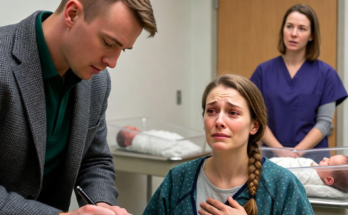
The air in the penthouse nursery was colder than the zero-degree mid-winter weather outside the triple-paned windows. It was a room designed by architects and child psychologists, a sterile haven of muted greys and sustainable blonde wood, utterly devoid of warmth.
Elias Sterling threw the papers onto the imported Italian changing table so hard that the sterling silver rattle jumped. The bold red stamp on the top page seemed to pulse in the dim recessed lighting: PATERNITY EXCLUDED.
“Explain this,” Elias hissed. His voice, usually a baritone instrument smooth enough to calm global markets during a crash, was jagged. It cracked around the edges. “Zero percent chance. That’s what the lab director told me. You think I’m an idiot, Clara? You think I wouldn’t check the genetics of a fifty-billion-dollar heir?”
I stood by the crib, my hands clasped in front of me to hide the tremors. I looked down at Leo, our three-week-old son. He was sleeping soundly, a tiny miracle wrapped in organic cashmere, blissfully unaware that his existence had just shattered an empire.
Elias moved closer, invading my space. His expensive, custom-blended cologne turned sour with the metallic scent of his own adrenaline and rage. “Who is he? The trainer? The new CFO? Tell me which nobody fathered the future CEO of Sterling Corp so I can destroy you both financially and socially before lunch.”
For five years, I had been the perfect, silent ornament on the arm of the city’s youngest, most ruthless billionaire. I had smiled until my jaw ached at charity galas, I had pointedly ignored the tabloid rumors of his “business trips” to Monaco with starlets, and I had undergone endless, invasive fertility treatments to give him the genetic legacy he demanded. I was the vessel, the incubator for the Sterling greatness.
But as he stood there, shaking with the fury of a bruised ego, his perfect facade cracking to reveal the tyrant underneath, I didn’t feel the fear I was programmed to feel. I felt an icy, unfamiliar calm.
“You’re right, Elias,” I said quietly, finally tearing my eyes from the baby to look directly into his furious blue eyes. “The test is accurate. You are not his biological father.”
He froze. The admission hit him harder than a denial would have. He blinked, the gears of his brilliant, ruthless mind grinding to a halt. He opened his mouth to roar, to summon security, to end my life as I knew it.
But I stopped him with a slight raise of my hand. “Before you throw me out, and before you call your lawyers to annul our prenup,” I nodded toward the crib, “you need to read what’s tucked under Leo’s blanket.”
Elias looked down. There, peeking out from beneath the sleeping infant’s arm, was a cream-colored linen envelope sealed with dark blue wax.
Elias stared at it. He recognized the wax seal. It was an old family crest he had abandoned years ago in favor of a sleek, modern corporate logo. His hand trembled violently as he reached into the crib, his fingers brushing against the baby he now hated, to retrieve the letter.

To understand why that letter existed, you have to understand the Sterling dynasty. Elias Sterling was not a man; he was an optimization algorithm made flesh. He believed that wealth, intelligence, and success were purely genetic traits that needed to be guarded aggressively.
When he married me, it wasn’t for love. It was because my pedigree—old European money, Ivy League education, clean health history—vetted out perfectly. I was acquired, like a promising tech startup, to merge my assets with his.
But there was a glitch in the Sterling programming: his younger brother, Julian.
If Elias was cold steel and efficiency, Julian was watercolor and raw nerve. Julian was an artist, a poet, a gentle soul who felt the weight of the world. He was everything Elias despised because he was everything Elias couldn’t control.
Six years ago, Elias gave Julian an ultimatum: stop “embarrassing the family name” with his bohemian lifestyle and drug addiction, or be cut off forever. Julian chose art. Elias cut him off.
Two years later, Julian overdosed in a squat in Berlin.
I was the one who flew to identify the body because Elias was in the middle of a hostile takeover and “couldn’t spare the bandwidth.” I found Julian’s meager possessions. Among them was a sketchbook filled with drawings of me—drawings that saw me not as the trophy wife, but as the trapped bird in a gilded cage.
And there was something else. A letter Julian had written to me weeks before he died, along with the contact information for a cryobank in Switzerland.
Clara, the letter read. Elias will consume you. He needs an heir to validate his own existence, but he will raise a monster just like himself. Don’t let the Sterling bloodline end with his coldness. If you ever find the strength to defy him, there is another option stored in Geneva. A chance for a Sterling child who has a heart.
For years, I hid that letter. I tried to be the good wife. I endured the IVF cycles with Elias’s genetic material, which all ended in heartbreaking miscarriages. Elias blamed me. He said my body was “inefficient.”
The breaking point came nine months ago. We were at dinner, and I mentioned I wanted to donate to a foundation funding art therapy for addiction recovery in Julian’s name.
Elias laughed. It was a cruel, dismissive sound. “Why throw good money after bad genetics? Julian was a mistake. Nature corrected the error. Let him stay forgotten.”
In that moment, looking at the man who viewed his own brother’s tragic death as a “market correction,” the love I once tried to manufacture for him died completely.
The next week, I flew to Geneva for a “spa retreat.” I visited the cryobank.
Back in the nursery, the silence was suffocating as Elias broke the wax seal. The paper crinkled loudly.
He read the first line and stumbled back a step, as if physically struck.
To my brother, Elias,
If you are reading this, it means Clara finally found the courage to save your child from you.
Elias’s breath hitched. He looked at me, his eyes wide with a dawning, horrific comprehension. He looked back at the letter.
You always obsessed over genetics, Elias. Over the purity of the Sterling line. You spent your life trying to erase me, to pretend I didn’t exist because I didn’t fit your blueprint for perfection. You thought you won when I died.
But Clara knows the truth. You didn’t win. You just survived.
Look at the baby in the crib. Really look at him. You won’t see your reflection. You’ll see mine. You’ll see the brother you let die.
The DNA test is right. You aren’t the father. But the baby is a Sterling. He is my son. Clara used what I left behind to ensure that the next generation of our family has a chance to be something you never could be: human.
You wanted an heir, brother. You have one. Now the world will know that the future of your company belongs to the ghost you tried to bury.
—Julian.
Elias finished reading. The letter fluttered from his numb fingers to the floor.
He looked at the crib. For the first time, he truly looked at Leo. He didn’t see a usurper anymore. He saw the curve of Julian’s nose. He saw the distinct shape of Julian’s eyes, even closed in sleep.
The mightiest man in the city crumbled. He didn’t scream. He didn’t throw things. He sank to his knees on the plush wool rug, making a choked, guttural sound that was terrifying in its rawness.
It was the sound of a narcissist’s entire worldview collapsing. His obsession with genetic superiority had just become his ultimate undoing. His heir—the child he had paraded to the press just days ago—was the biological son of the “failure” he had despised.
“You…” Elias looked up at me from the floor, his face gray. “You denied me my own child. You replaced me with him.”
“I gave you exactly what you asked for, Elias,” I said, my voice steady. “A Sterling heir. But I made sure he got the better parts of the family.”
I walked past him to the crib and gently picked up Leo. The baby stirred and yawned.
“My lawyers have already drafted the press release,” I said, looking down at the man kneeling on the floor. “If you try to fight me, if you try to cut us off, the world will know the truth. They’ll know you are raising Julian’s son. Think of what that will do to your stock price. Your image of infallibility.”
Elias stared at the floor. He knew he was checkmated. To disown the baby now would be to admit that his “perfect genetics” were flawed and that his wife had sought out his disgraced brother over him. It would make him look weak, cuckolded by a ghost.
His vanity was a stronger prison than any I could build.
“What do you want?” he whispered.
“I want a divorce. I want full custody. And I want half of everything, as per the infidelity clause in our prenup.”
He looked up sharply. “You’re the one who was unfaithful!”
I pitied him then. “Read the clause again, Elias. It defines infidelity as ‘actions leading to the conception of a child outside the marriage union without the partner’s consent.’ You consented to the IVF. You just didn’t ask whose sample was used that final time. My lawyers say it’s airtight.”
I walked to the door of the nursery, holding Julian’s son close to my chest.
“Goodbye, Elias. You have your empire. Try not to be too lonely in it.”
I left him kneeling in the cold, perfect nursery, surrounded by the wreckage of his own ego, the letter from the dead brother he couldn’t erase lying on the floor between us like a boundary line that could never be crossed again.