I was just trying to eat my burger in peace. That’s all. I’d just finished a ten-hour shift pouring concrete, and I was too tired to think. I sat in the corner booth of “Marge’s Diner,” the kind of place where the coffee is burnt and the locals don’t ask questions.
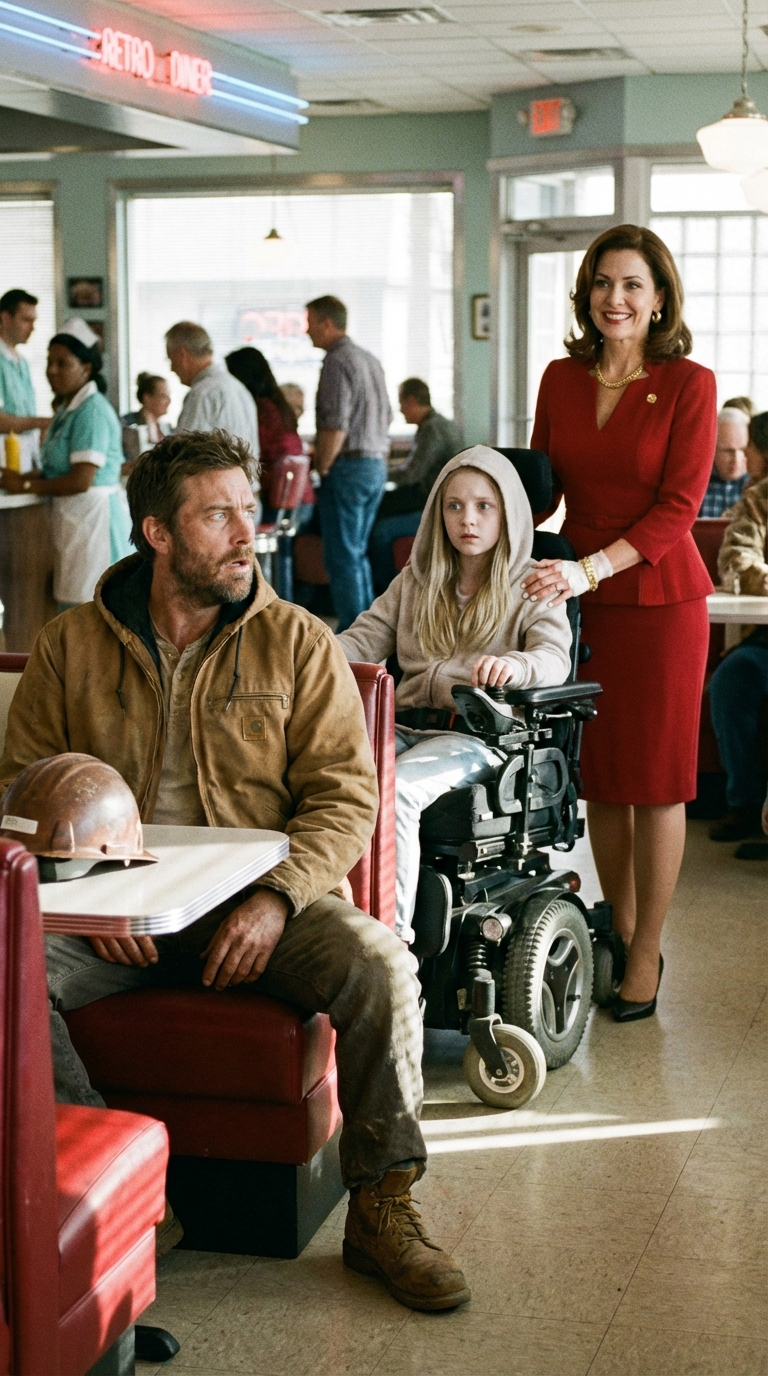
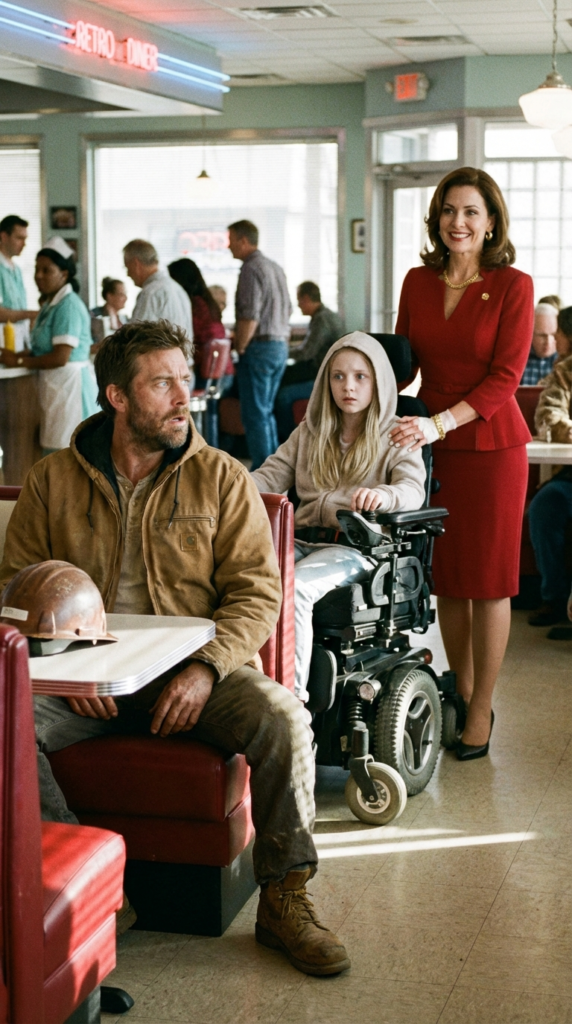
Then the woman in the red dress walked in, pushing a high-end, custom wheelchair.
The girl in the chair looked about twelve. She was strikingly beautiful but totally motionless, her head lolling slightly to the side. She was pale, almost translucent. The woman—her mother, I assumed—was loud. Too loud. She was performing for the diner, making a show of wiping the girl’s face, talking in that sickeningly sweet voice people use for toddlers or pets.
“Open wide, sweetie! Mommy loves you!” she chirped, shoving a spoon of hot tomato soup into the girl’s mouth.
The girl didn’t swallow fast enough. The soup spilled down her chin. The woman sighed, a heavy, dramatic sound that invited sympathy from the other patrons, and grabbed a napkin.
“It’s so hard,” the woman said loudly to the waitress pouring her water. “Caring for her. She’s a vegetable, really. But a mother’s love, right?”
The waitress nodded sympathetically. “You’re a saint, ma’am.”
But I saw it. Under the table, shielded by the tablecloth, I saw the woman’s other hand dig her manicured red nails into the girl’s thigh. Hard. It was a pinch meant to hurt, meant to control.
The girl didn’t flinch. She couldn’t. She was paralyzed. But her eyes… they locked onto mine.
They were screaming.
I looked down at her hand resting on the black plastic armrest. Her fingers were trembling. To the untrained eye, to the waitress, to the rest of the diner, it looked like a spasm. A neurological misfire.
But I didn’t see a spasm.
My late wife, Sarah, was deaf. We used American Sign Language (ASL) in our house for twenty years. It was our secret language, our love language. I knew exactly what I was looking at.
The girl’s index finger tapped her thumb. Then she formed the letter ‘H’. Then ‘E’. Then ‘L’. P.
H. E. L. P.
My heart hammered against my ribs. I stared harder. The girl saw me watching. A flicker of hope lit up her terrified eyes. She moved her fingers again, excruciatingly slow.
N-O-T M-O-M.
And then a word that made my blood run cold: P-O-I-S-O-N.
I stood up. My chair scraped loudly against the linoleum floor. The woman in the red dress looked up, her smile tight and fake. She scanned my cement-stained jeans, my heavy boots, my unshaven face.
“Can I help you?” she sneered, dismissing me instantly.
I walked over to their table. The diner went silent.
“Yeah,” I said, my voice shaking with a rage I hadn’t felt since Sarah died. “You can take your hands off her.”
The woman gasped, clutching her pearls. “Excuse me? She is my daughter! She is severely disabled! Someone call the police, this man is harassing us!”
“She’s not your daughter,” I stated, stepping into her personal space. “And she’s not a vegetable.”
To understand why I didn’t back down, you have to know about the silence. After Sarah passed away three years ago, my house was silent. We never had kids. My life became work, sleep, and the silence. I became an observer. I watched people because I didn’t have anyone to talk to.
And I recognized a bully when I saw one.
The woman stood up. She was tall, wearing expensive perfume that smelled like chemicals and money. “I am Sylvia Thorne. My husband is Councilman Thorne. If you don’t back away, you filthy brute, I will have you arrested for assault.”
The patrons were murmuring. “Leave her alone, pal,” a trucker at the counter grunted. “She’s just feeding her kid.”
“She’s hurting her,” I said, pointing at the girl’s leg. “She’s pinching her.”
Sylvia pulled the tablecloth down. “I was doing no such thing. Bella has spasms. She bruises easily.”
She looked at the girl, Bella. “Don’t you, sweetie?”
Bella’s eyes went wide. She looked terrified.
“She’s telling me you’re hurting her,” I said.
Sylvia laughed, a cold, brittle sound. “Telling you? She’s non-verbal. She has the mental capacity of a two-year-old. She can’t tell you anything.”
“She’s signing,” I said. “Fingerspelling. Under her hand.”
Sylvia froze. For a split second, the mask slipped. Pure, unadulterated panic flashed across her face. Then it was gone.
“You’re insane,” she hissed. “We’re leaving.”
She unlocked the wheelchair brakes and tried to shove past me.
I planted my feet. “No.”
“Officer!” Sylvia screamed.
Two police officers had just walked in for their coffee break. They saw the commotion and rushed over.
“Okay, break it up,” the older officer said, putting a hand on my chest. “Sir, step back. What’s going on here?”
“This man is threatening me and my disabled daughter!” Sylvia cried, turning on the waterworks instantly. “He’s crazy! He thinks she’s talking to him!”
The officer looked at me. “Sir, is this true?”
“She is talking,” I insisted. “She’s signing. She said ‘Not Mom’ and she said ‘Poison’.”
The officer looked at Bella. She sat slumped, motionless. She looked completely checked out.
“Ma’am, is this your daughter?” the officer asked Sylvia.
“Step-daughter,” Sylvia corrected. “Her father passed away six months ago. I’m her legal guardian. It’s been… so hard.” She wiped a fake tear. “She had a stroke. She can’t move. She certainly can’t use sign language.”
“Sir,” the officer said to me, his voice hardening. “You’re disturbing the peace. I’m going to ask you to leave. Now.”
I looked at Bella. She had stopped moving her hand. She had given up. Her eyes were filling with tears. If I walked out that door, she was gone. Whatever was happening to her—the poison—would finish her.
I couldn’t leave her. I couldn’t leave her like I couldn’t save Sarah.
“Ask her,” I said desperately. “Just ask her a question. A yes or no question. Tell her to blink.”
“She can’t control her blinking!” Sylvia shouted.
“Officer,” I pleaded. “Look at her hand. Just look at it. If I’m wrong, arrest me. I’ll go quietly. But if I’m right… you’re letting a murderer walk out of here.”
The officer hesitated. He looked at the desperate sincerity in my eyes. He looked at the frantic, sweaty woman in the red dress.
“One question,” the officer said. He knelt down by the wheelchair. “Miss? Can you hear me?”
Bella stared straight ahead. Nothing.
Sylvia smirked. “See? Waste of time.”
I dropped to my knees on the other side. I grabbed Bella’s hand. Her skin was ice cold.
I signed to her. I am listening. I see you. Don’t be afraid.
Her pinky finger twitched.
“Ask her if her name is Bella,” I said.
The officer sighed. “Is your name Bella?”
Nothing.
“Ask her if she wants to go with Sylvia,” I said.
The officer looked at me, annoyed. “Do you want to go home with this woman?”
Bella’s hand, which I was holding lightly, suddenly convulsed. Her index finger shot out. She tapped the armrest once. Then again.
N-O.
The officer saw it. It wasn’t a random spasm. It was rhythmic.
“She moved her finger,” the officer said, looking up at Sylvia.
“It’s a twitch!” Sylvia shrieked. “Stop harassing us!”
“Do it again,” I whispered to Bella. Spell it. Who is she?
Her fingers moved. Shaky, weak, but distinct.
K-I-L-L-E-R.
“Killer,” I said aloud. “She spelled Killer.”
Sylvia lunged. She actually tried to grab the wheelchair and run. “I am the wife of a Councilman! You will all be fired!”
The second officer blocked her path. “Ma’am, calm down.”
“Check her bag,” I said, remembering the first word Bella signed. “She signed poison. Check her purse.”
Sylvia clutched her Prada bag to her chest. “You need a warrant!”
“Probable cause,” the older officer said, his instincts finally kicking in. The way Sylvia was acting—sweating, erratic, terrified—wasn’t the behavior of a grieving mother. It was the behavior of a cornered animal.
“Ma’am, hand over the bag.”
Sylvia tried to run. In high heels, on a diner floor, it was a bad idea. She slipped, the bag went flying, and the contents spilled everywhere. Lipstick, wallet, phone… and three distinct orange prescription bottles with the labels scraped off.
The officer picked one up. He opened it. “These aren’t vitamins.”
The investigation that followed unraveled a nightmare that had been happening in the shadows of the city’s elite.
Bella hadn’t had a stroke. She wasn’t naturally paralyzed.
Sylvia Thorne, the “grieving widow,” had been systematically dosing her step-daughter with a cocktail of muscle relaxants and sedatives for months. She had started shortly after Bella’s father died.
Why? The inheritance. Bella’s father had left everything to his daughter in a trust, accessible only when she turned eighteen. Sylvia got a stipend, but she wanted it all. If Bella were deemed “mentally incompetent” or, better yet, if she succumbed to her “illness,” Sylvia would gain control of the estate.
The paralysis was chemical. It was induced. Bella had been trapped in her own body, fully conscious, unable to move or speak, while her step-mother played the saint and slowly killed her.
But Sylvia made one mistake. She didn’t know Bella’s biological mother had taught her to fingerspell when she was a toddler, before she died. Sylvia thought Bella was a vegetable. She didn’t know she was watching, listening, and waiting.
The Resolution
Two months later.
I was back at Marge’s Diner. I sat in the same booth.
“Hey, Jack,” the waitress said, pouring my coffee. “You got visitors.”
I looked up. A young girl walked in. She was using a cane, and she moved slowly, her legs still regaining their strength, but she was walking.
It was Bella.
Behind her was a woman I recognized from the news—her aunt, who had fought for custody the moment the news broke.
Bella didn’t look pale anymore. Her cheeks were pink. Her eyes were bright.
She walked right up to my table. She didn’t say a word. She dropped her cane and wrapped her arms around my neck, burying her face in my rough work jacket.
I held her, tears streaming down my face, washing away the concrete dust and three years of loneliness.
She pulled back and looked at me. She raised her hands.
Thank you, she signed. You heard me when no one else did.
You were loud, I signed back. You were the loudest person in the room.
Sylvia Thorne is currently serving a 25-year sentence for attempted murder and child abuse. The Councilman divorced her before the trial even started.
I still work construction. I still eat at Marge’s. But the silence in my life is gone. Every Sunday, Bella and her aunt come over for dinner. We’re teaching her aunt ASL.
We live in a noisy world. Everyone is shouting to be heard. But sometimes, the most important things are said without a single sound. You just have to be willing to look.