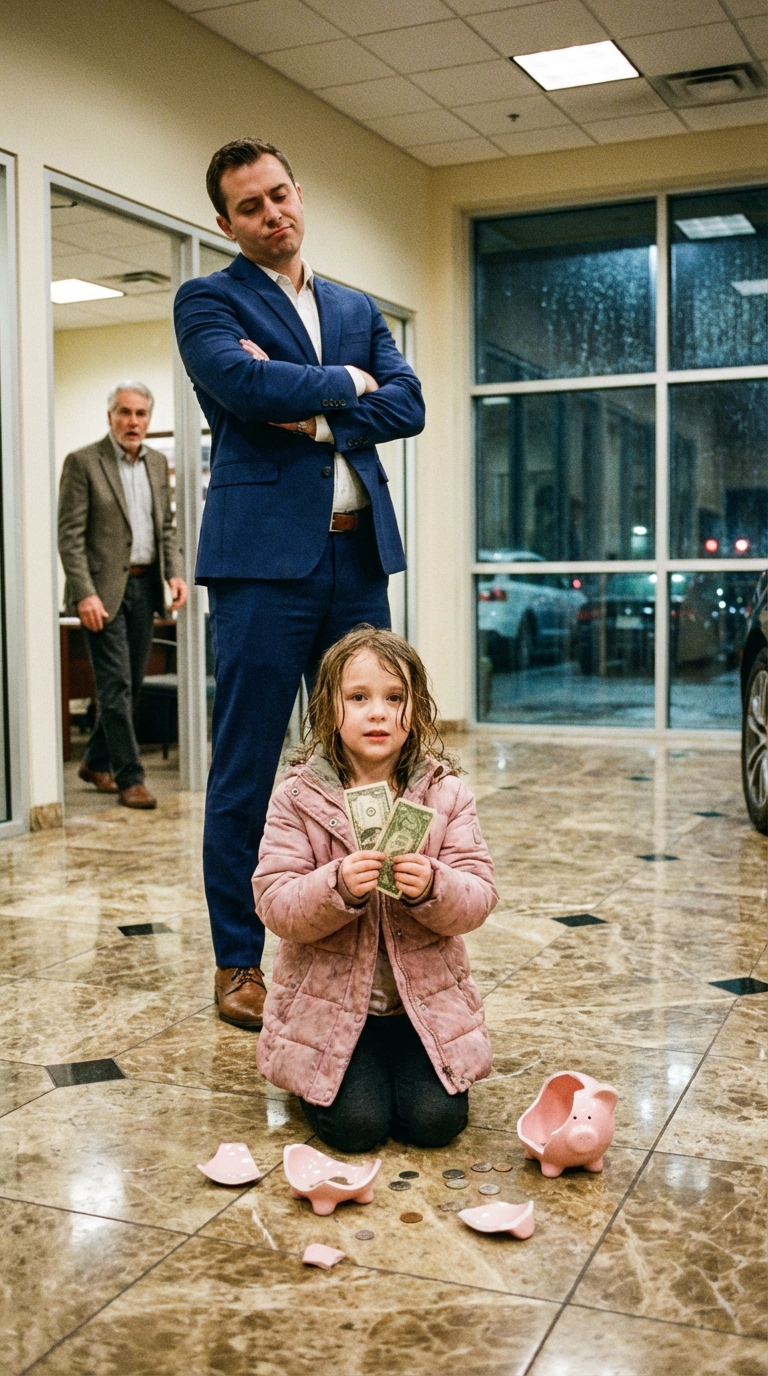
“Get out. We don’t serve beggars here.”
The salesman’s voice, sharp and nasally, echoed off the polished marble floors of Prestige Motors, freezing everyone in the showroom.
I stood there, dripping wet from the relentless October rain, clutching the cold hand of my six-year-old daughter, Mia. We had walked four miles along the highway shoulder because the city bus drivers were on strike, and my transmission had finally died that morning. I was desperate. If I didn’t get to the warehouse by 6:00 PM for the night shift, I was fired. And if I was fired, we were homeless.
“Sir, please,” I begged, wiping rain from my eyes, trying to maintain a shred of dignity. “I saw the sign online for the budget lot in the back. The ‘Trade-ins under $2,000’ section? I have a down payment…”
The salesman, whose name tag read ‘Greg’ and whose suit cost more than my entire wardrobe, looked us up and down with unmasked disgust. He looked at my worn-out sneakers, soaked through with mud. He looked at Mia’s coat, which had a patch on the elbow.
“Look at you,” Greg sneered, crossing his arms. “You’re dripping on my floor. You couldn’t afford the air in the tires of these cars. The budget lot is for paying customers, not vagrants. Leave before I call security.”
I felt the heat rise in my cheeks—the burning shame of poverty. I squeezed Mia’s hand. “Come on, baby. Let’s go.”
I turned to leave, defeated. The walk back would take another hour. I would miss my shift. It was over.
But Mia didn’t move. She yanked her hand free from mine.
“Mia, no,” I whispered.
She ignored me. She reached into her small, pink backpack—the one she insisted on bringing everywhere—and pulled out her plastic piggy bank. It was shaped like a unicorn.
Before I could stop her, she smashed it onto the pristine white tile floor.
CRACK.
The sound was like a gunshot in the quiet showroom. It broke open, spilling a meager collection of pennies, nickels, dimes, and two crumpled, carefully folded dollar bills.
“Excuse me, mister,” Mia said. Her voice was high and trembling, but there was a steel in it I recognized from her grandmother.
Greg rolled his eyes, sighing loudly. “Oh, great. Now who’s going to clean this garbage up?”
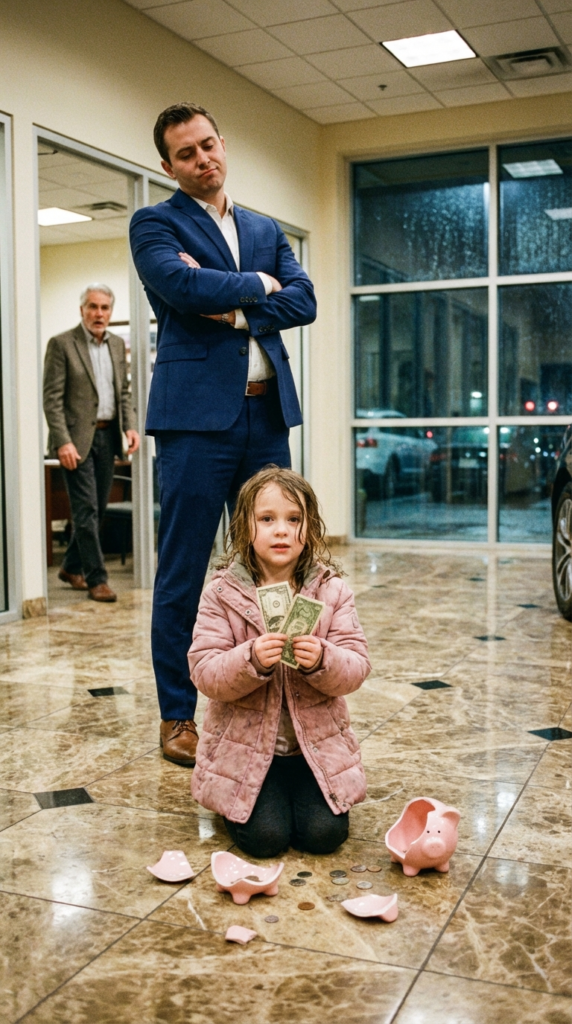
Mia ignored him. She knelt down, her wet knees touching the cold tile, and picked up the two dollar bills. She stood up, walked right up to Greg, and held them out.
“My mommy cries at night because her feet hurt from walking,” Mia said, looking up at him. “And she can’t lose her job. I want to buy a car. Is this enough?”
Greg laughed. It wasn’t a chuckle; it was a cruel, barking laugh that invited the other customers to join in. “Two dollars? Kid, get real. You can’t even buy a Happy Meal with that. Get your junk and get out.”
Suddenly, the heavy glass door to the corner office slammed open.
An older man with silver hair and a stern face walked out. He was wearing a simple polo shirt, but he carried an air of authority that silenced the room instantly. It was Mr. Henderson, the owner of the dealership chain.
He walked past the Ferraris and the BMWs. He looked at the broken plastic unicorn on the floor. He looked at the scattered pennies. Then he looked at Greg, and finally at Mia’s outstretched hand holding the two dollars.
The room went dead silent. Greg smirked, adjusting his tie. “Sorry about the noise, Mr. Henderson. I was just removing some riffraff. They were making a mess.”
Mr. Henderson didn’t acknowledge Greg. He walked right up to Mia and got down on one knee, ruining his trousers on the wet floor.
To understand why this moment meant everything, you have to understand the year we’d had.
Twelve months ago, I was Sarah Miller, a suburban mom with a minivan and a husband named Mark. Mark was charming, ambitious, and, as it turned out, a gambler. He emptied our savings, maxed out our credit cards, and then disappeared one night, leaving a note that said, “I can’t handle the pressure.”
He left me with $40,000 in debt and a foreclosure notice.
I lost the house. I lost the minivan. We moved into a studio apartment that smelled like mildew. I took a job at an Amazon warehouse, picking and packing for twelve hours a day. My feet bled. My back spasmed. But I did it for Mia.
The only thing that kept us going was the dream of getting back on our wheels. A car meant I could take better shifts. A car meant I could drive Mia to a better school. A car was freedom.
But the universe seemed determined to keep us walking. And now, standing in this temple of wealth, getting mocked by a man who had never known a day of hunger in his life, I felt like I was breaking into pieces.
Mr. Henderson looked at Mia. His eyes were kind, surrounded by laugh lines, but they were currently filled with a profound sadness.
“What’s your name, little one?” he asked softly.
“Mia,” she whispered.
“And is this your money, Mia?” He pointed to the two dollars.
“Yes,” she said. “I saved it. I didn’t buy ice cream for a whole month.”
Mr. Henderson nodded solemnly. He reached out and gently took the two crumpled bills from her hand. He smoothed them out on his knee.
“This is a lot of money,” he said. “Are you sure you want to invest this in a vehicle?”
“Yes,” Mia said. “For Mommy.”
Mr. Henderson turned his head slowly to look up at Greg. The look on his face shifted from grandfatherly warmth to cold, hard granite.
“Greg,” Mr. Henderson said. “Bring me the keys to the 2019 Honda Odyssey. The blue one. It just came in on trade.”
Greg blinked, confused. “The Odyssey? Sir, that’s a pristine trade-in. We haven’t even detailed it yet. We’re listing that for $18,000.”
“Did I stutter?” Mr. Henderson’s voice didn’t rise, but it cut deeper. “Bring me the keys. And bring me the title.”
“But sir,” Greg argued, looking around at the customers watching. “She has two dollars. You can’t be serious. You’re going to let these… people… drive off in an $18,000 van for two bucks?”
Mr. Henderson stood up. He towered over Greg.
“No, Greg. I’m not selling it to them for two dollars.”
Greg smirked again, thinking sanity had returned. “Exactly. I told them—”
“I’m selling it to them for two dollars,” Mr. Henderson interrupted, “because that is the price we agreed upon. And as for you…”
Mr. Henderson pointed to the door. “You’re fired. Get your things. Get off my property. I don’t employ people who mock children. I don’t employ people who measure a person’s worth by their shoes.”
Greg’s face went pale. “You can’t do that! I’m your top earner!”
“You were,” Henderson said. “Now you’re a trespasser. Leave.”
Security stepped forward. Greg, sputtering and red-faced, was escorted out into the rain, the same rain he had mocked us for standing in.
Mr. Henderson turned back to me. I was crying openly now. I couldn’t stop.
“Ma’am,” he said gently. “I apologize for my former employee. That is not how we do business here.”
Greg returned with the keys before being shoved out the door. Mr. Henderson took them and pressed them into Mia’s hand.
“A deal is a deal,” he said to her. “Two dollars. Paid in full.”
I looked at him, shaking my head. “Mr. Henderson, I can’t. That’s too much. I can’t pay the taxes, the insurance…”
“My corporate account will cover the taxes and the first year of insurance,” he said, waving a hand. “Consider it a marketing expense. Or better yet… consider it an investment in a brave little girl.”
He looked at the broken piggy bank on the floor.
“You know,” he said, his voice thick with emotion. “My granddaughter is about your age. She lives in London. I don’t see her enough. You reminded me that the most precious things aren’t the cars on this floor.”
He handed me a handkerchief. “Go. Take the van. And drive safe.”
The Resolution
We walked out to the lot. The Honda Odyssey wasn’t just a car; to us, it looked like a chariot. It had leather seats. It had heated mirrors. It had a full tank of gas.
As I buckled Mia into the back seat, she looked at the empty spot where her piggy bank used to be.
“Was it a good deal, Mommy?” she asked.
I climbed into the driver’s seat, smelling the clean scent of leather and hope. I turned the key, and the engine purred to life. The heater blasted warm air against my frozen hands.
“Yes, baby,” I sobbed, laughing through the tears. “It was the best deal in the world.”
I drove out of the lot. As we turned onto the main road, I saw Greg standing at the bus stop in the pouring rain, his expensive suit soaked, holding a box of his desk things. He looked miserable. He looked cold.
I slowed down as I passed him. He looked up and saw me. He saw the warm, dry minivan. He saw Mia waving from the back window.
I didn’t honk. I didn’t yell. I just drove past him, leaving him in the rearview mirror, shrinking smaller and smaller until he was gone.
That was six months ago.
I made it to work that night. I got a promotion three months later because I was never late. We moved into a two-bedroom apartment last week.
And on the mantle, in the center of the room, sits a new piggy bank. But next to it, framed in glass, are the receipt from Prestige Motors and a single penny we saved from the floor.
The receipt reads: One Honda Odyssey. Paid in Full. Cost: Love and $2.00.