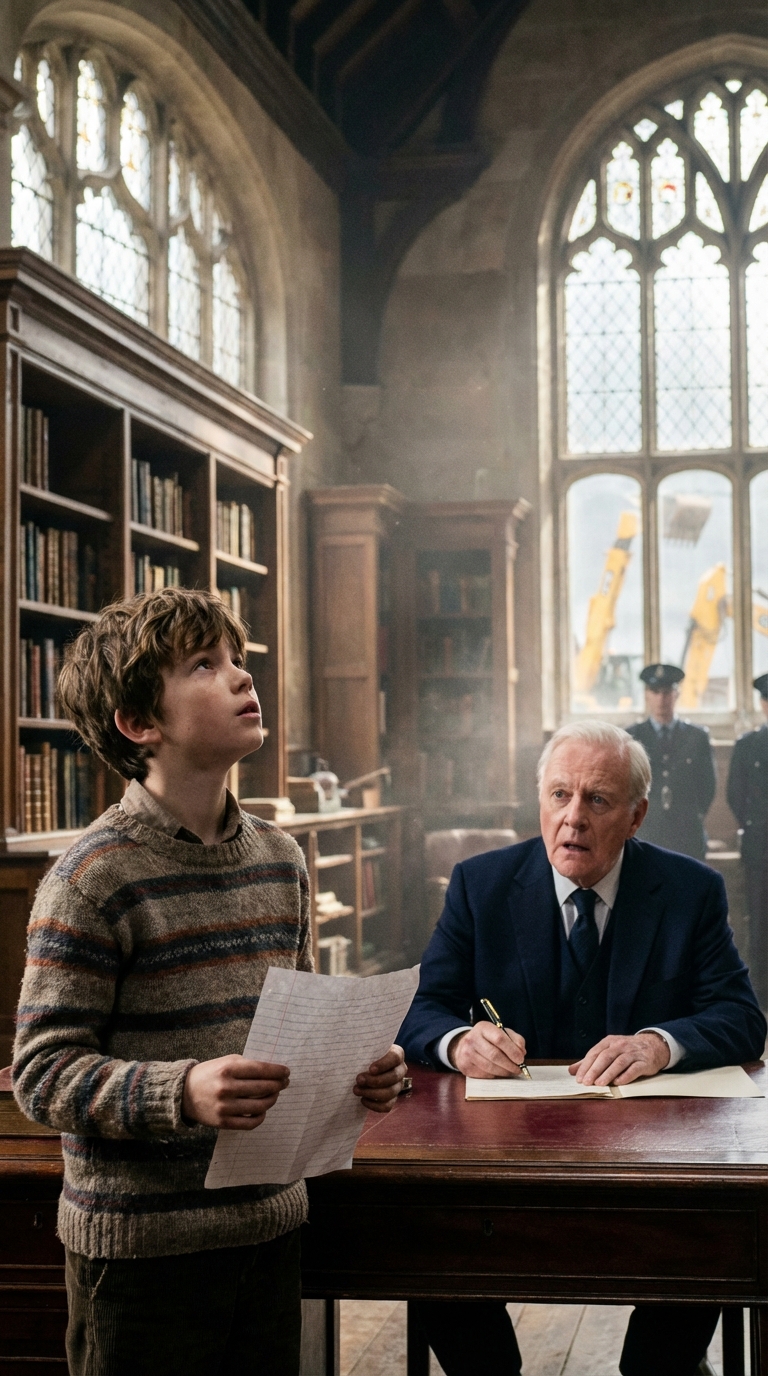
“This building is coming down at 8:00 AM tomorrow. Period. Now get this kid out of my face.”
Mr. Arthur Sterling didn’t even look up from the contract. He waved his hand dismissively, as if my seven-year-old son, Leo, was nothing more than a fly buzzing around the lapel of his three-thousand-dollar Italian suit.
We were standing in the center of the Oak Creek Public Library. The air smelled of old paper and lemon polish—a scent that used to bring me peace, but today smelled like a funeral. This library was the sanctuary that had saved my life three years ago when my husband emptied our bank accounts and disappeared, leaving me with a toddler, a mountain of debt, and nowhere to go.
It was the only place Leo, who suffered from a severe stutter and crippling social anxiety, felt safe enough to speak above a whisper.
And now, Arthur Sterling, the billionaire real estate developer who had purchased the city block, was turning it into a multi-level parking garage for his new luxury high-rise.
The demolition crew was already parked outside. Through the large arched windows, I could see the yellow bulldozers idling in the rain, a low mechanical growl that shook the dust from the bookshelves.
“Please, sir,” I begged, my voice trembling as I held back tears. “Just five minutes. He wrote something for you. He’s been working on it all week.”
“I don’t have five minutes,” Sterling snapped, uncapping his heavy gold fountain pen. The ink nib hovered over the signature line. “I have a board meeting in an hour. Security, escort them out.”
Two burly guards in dark suits stepped forward. I felt the crushing weight of defeat. I grabbed Leo’s hand. “Come on, baby. Let’s go.”
But Leo pulled away.
He didn’t run to me. He didn’t hide. He walked right up to the mahogany table they had set up in the children’s section for the ceremonial signing. His small hands were shaking so hard that the crumpled notebook paper in his grasp rattled like dry leaves in a storm.
“M-m-mister Sterling?” Leo stammered.
Sterling let out a heavy sigh, the sound of a man whose time was worth more than our entire existence. He looked up, his eyes cold and grey like steel. “What?”
Leo didn’t ask for mercy. He didn’t ask for the library to be saved. He opened his notebook.
“I f-found this in the b-basement,” Leo whispered. “Inside a copy of Great Expectations.”
He placed an object on the table. It wasn’t a weapon. It was an old, yellowed library checkout card. The edges were frayed. It was dated October 14, 1974.
Sterling froze. The pen stopped moving. His eyes locked onto the card.
“And I w-wrote a story about the boy who signed it,” Leo said.
Sterling went pale, the blood draining from his face. “Where did you get that?”
“Chapter One,” Leo read, his voice gaining a sudden, terrifying strength. “The boy had holes in his shoes, and he came here because it was the only place that was warm…”
To understand the magnitude of this moment, you have to understand the history of this town, and the history of Arthur Sterling.
Sterling wasn’t just a developer; he was a myth. The story went that he came from old money, educated in Europe, a titan of industry who reshaped skylines. He was known as “The Iron Architect.” He didn’t have feelings; he had blueprints.
But I knew the truth about the library. I was the head librarian. For the last six months, as the eviction date loomed, I had been frantically archiving the basement—the “Graveyard of Books,” as we called it.
Leo spent his afternoons down there with me. While other kids played video games, Leo read. He found comfort in the characters who struggled, just like him.
Last week, he came running up to my desk, holding a dusty copy of Dickens. “Mom,” he had said, pointing to the checkout card in the back pocket. “Look at the name.”
The name scrawled in sloppy, childish cursive was: Artie Sterling.
It wasn’t the signature of a billionaire. It was the signature of a child. And next to it, the librarian from fifty years ago had written a note in red ink: Fees waived. Coat provided from Lost & Found.
Leo, in his infinite seven-year-old wisdom, decided that the man destroying the library didn’t hate books. He decided the man had simply forgotten who he was.
Back in the room, the silence was deafening. The security guards hesitated. The city council members, who were there to witness the signing, looked confused.
Leo continued reading.
“The boy’s dad yelled a lot,” Leo read, his stutter vanishing as he got lost in the narrative. “So Artie came to the library. He sat in the big green chair by the window. The one with the rip in the arm.”
Sterling’s hand, the one holding the pen, began to tremble. He slowly lowered the pen to the table. He looked at the green chair in the corner—the very chair he had ordered to be thrown in the dumpster.
“He didn’t have a lunch,” Leo continued. “So Mrs. Higgins, the lady with the glasses, gave him half her sandwich. She told him that books were food for the brain, but sandwiches were food for the belly, and he needed both.”
A muscle in Sterling’s jaw jumped. He was staring at Leo, but he wasn’t seeing a seven-year-old boy. He was seeing a ghost.
“Artie read about pirates and kings,” Leo said, his voice ringing clear. “He promised that one day, he would build a castle. And he promised Mrs. Higgins that he would never let the cold get in again.”
Leo lowered the paper. He looked the billionaire in the eye.
“But now,” Leo whispered, “Artie is the one bringing the cold.”
The room spun. I held my breath. This was it. Sterling was going to scream. He was going to have us arrested. You don’t humiliate a man worth ten billion dollars in front of the press.
Sterling slowly reached out and picked up the yellowed card. He ran his thumb over the childish signature. He looked at the red ink note: Coat provided.
He closed his eyes. For a long moment, the Iron Architect looked incredibly old and incredibly tired.
Then, he opened his eyes. He looked at the demolition contract in front of him.
RRRRRIP.
The sound of the thick paper tearing echoed like a gunshot.
Sterling tore the contract in half. Then in quarters. He swept the pieces onto the floor.
“Mr. Sterling?” his assistant gasped. “Sir, the demolition crew is on the clock. The investors…”
“Send them home,” Sterling said, his voice hoarse. “Pay them for the day. Send them home.”
He stood up. He walked around the table and knelt down in front of Leo. He didn’t care about his suit pants on the dusty floor.
“I forgot about the sandwich,” Sterling whispered, his voice thick with emotion. “I remembered the hunger. But I forgot about the sandwich.”
He looked at me. “Mrs…?”
“Miller,” I managed to choke out. “Sarah Miller.”
“Mrs. Miller,” Sterling said, standing up and buttoning his jacket. “This library needs renovations. The roof leaks. The heating system is archaic. And that green chair…” He looked at it fondly. “It needs to be reupholstered.”
He turned to his assistant. “Cancel the parking garage. Draft a new proposal. The Sterling Foundation is taking over the preservation of this building. We’re adding a new wing. A children’s wing.”
He looked down at Leo.
“But I have one condition,” Sterling said sternly.
Leo’s eyes went wide. “Y-y-yes sir?”
“You have to be the first author in the new wing,” Sterling said. “I want a signed copy of that story. Frame it. Put it right next to the door.”
The Resolution
That was six months ago.
Today, the Oak Creek Library isn’t a pile of rubble. It’s a beacon. The scaffolding is coming down next week to reveal the new “Mrs. Higgins Children’s Wing.”
Arthur Sterling didn’t just save the building. He saved himself. He comes by every Tuesday afternoon. He sits in the reupholstered green chair. He doesn’t bring his phone. He doesn’t bring contracts. He reads to the kids.
And Leo?
Leo doesn’t stutter when he reads anymore. He realized that words have power. Power to destroy, yes, but also power to heal.
Yesterday, I walked past the children’s section. I saw Sterling sitting on the floor, struggling to fold an origami crane while Leo patiently explained the steps.
“You’re doing it wrong, Artie,” Leo said, giggling.
“I’m trying, kid,” the billionaire grumbled, smiling a smile I hadn’t seen on a billboard. “I’m trying.”
We often think that to change the world, we need millions of dollars or massive power. But sometimes, all you need is a library card, a memory, and a little boy brave enough to remind a king where he came from.