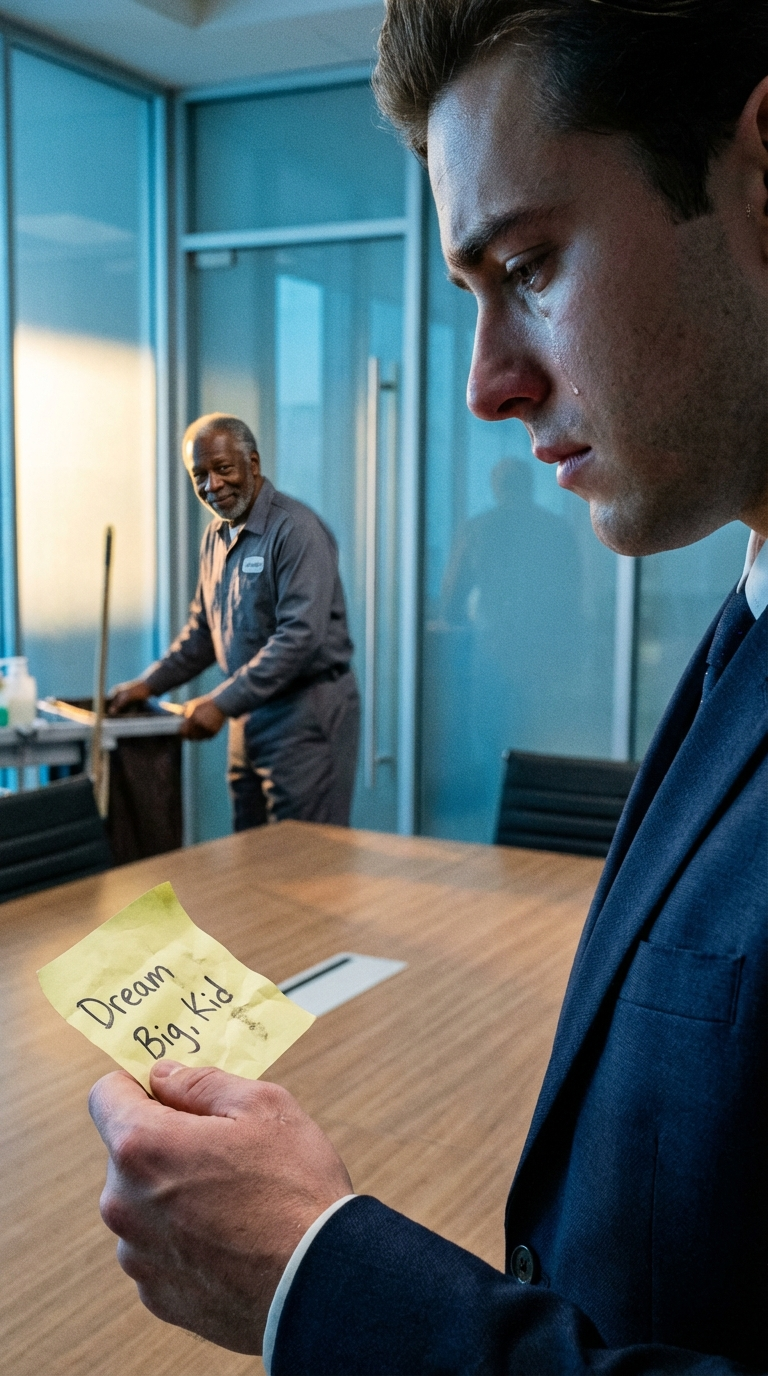
I sat in the boardroom, the air conditioning humming a low, expensive purr that sounded like money. I was surrounded by men in five-thousand-dollar suits, but my eyes were glued to a crumpled yellow Post-it note that had just fallen out of my brown paper lunch bag.
“Dream big, kid.”
The room was buzzing with the kind of electric tension that precedes a nine-figure deal. We were minutes away from signing the merger that would make me the youngest partner in the history of Vance Capital. My boss, Sterling Vance—the billionaire CEO who loved to tell the press how he plucked me from the squalor of the foster care system and paid my college tuition—was standing over me, clapping a heavy hand on my shoulder.
“Big day, Leo,” Sterling grinned, his teeth blindingly white, his eyes devoid of any actual warmth. “Make sure the signature is legible. And don’t forget who got you here.”
For years, I believed him. God, I worshipped him. I believed Sterling was the anonymous donor who paid my tuition when I had nothing. I believed he was the one who, somehow, had arranged for those notes to appear in my lunchbox when I was a starving, lonely kid in middle school, encouraging me to keep going.
He used my story in every Forbes interview. I was his trophy: the poor boy he saved, the living proof of his “philanthropy.”
But as I looked at the Post-it note in my hand—fresh ink, written today, smelling faintly of lemon cleaner—my blood ran cold.
The handwriting. It had a distinctive, shaky loop on the ‘D’. A tremor in the ‘k’.
I looked up at Sterling. He was texting on his phone, bored, ignoring the room full of lawyers. His handwriting was jagged, aggressive, all sharp angles. I had seen it a thousand times.
Then, I looked through the glass walls of the conference room.
Out in the hallway, slowly pushing a gray trash cart, was Mr. Henderson. The night janitor. He was an older man, maybe seventy, with a back curved like a question mark and hands roughened by decades of bleach and labor.
He was wearing his street clothes. He wasn’t wearing his uniform.
That’s right. Sterling had fired him twenty minutes ago. I had been there. Sterling had stepped over a wet spot on the floor and snapped, “Get rid of him. He moves too slow. We need efficiency, not geriatrics.”
Mr. Henderson caught my eye through the glass. He didn’t look angry. He looked at me with a profound, quiet pride. He gave me a sad, tired smile, tapped his chest once, and turned to walk toward the elevators.
The memory hit me like a freight train.
That shaky ‘D’.
I had seen it on a mop handle label Mr. Henderson had written his name on yesterday. I had seen it on the sign-out sheet at the security desk. And I had seen it on the notes in my lunchbox every day for fifteen years.
The Lie
My childhood was a blur of foster homes and hunger. The only bright spot was the anonymous “Guardian Angel” fund that began paying for my school supplies, then my clothes, and finally, my full tuition to Wharton.
When I graduated top of my class, Sterling Vance approached me. He told me, over a celebratory dinner at a steakhouse I was too afraid to order from, that he was the donor. He hired me on the spot.
“I saw potential,” he had said, swirling his scotch. “I wanted to mold you.”
I gave him everything. My loyalty, my time, my ethics. I helped him acquire companies. I helped him lay off thousands of workers to boost stock prices. I told myself it was for the greater good, because a great man like Sterling Vance believed in it.
But the math never added up. Sterling didn’t care about people. He didn’t even know the names of his own secretaries. Why would he send handwritten notes to a foster kid in Ohio?
He wouldn’t.
But Mr. Henderson?
I remembered now. Mr. Henderson had been the custodian at my elementary school in Ohio before he moved to the city. I remembered him giving me extra milk cartons. I remembered him asking me about my grades.
He wasn’t a billionaire. He was a man who lived on nothing so he could give everything to a kid who had no one. He had followed my career. He had gotten a job at the same building just to watch me succeed.
And today, on the biggest day of my life, he had slipped one last note into my bag before being thrown out like trash by the man taking credit for his sacrifice.
The Breaking Point
“Leo?” Sterling’s voice cut through the noise. ” pen’s drying out. Sign the damn papers.”
I looked at the merger documents. This deal was going to gut a manufacturing town in the Midwest. It was going to put three thousand people out of work—people like Mr. Henderson. It would add another zero to Sterling’s net worth.
I looked at the note again. Dream Big, Kid.
Mr. Henderson didn’t dream of me becoming a corporate hatchet man. He didn’t pay for my education so I could become Sterling Vance.
I stood up. The chair scraped loudly against the floor. The room went silent.
“Is there a problem?” the opposing counsel asked.
“Yes,” I said. My voice was steady, surprising even me. “There is.”
I looked at Sterling. “You didn’t pay my tuition, did you?”
Sterling let out a sharp, incredulous laugh. “What are you babbling about? Sit down.”
“You found out I had a scholarship from an anonymous donor, and you claimed it was you so you could own me,” I said, my volume rising. “You stole the credit. Just like you steal pension funds. Just like you’re about to steal the livelihood of three thousand workers in Ohio.”
Sterling’s face turned a dangerous shade of red. He leaned in close, whispering so the others couldn’t hear. “Listen to me, you ungrateful little gutter rat. I made you. I can unmake you. Sign the papers, or you’ll never work in this city again.”
I looked at the glass wall. Mr. Henderson was gone. The elevator had taken him down.
I looked back at Sterling. “You didn’t make me. A janitor made me. A man with more honor in his pinky finger than you have in your entire offshore portfolio.”
The Revenge
I picked up the heavy, leather-bound folder containing the merger contracts.
“What are you doing?” Sterling hissed.
“Dreaming big,” I said.
I didn’t sign. Instead, I opened my briefcase. I pulled out a different file. The “Doomsday” file.
Every partner keeps one, just in case. But mine was different. Because I handled Sterling’s personal accounts, I knew where the bodies were buried. I knew about the shell companies used to launder money. I knew about the bribes to zoning commissioners.
“Gentlemen,” I addressed the opposing counsel and the board members. “Before we proceed, I think you should take a look at the Due Diligence addendum I just prepared.”
I slid the file down the long mahogany table.
Sterling grabbed for it, but the opposing CEO, a shark named Mr. Takagi, got there first. Takagi opened the file. His eyebrows shot up.
“Sterling,” Takagi said, his voice cold. “What is this account in the Caymans labeled ‘Structural Bribes’?”
“That’s—that’s privileged!” Sterling sputtered.
“And this email chain,” I added, projecting my voice. “Where Sterling admits that the valuation of Vance Capital is inflated by forty percent due to fraudulent accounting.”
The room erupted. Lawyers were shouting. Phones were coming out.
Sterling lunged at me. “I’ll kill you! I’ll ruin you!”
Security guards—the ones who actually liked Mr. Henderson—stepped in, blocking Sterling.
I looked at him, sweating and screaming, his empire crumbling in real-time. “You fired the wrong man today, Sterling.”
The Aftermath
I walked out of the building ten minutes later. I left my career, my partnership, and my seven-figure salary on that table.
I found Mr. Henderson sitting on a bench in the plaza outside, feeding pigeons. He had his small box of personal items next to him.
I sat down beside him. I loosened my tie.
“You knew I’d figure it out eventually,” I said.
Mr. Henderson chuckled, a dry, raspy sound. “You were always a smart kid, Leo. Took you long enough, though.”
“Why?” I asked. “How did you afford it?”
“I lived cheap,” he shrugged. “Won a scratch-off back in ’98. Didn’t need much. Saw a kid who needed a push. That’s all.”
I pulled the yellow Post-it note out of my pocket. “You saved me.”
“No,” he said, pointing a calloused finger at me. “You saved yourself. I just paid the bill.”
I put my arm around his shoulders. “Well, I just quit. And I think I made a bit of a mess upstairs.”
Mr. Henderson looked up at the skyscraper. We could see figures running around in the glass office on the 40th floor. “Looks like you did good.”
The Resolution
The fallout was spectacular. Sterling Vance was indicted for fraud and embezzlement three months later. The merger was cancelled, saving the factory in Ohio.
As for me? I didn’t get blacklisted. Turns out, when you expose a massive fraud, honest companies actually want to hire you.
But I didn’t go back to corporate finance.
I started a new firm. Small. Ethical. We focus on helping nonprofits and managing endowments for scholarships.
And my first hire?
Mr. Henderson doesn’t push a broom anymore. He sits at the front desk of my office. He’s the Director of Morale. He greets every client with a smile, and he makes sure every intern gets a note in their lunchbox when they’re having a hard day.
I pay him a partner’s salary. And every day at lunch, we sit together, eat sandwiches, and dream big.