The Bench at the End of the World
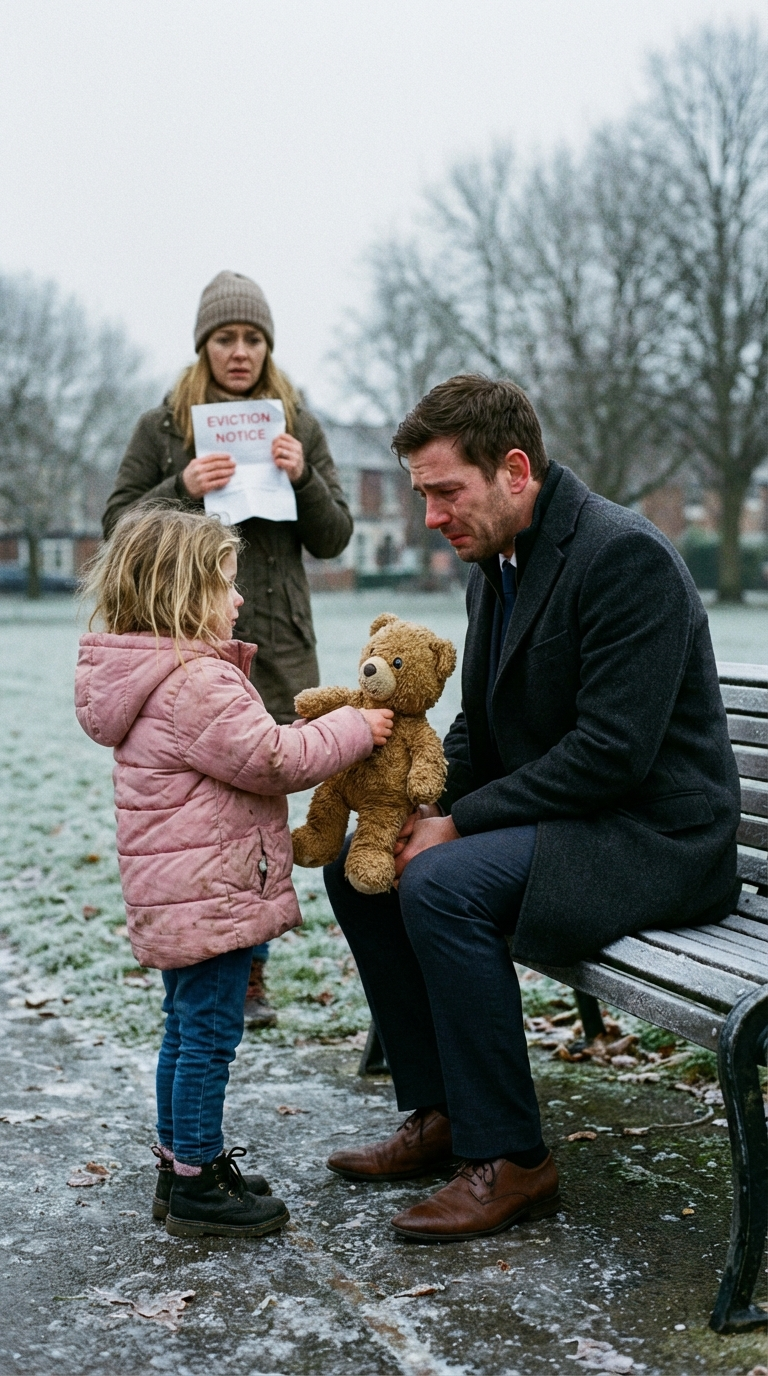
I was down to my last $14. The eviction notice in my pocket felt like it weighed a hundred pounds, burning a hole right through the thin lining of my cheap puffer coat. We were sitting on a freezing, wrought-iron park bench in the middle of Boston’s financial district—the only place I could afford to take my four-year-old daughter, Lily, for an afternoon out.
The irony wasn’t lost on me. We were surrounded by towers of glass and steel, monuments to unimaginable wealth, while I was mentally calculating if I could afford to split a bodega cheese sandwich with my child for dinner.
My ex-husband, Gary, had thoroughly and methodically cleaned us out six months prior. It wasn’t just a divorce; it was an annihilation. He took the savings account he swore was for Lily’s college, he leveraged the house until the bank foreclosed, and he took every shred of dignity I had left. He told our friends, our family, and crucially, the family court judge, that I was unstable. An unfit mother who couldn’t handle finances.
Sitting on that bench, three days away from a homeless shelter, I knew I was about to prove him right. The cold bit through my jeans. I felt the familiar sting of tears I couldn’t afford to shed in public.
Lily, oblivious to the precipice we were standing on, was absorbed in playing with “Barnaby.” Barnaby was a teddy bear that had survived the wars. He was missing an eye, his stuffing was leaking from a seam in his neck, and he looked about as pathetic as I felt. But to Lily, he was security.
Suddenly, the air shifted. A man sat down on the far end of the bench.
He didn’t just sit; he collapsed, as if his legs had suddenly refused to carry the weight of his existence. He was impeccable—wearing a charcoal cashmere coat and a suit underneath that probably cost more than my entire year’s rent three times over. His shoes were polished to a mirror shine, reflecting the grey sky.
But his face. I’d never seen such profound, hollow sadness. It was a look of utter devastation, the face of a man who was attending his own funeral and no longer had the energy to pretend otherwise. He stared at the pavement, unseeing.
My maternal radar pinged wildly. I instinctively pulled Lily closer by the hood of her jacket, terrified. You hear horror stories in the city. Desperate people do desperate things, regardless of their bank balance.
But Lily has none of my fear. Before I could stop her, she wriggled out of my grip and waddled over to the stranger.
My heart slammed against my ribs. “Lily, no, come back here,” I hissed, trying to keep my voice calm.
She ignored me, stopping right in front of his polished shoes.
“You look very sad, mister,” she said in her tiny voice, cutting through the ambient noise of city traffic.
The man jerked, startled out of his reverie. He looked down at her, his eyes red-rimmed and glassy. It took him a moment to focus, as if he was surprised to see another human being.
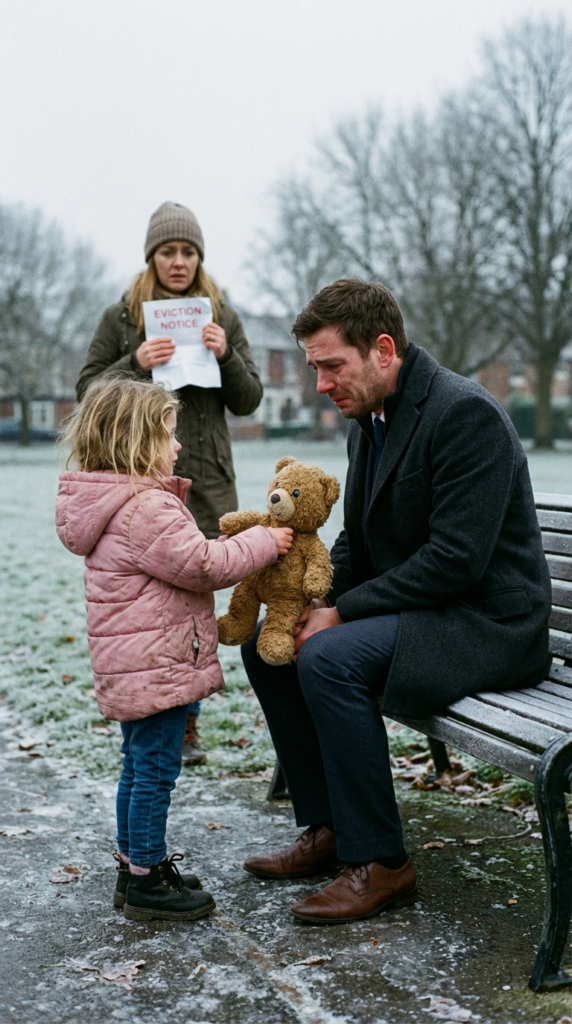
Lily held out Barnaby. “You need him more than me today. He’s very good at hugs.”
Time stopped. I held my breath, waiting for the rejection. I waited for him to snap at her, to be offended by her intrusion, to tell her to get her dirty, germ-ridden toy away from his Italian wool suit. I was ready to snatch her up and run.
Instead, his perfectly tailored shoulders began to shake. A sob ripped out of his throat—a raw, guttural sound that scared the nearby pigeons into flight. He reached out a hand that was trembling violently and gently, so gently, took the one-eyed bear from her small hands.
He stared at the bear, and then he looked at me. Tears were streaming unashamedly down his cheeks.
He reached into his inside pocket and pulled out a thick, cream-colored envelope. He stood up, his legs unsteady, and crossed the distance between us. He pressed the envelope into my frozen hand. It felt heavy. Significant.
“Don’t open it until I leave,” he choked out, his voice ravaged. “Please. And thank her. Thank her for saving me today.”
He turned and walked away rapidly, clutching that ratty, leaking bear to his chest like it was the rarest gold on earth, disappearing into the sea of grey suits.
I looked down at the envelope. The paper was textured, expensive. The wax seal on the back was stamped with a stylized ‘W’ crest I dimly recognized from the business pages of newspapers I used to read in another life.
My hands were shaking so badly I almost dropped it. I ripped the seal open.
Inside wasn’t cash. It was a single check. And a smaller note.
The check was made out to “Cash.” The amount made the world tilt on its axis. Fifty thousand dollars.
The note, written in hurried, elegant script on personal stationery, read: His name was Leo. He would have been four today, too. Thank you for seeing me. It was signed simply: Arthur Wellington.
Arthur Wellington. The venture capital titan. The man whose firm owned half the skyline we were looking at. I remembered reading about the tragic accident a year ago—a car crash that took his wife and young son.
I didn’t scream. I didn’t laugh. I just sat there on the freezing bench, clutching fifty thousand dollars and my daughter, and finally, finally let myself cry.
The Long Shadow of Gary
To understand why $50,000 felt like five hundred million, you have to understand Gary.
Gary was the kind of man who could charm the birds out of the trees, only to clip their wings once they landed in his hand. When we met, he was a rising star in real estate. I was an interior designer. We made sense. We were the suburban dream couple.
But Gary’s charm was a facade for a deep, corrosive need for control. It started slowly. Why did I need a separate bank account? It was easier if he managed the investments. Why was I spending so much on groceries?
By the time Lily was born, I was having to ask permission to buy diapers. If I bought a coffee for myself, I got the silent treatment for two days. He gaslit me relentlessly. If I questioned where our money was going, I was “hysterical” or “bad at math.”
When he finally discarded me for his twenty-four-year-old assistant, he didn’t just leave. He scorched the earth. He had been siphoning money into offshore accounts for years. On paper, we were broke. He had hidden assets so effectively that even my lawyer admitted defeat.
“He’s a monster, Sarah,” my lawyer had said, pinching the bridge of her nose. “But he’s a monster with very good accountants.”
Gary got the waterfront condo. I got the debt and a rental deposit in a neighborhood where I fell asleep to the sound of police sirens.
Every day was a fight for survival. I took freelance design jobs that paid pennies, cleaned houses under the table, anything to keep the lights on. But the eviction notice was the final blow. My landlord, a slumlord who hated kids, had found a loophole to kick us out to raise the rent for someone else.
Gary knew. He always knew. He sent me a text the morning before the park incident: Hear you’re having trouble keeping a roof over my daughter’s head. Maybe it’s time we reconsidered custody. You’re clearly unfit.
That text was burning in my brain when Lily handed Arthur Wellington that bear.
The Delivery
The $50,000 check didn’t just pay the rent back. It bought us breathing room. It bought us safety. I moved us into a modest, clean two-bedroom apartment in a safer suburb within a week. I prepaid six months of rent. I bought Lily a winter coat that actually fit. I filled the fridge.
But I couldn’t stop thinking about Arthur Wellington. About the raw agony in his eyes. The money felt less like a gift and more like a sacred trust.
I wrote him a letter. I didn’t know his home address, so I sent it to his firm’s headquarters, marked “Personal and Confidential.” I didn’t ask for anything. I just told him about Lily, about our situation, and how his gesture had pulled us back from the abyss. I told him we would keep Barnaby’s memory alive.
Two weeks passed. We were settling in. I was beginning to feel human again.
Then came the Saturday morning that changed everything.
We were eating pancakes when a massive, sleek black horsebox truck pulled up in front of our small apartment complex. It looked entirely out of place in our neighborhood of aging Hondas and Toyotas.
My doorbell rang. A man in a chauffeur’s uniform stood there, holding a clipboard.
“Delivery for Miss Lily,” he said formally.
“A delivery? From who?”
“Mr. Arthur Wellington, ma’am. He requests your presence in the parking lot.”
My stomach flipped. Had I offended him with the letter?
I grabbed Lily’s hand and walked outside. The back ramp of the horsebox was being lowered hydraulically.
Standing next to the truck, looking slightly less haunted but still carrying the weight of the world, was Arthur Wellington. He wasn’t wearing a suit today; he was in expensive-looking casual wear, leather boots and dark jeans.
He saw Lily and managed a genuine, albeit fragile, smile.
“Hello again, Lily,” he said softly. “I have something of yours. And I brought you something of mine.”
He reached into his jacket and pulled out Barnaby. The bear had been professionally cleaned. His leaking neck seam was meticulously stitched up with golden thread.
Lily squealed and grabbed the bear, hugging it tight.
“And now,” Arthur said, his voice thick with emotion, “for your gift.”
He nodded to an attendant inside the truck.
Slowly, carefully, a creature stepped down the ramp.
It wasn’t a pony.
It was a retired racing greyhound. He was sleek, elegant, and colored a soft, fawn brown. He looked nervous, his large, intelligent eyes scanning the unfamiliar surroundings. He had a slight limp in his back leg.
“This is Dancer,” Arthur said, watching the dog. “He was a champion. But he hurt his leg on the track, and… well, when they can’t run, they aren’t wanted anymore. They were going to put him down yesterday.”
Arthur looked at me, his eyes intense. “I was at the track. I saw him in the holding pen. He looked just like I felt on that bench. Like he was waiting for the end.”
He knelt down so he was eye-level with Lily.
“You gave me your bear when I was sad, Lily. You saved me a little bit. I thought maybe you could help Dancer too. He needs a friend who knows how to give good hugs. Do you think you could take care of him? I’ve paid for all his vet bills and food for life. You just have to provide the love.”
Lily didn’t hesitate. She walked up to the large, trembling dog. Dancer lowered his long snout to sniff her. Lily gently placed her hand on his head. The dog let out a long sigh and leaned into her touch.
“He’s perfect,” Lily whispered.
Arthur stood up and looked at me. “I read your letter, Sarah. I know about Gary. I know about everything.” His voice hardened slightly. “Nobody should be discarded because they’re momentarily broken. Not dogs, and not people.”
The Confrontation
Word travels fast in the suburbs, especially when billionaire venture capitalists are delivering greyhounds to basement apartments.
It took Gary exactly four days to show up.
I was walking Dancer, Lily skipping ahead, when Gary’s flashy red sports car screeched to a halt beside us. He got out, looking furious and confused.
“What the hell is going on, Sarah?” he demanded, marching toward me. “I hear you’re living here now? And what is that mutt? Where are you getting money? You’re turning tricks now, is that it?”
The old Sarah would have cowered. The old Sarah would have cried.
But I wasn’t holding an eviction notice anymore. I was holding the leash of a ninety-pound greyhound who had instantly decided I was his person.
Dancer sensed the threat. He didn’t bark; greyhounds rarely do. he just stepped silently in front of me, creating a lean, muscular barrier between me and my ex-husband. A low rumble started in Dancer’s chest.
“Get that thing away from me,” Gary sneered, stepping back.
“Leave, Gary,” I said. My voice was steady. It surprised me.
“You can’t talk to me like that. I’ll call CPS. I’ll tell them you’re unstable, running around with dangerous animals—”
Another car pulled up. A black town car. Arthur’s driver stepped out, followed by Arthur himself. He must have had someone watching the house.
Arthur didn’t shout. He didn’t look angry. He just looked immaculately powerful. He walked over and stood beside me.
“Is there a problem here, Sarah?” Arthur asked quietly.
Gary looked at Arthur Wellington, the man whose face was on the cover of Forbes last month, standing next to his discarded wife. Gary’s jaw literally dropped.
“Who are you?” Gary sputtered, his bravado vanishing like smoke.
“I’m a friend of the family,” Arthur said coldly. “And you are trespassing. I suggest you leave before I have my legal team look into the fascinating accounting practices of your real estate firm. I’m sure the IRS would love a tip.”
Gary turned pale. He knew who Arthur was now. He looked from Arthur, to me, to the growling dog, and back to the billionaire. He realized, for the first time in his life, he was completely outmatched.
Without another word, Gary got back in his red car and drove away. He didn’t even look at Lily.
The New Normal
We didn’t end up marrying the billionaire. This isn’t a fairy tale. But Arthur became something better than a husband; he became our guardian angel.
Arthur comes over for dinner every Sunday. He doesn’t wear suits anymore. He wears sweaters that Lily likes to get dog hair on. He sits on the floor and plays with Lily and Dancer, who is now a permanent fixture on our couch.
Arthur is still sad. You don’t get over losing a child. But when he’s with Lily, the hollow look leaves his eyes. He laughs.
With Arthur’s mentorship and investment—a legitimate business loan this time, which I am proudly repaying—I started my own interior design firm. I specialize in creating safe, comforting spaces for families starting over.
Gary is currently dealing with a massive audit that “anonymously” got triggered. He’s too busy trying to stay out of jail to bother us with custody threats.
Sometimes I look at Dancer, sleeping peacefully with his head in Lily’s lap, Barnaby tucked between his paws. I think about that freezing bench. I think about how close we came to losing everything.
They say money can’t buy happiness. Maybe that’s true. But a ragged teddy bear, given with pure heart by a four-year-old to a stranger drowning in grief? That bought us a whole new life. And it bought a sad, rich man a reason to smile again.