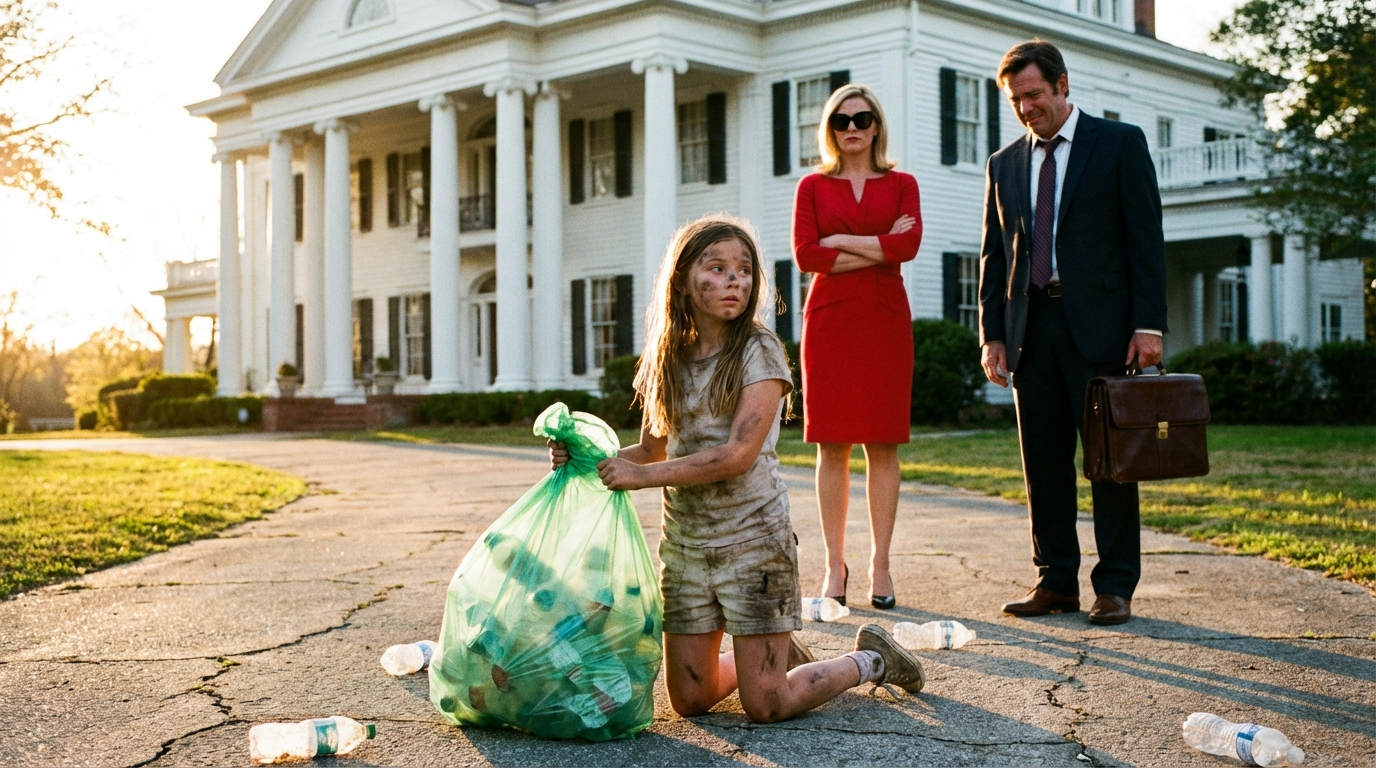
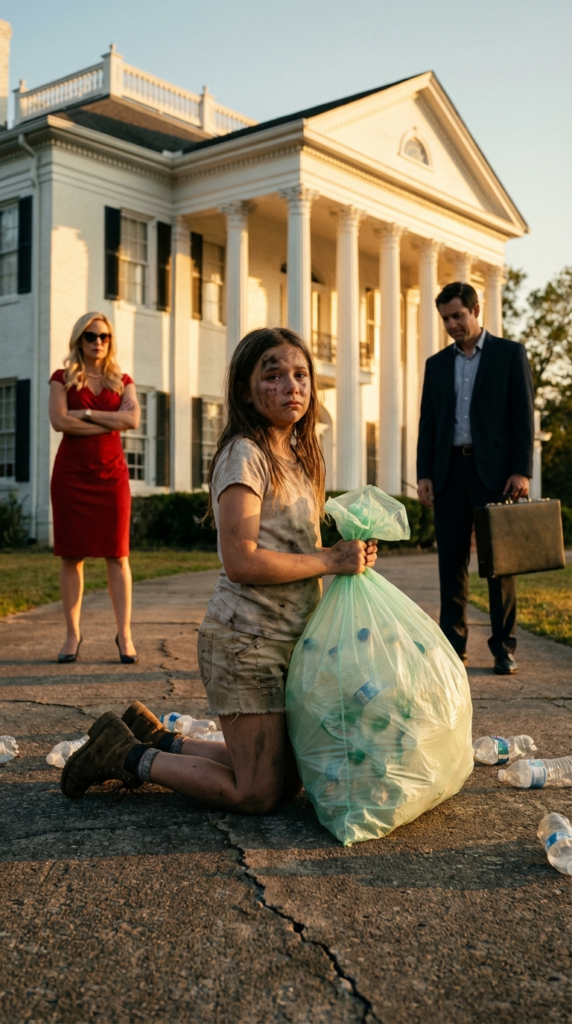
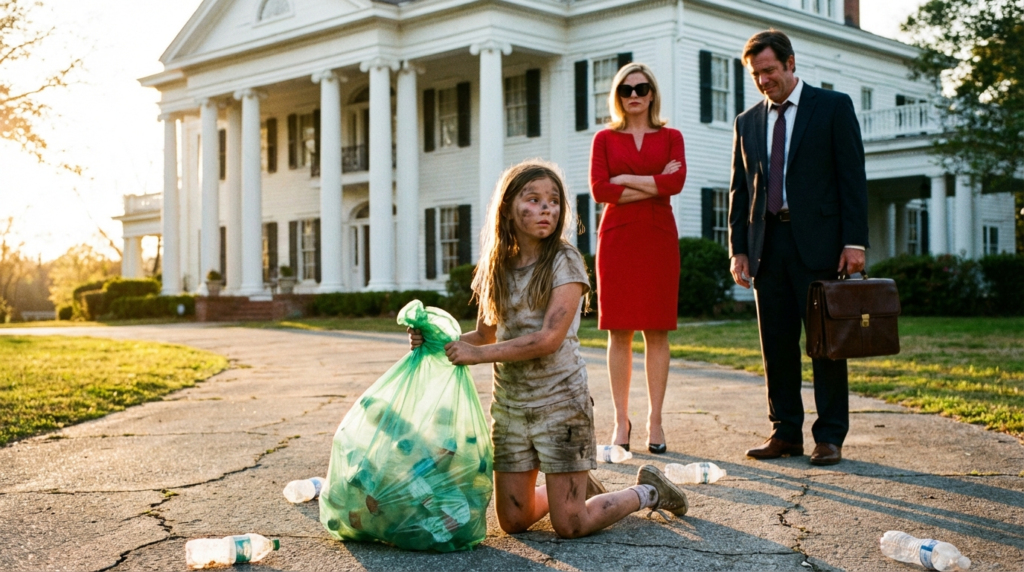
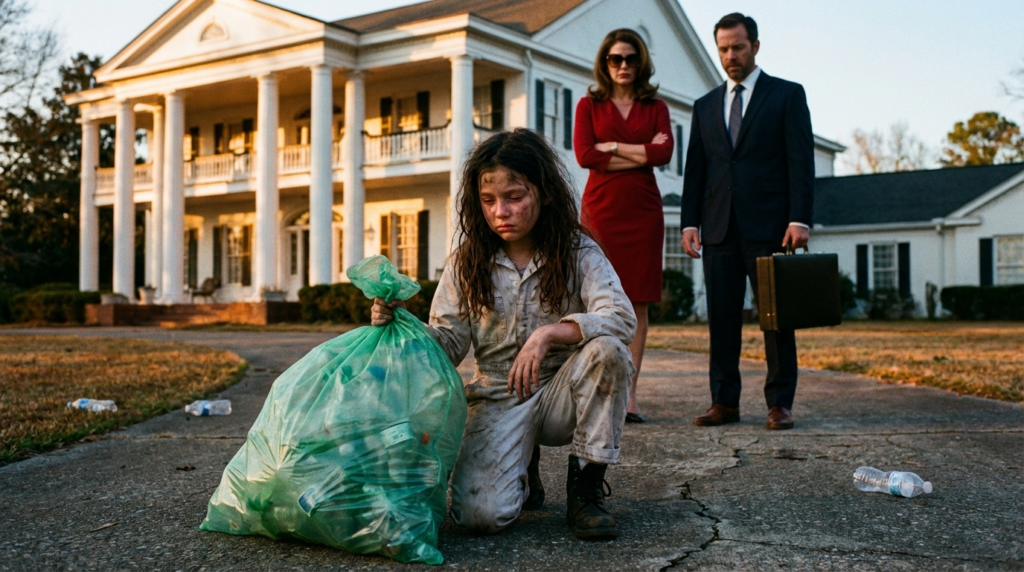
I was on my knees in the driveway of our $4 million estate, my hands covered in garbage juice, when I heard my mother’s heels clicking behind me.
“You missed three bottles near the azaleas,” she said coldly, her arms crossed, diamond bracelet glinting in the sunset. My father stood beside her in his $3,000 suit, briefcase in hand, watching me like I was a stranger.
This was Day 5 of my “punishment.”
My crime? I’d asked our housekeeper, Maria, to sit down and have lunch with me. I was tired of eating alone while she stood in the corner. My mother overheard and completely lost it. “You’re forgetting your place,” she hissed. “You need to learn what real work looks like.”
So they made me live like Maria for a week. I woke at 5 AM to scrub toilets. I hand-washed their cars. I sorted recycling in my destroyed clothes while their friends drove past, staring. I wasn’t allowed to shower properly. I ate leftovers standing up in the kitchen.
The neighbors whispered. My friends’ parents took pictures. I heard someone call CPS.
But right now, Day 5, something was different. As I reached for another bottle, an old pickup truck pulled up. An elderly man stepped out—weathered face, calloused hands, wearing a faded work shirt. He looked at me, then at my parents, then back at me.
“Excuse me,” he said quietly. “Is this your daughter?”
My mother’s face went pale. My father straightened his tie.
The old man walked past them, bent down, and whispered something in my ear that made my blood run cold. Then he handed me a folded piece of paper.
I opened it with shaking hands. What I read changed everything.
The note was written in shaky handwriting:
“Lily, I’m your grandfather. Your mother told you I was dead. I’ve been watching from down the street. I’m the ‘homeless man’ your mother had arrested last month for sleeping in the park. I tried to see you then. This ends now. Show this to your father. – Robert Chen”
I looked up at the old man. His eyes—they were the same gray-blue as mine. The same eyes I saw in my mirror every morning.
My mother’s face drained of color. “Get away from her,” she hissed. “Thomas, call the police. Now.”
But my father wasn’t moving. He was staring at the note I was holding, and something in his expression cracked.
“Robert?” my father whispered.
The old man nodded. “Hello, Thomas. It’s been twelve years.”
I didn’t understand. My mother always told me her family was poor, that she’d “married up” when she met my father. That she’d worked her way from nothing to everything. That I should be grateful.
But now this stranger—this grandfather I never knew existed—was standing in our driveway, and my father looked like he’d seen a ghost.
“Someone needs to explain what’s happening,” I said, my voice shaking. I was still holding garbage, still covered in filth, still being treated like I was less than human.
My father finally moved. He set down his briefcase and walked toward the old man slowly, like he was approaching something fragile.
“Robert, I… I thought you were…”
“Dead?” the old man—my grandfather—said softly. “That’s what she told everyone, wasn’t it?” He looked at my mother with infinite sadness. “Even her own father.”
My mother’s mask finally slipped. “You were a drunk. A failure. You embarrassed me my entire childhood. When I finally made something of myself, you think I wanted you dragging me back down?”
“So you erased me,” my grandfather said quietly. “You told everyone I died. You changed your last name. You built this perfect life and pretended I never existed.”
I felt like the ground was tilting beneath me. My mother—the woman who lectured me about honesty, about integrity, about “family values”—had been lying for over a decade.
“You made me pick up garbage in front of our house to teach me humility,” I said, my voice rising. “But you threw away your own father.”
Maria appeared in the doorway. She’d been with our family for eight years—longer than any other staff. My mother went through housekeepers like tissues, firing them for the smallest infractions. But Maria always stayed.
“I knew,” Maria said quietly, stepping onto the driveway. “I saw him three weeks ago. He was trying to leave flowers at the gate for Lily’s birthday. Mrs. Chen called the police.”
My father turned to my mother, his face transforming into something I’d never seen before. Pure rage.
“You had her father arrested? On our daughter’s birthday?”
“He’s not my father anymore,” my mother spat. “He lost that right when he—”
“When he what?” my grandfather interrupted gently. “When I lost my job after your mother died? When I struggled with depression? When I was human and imperfect?” He looked at me. “Your grandmother—my wife—died when your mother was sixteen. I fell apart. I made mistakes. But I got help. I’ve been sober for ten years. I’ve been trying to reach out for five.”
He pulled out his phone, showing screenshots of blocked emails, returned letters, ignored calls.
“Every birthday. Every Christmas. Every time I saved enough money to buy her something, to try to reconnect, she shut me out.”
My father did something I’d never seen him do in my entire life. He sat down on the curb, right there in his expensive suit, and put his head in his hands.
“What have we become?” he whispered.
My mother stood frozen, her perfect façade crumbling. The neighbors were definitely watching now. Mrs. Patterson from next door had her phone out.
“You made our daughter pick up trash to teach her about class and gratitude,” my father said, looking up at my mother. “But you threw away your own family like garbage.”
“That’s different,” my mother insisted, but her voice cracked. “I was protecting our reputation. Our standing in the community.”
“Our standing?” I said, and I heard my voice echo across the lawn. “Mom, you made me scrub toilets for a week because I showed kindness to someone. You humiliated me in front of the entire neighborhood. You wanted to teach me that some people matter less than others.”
I walked over to my grandfather, still covered in grime, and did something that made my mother gasp.
I hugged him.
He smelled like cheap soap and old cotton, and when his arms wrapped around me, I started crying. Really crying. All the loneliness, all the years of being raised by people who valued appearances over humanity, all the meals eaten alone while staff stood watching—it all came out.
“I’m sorry,” my grandfather whispered into my hair. “I’m so sorry I wasn’t there.”
“You’re here now,” I said.
What happened next still gives me chills.
Mr. Patterson—our neighbor, a retired judge—walked across his lawn and stood at the edge of our driveway. Then Mrs. Kim from two houses down. Then the Martinez family. Then more neighbors, until there were fifteen people standing in a semi-circle around us.
“We’ve been watching all week,” Mr. Patterson said, his voice carrying authority even in retirement. “We’ve watched you humiliate your child. We’ve documented it. We’ve been in contact with family services.”
My mother’s face went white. “You can’t—this is discipline. This is parenting.”
“This is abuse,” Mrs. Kim said firmly. She looked at me with such kindness it made my chest hurt. “Lily, honey, we see you. We’ve always seen you. You’re the little girl who helps me with my groceries. Who plays with the Martinez kids. Who leaves water out for the stray cat.”
“You’re the kid who treats everyone the same,” Mr. Martinez added. “Rich, poor, young, old—you see people as people. That’s not something your parents taught you. That’s who you are despite them.”
My father stood up slowly. I watched something transform in his face—like a man waking up from a nightmare and realizing he’s been sleepwalking through his life.
“You’re right,” he said hoarsely. “You’re all right.” He looked at my mother. “Charlotte, I’ve watched you become someone I don’t recognize. And I’ve let it happen. I’ve been so focused on work, on success, on maintaining this image, that I forgot what actually matters.”
He turned to my grandfather. “Robert, I’m sorry. I should have questioned it when Charlotte said you’d died. I should have looked for you. I should have—”
“You didn’t know,” my grandfather said gently. “But you know now. The question is, what do you do with that knowledge?”
My father looked at me—really looked at me—maybe for the first time in years.
“Lily, go inside and take a shower. A long, hot shower. When you come down, we’re going to have a family meeting. A real one.”
My mother started to protest, but my father held up his hand.
“Charlotte, you have a choice to make. You can keep living in fear of being discovered as the girl who came from nothing. Or you can remember that the man standing in our driveway is the reason you survived at all. He raised you alone after your mother died. He worked three jobs to keep you in private school. Yes, he struggled. Yes, he fell apart for a while. But he got back up. And you repaid him by erasing him from existence.”
My mother’s carefully applied makeup was running now, black trails down her cheeks.
“I was ashamed,” she whispered. “Everyone at the country club, all our friends—they come from old money. Real money. I was just the girl who got lucky, who married well. I couldn’t let them know the truth.”
“So you made sure your daughter never knew love,” my grandfather said softly. “Because you confused love with perfection.”
That night, after I’d showered and changed into clean clothes, we sat at the kitchen table. Not the formal dining room where we usually ate in silence. The kitchen table, where Maria prepared meals and where I’d always wanted to sit.
Maria made hot chocolate. My grandfather stayed. My father sent his assistant a message that he was taking the next week off—something he’d never done.
And my mother… my mother cried. Really cried. The kind of crying where your whole body shakes and you can’t catch your breath.
“I don’t know how to fix this,” she sobbed. “I don’t know how to be the person I should have been.”
My grandfather reached across the table and took her hand. After everything she’d done—lying about his death, having him arrested, erasing him from my life—he took her hand.
“You start by telling the truth,” he said. “You start by remembering where you came from. And you start by treating people—all people—like they matter.”
He looked at me. “Your daughter already knows this. She learned it despite you, not because of you. Maybe it’s time you learned from her.”
The house is different now. We sold it, actually. Moved to something smaller—still nice, but not a monument to wealth. My mother started volunteering at a homeless shelter. She cries a lot. She’s in therapy. So is my father.
My grandfather lives with us now, in the guest room that used to be off-limits to everyone but VIP visitors. He picks me up from school every day. He taught me to fish. He tells me stories about my grandmother, about growing up poor but happy, about making mistakes and finding redemption.
My mother is learning to cook. She’s terrible at it, but she’s trying. Last week she made pancakes with Maria—not having Maria make them while she supervised, but actually working side by side. They burned. We ate them anyway.
My father took a demotion at work to have more time at home. He coaches my soccer team now. We’re awful, but we’re having fun.
The neighbors don’t whisper anymore. They wave. They come over for dinner parties where everyone helps cook and clean up. Mrs. Kim teaches my mother to make kimchi. Mr. Patterson plays chess with my grandfather.
Maria still works for us, but now she’s family. She sits at the table. She argues with my mother about recipes. She laughs at my father’s terrible jokes.
People ask me if I’m angry about that week. About being humiliated, about the punishment, about discovering my grandfather had been erased from my life.
Here’s the truth: I’m grateful.
Not because the punishment was justified—it wasn’t. But because it forced the truth into the light. It made my parents confront who they’d become. It brought my grandfather back into my life. It showed me that our neighbors—people my mother looked down on for not being “important” enough—were more decent than the people she tried to impress.
That week wasn’t about teaching me humility. I already had that. It was about my parents learning it.
My mother told me something last week that made me cry. We were washing dishes together—a routine that still feels new—and she said, “You know what the saddest part is? I spent so much time teaching you to value things and status that I almost destroyed your ability to value people. But you held onto your kindness anyway. You saved us, Lily. Your compassion saved this whole family.”
I hugged her, and for the first time, it felt real.
There’s a photo on our mantle now. It’s from that terrible day—someone in the neighborhood took it. I’m on my knees, covered in dirt, pulling garbage. My mother stands behind me with her arms crossed. My father looks lost.
We keep it as a reminder.
Next to it is a new photo. It’s from last weekend. We’re at the soup kitchen where my mother volunteers. My grandfather is ladling food. My father is washing dishes. Maria is organizing donations. And I’m sitting at a table, talking to a homeless veteran about his service.
Everyone is smiling.
The old photo reminds us where we were. The new one shows us where we’re going.
My parents made me live like a servant to teach me a lesson. Instead, I taught them one: Kindness isn’t something you perform for the right people. It’s how you treat everyone, especially when no one is watching. Especially when the person in front of you can’t do anything for you in return.
My grandfather says my grandmother would have loved who I am. My mother agrees, her voice thick with regret and hope.
We’re not perfect. We’re still learning. But we’re learning together.
And sometimes, that’s enough.