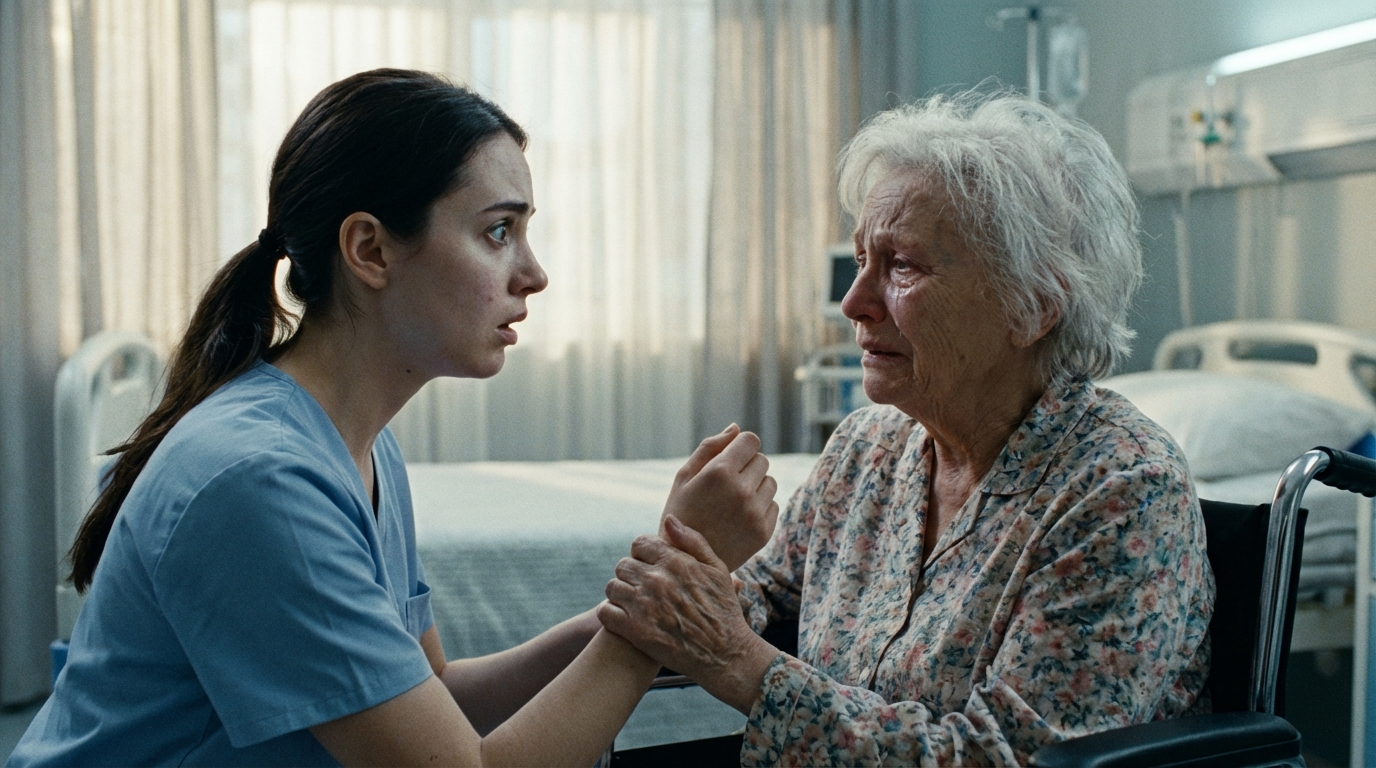
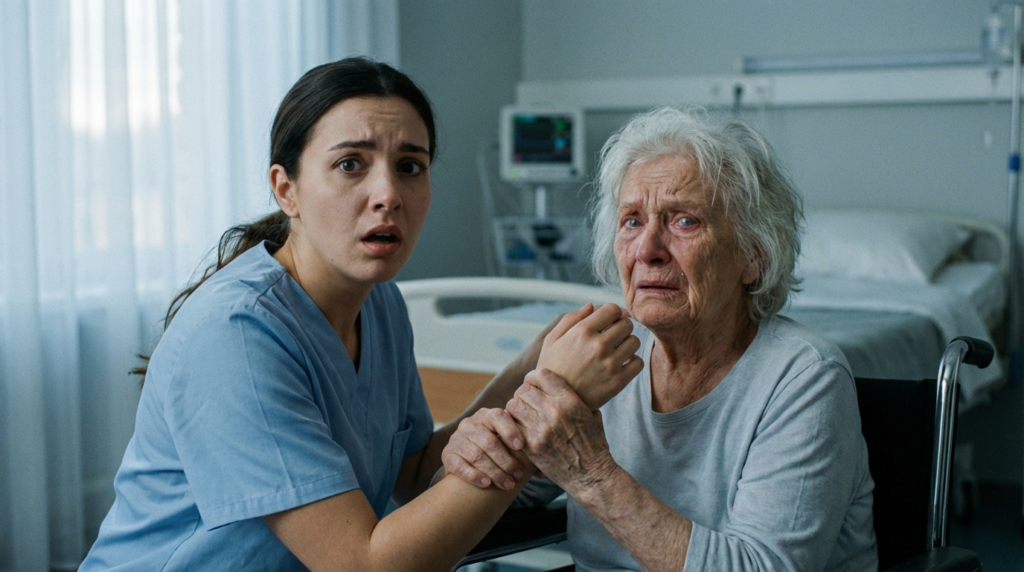
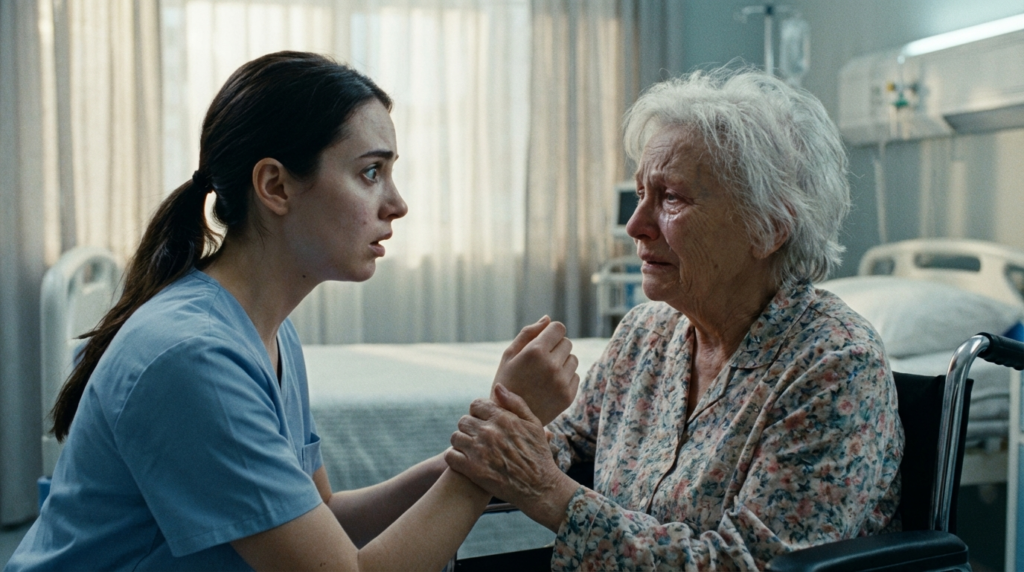
I was changing Margaret Chen’s bedsheets when she grabbed my wrist so hard I gasped.
“I did something terrible,” she whispered, her normally cloudy eyes suddenly piercing and clear in a way I hadn’t seen in the three months I’d been her nurse.
My blood turned to ice. Something in her tone—the raw anguish, the desperate need to confess—made every hair on my body stand up.
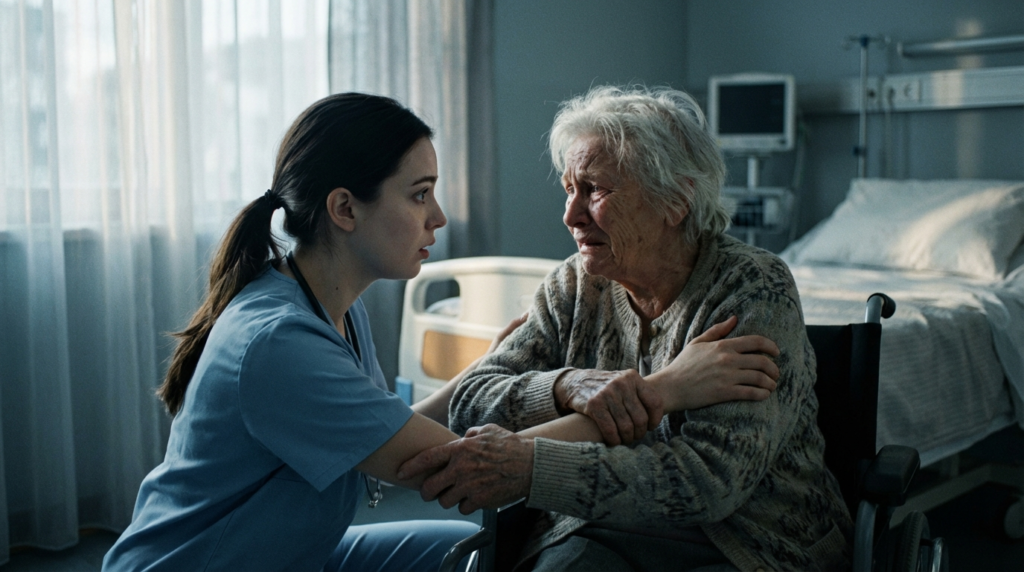
“What are you talking about, Margaret?” I asked softly, kneeling beside her wheelchair so we were eye to eye.
“The man at the bar. The fight outside O’Malley’s.” Her thin hands trembled as they gripped mine. “I got it wrong. I told them the wrong man.”
The world stopped.
O’Malley’s Bar. A cold November night fifteen years ago. A fight in a poorly lit parking lot. One man beaten so badly he spent two weeks in a coma. And my father—Michael Torres, 43 years old, devoted husband and father of two—arrested, tried, and convicted based largely on the testimony of one witness.
Margaret Chen.
The “credible witness.” The respectable high school English teacher who happened to be driving by. The woman who sat on that stand with such calm certainty and said, “Yes, that’s the man I saw. I’m absolutely sure.”
That woman was sitting in front of me right now, tears streaming down her weathered face, confessing that she’d never been sure at all.
“It was dark,” she continued, her voice breaking. “And I was scared. And the detectives kept showing me photos, kept asking, ‘Is this the man? Are you certain?’ And I convinced myself I was. I thought I was helping. I thought I was doing the right thing.”
“Do you remember his name?” I whispered, even though I already knew the answer. “The man you identified?”
She shook her head, the clarity already beginning to fade from her eyes like fog rolling back in. “I’m sorry. I’m so tired. I want to sleep now.”
Just like that, she retreated back into the disease, leaving me kneeling on the floor of Room 237, my entire world crumbling around me.
My name is Claire Torres. I’m 28 years old. I’m a registered nurse at Meadowbrook Senior Living facility in a mid-sized town in Ohio. And the patient I’d just been caring for—feeding, bathing, medicating, speaking gently to—was the woman who destroyed my family.
When I saw her name on my patient roster three months ago, I thought I would vomit right there in the hallway. Margaret Chen, Room 237, Advanced Alzheimer’s Disease. The odds seemed impossible. Our town wasn’t that small. There had to be other Margaret Chens.
But when I looked at her photo in the file—even aged fifteen years, even diminished by disease—I recognized her immediately. Those were the same eyes that had looked at my father in that courtroom and sealed his fate.
I’d been fifteen when they took my dad away. Old enough to understand what was happening, young enough to believe that truth and justice actually mattered. I watched my father—a gentle man who coached Little League and cried during Disney movies—try to explain to a jury that he’d been inside the bar using the bathroom when the fight happened. That he’d run outside when he heard shouting, tried to help the victim, and that’s why his DNA was at the scene.
The prosecutor painted a different picture. A drunk, violent man who beat another patron nearly to death over a spilled drink. And Margaret Chen’s testimony was the cornerstone of their case.
“I saw him clearly,” she’d testified. “He threw the first punch. He kept hitting the victim even after he fell down. There’s no doubt in my mind.”
My father got fifteen years. My mother, Elena, worked three jobs trying to pay for appeals that went nowhere. The stress killed her. Literally. Heart attack at 51, two years before my father died of the same thing in his prison cell at 54.
I never got to say goodbye to either of them properly.
So when Margaret Chen became my patient, I had a choice. I could request a transfer. I could refuse the assignment. I could tell my supervisor there was a conflict of interest.
Instead, I took the assignment. And I told myself it was because I needed the job, needed the experience, needed to be professional.
But I’d be lying if I said there wasn’t a darker reason. A part of me wanted to see karma do its work. Wanted to watch Alzheimer’s steal her memories the way she’d stolen my father’s freedom.
I’m not proud of that feeling. But it was there.
For three months, I wore a mask. I was Nurse Claire—competent, kind, professional. I helped Margaret eat when she forgot how to use a fork. I walked her to the activity room for bingo. I sat with her during her frightened episodes when she didn’t recognize where she was.
And every single day, I went home and cried.
Because caring for someone requires tenderness. It requires looking them in the eye and treating them with dignity. And every time I did that for Margaret Chen, I thought about my father dying alone in a prison infirmary, no one holding his hand, no gentle nurse making sure he was comfortable.
My coworkers thought I was just stressed. “First year is always hard,” they’d say sympathetically. “You’ll get used to it.”
But how do you get used to feeding the woman who murdered your father? Not with a weapon, but with words. With certainty she never actually had.
Margaret’s Alzheimer’s was advanced. Most days, she lived in fragments—unable to remember what she’d eaten for breakfast, sometimes not recognizing her own daughter when she visited, asking for her mother who’d been dead for twenty years.
But some days, there were moments of clarity. Brief windows where the fog lifted and she’d say something sharp, something that reminded you she’d once been a sharp, educated woman.
I’d started to see those moments as cruel gifts from the universe. Just enough consciousness to know what she’d lost, but not enough to hold onto it.
Until the day she grabbed my wrist and confessed.
After Margaret’s confession, I sat in my car in the Meadowbrook parking lot for two hours, unable to drive home. My hands wouldn’t stop shaking.
I had what my father’s lawyers had searched for desperately—evidence of reasonable doubt. An admission from the star witness that she’d never been certain. That she’d been pressured. That she’d convinced herself she was right because the alternative was too frightening.
But what good was it now?
My father was dead. My mother was dead. And the confession had come from a woman with advanced dementia, someone whose testimony wouldn’t hold up in any court. Hell, she probably wouldn’t even remember saying it tomorrow.
I pulled out my phone and stared at the photo I kept in my favorites—my dad at my high school graduation, just months before his arrest. He was smiling so wide, so proud. He’d been proud of everything I did. Every spelling test, every basketball game, every stupid certificate.
“What do I do, Dad?” I whispered to the photo.
The smart thing would be to report it. Document it. Try to get his conviction posthumously overturned, clear his name, maybe get some acknowledgment that the system had failed him.
But I knew how that would go. Lawyers would get involved. Reporters. Margaret’s family would lawyer up. It would become a circus. And at the end of it all, my father would still be dead.
The other option was simpler, darker: do nothing. Let Margaret Chen live out her remaining days not knowing that I knew. Not knowing that I was the daughter of the man she’d helped convict. Let her die with whatever peace the disease had granted her.
But there was a third option. One I didn’t fully understand yet, but felt pulling at me like a tide.
What if I just… stayed? What if I kept being her nurse? What if I took this horrible knowledge and did absolutely nothing with it except let it change me?
Over the next few weeks, something shifted. Margaret had more lucid moments, though she never again mentioned O’Malley’s or the trial. But she started recognizing me more consistently.
“You’re the kind one,” she’d say. “The one who doesn’t rush.”
I started asking her about her life. Where she grew up. What she taught. Why she became a teacher.
“I wanted to help young people think critically,” she told me during one clear afternoon. “To question things. To not just accept what they’re told.”
The irony was devastating.
I learned that Margaret had been divorced. That her ex-husband had been controlling, sometimes violent. That she’d spent years in therapy learning to trust her own perceptions again.
And suddenly, her testimony made horrible sense. A woman who’d been gaslit for years, who’d finally learned to trust herself, being pressured by authority figures to be certain about something she’d seen in the dark while driving. Of course she’d convinced herself. Of course she’d doubled down rather than admit doubt.
It didn’t make what happened to my father okay. But it made Margaret Chen human.
One evening in December, as I was helping her into bed, she grabbed my hand—gently this time.
“You’re sad all the time,” she said. “I can see it. Why are you so sad?”
And I don’t know what possessed me, but I told her. Everything. About my father. About the trial. About watching him be led away in handcuffs while I screamed. About my mother working herself to death. About my father’s final heart attack, alone in a prison hospital.
I even told her the truth: “You were the witness. You identified him. And a few weeks ago, you told me you got it wrong.”
I expected her to shut down. To retreat into confusion. Instead, her whole body crumpled. She began to cry—deep, gasping sobs that sounded like they were being torn from her chest.
“I’m so sorry,” she kept saying. “I’m so, so sorry. I tried to do the right thing. I thought I was helping. I thought I was sure.”
I held her while she cried. This tiny, frail woman whose testimony had orphaned me—I held her and let her sob into my shoulder.
“I forgive you,” I heard myself say.
And the strangest, most unexpected thing happened: I meant it.
I didn’t forgive the system that had pressured her. I didn’t forgive the prosecutor who’d coached her to sound more certain than she was. I didn’t forgive the appeals courts that had denied my father’s case again and again.
But I forgave Margaret Chen. This imperfect human being who’d made a catastrophic mistake and had been carrying the weight of it—consciously or unconsciously—for fifteen years.
Margaret died three weeks later, peacefully in her sleep on a Tuesday morning. I was the one who found her. I held her hand for a while, even though she was already gone, and told her I hoped she found peace.
Her daughter, Rachel, came from Seattle for the funeral. She was about my age, exhausted and sad in the way people are when they’ve been grieving someone slowly for years.
“Thank you for taking care of my mom,” she said to me at the service. “I know she wasn’t easy. The Alzheimer’s made her so different from who she was. But these last few months, whenever I called, the staff said she seemed more peaceful. I don’t know what you did, but thank you.”
I almost told her everything. Almost said, “Your mother testified against my innocent father and he died in prison.” But what would that accomplish? Margaret was gone. Rachel was already carrying enough pain.
“She was a good patient,” I said instead. “I was glad to know her.”
And I meant that too.
After the funeral, I drove to Riverside Cemetery, where my parents are buried side by side. I sat on the cold ground between their headstones and told them about Margaret.
“I forgave her, Dad,” I said. “I hope that’s okay. I hope you’d understand. She made a mistake. A terrible, life-destroying mistake. But she was human. And she carried it. And at the end, she was sorry.”
The wind picked up, rustling the bare tree branches above, and somewhere in the distance, I heard wind chimes.
I chose to believe that was his answer.
I still work at Meadowbrook. I’ve been promoted to charge nurse. I take care of people who are losing everything—their memories, their independence, their sense of self.
And I think about Margaret every single day.
Not because I’m still angry. But because she taught me something my father had tried to tell me all along: that holding onto hate only creates another prison. That forgiveness isn’t about excusing what someone did—it’s about freeing yourself from the weight of it.
My father died in prison for a crime he didn’t commit. That will never be okay. The system failed him catastrophically. Margaret Chen’s uncertain testimony, presented as absolute truth, stole fifteen years of his life.
But I’m not going to spend the rest of my life as “the daughter of that innocent man who died in prison.” I’m not going to let my father’s injustice become my identity.
Instead, I’m going to be Claire—the nurse who chose kindness even when it was impossibly hard. Who looked at the woman who destroyed her family and chose to see her humanity. Who broke the cycle of punishment and rage.
Last week, I started volunteering with the Innocence Project, helping investigate wrongful conviction cases. I can’t bring my father back. But maybe I can help someone else’s father come home.
And maybe that’s the only testimony that really matters in the end—not what we say about others, but what we choose to do with the broken pieces we’re given.
I’m choosing to build something kind.
Because my father, who forgave everyone who failed him, would have wanted nothing less.