I stood outside Apartment 4B with a crowbar in one hand and a final eviction notice in the other. My heart was hammering against my ribs like a trapped bird.
“Just do it, Mike,” my property manager, Greg, hissed from behind me. “She’s hasn’t paid in eight months. The place is a health hazard. The neighbors say she’s dragging trash in there at all hours. She’s senile, and she’s bankrupting you.”
He was right. I was three months behind on the building’s mortgage. My wife, Sarah, was at home crying because we couldn’t afford to fix our own car, let alone carry a deadbeat tenant. Mrs. Calloway was eighty-two years old, and according to Greg, she had turned my father’s legacy into a landfill.
I banged on the door. “Mrs. Calloway! It’s Mike. Open up, or I’m coming in!”
Silence. Just the low hum of the refrigerator through the wood.
“She’s probably in there sleeping on a pile of garbage,” Greg sneered, checking his watch. “Break the lock. The cops are on their way to escort her out anyway. Let’s get this over with so I can list the unit.”
I didn’t want to be this person. My dad had loved Mrs. Calloway. He’d told me she was the heart of the building. But Dad was dead, and his ‘heart’ was costing me my future.
I jammed the crowbar into the frame. With a sickening crunch of wood, the lock gave way. I kicked the door open, bracing myself for the smell of rot, cat litter, and decay. I raised my arm to cover my nose.
But there was no smell of garbage.
Instead, the air smelled like… lavender and fresh coffee?
I lowered my arm. The apartment wasn’t a hoard. It was immaculate. The floors shone. The windows were sparkling.
But it was what was sitting on her dining room table that froze the blood in my veins.
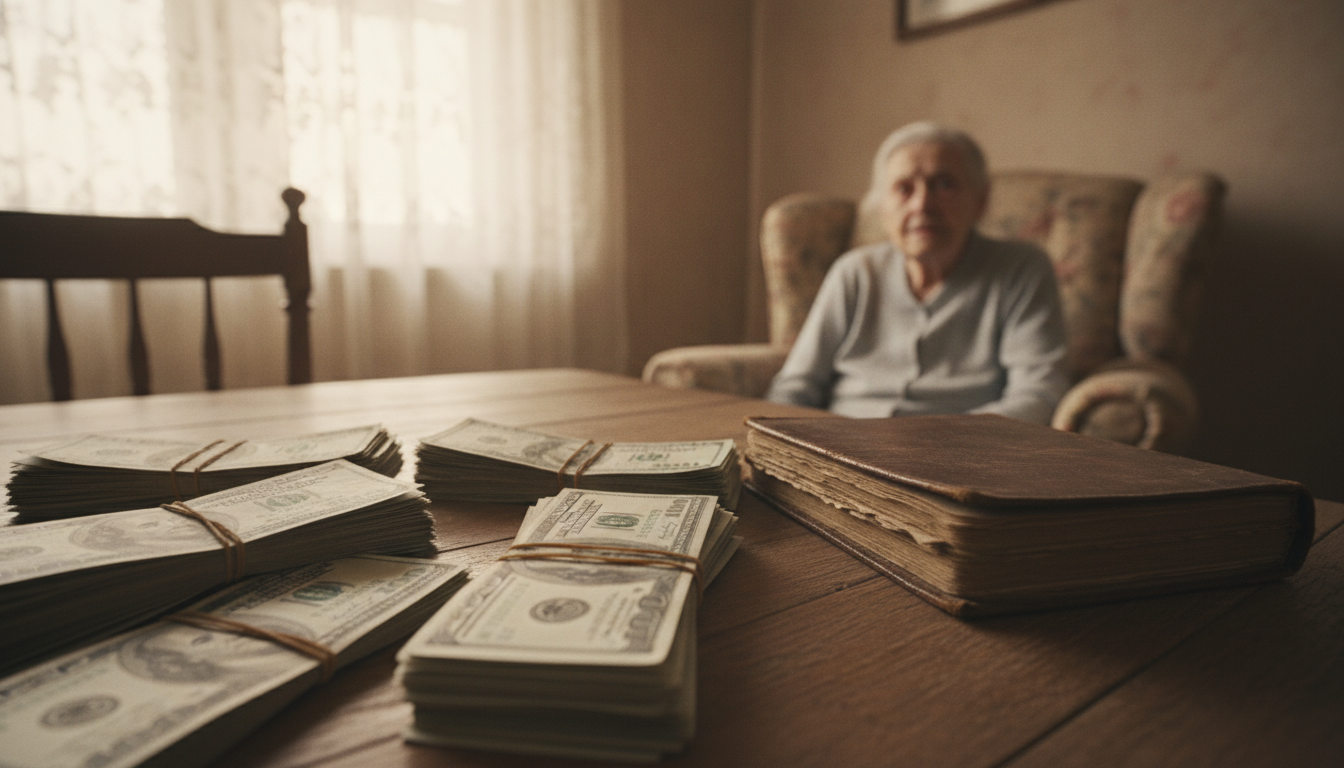
It wasn’t trash. It was stacks. Dozens of neat, rubber-banded stacks of hundred-dollar bills. And right next to them, a ledger with my name written on the cover in shaky cursive.
I took a step forward, confused. Then, I saw Mrs. Calloway. She was sitting in her armchair in the corner, holding a heavy metal box, looking terrified.
“I tried to tell you, Mikey,” she whispered, her voice trembling. “I tried to tell you, but that man wouldn’t let my letters through.”
I looked at the money. I looked at Greg, whose face had suddenly gone pale white.
I picked up the ledger. The first entry was dated eight months ago.

To understand why I was breaking down a door with a crowbar, you have to understand the mess I inherited.
My father, Frank, was a good man, but a terrible businessman. When he passed away from a sudden stroke a year ago, he left me a six-unit apartment building in Chicago. He also left me a mountain of debt and a building that was falling apart.
I was twenty-eight, working a mid-level IT job, and barely scraping by with my wife, Sarah. Suddenly, I was a landlord.
I didn’t know the first thing about property management. I didn’t know how to fix a boiler or how to handle city codes. That’s when Greg walked into my life.
Greg was slick. He wore tailored suits and spoke in confident, rapid-fire sentences. He ran a boutique property management firm called “Apex Living.” He told me he could turn the building around. He’d handle the tenants, the repairs, and the rent collection. All I had to do was sign the checks.
“You’re too nice, Mike,” Greg had told me three months in. “Your dad ran this place like a charity. You need to run it like a business.”
He identified the problem immediately: Mrs. Calloway.
Mrs. Calloway had lived in 4B for thirty years. She was a fixture. I remembered her giving me butterscotch candies when I was a kid visiting Dad at work. But according to Greg, she had stopped paying rent.
“She claims she sent checks,” Greg would say, rolling his eyes. “But they bounce. Or she says she lost them. And the other tenants? They’re complaining. Smells. Hoarding. Vermin.”
For eight months, Greg fed me this narrative. He showed me emails from “angry neighbors” (emails I later learned were fake). He showed me photos of a trash-filled hallway (photos that were taken at a completely different building).
I was drowning. The mortgage on the building was $4,000 a month. Without Mrs. Calloway’s rent, and with the “repair costs” Greg kept billing me for, I was bleeding out.
Last week, the bank sent a foreclosure warning. I had no choice. I had to evict her, renovate the unit, and get a paying tenant in there. Or better yet, sell the building.
Greg had actually made me an offer. “I’ll take the headache off your hands, Mike. I’ll buy the building for $200,000.”
It was half of what it was worth, but I was desperate. I told him if I couldn’t evict her today, I’d sign the sale papers tomorrow.
Standing in that lavender-scented living room, the reality crashed into me.
“Greg,” I said, my voice low and dangerous. “What is this money?”
Greg was backing toward the door. “Mike, look, she’s crazy. She probably stole that. We need to call the cops on her for theft, not just eviction.”
“I didn’t steal it!” Mrs. Calloway’s voice was surprisingly strong. She stood up, her small frame shaking with indignation. “I paid my rent every single month, Mikey. Just like I did for your daddy. Cash. Every first of the month.”
She pointed a trembling finger at Greg. “I gave it to him.”
I looked at the ledger.
- January 1st: $1,200 – Paid to Greg V.
- February 1st: $1,200 – Paid to Greg V.
- March 1st: $1,200 – Paid to Greg V.
Next to the ledger were the stacks of cash on the table.
“What is this, Mrs. Calloway?” I asked, gesturing to the money on the table.
“That’s not rent,” she said, clutching her metal box. “That’s the ‘Repair Fund’. Your daddy always kept a reserve. But this man…” She glared at Greg. “He stopped fixing things. The boiler broke in November? He told you it cost $5,000 to fix, didn’t he?”
I nodded. I had taken a loan to pay that bill.
“He didn’t fix it,” Mrs. Calloway said. “He put a piece of tape on the valve. I fixed it. My nephew is a plumber. I paid him $200 out of my savings. And the roof leak? I paid for the patch. And the pest control? I paid for that too.”
She opened the metal box. It was full of receipts. Hardware store receipts. Contractor invoices. All paid in cash by Mrs. Calloway.
“I knew he was stealing your rent money, Mikey,” she said softly. “But I couldn’t prove it. He blocked my number on your phone. He threw away the letters I mailed to your house. So, I started saving. I cashed out my husband’s life insurance. I withdrew my retirement.”
She pushed the stacks of bills toward me.
“There’s $40,000 there. I was waiting for you to come yourself. I knew if I just waited, Frank’s boy would eventually come to see me.”
The silence in the room was heavy, suffocating.
I turned to Greg. The slick, confident property manager was sweating through his expensive suit.
“She’s lying,” Greg stammered, his eyes darting to the door. “She’s… she’s a senile old bat. You’re going to trust her over me? I’m a professional, Mike!”
“A professional thief,” I said.
I didn’t scream. I didn’t punch him, though God knows I wanted to. I felt a cold, hard clarity wash over me.
“Greg,” I said. “Open your phone.”
“What?”
“Open your banking app. Right now.”
“You can’t make me—”
“I can,” I interrupted. “Because if you don’t, I’m going to call the police right now and show them this ledger. And then I’m going to have them interview every single tenant in this building about who they’ve been handing their rent to.”
Greg froze. He knew he was caught. In Illinois, grand larceny is a felony.
“Mike, look,” he said, his voice dropping to a wheedling whisper. “We can work this out. I was… holding the funds. In escrow. For the purchase. To make it easier when I bought the building.”
“You were driving down the value,” I realized, the pieces finally clicking together. “You were stealing the rent to starve me out. You were faking the repair costs to bankrupt me. And you were letting the building rot so you could buy it for pennies on the dollar and flip it.”
It was a classic predatory scheme. And he had used an eighty-year-old woman as his scapegoat.
“Get out,” I said.
“Mike—”
“Get. Out.” I stepped toward him with the crowbar still in my hand. “If I see you near this building again, I will end you. You will hear from my lawyer tomorrow.”
Greg looked at the crowbar, then at Mrs. Calloway’s defiant face. He turned and ran. I heard his footsteps pounding down the stairs, followed by the screech of tires outside.

When he was gone, the adrenaline faded, leaving me exhausted. I looked at Mrs. Calloway.
“I’m so sorry,” I said, my voice cracking. “I almost threw you on the street.”
She walked over and patted my cheek, her hand soft and warm. “You didn’t know, Mikey. You were scared. Fear makes people do stupid things. Your daddy would have been proud you came to check on me yourself.”
I sat down at her table and we went through the box. It was worse than I thought. Greg had stolen nearly $15,000 in rent from her alone. But the money she had saved—the $40,000 on the table—was enough.
It was enough to pay the mortgage arrears. It was enough to hire a real lawyer to go after Greg (spoiler: we did, and he is currently serving three years for fraud). It was enough to fix the roof properly.
But the biggest surprise came later that evening.
I walked down to the basement, the place Greg had told me was a “flooded hazard zone.”
It wasn’t flooded. Mrs. Calloway had given me a key.
I opened the door to find a clean, warm community space. There was a small library. A coffee station. And a workbench.
“What is this?” I asked her.
“The tenants,” she said, coming up behind me. “The young couple in 2B? They don’t have internet, so they come here to apply for jobs. Mr. Henderson in 3A? He’s lonely, so he comes here to read. We take care of each other, Mikey. That’s what a building is. It’s not bricks. It’s people.”
Greg had tried to evict the soul of the building.

That was six months ago.
I didn’t sell the building. I fired Apex Living and took over management myself. It’s hard work, but with Mrs. Calloway’s help, it’s manageable. I call her my “onsite supervisor.”
I tried to give her the $40,000 back. She refused.
“Buy new windows,” she ordered. “And maybe fix that front step.”
So, we made a deal. Mrs. Calloway lives in Apartment 4B rent-free for the rest of her life. It’s the least I could do.
Last week, I brought my newborn daughter, Emily, to meet her. We sat in that lavender-scented living room, and Mrs. Calloway gave me a butterscotch candy, just like she used to give me.
“She has your eyes, Mikey,” she said, rocking the baby.
I looked around the apartment that I had almost destroyed. I thought about how close I came to losing everything because I listened to a man in a suit instead of checking on the people who mattered.
I touched the new deadbolt on the door—a lock I installed myself.
“Thank you, Mrs. Calloway,” I said. “For saving us.”
She just smiled and handed me another candy. “Don’t thank me, honey. Just make sure the hallway light is fixed by Tuesday.”
“Yes, ma’am,” I said. And I meant it.