THE BREAKING POINT
“You have got to be kidding me!” I screamed, staring at my phone screen until the pixels blurred. “Your driver is completing another order.”
It was 7:45 PM on a Tuesday that felt like the end of the world. In my living room sat Mr. Sato, the CEO of a tech firm I had been trying to land as a consulting client for six months. He was checking his Rolex every thirty seconds, the gold glinting under my recessed lighting. I had promised him a ‘gourmet casual’ working dinner to close the deal—the deal that would finally pay off the mountain of legal fees my ex-husband had left me with and save this house from foreclosure.
But the universe had a sense of humor. My oven had short-circuited an hour ago, emitting a puff of black smoke and dying instantly. I had panic-ordered from Luigi’s, the best Italian place in town, praying the food would arrive before Mr. Sato walked out.
The app said the driver was here twenty minutes ago. Then the little GPS dot just… stopped. Right outside my house.
I looked out the bay window. The Seattle rain was coming down in unforgiving sheets. I saw the delivery scooter parked haphazardly at the end of my long driveway. The driver wasn’t moving. He wasn’t walking up the path. He was just standing there in the dark, ignoring my texts, ignoring the food getting cold, ignoring the fact that my entire life was crumbling inside that house.
I snapped. The stress of the divorce, the crippling debt, the humiliation of pretending to be successful while I was drowning—it all boiled over.
“Excuse me for a moment,” I told Mr. Sato with a tight, fake smile.
I threw open the front door and marched into the storm without a coat. I didn’t care about the freezing rain ruining my blowout. I didn’t care about my silk blouse. I wanted a target. I wanted to scream at someone who couldn’t fire me.
I reached the end of the driveway, water blinding me, my heels sinking into the sodden lawn.
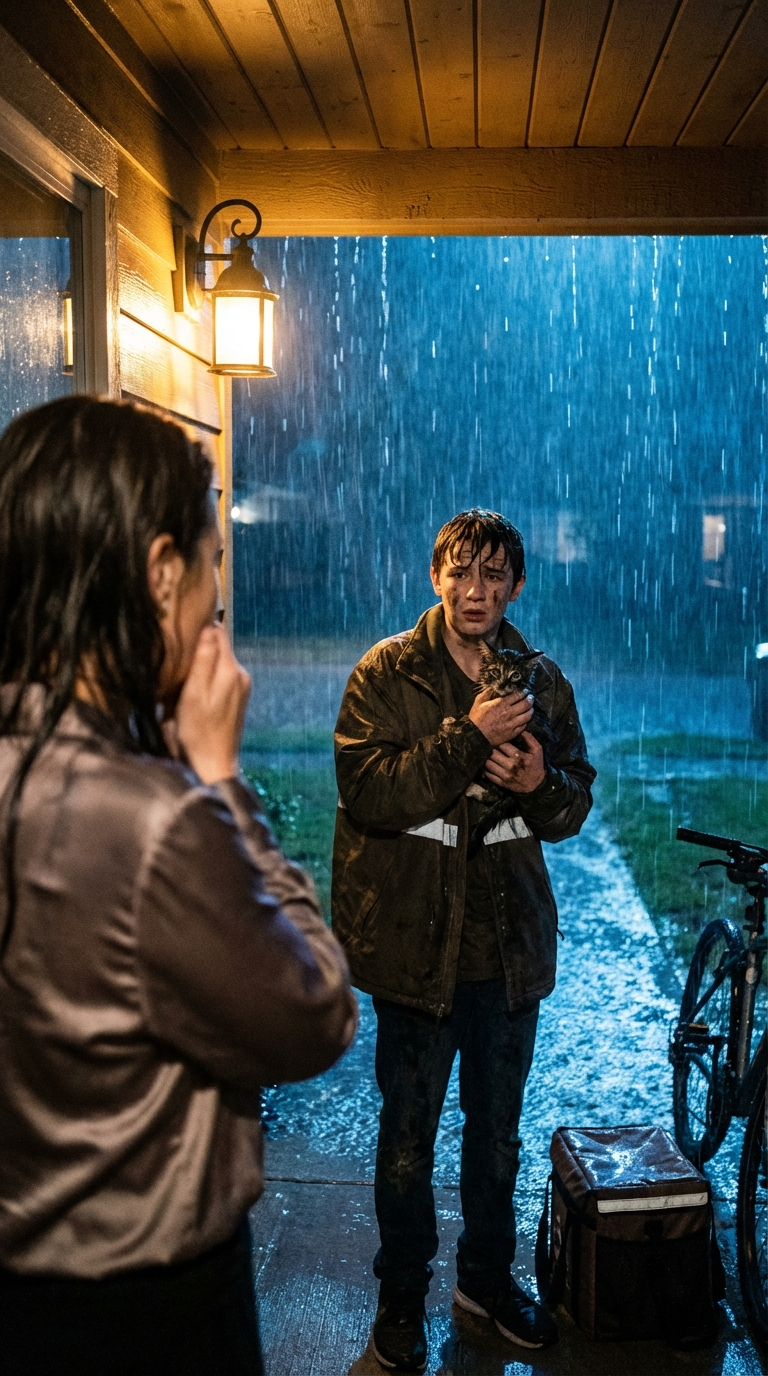
The driver was a kid—maybe seventeen. He was skinny, wearing a helmet that was too big for him. He was covered in mud. Not just splashed; he looked like he had been rolling in it. The thermal food bag was sitting on the wet pavement.
“What is wrong with you?” I roared, my voice cracking with hysteria, competing with the thunder. “I have a VIP client waiting! Do you have any idea how unprofessional this is? You’re just standing here while my life falls apart!”
The boy flinched as if I had slapped him. He looked up at me, his face streaked with rain, grease, and what looked like blood on his cheek. He was trembling violently.
He didn’t argue. He didn’t check his phone. He just slowly reached for the zipper of his soaking wet, oversized delivery jacket.
“Don’t you dare give me an excuse,” I hissed, stepping closer.
He unzipped the jacket.
A tiny, high-pitched mew cut through the sound of the thunder.
I froze. The anger died in my throat, replaced by a sudden, jarring confusion.
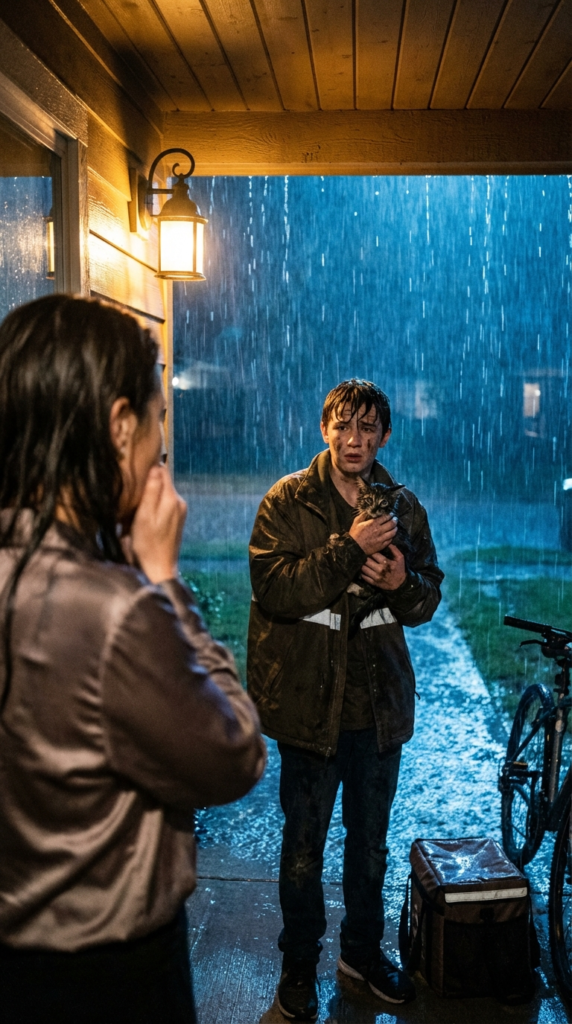
Tucked against his chest, inside his flannel shirt, shivering and covered in thick black engine oil, was a kitten. It was no bigger than a lemon. Its eyes were crusted shut, and it was clinging to the boy’s shirt with desperate, tiny claws.
“I’m sorry, ma’am,” the boy whispered, his teeth chattering so hard he could barely form words. “I heard him crying when I pulled up. He… he was stuck in your wheel well. Wrapped around the axle of your SUV. It took me a while to wiggle him out. I didn’t want you to start the car and… and…”
He trailed off, looking down at the creature. “I didn’t want him to die.”
THE GHOST OF WHO I WAS
To understand why that moment broke me, you have to understand the armor I was wearing.
Three years ago, I was Sarah Jenkins, “The Shark.” I was a corporate fixer. I didn’t have time for excuses. I didn’t have time for weakness. My husband, Greg, loved the money I made, until he decided he loved his twenty-two-year-old personal trainer more.
When Greg left, he didn’t just break my heart; he broke my finances. He had leveraged our assets in ways I hadn’t noticed because I was too busy working. He left me with the mortgage, the debts, and a reputation that I was “cold.”
I had spent the last year trying to rebuild. This dinner with Sato was my last stand. If I lost this contract, the bank took the house on the first of the month.
So, standing in the rain, screaming at a teenager, I saw the reflection of the person I had become: a woman so terrified of losing control that she had forgotten how to be human.
The boy—his name tag said Leo—looked at me with terror. He expected me to report him. He expected me to yell about the cold food.
Instead, I looked at his bleeding knuckles. He had torn his hands up reaching into the sharp metal undercarriage of my car to save a stray cat.
I looked back at the house. Mr. Sato was watching from the window.
I had a choice. Go inside, apologize for the delay, and try to salvage the “professional” facade. Or deal with the reality in front of me.
“Pick up the bag,” I said, my voice shaking.
“Ma’am, I can take it back, I can get a refund—”
“Pick up the bag, Leo. And bring the cat. Get inside.”
THE UNLIKELY DINNER GUEST
We walked into the house looking like two drowned rats. I was dripping onto my hardwood floors. Leo was trailing mud. The kitten was mewing pitifully.
Mr. Sato stood up, his face unreadable. He was a man of few words, known for being ruthless in business.
“Sarah?” he said, raising an eyebrow. “What is… this?”
“This is Leo,” I said, grabbing a towel from the hallway closet and throwing it over the boy’s shoulders. “And this is…” I looked at the grease ball in his jacket. “A rescue mission.”
I turned to Leo. “Kitchen. Now.”
We went into the kitchen. I put the expensive Italian food on the counter—it was lukewarm at best. I didn’t care.
“Give him to me,” I said gently.
Leo handed over the kitten. It was freezing. “He needs warm water and Dawn dish soap,” Leo said, his voice surprisingly steady now that the cat was the focus. “To get the oil off. Otherwise, he’ll ingest it.”
I looked at Mr. Sato, who had followed us into the kitchen.
“Mr. Sato,” I said, taking a deep breath. “I know we have a timeline. But this life is currently more important than our Q3 projections. If you want to leave, I understand.”
Sato looked at me. He looked at the trembling boy. He looked at the tiny creature in my hands.
Slowly, he took off his suit jacket. He rolled up the sleeves of his pristine white dress shirt.
“I believe the sink is over here?” Sato said. “I will wash. You hold. The boy… Leo? You look like you need to sit down.”
THE CLEANING
For the next thirty minutes, the strangest tableau unfolded in my kitchen.
Mr. Sato, a man worth millions, was elbow-deep in my kitchen sink, gently scrubbing a stray kitten with dish soap. I was holding the tiny head up, keeping water out of its ears. Leo sat at the island, eating a slice of cold pizza, watching us with wide eyes.
“You have to be gentle with the underbelly,” Sato murmured, his face focused. “My grandmother… she raised cats in Kyoto. She taught me.”
“He’s purring,” I whispered.
“He is safe,” Sato said. “That is why.”
As we worked, the layers of pretense fell away. I told Sato about the oven breaking. I told him about the stress. I didn’t tell him about the foreclosure, but I think he sensed the desperation.
Leo told us about his night. He was working two jobs to help his mom pay rent. He was terrified that being late would get him “deactivated” from the app.
“I just couldn’t leave him,” Leo said, looking at the floor. “I know it’s just a cat, but… I was down there in the mud, and he looked at me. He looked scared.”
Sato dried his hands on a dishtowel. The kitten, now a fluffy, slightly damp ball of grey fur, was wrapped in a warm blanket, sleeping in a Amazon box.
Sato turned to Leo. “You risked your employment to save a helpless thing?”
“Yes, sir.”
“And you,” Sato turned to me. “You risked a multi-million dollar contract to help the boy who made you late?”
“I… I suppose I did,” I said.
Sato smiled. It was the first time I’d seen him smile all night.
“The food is cold,” Sato stated.
“I know. I’m so sorry.”
“Do you have a toaster oven?”
“Yes.”
“Good. We reheat the lasagna. We eat. Then we sign the papers.”
THE AFTERMATH
I signed the contract that night. Mr. Sato didn’t even look at the proposal again. He told me later, “I can hire anyone to make spreadsheets, Sarah. I cannot hire people who have a soul. Tonight, I saw how you handle a crisis. You protect the weak. That is who I want managing my business.”
But the story didn’t end there.
The next day, I called the delivery app. I didn’t complain. I told them Leo was a hero. I made sure he got a commendation.
But I knew that wasn’t enough.
I started a GoFundMe for Leo’s college fund, posting the picture of him in my kitchen, mud-soaked, holding the clean kitten. I titled it: The Boy Who Stopped for the Smallest Life.
It went viral.
People were hungry for something good. Within 48 hours, we had raised $50,000. Leo didn’t just get to keep his job; he got to quit the delivery gig and focus on school.
As for the kitten?
His name is Lucky. He lives with me. Or, I should say, he rules my house. He sleeps on Mr. Sato’s contracts when I’m working late.
Every time I look at him, I remember that night. I remember that the things that interrupt our plans—the broken ovens, the late drivers, the storms—are sometimes the very things that save us.
I thought I was screaming at a lazy delivery boy. It turned out I was screaming at an angel in a muddy raincoat who was there to teach me that being human is the only success that matters.