THE THEFT
“Where is it, Sam?” I was trying to keep my voice steady, but the vein in my temple was throbbing. My hands gripped the steering wheel so tight I thought the leather might crack.
My ten-year-old son, usually a chatterbox about Minecraft and space facts, was sitting in the passenger seat, shrinking into himself. He refused to make eye contact. His backpack lay open at his feet, and the limited edition Zelda Nintendo Switch—the one I had picked up extra shifts at the warehouse for six months to afford—was gone.
“I gave it to Tyson,” Sam whispered, staring out the window at the passing suburbia.
Tyson. The name hit me like a physical slap. Tyson was the fifth-grade terror. He was the kid the teachers spoke about in hushed tones. He was twice the size of the other boys, held back a year, with a reputation for volatility. Last week, he’d put a kid in a headlock for looking at him wrong. Yesterday, Sam came home with a bruised shin and refused to tell me how it happened.
“You gave a four-hundred-dollar console to the kid who kicks you?” I shouted, the car swerving slightly as I turned to look at him. “Is he threatening you? Is this protection money, Sam? Did he say he’d hurt you if you didn’t pay up?”
Sam didn’t answer. He just tucked his chin into his chest and started crying silently, big tears rolling down his cheeks.
That was it. The protective father instinct overrode all logic. I didn’t even drop Sam off at the curb. I parked the car in the fire lane, threw the hazards on, and marched into the school office, dragging Sam by the hand. The receptionist looked up, startled, but I didn’t stop. I demanded to see the Principal and Tyson. Immediately.
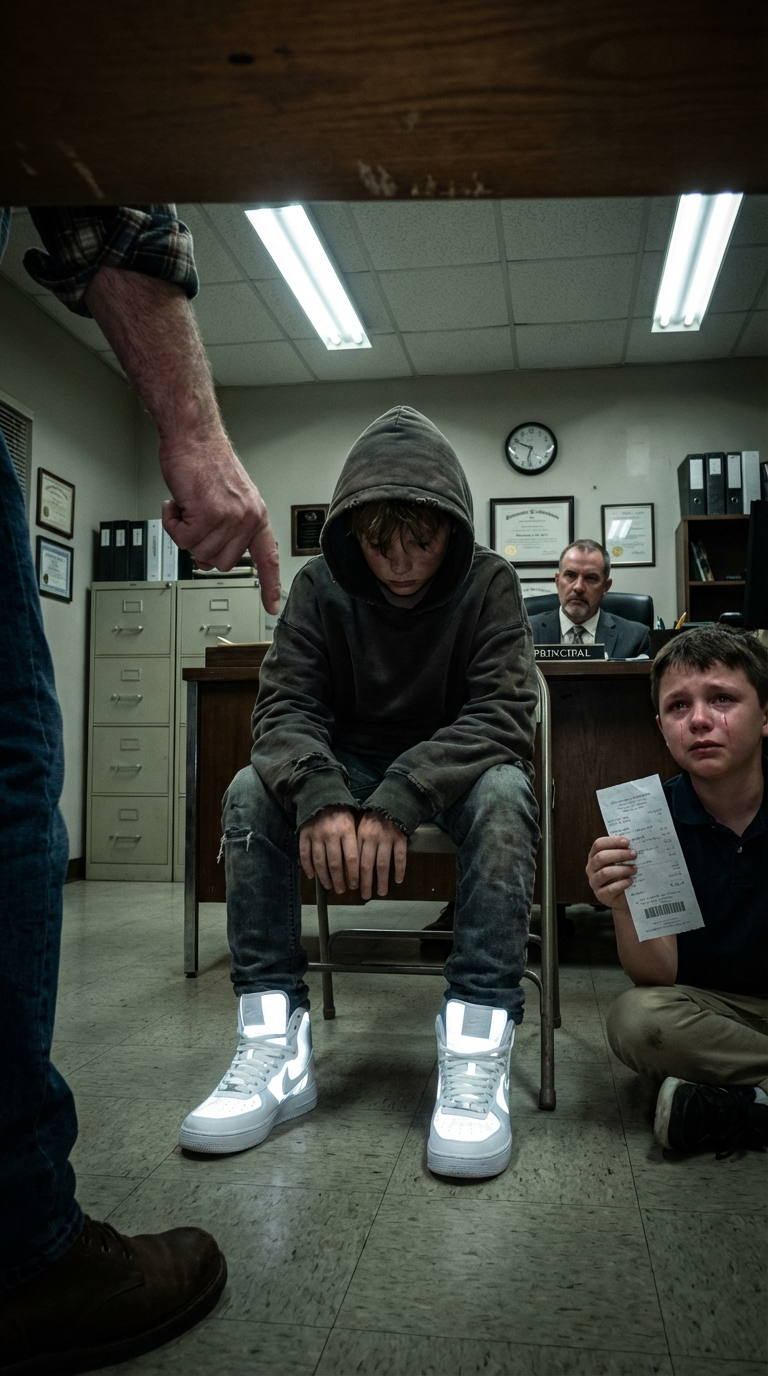
Ten minutes later, the air in Mrs. Gable’s office was thick enough to choke on. Tyson was sitting in the corner chair, arms crossed, looking defiant. He looked like a thug in training—jaw set, eyes hard. His clothes were baggy, a stained hoodie pulled up over his head.
“Mr. Miller,” the Principal started, adjusting her glasses. “Please calm down. We need to get the full story.”
“I will not calm down!” I roared, standing up and pointing a shaking finger at Tyson. “That kid is extorting my son! He took a gaming console that costs more than my rent! I want it back, and I want him expelled! This is bullying, plain and simple!”
Tyson didn’t say a word. He didn’t defend himself. He just stared at the carpet, his leg bouncing nervously.
“Sam,” I turned to my son, my voice softening only slightly. “Tell them. Tell them he forced you to give it to him.”
Sam wiped his nose with his sleeve. He walked over to Tyson. He didn’t look scared, which confused me. He looked… sad.
“I didn’t give him the Switch, Dad,” Sam said softly. “I sold it. To the kid on the bus who always carries cash.”
“You… what?” I stammered, the wind knocked out of my sails. “Why? Did Tyson make you get him cash? Is he taking lunch money too?”
“Yes,” Sam said. “I mean, no. I got the cash for him.”
“For what?”
“For these.”
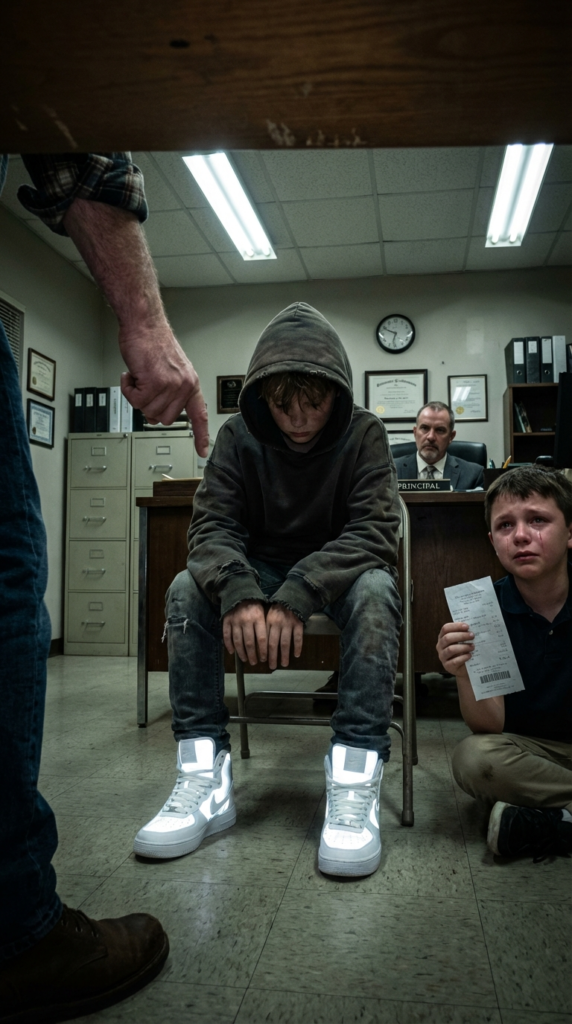
Sam reached into his pocket and pulled out a crumpled receipt from the local sporting goods store. Then he pointed at Tyson’s feet.
I looked down.
I stopped breathing. The anger that had been fueling me for the last hour evaporated, replaced instantly by a cold, heavy bucket of shame.
THE HOLE IN THE SOLE
Tyson wasn’t wearing his usual scuffed, falling-apart boots. He was wearing a brand-new, blindingly white pair of Nike Airs. They were pristine. They were beautiful. And they looked completely alien on him.
“He… he was crying,” Sam whispered.
I looked at Tyson. The tough guy facade was cracking. His lip was quivering.
“What?” I asked, my voice barely a croak.
“Yesterday,” Sam continued, looking at me with big, pleading eyes. “In gym class. We were doing sprints. Tyson’s shoe… the bottom came off. The whole sole. It just flapped open.”
Sam took a breath. “Everyone laughed, Dad. Everyone. Even the coach smirked a little. Tyson tried to tape it back together with scotch tape from the teacher’s desk, but it wouldn’t stick. He ran into the bathroom and locked the stall. I went in after him.”
I looked at Tyson. He was hiding his face in his hands now.
“He was crying, Dad,” Sam said. “He told me his mom got laid off and his dad isn’t around, and he’s been wearing those boots for two years. His toes were touching the floor. He said he hurts people so they won’t look at his clothes. So they’ll look at his fists instead of his feet.”
The silence in the room was deafening. Mrs. Gable had taken off her glasses and was wiping her eyes.
“I didn’t need the Switch,” Sam said, shrugging his small shoulders. “I have books. I have you. Tyson couldn’t walk home.”
THE GHOST OF POVERTY
I collapsed into the chair next to me.
I thought about the last week. I thought about the “bruise” on Sam’s shin.
“The bruise,” I whispered. “Sam, did Tyson kick you?”
“No,” Sam said. “I tripped trying to catch him when he ran to the bathroom. He actually stopped to help me up. That’s when I saw the tape on his shoe.”
I had constructed an entire narrative in my head. I had cast my son as the victim and this boy, this child living in poverty, as the villain. I had judged a book not just by its cover, but by the rumors surrounding it.
I looked at Tyson. Really looked at him. Under the baggy hoodie, he was skinny. His fingernails were dirty, not from neglect, but likely from lack of hot water. And those shoes—those bright white shoes—were the only clean thing on him.
My son had sold his most prized possession, a toy that granted him status among his peers, to give dignity to the boy everyone else hated.
“Tyson,” I said.
He looked up, terrified. He thought I was going to take them. He thought I was going to demand the shoes as repayment for the Switch. He began to reach for the laces.
“I can give them back,” Tyson choked out. “I haven’t scuffed them yet.”
“No,” I said, reaching out and stopping his hands. My own hands were shaking. “No, you keep them. They fit?”
Tyson nodded. “Yeah. They feel like walking on clouds.”
“Good,” I said. I stood up and turned to Mrs. Gable. “Am I free to take Tyson to lunch? With his guardian’s permission?”
Mrs. Gable smiled. “I think we can arrange that.”
THE REPAIR
We didn’t just go to lunch. I drove Sam and Tyson to the pizza place down the street. We ordered a large pepperoni and sodas.
Watching Tyson eat was another revelation. He didn’t eat like a kid enjoying a treat; he ate like a kid who didn’t know when the next meal was coming. He finished four slices in under five minutes.
“Tyson,” I said, wiping grease from my chin. “I’m sorry. I judged you. And I was wrong.”
Tyson looked down at his new shoes. “It’s okay, Mr. Miller. Everyone does.”
“It’s not okay,” I said. “But we’re going to fix it.”
I learned a lot about Tyson that afternoon. I learned he loved drawing but had no supplies. I learned he was “bullying” kids because it was the only way to keep them at a distance so they wouldn’t see how poor he was. It was a defense mechanism, a wall built of aggression to hide the vulnerability.
When I dropped Tyson off at his house—a run-down apartment complex on the edge of town—I saw his mother waiting outside. She looked exhausted, wearing a waitress uniform that had seen better days.
When she saw the shoes, she burst into tears. She tried to give me money from her apron—crumpled ones and quarters.
“Put that away,” I told her gently. “Sam took care of it.”
THE RETURN
That night, Sam was sitting in his room, reading a book. The spot on his dresser where the Switch used to be was empty.
I walked in and sat on the edge of his bed.
” You know,” I said, “I saved for six months for that Switch.”
“I know, Dad,” Sam said, looking down. “I’m sorry.”
“Don’t be,” I said, feeling a lump in my throat the size of a grapefruit. “I saved that money to get you something that would make you happy. And I watched you today. You were happier watching Tyson walk in those shoes than you ever were playing Zelda.”
Sam smiled. “He walked different, Dad. He stood up straight.”
“You’re a good man, Sam,” I kissed his forehead. “Better than me.”
The next day, I started a GoFundMe. I didn’t use Tyson’s name, but I told the story. The Boy Who Traded a Game for Dignity.
I wanted to raise $400 to replace the Switch.
The internet, in its rare moments of beauty, did its thing. We didn’t raise $400. We raised $25,000.
We bought Sam a new Switch (and a PS5). But the rest? We gave it to Tyson’s mom. She paid off her rent for the year. She fixed her car so she could get a better job. Tyson got new clothes—clothes that fit.
Tyson doesn’t bully anyone anymore. He’s actually the goalie on Sam’s soccer team now. He’s still big, and he’s still tough. But now, when someone falls down, he’s the first one to offer a hand to pull them up.
Yesterday, I saw them at the bus stop. Tyson was showing Sam something on his phone, and they were both laughing. I looked at Tyson’s feet. The Nikes were a little scuffed now, worn in from months of playing.
They didn’t look like charity anymore. They looked like justice.