THE CRASH
The noise in O’Connell’s Diner on a Friday night was a physical assault. It was a symphony of clattering ceramic plates, the hiss of the burger grill, and the high-pitched shrieks of toddlers denied dessert. I had been on my feet since 4 PM, running on lukewarm coffee and the desperate knowledge that my bank account balance was currently negative twelve dollars. Rent was due Monday. My landlord didn’t care about my aching arches.
I was three tables behind. Table four was waving an empty ketchup bottle like a weapon, and table seven was sending back a steak for the second time. My patience wasn’t just thin; it was non-existent.
Then the door chimed, a cheerful little ding-dong that heralded doom. And they walked in.
It wasn’t just a family entering a restaurant; it felt like a clown car unloading an invasion force. Nine people total. The man at the head of the pack looked like he hadn’t slept since the Bush administration. Behind him trailed eight children, a chaotic conga line ranging from a moody, phone-staring teenager down to twin babies howling in dual carriers.
They stopped right in the entryway, paralyzing the flow of traffic. It was an instant roadblock of strollers, oversized backpacks, and tangled limbs.
Every eye in the restaurant turned to them. The collective groan was audible. They were standing in my section. Of course they were.
Something inside me snapped. It was the cumulative weight of six months of bad luck—the divorce, the move to this cramped apartment, the double shifts just to keep the lights on. I saw those eight kids not as human beings, but as eight more messes to clean up, eight more complicated orders, eight more reasons I wouldn’t get off my shift until midnight.
I marched up to the man, dodging a busboy. I ignored the profound, exhausted slump of the man’s shoulders, or the way he was gently trying to shush one of the screaming twins.
“Sir, you can’t block the entrance,” I said. My voice came out sharper, louder, meaner than I intended. It cut through the diner noise.
He looked up. His eyes were bleary, red-rimmed, and stunned. He looked like a man holding onto the edge of a cliff by his fingernails.
Before he could speak, I held up a hand, palm out. A stop sign. “And honestly? Look around. We don’t have the room for a party of nine tonight. We’re slammed. The kitchen is backed up an hour. You need to take this circus somewhere else.”
The word “circus” hung in the air. It was cruel. It was unnecessary. The diner went deathly silent. I heard a fork drop onto a plate three tables away.
The man didn’t argue. He didn’t get angry. He just nodded slowly, a look of crushing, familiar defeat settling over his face, as if this was exactly what he expected from the world.
“Understood, ma’am,” he whispered, his voice roughened by disuse. “Sorry to bother you. Come on kids, let’s go. Marching orders.”
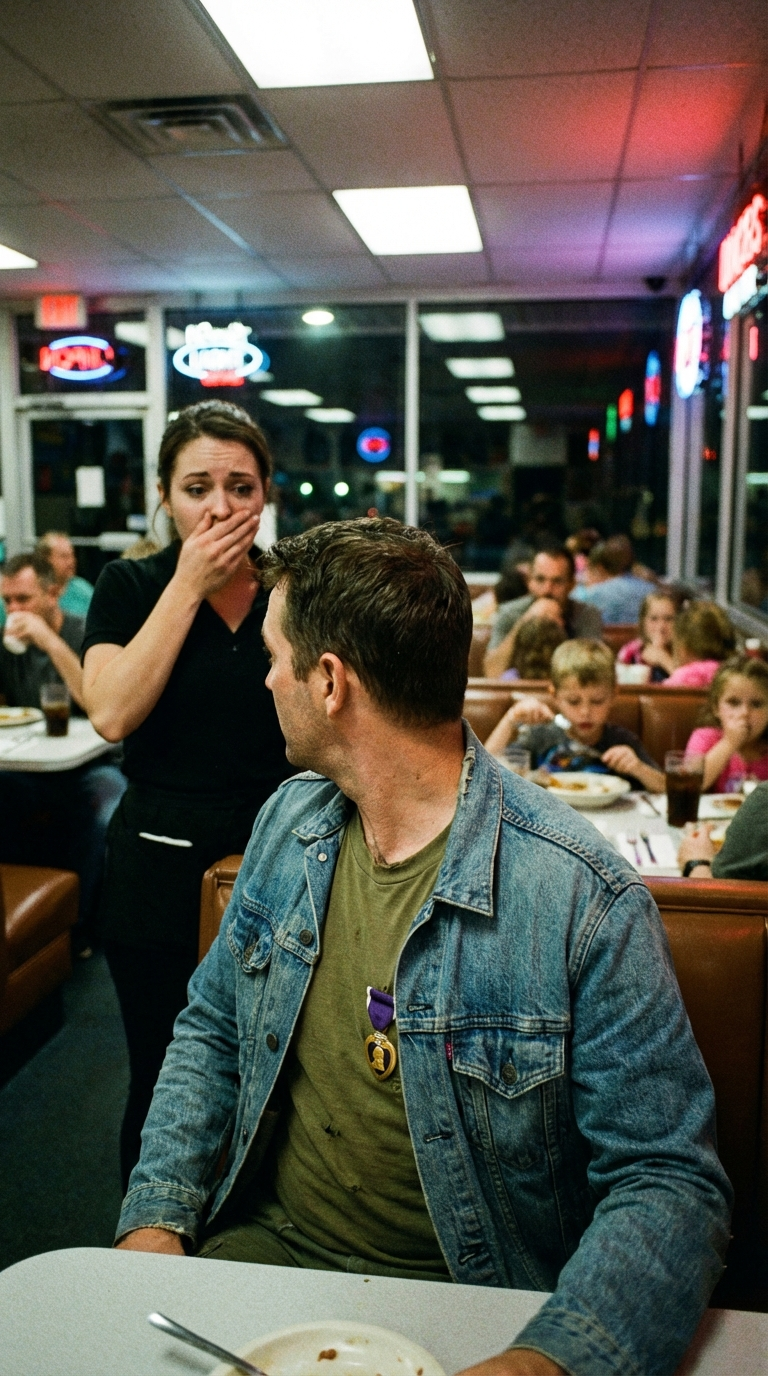
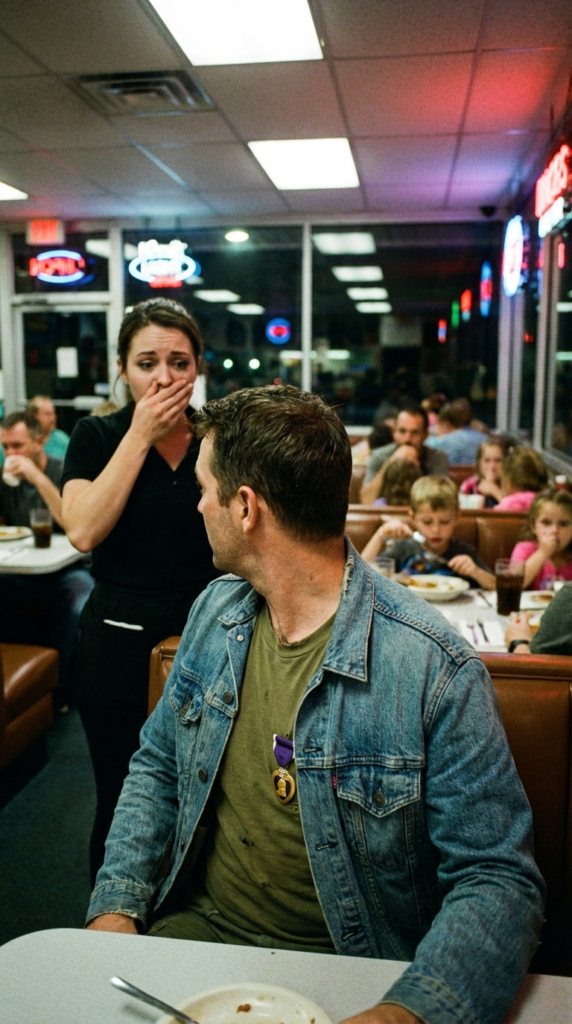
He turned to herd the children back out into the cold night. As he twisted to grab the door handle, his worn, oversized denim jacket swung open.
The harsh overhead fluorescent light caught something pinned to the inner lining of his olive-drab t-shirt underneath.
It was a flash of purple and gold. A heart. The unmistakable profile of George Washington.
I froze. My breath caught in my throat, burning like acid. The heavy serving tray slipped from my sweat-slicked hand and crashed to the tile floor. The sound of shattering glass and silverware echoed like a gunshot in the sudden silence.
He wasn’t just a tired dad with too many kids. He was wearing a Purple Heart. The medal given to those wounded or killed while serving the United States military.
THE INVISIBLE WOUNDS
To understand why I shattered that tray, you have to understand the pressure cooker I was living in. I’m Sarah. I used to be a dental hygienist in the suburbs. I had a 401k. I had a garden. Then my husband developed a gambling addiction that he hid until the foreclosure notices started pasting up on our front door. He cleaned us out and vanished to Vegas with a cocktail waitress, leaving me with mountains of debt and a profound inability to trust anyone.
I took the job at O’Connell’s because they paid cash daily. I was living shift to shift, fighting a losing battle against poverty. I had become hard. I judged customers by their shoes—expensive meant a good tip; scuffed meant a waste of time. I had turned off my empathy because empathy didn’t pay the electric bill.
When I looked at that man, I didn’t see a person. I saw an obstacle.
But I didn’t know David’s story. I learned it later, piece by agonizing piece, as the night unfolded.
David hadn’t just come back from a tour in the sandbox with shrapnel scars on his leg and that medal on his chest. He came back to a life that had fallen apart without him. Four of those kids were his. The other four were his sister’s.
Six months ago, while David was deployed, his sister and her husband were killed by a drunk driver. There was no other family. David, still in rehab for his injuries, came home to bury his sister and instantly became a single father to eight traumatized children under the age of fifteen.
His wife, overwhelmed by his injuries, the sudden influx of grieving children, and the PTSD that made him wake up screaming, had filed for divorce two weeks ago.
He was living in a two-bedroom transient housing unit near the base. He was drowning in bureaucracy, therapy appointments, and the sheer logistics of feeding nine mouths on a disability check that hadn’t fully kicked in yet.
Tonight, the stove in their unit had broken. He just wanted to give them one normal, hot meal. He had driven past three other restaurants, too ashamed of the spectacle his family created to go inside. O’Connell’s was his last desperate attempt before giving up and feeding them cold cereal.
And I had called them a circus and thrown them out.
THE ABOUT-FACE
The sound of the crashing tray seemed to snap the entire diner out of its trance. David flinched at the noise, his hand instinctively going to his hip for a weapon that wasn’t there. He looked back at me, his eyes wide with alert panic.
I was shaking. My heart hammered against my ribs. Shame, hot and agonizing, flooded my entire body. I looked at that medal—a small piece of metal that represented more sacrifice than I could comprehend—and then I looked at my own petty, miserable reflection in the window glass.
“Wait.” My voice was a strangled croak.
David paused, one hand on the door, the cold wind already blowing in. “Ma’am?”
I stepped over the broken glass, ignoring the manager, Sal, who was marching over with a vein throbbing in his forehead.
“Don’t go,” I said, louder this time. I reached out, almost touching his arm, then pulled back. “Please. Don’t go. I… I didn’t see.”
His hand went to his chest, covering the medal through the jacket. “It’s fine. We’re used to it. Come on, Leo, grab your sister.”
“No,” I said, planting my feet. I turned to Sal, who opened his mouth to yell about the broken glasses. “Sal, shut up for a second. We are seating this family.”
Sal blinked, stunned by my insubordination. “Sarah, where? We don’t have a nine-top.”
I looked around the diner. The booth in the far corner, the “VIP” booth, was occupied by four teenagers nursing sodas and looking at their phones.
I walked over to their table. “Guys, you gotta move. Now.”
They looked up, sneering. “We’re paying customers, lady.”
“I don’t care,” I said, my voice shaking with an intensity that scared even me. “See that man by the door? He took a bullet for this country. You’re taking your Cokes to the counter, or you’re leaving.”
Maybe it was the look in my eye, or maybe they saw the medal too. They grabbed their phones and scrambled.
I pushed two other tables together next to the booth. I threw menus down.
I walked back to David. He was watching me as if I were a grenade that might go off again.
“Sir. David. Please. Sit down. Let me feed your kids.” I felt tears pricking the corners of my eyes. “It’s the least I can do.”
He hesitated, looking at the makeshift table, then at his hungry, tired children. The oldest girl nodded slightly at him.
“Okay,” he whispered. “Thank you.”
THE MEAL
The mood in the diner shifted instantly. The ambient noise dropped by half. People were whispering, looking.
I took their order. Burgers, fries, milkshakes—comfort food. I ran the ticket back to the kitchen.
“Cookie,” I yelled at the cook, a grizzled ex-con named Marcus. “Table nine is priority one. The guy’s a vet. Purple Heart.”
Marcus, who usually grumbled about every ticket, stopped chopping onions. He wiped his hands on his apron and peered through the pass-through window at David.
“No shit?” Marcus grunted. He turned back to the grill. “Everything on this ticket gets double meat, double cheese. And throw in a mountain of onion rings. On the house.”
I ran that table like it was a sacred mission. I kept the sodas full. I brought extra napkins for the babies. When the food arrived, it was a feast.
For an hour, the “circus” wasn’t a circus. It was just a family eating together. For the first time since they walked in, I saw David’s shoulders lower. I saw him smile when the youngest boy got milkshake on his nose. I saw the oldest daughter actually put her phone down and talk to her siblings.
The other customers were watching. The annoyance was gone, replaced by a palpable sense of respect, tinged with guilt.
When they were finished, David asked for the check. He looked terrified of what the total would be.
I walked to the register to print it out. It was over two hundred dollars. My stomach churned. I knew I couldn’t comp the whole thing without Sal firing me on the spot, and I needed this job.
As I stood there, debating whether to put it on my own credit card and deal with the fallout later, a hand reached over my shoulder.
It was the guy from table seven—the one who had sent the steak back twice. He was wearing an expensive Italian suit.
“I got it,” he said quietly, sliding a black Amex card onto the counter.
I stared at him. “Sir?”
“My dad served in Vietnam,” the man said, not looking at me, watching David wipe ketchup off a toddler’s face. “People treated him like garbage when he came back. Not on my watch. Pay for their meal. And add a hundred dollars for yourself. You did good, kid.”
I ran the card, my hands trembling again.
I walked back to David’s table with the receipt.
“Where do I sign?” he asked, reaching for his thin wallet.
“You don’t,” I said, placing the zero-balance receipt in front of him. “It’s taken care of.”
His head snapped up. “What? No, I can’t accept charity. I pay my own way.”
“It’s not charity, David,” I said softly. “It’s gratitude. A customer took care of it. He said… he said welcome home.”
David stared at the receipt. His jaw tightened, and his eyes welled up. He quickly wiped them with the back of his scarred hand, trying to maintain composure in front of the kids. He didn’t say anything for a long time. He just nodded.
THE PARKING LOT
They packed up the circus. It took ten minutes to get coats on and babies strapped in. The diner was quiet as they walked out. A few people stood up as David passed. One old man in a booth simply saluted.
I followed them out into the parking lot. The cold air felt good on my flushed face.
“David,” I called out.
He turned by his beat-up Suburban.
“I am so sorry,” I said. It was inadequate, but it was all I had. “I judged you. I was stressed and mean, and I forgot that everyone is fighting a battle I know nothing about.”
He looked at me, the neon sign of the diner reflecting in his tired eyes.
“It’s okay,” he said. “You saw me eventually. A lot of people never do. They just see the noise.”
He opened the car door. “You know, when you dropped that tray… that was the loudest noise I’ve heard since Kandahar. Nearly jumped out of my skin.” He offered a small, genuine smile. “But the burgers were good. Thank Cookie for me.”
He got in and drove away.
I stood in the parking lot until my arms were numb with cold. I went back inside to finish my shift. I cleaned up the broken glass from the tray I dropped.
Sal didn’t fire me. He actually comped my meal that night.
I’m still broke. I’m still stressed. But the next time a large, loud, chaotic group walks in during the rush, I won’t see a circus. I’ll remember the flash of purple and gold, and I’ll remember that you never really know who you’re serving.