THE MELTDOWN AT GLACE
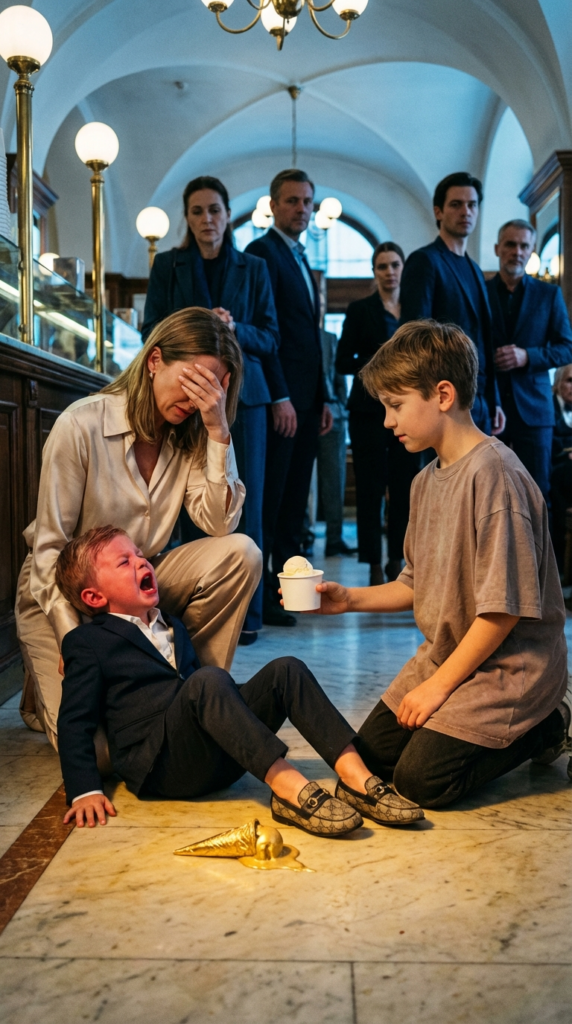
The sound of the $12 artisan waffle cone hitting the terrazzo floor was louder than a gunshot. It was the sound of my carefully curated life shattering.
“I wanted the gold flakes!” my six-year-old son, Preston, screamed, his face turning a terrifying shade of violet. “This is just sprinkles! I hate it! I hate you!”
The entire shop went silent. We were at Glace, the most exclusive dessert spot in the city, a place where the air smelled of burnt sugar and old money. The line wrapped around the block. The patrons wore Gucci to eat gelato. In that moment, I felt five hundred eyes burning into my back. I was wearing a silk blouse that cost more than my first car, but I felt naked. I felt exposed as exactly what I was: a woman who had lost control.
I tried to grab Preston’s hand, my own hands trembling. “Preston, please. Stop it. We can get another—”
“NO!” He kicked the pile of melting salted caramel, splashing the sticky mess onto my cream trousers. “It’s trash! You’re trash!”
The words hit me like a physical blow. It wasn’t his voice. It was his father’s cadence. It was the exact tone my husband, Richard, used when dinner was five minutes late or his shirts weren’t starched correctly.
I was ready to drag him out. I was ready to burst into tears. I was ready to let the ground swallow me whole to escape the judgment of the other mothers, the “perfect” ones who were already whispering behind their manicured hands.
Then, the bell above the door jingled.
A boy, maybe seven, walked in. He stood in stark contrast to the marble and brass interior. He wasn’t wearing designer clothes. He was wearing a faded graphic t-shirt that was two sizes too big, the collar stretched out. He was clutching a crumpled five-dollar bill in his fist like it was a winning lottery ticket.
He saw the scene. He saw the rich kid screaming. He saw the mother on the verge of a breakdown.
Most kids would stare. Most kids would laugh.
But this boy walked up to the counter. He ordered a single scoop of plain vanilla in a paper cup. He handed over his crumpled bill, took his change, and then, instead of walking out, he walked straight into the eye of the storm.
He approached Preston, who was winding up for another scream. He tapped my son on the shoulder.
“Here,” the boy said, holding out his cup.
Preston froze, his chest heaving. He looked at the paper cup with disdain. “It doesn’t have gold on it,” he sneered.
The boy smiled. It was a genuine, gap-toothed smile. “Gold doesn’t taste like anything,” he said softly. “But sharing tastes like magic. My mom says so.”
THE GOLDEN CAGE
To understand why my six-year-old was a tyrant, you have to understand the house he lived in.
I married Richard ten years ago. He was a hedge fund manager—charming, aggressive, brilliant. He promised me the world, and he delivered it. The mansion in Greenwich, the summer house in the Hamptons, the infinite credit limit.
But the price was my voice.
Richard didn’t want a partner; he wanted a prop. He wanted a wife who looked good on his arm and a son who carried his name. But he didn’t have time for the messy parts of a family. When Preston cried as a baby, Richard would close the nursery door and tell the nanny to “fix it.” When Preston wanted to play catch, Richard bought him a $500 glove and hired a coach.
“We don’t share feelings, Elena,” Richard told me once when I tried to talk about my loneliness. “We solve problems. And usually, problems are solved with purchase orders.”
So, I compensated. I bought Preston everything. I filled the void of his father’s absence with toys, gadgets, and experiences. I taught him that happiness was something you demanded, and if it wasn’t perfect, you threw it away and bought a new one.
I had created a monster. A mini-Richard. And standing in that ice cream shop, watching a boy with nothing offer everything to my son who had everything, the illusion finally broke.
PART III: THE TASTE OF VANILLA
Preston stared at the boy. He looked at the vanilla ice cream. Then he looked at me. He was waiting for me to intervene. He was waiting for me to say, “Don’t take that, we don’t know where it’s been.”
But I didn’t. I stayed silent.
Preston hesitantly reached out and took the paper cup. He took a small bite.
“It’s… cold,” Preston said, confused.
“Eat it with him,” the boy said, pointing to a plastic spoon. “My name is Leo.”
Preston blinked. “I’m Preston.”
“You want to sit?” Leo asked, gesturing to the curb outside, away from the staring eyes of the shop.
Preston looked at the sticky mess on the floor, then at Leo. He walked outside. He sat on the concrete. My son, who threw a fit over gold flakes, sat on the dirty sidewalk next to a boy in a stained shirt, passing a paper cup back and forth.
I walked out after them. I saw a woman running up the street, looking frantic. She wore a waitress uniform from the diner down the block.
“Leo!” she gasped, breathless. “I told you to wait by the hydrant!”
“I’m sorry, Mama,” Leo said, standing up. “But his ice cream fell. He was sad. So we shared mine.”
The woman looked at me, taking in my silk blouse and my tear-stained face. She looked at the expensive ice cream shop behind us. She looked at her son, who had given away his treat.
“Oh, Leo,” she sighed, pulling him into a hug. She looked at me apologetically. “I’m sorry, ma’am. I hope he didn’t bother you. That was his treat for the month.”
His treat for the month.
The words hit me harder than Preston’s insults. This boy had saved for a month for that ice cream. And he gave it to a screaming, ungrateful stranger because he thought Preston needed “happy” more than he did.
“He didn’t bother us,” I choked out, tears finally spilling over. “He saved us.”
THE PURGE
I drove home that day in silence. Preston fell asleep in the back seat, clutching the empty paper cup.
When I walked into the mansion, Richard was in his study on a call. He didn’t look up.
“Dinner at seven,” he barked at me. “Wear the red dress. The partners are coming.”
I looked at him. I looked at the man I had allowed to shape my son’s soul.
“No,” I said.
He stopped typing. He turned around slowly. “Excuse me?”
“No,” I repeated. My voice was steady for the first time in years. “I’m not wearing the red dress. And we aren’t having dinner.”
I went upstairs. I didn’t pack the jewelry. I didn’t pack the couture. I packed two suitcases of practical clothes for me and Preston. I grabbed our passports and my personal savings account info—the “run away” fund my mother had told me to keep, just in case.
We stayed in a hotel that night. Preston cried because he didn’t have his giant TV.
“I know it’s hard,” I told him, holding him close. “But we’re going to learn something new. We’re going to learn how to be like Leo.”
THE REAL GOLD
It’s been six months.
The divorce is messy. Richard is fighting for custody, not because he wants Preston, but because he hates losing assets. But he won’t win. I have recordings. I have the nannies’ testimonies.
We live in a townhouse now. It’s small. The kitchen is cramped.
But every Friday, we go to the diner where Leo’s mom, Maria, works.
The first time we went, I tipped her $500. She tried to give it back. I told her it was interest on a loan Leo gave us.
Preston and Leo are best friends now. It wasn’t an overnight fix. Preston still has moments where he expects the world to bow to him. But whenever he starts to get demanding, I ask him, “Does that have gold flakes on it?”
He stops. He remembers.
Last week, for his birthday, Preston didn’t ask for a new iPad. He asked if we could take Leo to the amusement park.
“Because Leo’s never been on a rollercoaster,” Preston told me seriously. “And screaming is only fun if you do it together.”
I looked at my son. He wasn’t wearing designer clothes. He had chocolate on his chin. And he was the richest little boy I had ever seen.
Gold doesn’t taste like anything. But freedom? Freedom tastes like vanilla.