THE TEN MINUTES THAT CHANGED EVERYTHING
“Move! Get out of the way!” I screamed, shoving past a firefighter who was trying to establish a perimeter with yellow tape.
The alarm was piercing, a rhythmic, mechanical shriek that vibrated in my teeth. Thick, oily black smoke was already billowing out of the windows of the 8th floor, curling up toward the night sky like a dark omen.
My floor.
I had just run down to the corner store for milk and a lottery ticket—my weekly ritual of hope. I was gone for ten minutes. Ten minutes was all it took for my world to catch fire.
My mom, Linda, was up there. She had lost her legs to complications from diabetes three years ago. She was sitting in her wheelchair by the window, watching Wheel of Fortune, completely helpless. The elevators, notoriously glitchy on a good day, were shut down. The stairwell was a chimney.
“Ma’am, you cannot go in there! The structure is unstable!” a cop shouted, grabbing my arm with a grip like a vice.
“My mother is in 8B!” I shrieked, tearing myself free with the desperation of a daughter who knows she is the only hope left. “She can’t walk! She’s trapped!”
I didn’t wait for permission. I ran into the lobby. The smoke hit me instantly, tasting of burning rubber, melting plastic, and old carpet. I scrambled up the stairs, my lungs burning, counting the flights. Three. Four. Five.
As I ran, my mind raced with hatred. I was thinking about him. Silas Sterling. The man who owned the penthouse on the 12th floor. The man who bought our building six months ago and immediately started sending notices about “renovations” that felt like thinly veiled eviction threats.
Silas wore $5,000 suits. He drove a car that cost more than my lifetime earnings. He complained if our trash cans were left out five minutes past pickup time. He was the villain of our story. I knew exactly where he was right now—probably on his private terrace, waiting for a private extraction, or already gone, leaving us peasants to burn. He didn’t care about human life; he cared about equity.
I reached the 8th-floor landing. The heat was unbearable, a physical wall pushing me back. I couldn’t see my hand in front of my face.
“Mom!” I screamed, stumbling toward where I knew our door was. “Mom!”
Then, a shadow emerged from the wall of black smoke. A figure. Tall. Coughing violently. Stumbling.
I froze.
It was Silas.
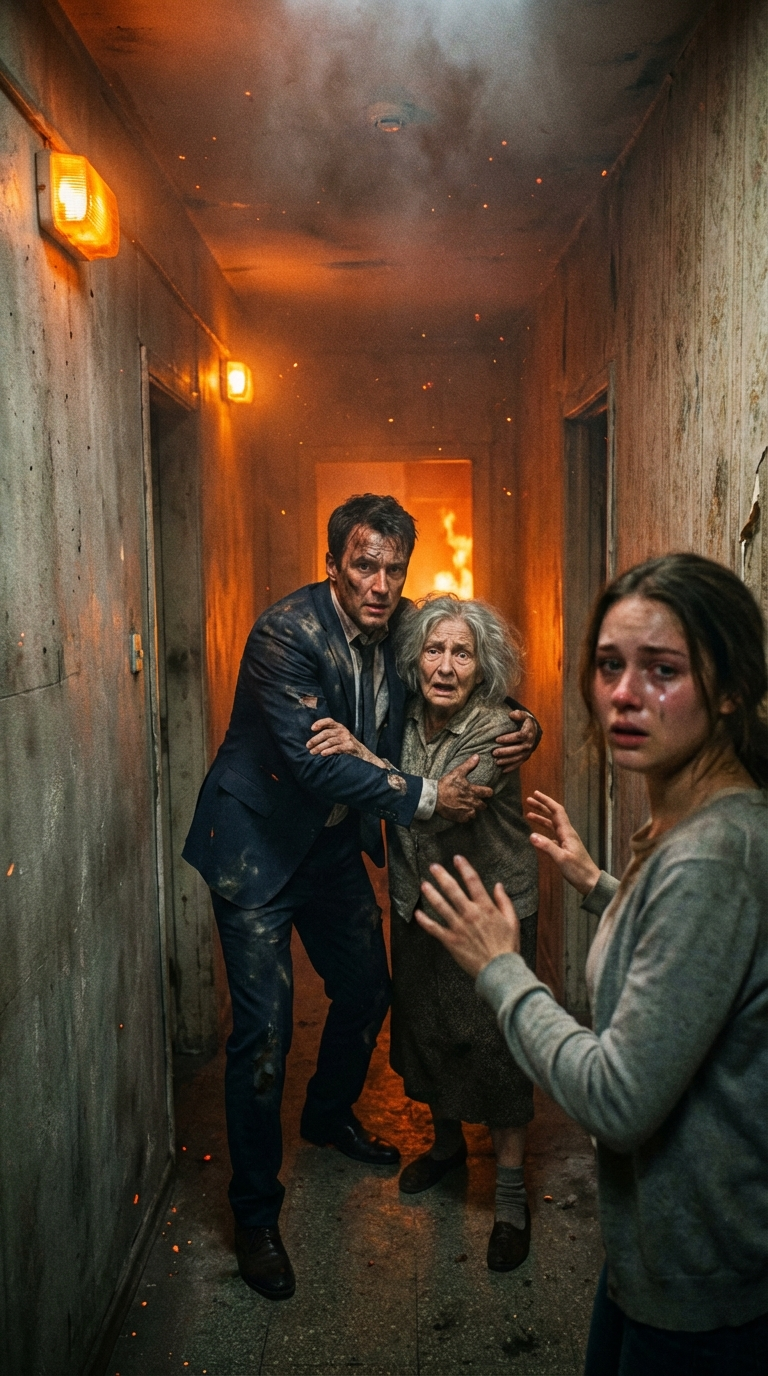
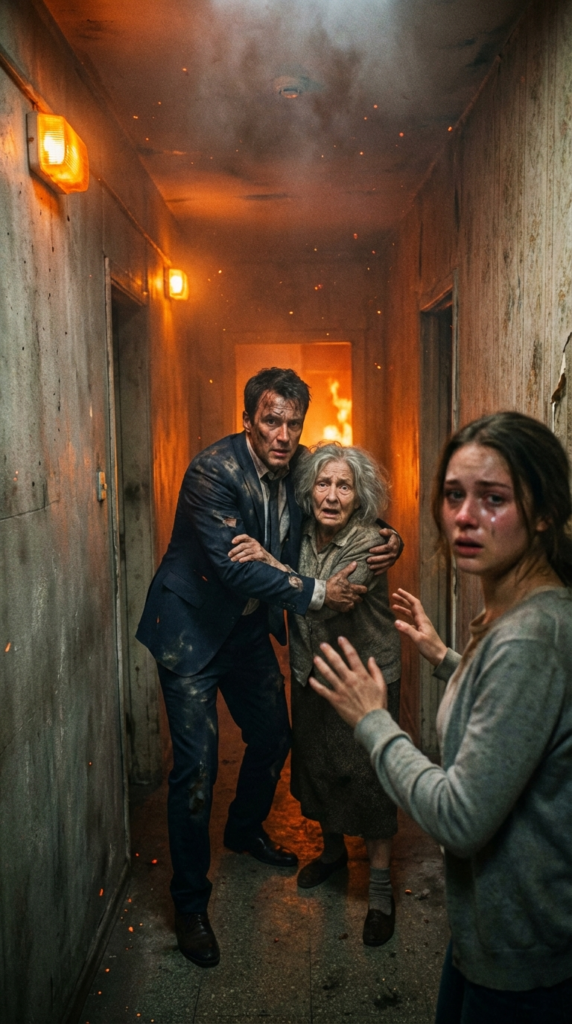
His Italian suit was shredded, the jacket gone, his white dress shirt stained gray and black. His face was unrecognizable, masked in soot. And in his arms, cradled tightly against his chest like a child, was my mother. Her wheelchair was gone. He had physically picked her up.
He wasn’t running away. He had come down four flights of stairs, into the heart of the fire, to get her.
He looked at me, his eyes bloodshot and wild. He took one step toward me, wheezed, and collapsed to his knees, still holding her up so she wouldn’t touch the hot floor.
“Take her,” he rasped, his voice sounding like broken glass. “Get her out, Clara.”
THE EVICTION NOTICE
To understand the shock of that moment, you have to understand the war we had been fighting.
Silas Sterling wasn’t just a neighbor; he was the Enemy. When he bought The Kensington Arms, it was a crumbling Art Deco building holding onto its last legs. Most of us were rent-controlled tenants who had been there for decades. We were a community.
Then came Silas. He was thirty-five, a tech mogul who had pivoted to real estate. He didn’t say hello in the elevator. He wore noise-canceling headphones and looked through you.
Three months ago, the letters started.
NOTICE TO VACATE: Structural Assessment Required.
He wanted us out. He offered buyouts that were insulting. $5,000 to leave a home we’d lived in for twenty years? In this city? It was a joke.
I organized the tenant meetings. I was the one who shouted at him in the lobby.
“You’re a vulture!” I had screamed at him just last week when the heat went out for two days. “You cut the heat on purpose to freeze us out! My mother is sick!”
Silas had looked at me with those cold, grey eyes. He didn’t apologize. He just said, “The boiler is sixty years old, Clara. It’s dangerous.”
“You’re dangerous!” I spat back.
I hated him. I hated his money. I hated his indifference. I was convinced he would burn the building down himself just to claim the insurance and build his glass tower.
And now, here we were. The building was burning. And the arsonist—in my mind—was the savior.
THE ASHES OF JUDGMENT
I grabbed my mother from his arms. She was coughing, dazed, soot-stained, but alive.
“Go!” Silas yelled, trying to push himself up but failing. “The ceiling is going to go!”
“Get up!” I screamed at him. “I can’t carry you both!”
“I’m not asking you to!” He shoved me toward the stairs. “Go!”
I didn’t argue. I hoisted my mother onto my back—adrenaline is a hell of a drug—and I ran. I ran down those stairs faster than I ever had in my life. We burst out of the lobby door just as the windows on the 8th floor blew out, showering the street in glass.
Paramedics swarmed us. I sat my mom on a gurney, checking her frantically. She was okay. Smoke inhalation, but okay.
I looked back at the door.
Silas wasn’t there.
“There’s a man inside!” I grabbed a firefighter. “The 8th floor landing! He’s down!”
Two firemen ran in.
Three minutes passed. They felt like three years.
Then, they emerged. dragging a limp body between them. They laid Silas on the grass. He wasn’t breathing.
I watched them cut open his expensive shirt. I watched them do CPR. I watched the man I hated more than anyone on earth fight for his life because he had saved my mother.
He gasped. A violent, retching cough. He was back.
THE HOSPITAL CONFESSION
Two days later, I walked into his private room at St. Jude’s.
He looked terrible. Bandages on his hands, an oxygen mask, burns on his neck.
“You’re alive,” I said, standing at the foot of the bed.
He opened one eye. “Disappointed?”
“You saved her,” I said. “Why? You want us out. You hate us.”
Silas pulled the mask down. He tried to sit up, wincing.
“I never hated you, Clara,” he whispered. “I was trying to save you.”
“By evicting us?”
“By getting you out before the wiring caught fire,” he said. “Do you know why I bought the building?”
I shook my head.
“I grew up in a place just like The Kensington,” Silas said, staring at the ceiling. “In Detroit. My mom was in a wheelchair too. MS. Our landlord was a slumlord who ignored the code violations. When the fire happened… nobody came for her. I was ten. I was at school. I came home to ash.”
The silence in the room was heavy.
“I made money,” he continued. “A lot of it. And I bought this building because I saw the inspection reports. The wiring was a ticking time bomb. The previous owner hid it. I tried to fix it, but the city permits were taking months. I tried to buy you guys out so you could move somewhere safe while I gutted the place. But I’m… I’m not good with people. I came off as the villain.”
“You cut the heat,” I whispered.
“I shut down the boiler because it was leaking carbon monoxide,” he corrected. “I wasn’t freezing you out. I was keeping you from dying in your sleep.”
I felt the tears coming. Hot, shameful tears. I had judged this man based on his suit and his silence. I had demonized him while he was frantically trying to prevent the very tragedy that defined his life.
“When the alarm went off,” Silas said, his voice breaking. “I knew. I knew she was on the 8th floor. I couldn’t let it happen again. Not this time.”
THE REBUILD
The Kensington was totaled. We lost everything.
Or so we thought.
A week later, I got a call from a lawyer. Not an eviction lawyer.
Silas had insured the building, obviously. But he had also taken out a massive policy on the tenants—something he didn’t have to do.
He paid for our temporary housing. A nice hotel, not a shelter.
And then came the plan.
Silas didn’t build condos. He rebuilt The Kensington. He rebuilt it with state-of-the-art fire suppression, wider doors for accessibility, and modern elevators that actually worked.
And he gave every single original tenant the option to return. Same rent. Rent-controlled. For life.
I visited him at the construction site six months later. He was wearing a hard hat and jeans, looking at blueprints.
“You’re losing money on this,” I said, walking up to him. “Rent-controlled units in a brand new building? It’s bad business.”
Silas smiled. It was the first time I’d really seen him smile. It wasn’t arrogant. It was relieved.
“I have enough money, Clara,” he said. “I don’t have enough sleep. Knowing you and Linda are safe? That buys me a lot of sleep.”
THE REVENGE
The “revenge” wasn’t against Silas. It was against my own prejudice.
But there was a little bit of justice served. The previous owner of the building? The one who hid the faulty wiring and sold it to Silas?
Silas used his resources to bury him. He funded a class-action lawsuit on behalf of us tenants. We sued the old slumlord for negligence. With Silas’s evidence, we won.
My mom and I moved back into unit 8B last week. It smells like fresh paint. The window looks out over the city.
Yesterday, I saw Silas in the lobby. He was wearing a suit again.
“Hey, Vulture,” I called out.
He stopped and turned, a smirk playing on his lips. “Hey, Tenant.”
“Dinner? 8B? Mom made lasagna.”
“I’ll bring the wine,” he said. “But nothing expensive. I’m on a budget. spent all my money on sprinklers.”
I laughed.
The arrogant millionaire in the penthouse didn’t just save my mom from a fire. He saved me from a life of bitterness. And it turns out, the best view in the building isn’t from the penthouse. It’s from the ground floor, looking at the man who held the door open for you when the world was burning down.