The Night Everything Changed
I was standing in the dark back alley behind Sweet Harmony Bakery at 2:17 AM on a Tuesday night, holding a five-pound bag of salt in my trembling hands, about to pour it into my rival’s flour supply and destroy her business, when the back door opened and Charlotte Bennett appeared.
For a moment, we just stared at each other—me frozen mid-sabotage, her backlit by the fluorescent kitchen lights, both of us caught in a moment that would define everything that came after.
Charlotte Bennett. The woman who’d opened her trendy artisanal bakery directly across the street from Chen Family Bakery six months after I’d inherited it from my grandmother. The woman who’d systematically stolen my customers, poached my employees, and destroyed my reputation. My nemesis for two years.
She should have been angry. Should have called the police. Should have screamed at me for breaking into her storage area.
Instead, tears were streaming down her face.
“I know what you’re doing,” she said, her voice barely above a whisper. “And I know you think I deserve it. God knows you probably have every reason to hate me. But please, Ruby. Please just let me explain before you ruin me.”
My hand tightened on the bag of salt. “Explain what? How you’ve spent two years destroying everything my grandmother built? How you stole the mayor’s daughter’s wedding contract? How you submitted my recipes to the Northwest Baking Competition under your name and got me disqualified for plagiarism?”
“I didn’t—” Charlotte’s voice broke. “Ruby, I didn’t do any of those things. Or rather, I did some of them, but not the way you think. Please. Five minutes. That’s all I’m asking.”
“How did you even know I was here?” I demanded.
Charlotte laughed bitterly. “Because I’ve been sleeping in my office for three weeks. Ever since my husband left and took everything—the house, the savings, custody of my six-year-old daughter three days a week. I’ve been living in my bakery because I have nowhere else to go. And I heard you in the alley messing with my storage bins.”
I stared at her. Charlotte Bennett, with her perfect Instagram presence and her seemingly effortless success, had been homeless?
“What does your divorce have to do with sabotaging my business?” I asked, trying to keep my voice hard.
“Everything. Ruby, I need you to understand something.” Charlotte stepped fully into the alley, letting the door close behind her. In the harsh streetlight, I could see how exhausted she looked. Dark circles under her eyes. Weight loss that made her chef’s coat hang loose. “I never meant to hurt you. I never wanted to be your enemy. But someone has been sabotaging both of us. Someone who wants both our bakeries to fail. And I finally figured out who.”
“This is bullshit—”
“It’s Marcus Webb,” Charlotte interrupted. “Your ex-business partner. And the man who’s been systematically trying to destroy every independent bakery in this neighborhood.”
The name hit me like ice water. Marcus Webb. The man I’d trusted when my grandmother died and I’d been drowning in grief and responsibility. The man who’d offered to help me “modernize” the bakery, to keep up with changing times. The man who’d pushed so hard for me to abandon my grandmother’s traditional recipes and turn Chen Family Bakery into something trendy and commercial.
The man who’d had access to all my recipes, all my business plans, all my secrets.
“I don’t believe you,” I said, but my voice wavered.
“Then look at this.” Charlotte pulled out her phone with shaking hands. “Three months ago, Marcus approached me with an offer to buy Sweet Harmony for $50,000—half what it’s worth. When I refused, things started going wrong. Suppliers suddenly couldn’t deliver. Health inspectors showed up for ‘anonymous complaints’ that were completely fabricated. Someone hacked my Instagram and posted racist comments that lost me half my followers.”
She showed me her phone. Emails. Documents. Evidence.
“But the worst part,” Charlotte continued, “was when I started getting anonymous tips about you. About how you were planning to undercut my prices. About how you were badmouthing me to shared clients. About how you’d stolen recipes from your grandmother’s archives that were supposed to stay private. Every tip made me more paranoid. Made me defensive. Made me fight back.”
“Someone was feeding you lies about me,” I said slowly.
“Yes. The same way someone was feeding you lies about me. Making us hate each other. Making us so busy destroying each other that we didn’t notice what was really happening.”
“And what’s really happening?”
Charlotte’s expression hardened. “Marcus is buying up every independent bakery in this neighborhood. He’s using intimidation, sabotage, and manufactured rivalry to force owners to sell cheap. Then he’s converting them into locations for his corporate chain—Bean & Butter. You know that new ‘artisanal’ café three blocks over?”
I did. It had opened six months ago with massive fanfare.
“That was Morelli’s Bakery,” Charlotte said. “Family-owned for thirty years. Marcus bought it after someone started a rumor about rats in their kitchen. It was completely false but it destroyed their business. They sold to him for nothing and now it’s a corporate café with no soul.”
I felt sick. “And he’s trying to do the same to us.”
“He needs us both gone. Chen Family Bakery has the best location on the street—corner property, high foot traffic, parking. Sweet Harmony has the liquor license and the event space he needs for wedding catering. Together, our properties would let him build a flagship location. But we won’t sell. So he’s been making us destroy each other instead.”
“The baking competition,” I whispered. “The recipes I submitted—”
“Were stolen by Marcus and submitted under my name two days before you sent yours in,” Charlotte finished. “Making you look like the plagiarist. Destroying your reputation while making me look like the villain. We both lost. He won.”
My legs went weak. I set down the salt and leaned against the brick wall. “How do you know all this?”
“Because I finally did what I should have done two years ago—I talked to other bakery owners. I called Morelli’s former owner. I called the family who had the French bakery that closed last year. Same pattern. Same mysterious problems. Same man showing up with lowball offers right when they were most desperate.”
Charlotte pulled out another document from her phone. “And yesterday, I got this. An email Marcus sent to one of his investors. It was attached to a different email by mistake. Look.”
She showed me. An email thread discussing “acquisition targets” in our neighborhood. Chen Family Bakery and Sweet Harmony were at the top of the list. The strategy was explicitly outlined: “Create conflict between Chen and Bennett. Let them exhaust each other’s resources fighting. Move in when both are vulnerable.”
“Jesus Christ,” I whispered.
“There’s more,” Charlotte said. “Remember your best baker? Amy Rodriguez? The one I supposedly ‘poached’ with double salary?”
“I remember.” The betrayal had stung. Amy had been with my family for eight years.
“I didn’t poach her. Marcus called her pretending to be a recruiter and offered her a job at my bakery. When she showed up for what she thought was an interview, I had no idea what she was talking about. By then, you’d already fired her for ‘disloyalty,’ and she was so angry and confused she decided to actually work for me just to spite you.”
I closed my eyes. Every terrible thing that had happened—every perceived betrayal, every business loss, every moment I’d spent hating Charlotte Bennett—had been manufactured by someone I’d trusted.
“Why are you telling me this?” I asked. “I was literally about to sabotage your business. Why not just call the police?”
Charlotte’s eyes filled with fresh tears. “Because I’m tired, Ruby. I’m so tired of fighting. My marriage fell apart partly because I became obsessed with business rivalry instead of paying attention to my actual life. I barely see my daughter. I sleep in my office. I’ve lost twenty pounds from stress. I’ve become someone I don’t even recognize.”
She gestured at the salt. “So go ahead. Destroy me. I probably deserve it for not figuring this out sooner, for fighting you instead of trying to understand what was really happening. But know that when you do, Marcus will buy my bakery for nothing, and then he’ll come for yours next. And your grandmother’s legacy—forty years of serving this community, of being the place where people celebrated birthdays and weddings and life itself—will die because we were too stupid to see we were on the same side.”
I looked at the salt in my hands. Looked at Charlotte’s exhausted face. Thought about my grandmother.
Nǎi nai had always said: “Ruby, the people trying to divide you are more dangerous than the people trying to compete with you. Competition makes you better. Division makes you bitter.”
I’d thought Charlotte was my competition. But she’d actually been another target all along.
“What do you want from me?” I asked.
“Help,” Charlotte said simply. “I want us to stop fighting each other and start fighting the person who’s actually destroying us both. I want us to expose what Marcus is doing. I want us to save our bakeries. And I want—” Her voice broke completely. “I want to stop being alone in this. Please.”
I was shaking. Every instinct screamed not to trust her. But my grandmother’s voice in my head was louder: Trust your gut, Ruby. And trust your enemies when they’re more honest than your friends.
I picked up the bag of salt, walked to the dumpster, and threw it in.
“Okay,” I said. “Let’s take Marcus Webb down.”
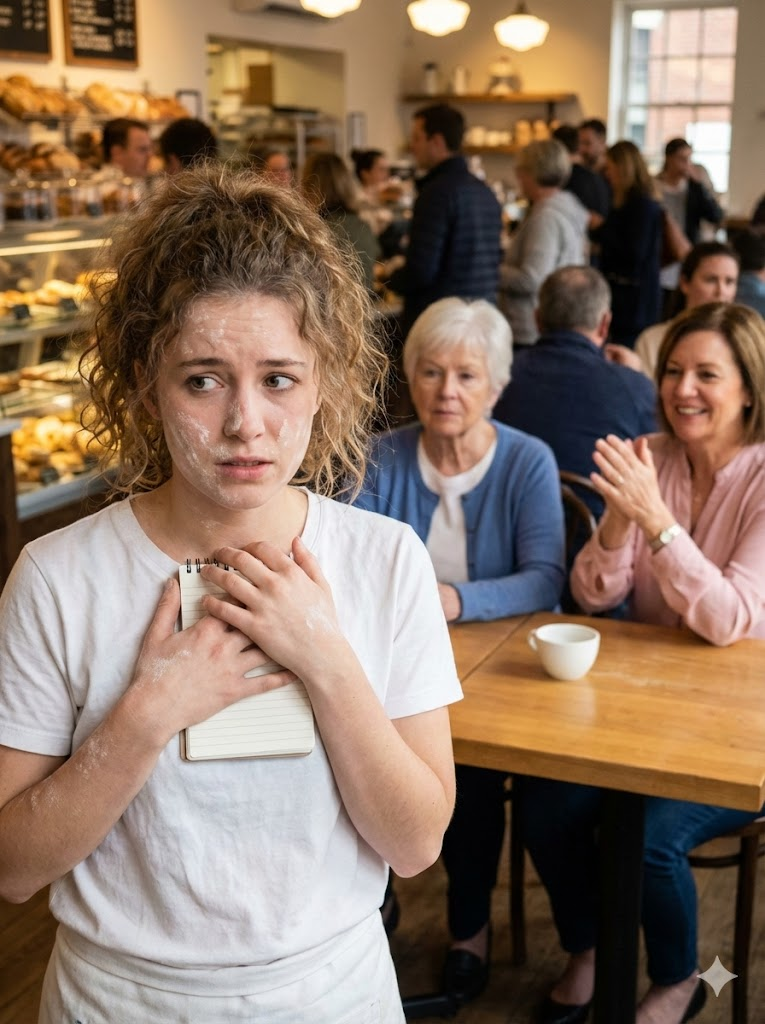
Two Years Earlier: How It Started
To understand how I ended up in that alley ready to sabotage my rival, you need to understand how Charlotte Bennett became my rival in the first place.
It started the day my grandmother died.
Nǎi nai—Grandmother Chen—had run Chen Family Bakery for forty years. She’d opened it in 1984 with my grandfather, a tiny hole-in-the-wall that sold traditional Chinese pastries to the growing immigrant community. Over decades, it became a neighborhood institution. Birthday cakes for three generations of families. Moon cakes every autumn. Pork buns for construction workers. Christmas cookies for the Catholic church next door.
My grandmother taught me everything. I spent every summer and weekend in that kitchen, learning her recipes, learning to feel dough instead of measure it, learning that baking was about feeding souls as much as bodies.
When she was diagnosed with pancreatic cancer at seventy-eight, she had six months. She spent four of them teaching me everything she hadn’t yet. The last two, she spent in hospice, squeezing my hand and saying, “Keep it alive, Ruby. Keep our family’s heart alive.”
She died on a Tuesday in March. The bakery closed for a week for mourning. When I reopened, everything felt wrong. The kitchen was too quiet. The recipes felt hollow without her guidance. I was twenty-nine years old, a graphic designer who’d never run a business, trying to fill shoes I’d never be big enough for.
That’s when Marcus Webb showed up.
He introduced himself as a “business consultant specializing in family business transitions.” He’d heard about my grandmother’s death—about the legendary Chen Family Bakery. He wanted to help.
“Family businesses die in the second generation 80% of the time,” he told me over coffee. “Not because the second generation doesn’t care, but because they don’t know how to adapt. The market changes. Customer expectations change. You can honor your grandmother’s legacy while also bringing it into the 21st century.”
It sounded good. I was drowning in grief and responsibility. He offered structure. Strategy. Marketing plans and financial projections and Instagram strategies.
“Partner with me,” Marcus said. “Not financially—I know the bakery is your inheritance. But let me consult. Let me help you modernize. I’ll take 15% of profits for two years, and by then you’ll be thriving.”
I said yes. Biggest mistake of my life.
Marcus started changing things immediately. “These traditional Chinese pastries are too niche,” he’d say. “You need to appeal to broader demographics. More Western desserts. Trendy items. Matcha. Ube. Things that photograph well.”
“But those aren’t our family’s recipes,” I protested.
“Your family’s recipes are dying with your grandmother’s generation. Adapt or fail, Ruby.”
Slowly, painfully, I let him convince me to change. We added trendy items. Removed traditional ones. The regular customers—elderly Chinese immigrants who’d been coming for decades—started complaining. “Where are the egg tarts? Where are the wife cakes? This isn’t Chen Family Bakery anymore.”
But Marcus showed me the numbers. Sales were up. Instagram followers were growing. “This is working,” he insisted.
Then, six months after my grandmother died, Sweet Harmony Bakery opened directly across the street.
Charlotte Bennett’s bakery was everything Marcus had been pushing me to become—trendy, Instagram-perfect, appealing to young professionals and tourists. French-inspired pastries, artisanal coffee, millennial pink décor.
And it destroyed my business.
Within three months, I’d lost 40% of my revenue. The hip young customers Marcus had courted went to Sweet Harmony instead—it was newer, prettier, more authentically “artisanal.” The traditional customers had already left because I’d eliminated their favorites.
“You need to compete harder,” Marcus said. “Undercut her prices. Extend hours. Fight for market share.”
So I did. I worked eighteen-hour days. Slashed prices. Added more trendy items. Fought tooth and nail for every customer.
And Charlotte seemed to fight back just as hard. Every time I launched a new product, she’d launch something similar but better. Every time I secured a big contract, she’d steal the next one.
The final blow came with the Northwest Baking Competition.
It was a prestigious regional contest. Winners got featured in Portland Monthly, appeared on local TV, received a $10,000 prize. It would be life-changing exposure.
I’d spent three months developing my grandmother’s secret recipe for pineapple buns—the ones she’d made special for the Mid-Autumn Festival. I’d modernized them slightly, adding contemporary flavors while honoring her technique.
I showed the recipe to Marcus for feedback. Submitted it to the competition.
Two weeks later, I got a devastating email: I was disqualified for plagiarism. Someone else had submitted nearly identical recipes two days before me.
Charlotte Bennett.
She won the competition with my grandmother’s recipe. Got the TV appearance, the magazine feature, the prize money. And I got labeled a copycat.
“She must have hacked your computer,” Marcus said, furious on my behalf. “Or bribed someone at the competition. This is industrial espionage, Ruby. You should sue.”
But I had no proof. And Charlotte’s submission was timestamped first. Legally, it looked like I’d copied her.
That’s when I started planning revenge.
The Investigation
After that night in the alley, Charlotte and I became unlikely allies. We spent the next week comparing notes, gathering evidence, and realizing just how thoroughly Marcus had manipulated us both.
We met at my bakery at midnight, after both businesses had closed. Spread documents across my grandmother’s old wooden work table.
“Look at the timeline,” Charlotte said, pointing at her laptop. “March—your grandmother dies. April—Marcus approaches you. September—I open Sweet Harmony. October—my husband starts having an affair.”
“What does your husband have to do with Marcus?”
“Everything. I thought Paul was cheating randomly. But look at this.” She pulled up social media photos. Her ex-husband Paul at business networking events. Standing next to Marcus Webb in three different photos.
“They knew each other,” I said slowly.
“Paul worked in commercial real estate. Guess who he was working for last year?”
“Marcus.”
“Marcus. Paul was supposed to help identify properties for Bean & Butter expansion. And suddenly he’s encouraging me to open a bakery, helping me find the location directly across from you, pushing me to take out massive loans to build my ‘dream.'”
“He set you up,” I realized. “He put you in debt, put you directly in competition with me, then destroyed your marriage so you’d be desperate and vulnerable.”
Charlotte’s hands were shaking. “I lost my daughter three days a week because Paul convinced the court I was too ‘unstable’ and ‘work-obsessed’ to be a full-time parent. He documented every late night I worked, every time I missed a school event because I was fighting to keep my business alive. He created the evidence that I was a bad mother.”
“Jesus Christ.”
“Marcus is paying Paul. I found the bank records. $5,000 a month for ‘consulting services.’ He’s being paid to keep me distracted and desperate.”
I felt sick. “What else did you find?”
“Amy Rodriguez—your former baker. I called her. She’s willing to testify that Marcus offered her the job at my bakery using a fake recruiting agency. She has emails. Voice recordings.”
“That’s fraud.”
“It’s a pattern of fraud. I talked to eight other former bakery owners. Same story. Marcus creates problems, waits until they’re desperate, swoops in with a lowball offer.”
“How hasn’t he been caught?”
“Because he’s smart. He uses multiple shell companies. Has lawyers. Pays people off. And most importantly, he makes his victims blame each other instead of looking at him.”
We worked through the night, building a case. By morning, we had a plan.
The Trap
“We need him to confess,” Charlotte said. “All this circumstantial evidence is great, but we need him admitting what he’s done.”
“How do we get him to do that?”
“We give him what he wants. We pretend we’ve destroyed each other.”
We spent two days setting up the trap. Charlotte posted on Instagram about “closing Sweet Harmony due to insurmountable challenges” and tagged several posts about business failure. I did the same for Chen Family Bakery, adding tearful stories about “losing my grandmother’s legacy.”
Then we waited.
Marcus called me within six hours.
“Ruby, I just saw your Instagram. I’m so sorry. I know how hard you’ve worked. Listen, I have a proposal. I know a commercial bakery chain that’s looking to expand. They’d be willing to buy Chen Family Bakery—probably not for what it’s worth, but enough to pay your debts and start fresh somewhere else. Interested?”
“How much?” I asked, my voice deliberately broken.
“They’re thinking $75,000.”
My grandmother’s bakery was worth at least $400,000 with property value. $75,000 was robbery.
“That’s so low,” I said.
“I know. But Ruby, you’re out of options. You’re drowning in debt. The business is failing. This is a way out.”
“Can I think about it?”
“Of course. But they need an answer by Friday. These opportunities don’t last.”
He called Charlotte with a similar offer—$50,000 for Sweet Harmony.
“He’s making his move,” Charlotte said when we compared notes. “Now we spring the trap.”
Friday morning, Marcus arrived at Chen Family Bakery for what he thought would be a negotiation. Charlotte and I were both there, sitting at the table with documents spread out.
Marcus’s face went pale when he saw Charlotte.
“What is she doing here?” he asked me.
“Comparing notes,” I said calmly. “Turns out Charlotte and I have a lot in common. Like being manipulated by the same person.”
“I don’t know what you’re talking about—”
“Sit down, Marcus,” Charlotte said coldly. “We know everything. The manufactured rivalry. The stolen recipes. The sabotage. All of it.”
We laid out the evidence. Documents. Testimonies. Email records we’d obtained through “creative” means that might not be admissible in court but were damning nonetheless.
Marcus’s lawyer would later call it “aggressive investigative overreach.” I called it justice.
“This is insane,” Marcus said, trying to bluster. “You’re both clearly having breakdowns. Conspiracy theories—”
“We have recordings,” I interrupted. “From Amy Rodriguez. From three other former bakery owners. All describing the exact same pattern of sabotage and manipulation.”
“And we have your investor emails,” Charlotte added. “The ones explicitly discussing your ‘divide and conquer’ strategy.”
Marcus went very still.
“Here’s what’s going to happen,” I said. “You’re going to sell your stake in Bean & Butter. You’re going to leave this neighborhood. You’re going to leave us alone. And you’re going to pay restitution to every bakery owner you’ve defrauded.”
“Or?” Marcus asked.
“Or we go to the media. We go to the Better Business Bureau. We file criminal complaints for fraud and harassment. And we make sure everyone in Portland knows exactly what kind of person you are.”
Marcus stared at us. “You can’t prove half of this.”
“Maybe not in criminal court,” Charlotte agreed. “But we can prove enough to destroy your reputation. To make sure no small business owner ever trusts you again. To turn you into a cautionary tale.”
We sat in silence for a long moment.
“I want immunity from prosecution,” Marcus finally said.
“Not our call,” I said. “But we’ll agree not to pursue charges if you agree to our terms.”
“I’ll need it in writing.”
“I’ll have something drawn up,” Charlotte said. She’d found a lawyer who worked pro bono for small businesses facing corporate bullying.
Marcus left looking ten years older.
Three weeks later, he signed the agreement. He paid $150,000 in restitution split among the bakeries he’d sabotaged. He sold his ownership stake in Bean & Butter to his investors. And he left Portland entirely.
We’d won.
Six Months Later: Healing
Charlotte and I didn’t become best friends overnight. Two years of manufactured hatred doesn’t disappear instantly. But we became allies. Partners in rebuilding what had been destroyed.
We started by making amends with our communities. I brought back my grandmother’s traditional recipes. Charlotte kept her French pastries but added collaborative items—my grandmother’s pineapple buns with her artisan technique.
We started a “Bakery Alliance”—connecting independent bakery owners across Portland to share information and support each other against corporate exploitation.
Amy Rodriguez came back to work for me part-time, splitting shifts with Charlotte’s bakery. “I’m sorry I ever believed the lies,” she said.
“We all believed lies,” I told her. “That’s how manipulation works.”
Six months after exposing Marcus, both our businesses were thriving. Not competing—complementing. Customers would get breakfast at Sweet Harmony and dessert at Chen Family Bakery. We referred clients to each other. We collaborated on wedding contracts, with Charlotte doing French desserts and me doing traditional Chinese elements.
My grandmother would have loved it.
Charlotte and I had coffee one morning at the shop between our two bakeries.
“I got full custody back,” Charlotte told me. “Paul’s affair came out during the appeals process. Judge ruled his ‘work-obsessed mother’ accusations were projection.”
“That’s wonderful,” I said, genuinely happy.
“I couldn’t have done it without you. The evidence we gathered about Marcus helped prove Paul was being paid to sabotage me. That was the turning point.”
“We saved each other,” I said.
“Yeah.” Charlotte smiled. “Ironic, isn’t it? We were so busy trying to destroy each other that we didn’t realize we could be stronger together.”
“My grandmother used to say that competition between women is usually manufactured by men who benefit from our division.”
“Wise woman.”
“The wisest.”
We sat in comfortable silence.
“So what now?” Charlotte asked. “We’ve defeated the villain. Saved our businesses. What’s the next chapter?”
“I think the next chapter is boring and wonderful,” I said. “We run successful bakeries. We raise your daughter. We bake bread and live our lives.”
“Sounds perfect.”
And it was.
Today: The Legacy
It’s been three years since that night in the alley. Chen Family Bakery is thriving. Sweet Harmony is thriving. The neighborhood has successfully fought off corporate takeover.
Charlotte and I co-wrote a book called “The Sabotage: How We Almost Destroyed Each Other and How We Saved Our Businesses Instead.” It became a small business bestseller.
We give talks about manufactured rivalry, corporate manipulation, and the importance of small business solidarity.
And every year on the anniversary of my grandmother’s death, Charlotte closes Sweet Harmony and we spend the day at Chen Family Bakery making traditional Chinese pastries together. Teaching her daughter the recipes my grandmother taught me.
“Your nǎi nai would be proud,” Charlotte told me last year while we rolled dough for egg tarts.
“I think she’d mostly be amused that I almost ruined everything by trusting the wrong person and hating the right one.”
“She’d be proud you figured it out in time.”
I think she’s right. My grandmother’s legacy isn’t just the bakery. It’s the lesson she tried to teach me: division is poison, but solidarity is salvation.
And sometimes your greatest enemy is actually your strongest ally.
You just have to be brave enough to put down the salt and start listening.