The Night of the Cameras
I was thirty-four years old, a senior marketing director at a Fortune 500 company, a mother of six-year-old twin boys, a wife who hadn’t slept through the night in at least four years, and I was sitting alone in my dark home office watching my own family like they were strangers on reality TV.
On my desk: my work laptop, still open to a half-finished Q4 deck.
On my second monitor: a live grid of sixteen security feeds from the tiny cameras I’d had installed in my house three days earlier.
On my phone: a text from my husband, Mark, sent three hours ago.
“Let Ava handle bedtime. You need to prove to yourself she can actually do something besides draw pictures.”
On my kitchen counter, downstairs: my mother, probably refilling her wine glass and complaining about millennials.
And somewhere between those two women—one I trusted too much, one I hadn’t trusted at all—my twin sons, Theo and Liam, were testing the limits of what they could get away with.
It had started as a small suspicion.
An offhand comment from my mother: “Every time I come over, that girl is just sitting. She’s sweet, but she’s lazy.”
My mother’s nose wrinkled when she said “that girl,” like the words tasted sour. She refused to call her by her name.
Then Mark had added his own commentary.
“I came home early on Tuesday, and she had the boys watching some weird documentary while she sat on the floor drawing,” he’d said, grabbing a beer from the fridge. “You’re paying her twenty-five dollars an hour to color.”
“She said it was a nature documentary,” I’d replied. “She sent me photos. They were doing a leaf rubbing activity.”
He’d snorted. “Yeah, real rigorous childcare.”
It escalated. Little comments here and there. “The sink was full when I got home.” “The boys said she forgot to give them their vitamins.” “I had to remind her to start dinner twice.”
I was gone a lot. It came with the job. Evening pitches, early flights, late-night Zoom calls with clients in London. I lived with a constant, gnawing guilt that I wasn’t there enough. So every time someone hinted that my childcare wasn’t perfect, that the woman I’d trusted with my children might be letting them down, that guilt doubled into panic.
“What if they’re right?” I’d asked my therapist. “What if Ava’s not engaged enough? What if she’s scrolling her phone while the boys are online all day? What if I’m missing red flags because I want to believe she’s good?”
“Have you talked to Ava?” my therapist asked.
“Not directly,” I admitted. “It feels confrontational. And the boys adore her. Firing her would devastate them.”
“The boys adore her,” she repeated gently. “How do they describe their days with her?”
I thought back. “They say she draws with them. Bakes with them. Plays outside. Theo likes that she understands when he needs ‘quiet time.’ Liam says she’s ‘nice, not yelly.’”
Those were good things. Objectively.
But then my mother’s voice would cut in: “Children like the fun babysitter. That doesn’t mean she’s responsible.”
That’s when the idea of cameras started creeping in.
At first, I told myself it was just for safety. We live in Seattle. We have money. People know that. We’d had a package stolen off the porch, and Mark had been talking about security systems anyway.
“We should get a doorbell camera,” he’d said. “And something for the back yard.”
I hired a security company.
“Most families do one or two cameras,” the installer said, showing me options on his tablet. “Front door, back door, maybe the main living area.”
“What about the playroom?” I asked.
“Sure. We can do that. Maybe the kitchen too.”
He’d looked at me strangely when I said, “And the hallway. And the stairs. And the dining room. And the mudroom. And the basement. And could we put one in that stuffed owl on the bookshelf? And maybe a pinhole cam in the smoke detector? And the vent above the art table?”
“Ma’am, that’s… a lot of cameras,” he’d said. “Are you worried about a break-in, or…?”
I’d smiled too brightly. “Just want to be thorough.”
By the time he left, there were twenty-six cameras in my three-story townhouse. None in bathrooms or bedrooms—I wasn’t a monster—but everywhere else was fair game.
I told myself this was about peace of mind.
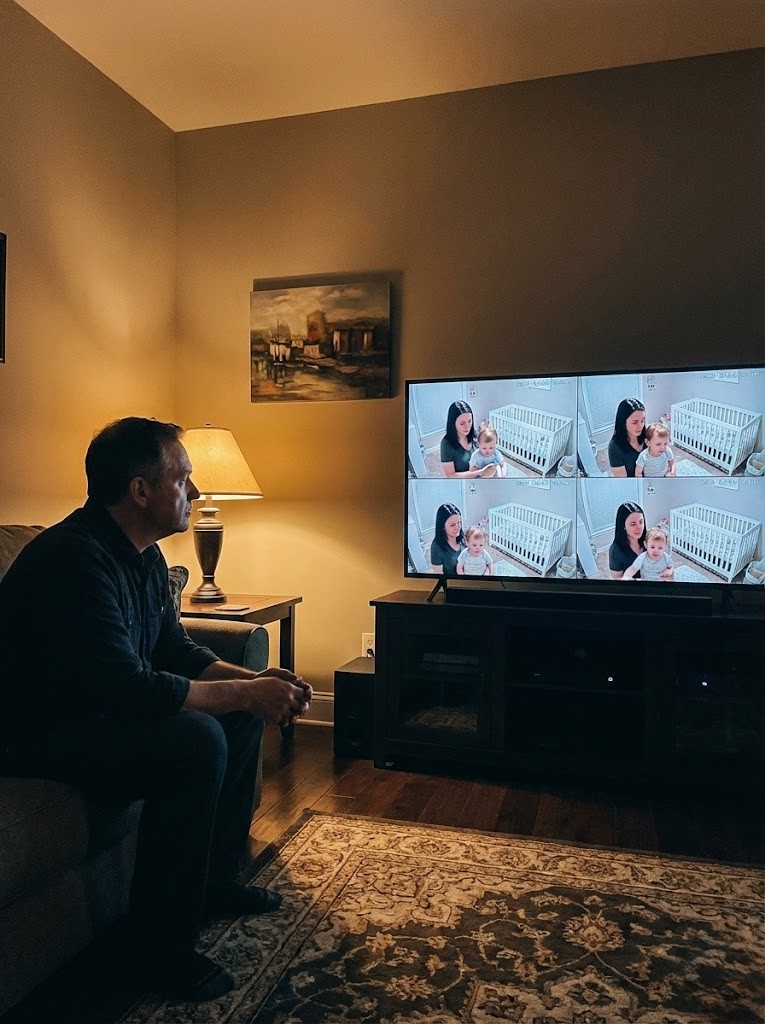
The truth: it was about control.
Because deep down, I didn’t trust myself. I’d grown up in a house where I was constantly told my instincts were wrong, my perceptions flawed, my feelings exaggerated. Part of me was terrified I was doing the same thing to my kids—that I was ignoring obvious issues because it was easier.
If the cameras showed that Ava was neglectful or checked-out, I could fire her guilt-free.
If the cameras showed she was fine… well, I wasn’t sure what I’d do then.
For the first two days, I didn’t see anything alarming.
What I saw was a quiet, patient, soft-spoken girl who worked harder than anyone gave her credit for.
On Monday, she made pancakes shaped like dinosaurs while Liam bounced off the walls and Theo covered his ears at the sound of the blender. She adjusted on the fly, turning it off, switching to a whisk.
“I forgot,” she said softly to Theo. “The blender’s too loud for you, huh? We’ll do quiet mixing instead.”
On Camera 5, I watched my mother walk in mid-morning, unannounced as always, coat still on, purse still over her arm.
“Is their lunch ready?” she demanded.
“It’s only ten-thirty, Mrs. Reynolds,” Ava said politely. “We’re doing a sensory activity first, then we’ll—”
My mother cut her off. “When I raised Claire, the house was spotless by ten and lunch was prepped. You girls think washing a few dishes is work.”
Ava’s shoulders hunched. “Yes, ma’am.”
On Camera 9, that same afternoon, I watched Ava sit criss-cross on the playroom rug with Theo, slowly helping him sort crayons by color. He was stimming—rocking slightly, humming under his breath. It was the kind of moment my mother would call “weird” and my husband would call “coddling.”
To me, it looked like kindness.
So why did I still feel uneasy?
Because every time I flew out for a client meeting and called home, Mark would sigh.
“She left the boys on their iPads for two hours today,” he’d say. “I walked in and they barely looked up. How is that worth what we’re paying?”
“Did you ask her why?” I’d say. “Maybe she was making dinner?”
“Claire, you’re doing that thing again,” he’d respond. “Making excuses. You always take the outsider’s side against your own family.”
That hurt. Because it had been true once.
When I was seventeen, I’d believed my guidance counselor over my parents when she said I should apply to a university out of state. My parents had called it a betrayal. “You think you’re better than us,” my dad had sneered. “You’re just like your aunt—running away and leaving family behind.”
I hadn’t gone. I’d stayed. I’d played the good daughter.
Maybe that’s why, twenty years later, I was sitting in my office at 1 a.m. watching my own kids on a screen, trying to decide whose version of reality was true.
Theirs?
Or the one unfolding in front of my eyes?
The ‘Lazy’ Girl and the Perfect Twins
To understand what I saw on those cameras, you have to understand the story that had been playing in my head long before I ever hit “install.”
I didn’t grow up in a house where children were believed.
I grew up in a house where children were corrected.
“Stop exaggerating.”
“You’re too sensitive.”
“That didn’t happen that way.”
“You’re making your mother look bad.”
My mother, Susan, was an elementary school teacher in a small Oregon town. She loved kids—other people’s kids. At school, she was patient, creative, adored. At home, she was exhausted, brittle, and perpetually disappointed.
“You got a B+?” she’d say, scanning my report card. “What happened to the A?”
My father, Tom, was a mechanic. He worked long hours, came home greasy and exhausted, and had little tolerance for “drama.”
“Your mother works hard,” he’d say whenever I cried. “Why are you making things harder?”
I was an anxious kid. The kind who chewed the sleeves of her sweatshirts and worried about climate change at ten. I told my parents when other kids bullied me. When a teacher embarrassed me. When I felt something was wrong.
They told me I was overreacting.
When I was thirteen, I told my mother one of her male colleagues made me uncomfortable. He stood too close. He made comments about my body.
“He’s just friendly,” she said sharply. “Don’t be ungrateful. He wrote you a recommendation letter.”
When I was sixteen, I told my father my boyfriend was pressuring me to do things I didn’t want to do.
“Boys are like that,” he said. “Learn to say no or don’t date. We’re not going to police your relationships.”
I learned two things: adults couldn’t be trusted with my vulnerability, and authority figures would always defend their own before they defended me.
So I became obedient. High-achieving. Quiet. I stopped telling my parents things that mattered and focused on things they approved of: grades, chores, college applications.
I stayed in-state for college to make them happy. I majored in something “useful.” I got a job they could brag about.
And I internalized the idea that my perception of reality was always suspect.
Then I married Mark.
Mark was charming. Ambitious. Confident in a way I found intoxicating—someone who walked into any room and immediately took up space without apology.
He loved that I was driven. At first.
“You’re the smartest woman I know,” he’d say. “We’re going to be a power couple.”
We got married at twenty-eight, moved to Seattle, and dove headfirst into corporate life. I climbed the marketing ladder. He climbed the tech ladder.
We told ourselves we’d wait five years before kids.
I got pregnant two years later. With twins.
The pregnancy was rough. High risk. Bed rest. An emergency C-section at thirty-four weeks.
Theo spent two weeks in the NICU. Liam, three. Tiny, fragile babies with tubes and monitors and a terror so all-consuming I didn’t sleep for months.
When we brought them home, I promised myself I would be the kind of mother who believed her children. Who listened. Who protected.
Reality had other ideas.
Theo was different from the start. He was sensitive to sound, to light, to touch. He cried inconsolably when the vacuum cleaner was on. He refused certain fabrics. He lined up his toys instead of playing “normally.”
Our pediatrician mentioned “sensory processing issues” and “possibly on the spectrum” at his two-year appointment.
My mother heard that and clutched her pearls. “Don’t label him,” she hissed. “He just needs structure. You can’t let him be weird. Kids are cruel.”
Mark had his own opinions. “We’re not making him one of those diagnoses,” he said. “He’s fine. He just needs boundaries.”
Liam, on the other hand, was charming and social. He loved attention. He figured out quickly that if he smiled at adults and said the right things, he got what he wanted.
“You have the perfect duo,” my mother would say. “One sensitive, one outgoing. As long as you don’t let that sensitive one pull you into his drama.”
I lived on a knife’s edge trying to be everything to everyone: the competent executive, the attentive wife, the perfect mother, the steady daughter.
When the boys were four, my company offered me a promotion. It came with more responsibility, more money, and more travel.
I took it.
My mother disapproved. “Why have children if you’re going to let strangers raise them?” she asked.
Mark sighed. “We can’t afford for you not to work,” he said. “But don’t let your job become your whole personality.”
So I did what many women do in that impossible middle ground: I outsourced help and took all the blame.
We went through three nannies in two years.
The first was older, experienced, and rigid. She clashed with Theo from day one. “He needs discipline, not negotiation,” she told me. “You’re too soft.”
Theo started regressing. Meltdowns. Night terrors. I let her go.
The second was young and fun, but disorganized. She forgot appointments. Lost permission slips. Liam adored her. Theo tolerated her. Mark called her “a babysitter, not a nanny.”
My mother called her “trash.”
I let her go too.
By the time we found Ava, I was exhausted and desperate.
Her profile on Care.com was simple. Twenty-two. Art student. CPR certified. Four years of experience with kids on the spectrum. Quiet in her video interview, but when she talked about sensory-friendly activities, her eyes lit up.
“Theo’s not officially diagnosed,” I told her, “but he struggles with noise and transitions.”
“I can work with that,” she said softly. “I interned at a clinic that used art to help kids regulate. We can build a routine that feels safe to him.”
She didn’t oversell herself. She didn’t promise to “fix” anyone. She just listened. It felt… different.
We hired her.
The boys loved her within a week. Theo in particular. He’d wait by the door every morning, fidgeting with his little hands until she arrived.
“You came back,” he told her on day three.
“Of course I came back,” she said. “I told you I would.”
He exhaled in relief.
My mother, predictably, was unimpressed.
“She wears jeans to work,” my mother sniffed. “Not even nice ones. Ripped ones. She’s always drawing. Girls like that are lazy. You mark my words, she’s taking advantage.”
Mark was more subtle but no less critical.
“She’s fine for now,” he said. “But as the boys get older, they need someone who’ll push them. Not an artsy babysitter who can’t even run a household.”
I watched Ava on the weekends. She was gentle but firm. She didn’t yell. She used timers and visual schedules for Theo. She redirected Liam’s theatrics without shaming him.
Still, my mother’s and Mark’s voices burrowed into my brain.
What if I was missing something?
What if Ava was great when I was watching, but different when I wasn’t?
What if my childhood training—“you see things wrong, you overreact”—was clouding my judgment now?
When multiple people tell you the same story long enough, you start to believe it.
And so, one rainy Thursday in November, I signed the contract with the security company.
I told myself it was about safety.
In reality, it was about proving someone—anyone—right.
The Truth on Camera
The night everything changed, I wasn’t even supposed to be home.
I was supposed to be in Chicago, presenting a campaign to a notoriously difficult client. A snowstorm grounded my flight at the last minute. The presentation moved to Zoom. I led it from my home office, blazer on top, leggings on bottom, heart racing as the CEO nodded along.
We wrapped at 4 p.m. Seattle time. I was wired, exhausted, and, for once, not expected anywhere.
“Stay upstairs,” Mark texted. “Use the quiet. Ava’s got them. Dinner at 6:30.”
I almost listened.
Instead, I opened the camera app.
It was around 5:30. The grid showed the usual evening chaos: boys in the playroom, my mother in the kitchen, Ava moving between rooms like a quiet ghost.
On Camera 3—the kitchen—I watched my mother pull a frozen lasagna from the oven, set it on the counter, and gesture sharply at Ava.
“You should have started this earlier,” she said. “Claire’s always complaining she has to eat late. Do you know how hard she works? The least you can do is have dinner ready on time.”
“It’s five-thirty, Mrs. Reynolds,” Ava said. “She said six-thirty was fine—she’s finishing a presentation.”
My mother rolled her eyes. “She says that. She doesn’t mean it. It’s your job to anticipate.”
Ava’s shoulders slumped. “Yes, ma’am.”
On Camera 7—the playroom—the twins were building something with Legos. A spaceship, maybe. They were bickering, as they did: “Give it back,” “You’re doing it wrong,” “Stop touching my stuff.”
Theo’s distress signs were visible if you knew how to look: his hands flapping a bit faster, his jaw tightening, his gaze going slightly unfocused.
Ava glanced in, clocked it, and stepped toward the door.
On Camera 3, my mother intercepted her. “I asked you to set the table,” she said. “Why are you still standing here? Go. You can’t just let the house run itself.”
On Camera 7, while Ava was being scolded, Liam grabbed the nearly finished Lego spaceship from Theo and waved it in the air.
“Give it back!” Theo shouted, panic edging into his voice.
“Make me.” Liam grinned.
He tugged. It broke. Pieces flew, clattering across the hardwood floor.
Theo screamed.
The sound cut through the whole house. Through my laptop speakers. Through my bones.
On Camera 7, Ava spun toward the playroom. On Camera 3, my mother shook her head dramatically. “See? If you were watching them instead of wandering around, things like this wouldn’t happen.”
By the time Ava reached the playroom, Theo was on the floor, sobbing, clutching a broken Lego wing. Liam stood nearby, arms crossed.
“You broke it!” Theo sobbed. “You broke my ship!”
“Hey, hey,” Ava said softly, crouching to their level. “Accidents happen. We can fix it.”
“He grabbed it!” Theo wailed. “He took it and broke it on purpose!”
“I did not,” Liam said quickly. “It fell.”
I expected the usual sibling blame game.
What happened instead made my skin crawl.
Liam looked at Theo. Something unspoken passed between them. A tiny nod. Then they both turned to Ava with eerily identical expressions.
“If you tell Mom we did it,” Liam said, “we’ll say you touched us.”
My breath caught.
On screen, Ava froze. “What?”
“We’ll say you touched our privates,” Theo added matter-of-factly. “Grandma says grownups go to jail for that. Mom will believe us.”
Liam smiled, a small, practiced smile I’d never seen on his face before. “You’ll get in trouble,” he sing-songed. “You’ll go to jail and we’ll get a new nanny. One who lets us do what we want.”
My hands were sweating so badly the mouse slipped.
“Ava, I’m stuck,” my mother called from the dining room on Camera 4. “These plates are too high; can you reach them or are you too busy in there?”
Ava’s eyes filled with tears. “Boys, that’s not funny,” she said, voice shaking. “You can’t ever say something like that. Do you understand me? You could ruin someone’s life with a lie like that.”
“It’s not a lie if we say it,” Liam replied. “Mom believes us. Not you.”
Theo nodded. “She always yells at you when we say you forgot. You’ll get fired.”
Something twisted in my gut.
Because they were describing the exact dynamic I’d allowed.
The spilled juice I’d blamed on Ava because the boys said “She forgot the lid.”
The missed homework I’d scolded her for because “Ava didn’t remind us.”
The time Theo had a meltdown and Liam told me, “Ava made him cry.” I’d believed them. I’d believed them over the quiet girl with paint on her jeans.
On Camera 7, Ava’s face crumpled. “I have never touched you inappropriately,” she said. “I would never. I take care of you. I make you snacks and help with homework and read you stories. That kind of lie—if you tell your mom that—I could go to jail. Do you know what jail is?”
“It’s where bad people go,” Theo said confidently.
“Yes,” Ava said. “And I am not a bad person. But people might think I am if you lie.”
Then she said the sentence that broke me:
“I need you to promise me you will never say something like that, even if you’re mad at me. Even if I make you do chores or turn off the TV. Can you promise me that?”
The boys exchanged another look.
“Promise,” Liam said slowly.
“Promise,” Theo echoed.
I replayed the last thirty seconds three times, zooming in on their faces. The way they seemed to evaluate Ava’s fear. The way they seemed… pleased by it.
Where had they learned that power?
On Camera 3, I rewound the feed from earlier that afternoon. At 3:42 p.m., while Ava washed dishes with her back turned, my mother leaned down between the boys at the kitchen island.
“Some people are here to help,” she whispered. “And some people are just paid help. If she annoys you, you come tell Grandma. We’ll make sure she’s gone.”
The boys giggled. “We can fire her?”
“Of course,” my mother said. “You’re family. She’s not.”
My stomach lurched.
On Camera 6—from the week before—I watched a similar moment. Ava asked Liam to pick up his toys. He pouted.
“I’ll tell Grandma you were mean,” he said. “She’ll tell Mom.”
Ava laughed it off. “Grandma wouldn’t want you leaving a mess either.”
But I saw the flash of anxiety in her eyes.
On Camera 8—from two weeks earlier—I watched Mark come home early. The boys were in the living room with a documentary on about ocean animals. Ava sat with a sketchbook, drawing jellyfish in time with the narration.
“Seriously?” Mark said, dropping his bag. “We pay you for this?”
“It’s a learning documentary,” Ava said. “They asked—”
“To watch TV,” he cut in. “Not what we meant by ‘creative activities.’ Claire might not say anything, but I will. Less screens, more structure. Got it?”
“Yes, sir,” Ava said quietly, closing her sketchbook.
He didn’t see that she’d drawn the boys into the scene—two little divers exploring the ocean. He didn’t see the bucket of homemade playdough on the floor from earlier. He saw what he wanted to see: a lazy girl “drawing.”
I sat there, watching these clips, and the narrative I’d been fed for months unraveled in front of me.
Ava wasn’t lazy.
She was doing her job in the narrow margin between my mother’s criticism, my husband’s micromanagement, and my sons’ growing understanding that adults in this house didn’t see her as fully human.
And my twins—my sweet, beautiful boys I would have died for—had discovered that in this house, words were weapons.
They’d watched my mother weaponize them against me for years.
“She’s dramatic.”
“She’s ungrateful.”
“She’s overreacting.”
They’d watched my husband weaponize them against Ava.
“She’s lazy.”
“She’s unstructured.”
“She’s not like a real nanny.”
Was it any surprise they’d figured out how to weaponize them too?
“If you tell Mom we did it, we’ll say you touched us.”
My first instinct, God help me, was anger at Ava.
Why hadn’t she told me they’d said that? Why hadn’t she reported it?
Then I realized: what would have happened if she had?
Would I have believed her?
Or would I have heard my mother’s voice in my head, saying, “These girls exaggerate to cover their mistakes”?
I didn’t like the answer.
I was shaking when I stood up. The office felt too small, the air too thin.
I could have stormed downstairs right then. I could have ripped the boys away from the playroom, fired my mother as babysitting backup, screamed at everyone until my throat was raw.
I didn’t.
I did something much colder.
I hit “Record” on the live feed and started collecting evidence.
Not against my nanny.
Against my own family.
Choosing Who to Believe
The next morning, I called in “sick” to work.
I wasn’t sick.
I was about to detonate a bomb in my living room.
At 8 a.m., Ava arrived, right on time, wearing her usual uniform of jeans, a soft sweater, and a canvas bag of art supplies over her shoulder.
“Morning,” she said, surprised to see me at the door. “You’re home?”
“Yeah,” I said. “Client rescheduled. Come in. We need to talk before the boys wake up.”
Instant panic flickered across her face.
“Am I—did I do something wrong?” she asked.
I thought of every time my mother had said, “We need to talk,” and the dread that had filled my teenage body.
The fact that Ava’s first assumption was that she was in trouble told me everything I needed to know about how my house felt to her.
“Sit,” I said gently, gesturing to the kitchen table. “You’re not in trouble. I promise. But I do need to have a serious conversation with you.”
She sat, hands folded tightly. “Okay.”
I opened my laptop and turned it toward her.
“Before we go any further, I need you to know something,” I said. “Three days ago, I had a security system installed in the house. Twenty-six cameras.”
Her eyes widened. “In the house?”
“In the common areas,” I clarified quickly. “Not bathrooms or bedrooms. But yes—kitchen, playroom, hallways, yard. Everywhere.”
Her face flushed red. “So you’ve been… watching me.”
Shame burned through me. “Yes. I have. And I need to apologize for that. It was a violation of your trust. I told myself it was about safety, but the truth is…” I exhaled. “I let other people’s opinions of you get into my head. My mother. My husband. I started to doubt my own instincts. And instead of just talking to you, I installed cameras like a coward.”
She stared at me, throat working.
“You should have told me,” she whispered.
“I know,” I said. “I’m sorry. Truly. If you want to quit after this conversation, I won’t blame you. I’ll give you a glowing reference and a severance package and—”
“Are you firing me?” she blurted.
“No,” I said, and I meant it. “I’m trying to stop that from happening. By telling you the truth and by showing you what I saw.”
I clicked play on the recording from the night before.
We watched in silence as the scene unfolded. The Lego spaceship. The scream. The boys’ threat.
By the time Theo said, “We’ll say you touched us,” Ava was sobbing.
“I swear to God, I never—” she choked out.
“I know,” I said.
“Please, Mrs. Reynolds, I would never—”
“Ava,” I said firmly. “Look at me.”
She did, eyes red, face blotchy.
“I know you didn’t,” I said. “I believe you. That’s why we’re having this conversation before anyone else is awake. Because what they said is not only wrong, it’s dangerous—for you, for them, for any future caregiver, for everyone.”
She put her head in her hands. “I didn’t know what to do. I tried to explain. I made them promise. I wanted to tell you, but I was afraid you’d think I was making it up because I was mad. Or that you’d think I did something to them, and they were reacting.”
It gutted me.
Because she’d been right to be afraid.
For months, I’d accepted my family’s narrative about her with minimal pushback.
She had every reason to believe I’d take the twins’ side.
“I owe you another apology,” I said. “For not making it clear that if something like this happened, I would want to hear it. I would investigate. I would listen. That’s on me.”
She wiped her eyes with her sleeve. “They’re good boys, usually,” she said. “Theo is so sweet when he’s regulated. Liam is so funny. But… they know they have power. They know adults listen to them when they don’t listen to me. Your mom—” she swallowed. “Your mom tells them I’m ‘just the help’ when she thinks I can’t hear. Your husband talks to me like I’m twelve. It’s… hard, sometimes.”
“Why didn’t you quit?” I asked quietly.
She hesitated. “Because of Theo,” she admitted. “He reminds me of my little brother. My parents didn’t believe him either when he said he couldn’t handle certain things. They just called him difficult. He got labeled ‘bad’ so early. I didn’t want that for Theo. And… because you’re kind. On the days we talk, you treat me like a person. I thought maybe it would get better.”
It took everything in me not to cry.
Because my bar was on the floor—“treats me like a person”—and I’d still managed to trip over it.
“What do you want?” I asked. “Truly. If staying here feels unsafe, I will help you find another family. If you want to stay, I want to change the environment so you’re not outnumbered and undermined all the time.”
She thought about it for a long minute.
“I want to stay,” she said finally. “If… if things can change. For them, too. Because if they learn they can lie like that and nothing happens, they’re going to hurt someone much more vulnerable someday.”
She was right.
False accusations are rare, statistically. But they happen. And when they do, they destroy lives. I wasn’t about to let my sons practice that kind of nuclear option on the woman who made their lunches.
“Okay,” I said. “Then here’s what’s going to happen today.”
By 9 a.m., my plan was in place.
At 9:30, Mark came downstairs in his usual weekend uniform: joggers, branded hoodie, AirPods in.
“Hey,” he said, surprised to see me. “I thought you were working.”
“Change of plans,” I said. “Family meeting at 10. No headphones.”
He frowned. “About what?”
“You’ll see.”
At 9:45, my mother let herself in with her key, as she always did on Saturdays.
“Thank God you’re home,” she said. “Maybe you can finally see how overwhelmed that girl is. The sink is already full and it’s not even ten.”
“Family meeting at 10,” I said. “Living room.”
She blinked. “What kind of meeting?”
“You’ll see,” I repeated.
At 10, we gathered in the living room: me, Mark, my mother, Ava, and two confused six-year-olds in Spider-Man pajamas.
The air was thick.
“What’s this about?” Mark asked.
I picked up the remote and turned on the TV.
“This,” I said.
The screen flickered, then showed a familiar angle: the playroom, Lego spaceship mid-construction.
“Is that—” Mark started.
“Yes,” I said. “I installed cameras earlier this week. Twenty-six of them, to be exact.”
My mother gasped. “In the house? Without telling us?”
“Yes,” I said. “I’ll deal with the ethics of that later. Right now, you’re going to watch something I saw last night.”
I hit play.
We watched the scene unfold in silence. The spaceship. The shove. The break. The scream. Ava’s arrival. The twins’ faces hardening.
“If you tell Mom we did it, we’ll say you touched us.”
The words hung in the air like smoke.
On the TV, Ava’s shock played out in real time. Her explanation. Her plea. Their nonchalant promises.
On the couch, the real Ava sat rigid, staring at her own humiliation from twelve hours earlier.
My mother’s face drained of color. Mark’s jaw clenched. The boys shifted uncomfortably.
When the clip ended, I turned off the TV.
“Explain,” I said.
No one spoke.
“Liam. Theo.” I looked at each of them. “Where did you get the idea to say something like that?”
Liam’s lower lip wobbled. Theo stared at his feet.
“Answer me,” I said, my voice sharper than they’d ever heard it. “Because this is not like saying someone pushed you or someone broke a toy. This is accusing someone of a crime. Do you know what happens to people when they are accused of touching children inappropriately?”
“They go to jail,” Theo whispered.
“Yes,” I said. “They go to jail. Their lives are ruined. Even if it’s not true. Even if there’s no proof. That kind of accusation can follow someone forever. People will never trust them again.”
I held their gaze.
“You were willing to do that to Ava because you didn’t want to get in trouble for breaking a toy.”
Liam burst into tears. “We were just kidding,” he sobbed.
“No,” I said. “You weren’t. If this had worked—if Ava had told me you broke the spaceship and you’d told me she touched you—what did you think I would do?”
Theo whispered, “You’d send her away.”
“And?” I asked. “What else?”
He swallowed. “She’d go to jail?”
“Yes,” I said. “She might. And you would be responsible. Because you lied.”
My mother cleared her throat. “They’re just children, Claire. They don’t understand the consequences—”
I turned on her so fast she actually flinched.
“We’ll get to you,” I said coldly. “Sit down.”
She sat.
I turned back to the boys.
“Where did you learn that you could say things like that and get adults in trouble?” I asked.
They glanced, almost imperceptibly, at my mother.
I rewound the DVR and played the kitchen clip from the previous afternoon. My mother leaning down, saying, “If she annoys you, you come tell Grandma. We’ll make sure she’s gone.”
I paused it on her face.
My mother put a hand to her chest. “Claire, that’s not the same as telling them to accuse her of—”
“No,” I said. “But it is telling them that people like Ava are disposable. That if they’re annoyed, they can get her fired. That their comfort matters more than her livelihood.”
I faced Mark. “And you,” I said. “Let’s watch your highlight reel.”
I cued up the clip of him walking in on the documentary and sketch session.
Onscreen, he said, “We pay you for this?” in that dismissive tone I’d heard a thousand times directed at service workers and interns.
“Out of context,” he started.
“It’s not out of context,” I cut in. “It’s entirely in context. The context being that in this house, authority is granted by paycheck and last name, and Ava has neither. So you talk to her like she’s incompetent. You undermine her in front of the boys. You make jokes about ‘real work’ while she wipes your children’s noses.”
Ava stared at her hands, cheeks blazing.
“Claire, we all say things in the moment,” my mother tried again. “You can’t make this about us when the boys—”
“It is about you,” I said. “And me. And this entire dynamic we’ve created.”
I took a breath.
“Here is what’s true,” I said, voice steady. “Ava has been the most patient, consistent adult in this house for the past year. She has supported Theo’s sensory needs better than any therapist we’ve hired. She has navigated Liam’s drama without shaming him. She has picked up your slack—both of you.”
I pointed at Mark and my mother.
“And how have we repaid her? By complaining. By criticizing. By letting two six-year-olds think they can destroy her life with a sentence.”
Mark opened his mouth, closed it.
“I installed those cameras hoping I’d catch Ava being lazy,” I said. “Instead, I caught all of us. I caught you, Mom, telling my children that the ‘paid help’ is disposable. I caught you, Mark, belittling her in front of them. I caught myself blaming her when things went wrong because it was easier than admitting we’d failed to set routines and boundaries.”
I felt tears prick my eyes.
“And I caught my sons threatening to falsely accuse her of child abuse because they knew the adults in this house would rather believe a comfortable narrative than do the hard work of figuring out the truth.”
Silence.
Then I did something my parents had never done for me.
I stood between my children and the adult they’d wronged.
“Ava,” I said, turning to her, “I am so, so sorry. For last night. For the months before. For not protecting you from my family’s contempt. For making you carry responsibilities without authority.”
Her eyes filled again. “Thank you,” she whispered.
“I understand if you want to quit,” I said. “Truly. But if you’re willing to give us one more chance, with very clear changes, I would like you to stay. And I am going to make it very clear to everyone here that you are not disposable.”
“How?” she asked softly.
I turned back to the boys.
“First,” I said, “Theo and Liam are going to apologize. Properly. Not ‘sorry you feel that way.’ Not ‘we were kidding.’ They’re going to say exactly what they did and why it was wrong.”
Liam hiccuped. “I—I’m sorry we said we’d say you touched us,” he stammered.
Theo’s chin trembled. “I’m sorry we tried to lie so you’d get in trouble and we wouldn’t,” he whispered.
Ava nodded, tears spilling over. “Thank you,” she said. “I forgive you. But we’re going to talk more, just us, about why this can never happen again.”
They nodded, still crying.
“Second,” I said, turning to my mother, “Grandma is no longer allowed to disparage Ava—or any caregiver—in front of my children. You are not allowed to call her lazy, the help, or anything else that suggests she is less worthy of respect than we are. If I hear you doing it, you will not be welcome here without supervision with the boys.”
My mother recoiled. “You can’t—”
“I can,” I said. “I’m their mother. And I should have set this boundary years ago. It’s long overdue.”
She looked wounded. “I was just trying to protect them. You work so much, Claire. Someone has to make sure they’re getting proper care.”
“And that someone is me,” I said. “Not you. You had your chance to raise children. You did the best you could with what you had. Now it’s my turn. You don’t get to undermine my choices because they don’t look like yours.”
Mark shifted. “Claire, maybe we should discuss this privately, not—”
“Third,” I said, steamrolling him, “Mark is going to treat Ava like a professional in front of our children. That means no more snide comments about ‘real work.’ No more undermining her decisions in the moment. If you have feedback, you bring it to me, and we address it with her like adults, not like you’re scolding a teenager.”
He bristled. “I’m allowed to address issues with the nanny I pay—”
“We pay her,” I corrected. “And this is exactly the problem. You think writing the check makes you her superior in every way. It does not. She is in charge when we’re not here. We either support her authority or we find someone else. There is no middle ground where we get to both delegate and disrespect.”
He opened his mouth, then closed it again. The boys were watching. Ava was watching. My mother was watching. For once, he seemed to understand that arguing would not make him look good.
“And finally,” I said, addressing the twins again, “you are both grounded from screens and playdates for two weeks. You will write an age-appropriate apology letter to Ava. You will also visit Ms. Jenna—the child therapist—three times to talk about honesty and consequences.”
Theo’s eyes went wide. “Three times?”
“At least,” I said. “Lying is serious. Lying about something this serious is huge. We’re going to get help making sure it doesn’t happen again.”
Liam sniffled. “Are you mad at us?”
“I am very upset about what you did,” I said. “But I love you. Nothing will ever change that. Loving you means teaching you—not just protecting you. Today, teaching you looks like consequences.”
They nodded, eyes huge and wet.
The meeting ended not with shouting, but with a kind of stunned quiet.
My mother left shortly after, muttering about “overreaction” but noticeably avoiding any direct criticism of Ava on her way out.
Mark retreated to his office. We would have a separate conversation later. A long one.
Ava stayed.
After the boys went to their rooms to write their first drafts of apology letters, I turned to her.
“Can we start over?” I asked. “Not from scratch—because everything that happened, happened. I can’t erase that. But from a place where you are not silently bearing the weight of everyone else’s issues.”
She gave a watery laugh. “We can try,” she said. “But I have one condition.”
“Name it.”
“If anyone—even your mother, even your husband—uses the words ‘lazy’ or ‘help’ like a slur in front of the boys again, you have to shut it down. Immediately. Or I’m out. Not because I don’t love these kids. But because I won’t let them grow up thinking it’s okay to dehumanize people who work for them.”
It was, hands down, the healthiest boundary anyone had ever set in my house.
“Deal,” I said.
We shook on it.
Justice, Boundaries, and the Girl They Hated
In the months that followed, our house changed.
Not overnight. Not magically. But in small, deliberate ways that added up.
We kept the cameras—for safety—but changed the settings. I turned off the live notifications to my phone. I told Ava where they were. I told the boys they were there too.
“They’re to keep everyone safe,” I explained. “Not to spy on you. If anyone ever hurts you or makes you feel unsafe, you can tell me and we can look at the video together.”
Knowing the cameras were mutual protection changed the dynamic. It wasn’t just about catching “bad behavior” anymore. It was about accountability for everyone.
I went to therapy more consistently. Not just for stress, but to unpack why my first instinct had been to distrust the person with the least power in the room.
“We repeat what we know,” my therapist said. “You grew up in a house where the child was always wrong and the authority was always right. Now you’re the authority. It’s easy to slip into defending the people who feel most like your parents.”
I brought Mark to a few sessions.
He was defensive at first. “So I’m the villain now?” he asked.
“No,” I said. “But you used your power carelessly. And that impacts the boys. They’re watching how you treat people. They’re learning.”
To his credit, he listened. He read books. He apologized to Ava. It was awkward and stiff, but he did it.
“I’m sorry I undermined you,” he said one evening, standing in the doorway of the kitchen while she chopped vegetables. “I… grew up in a house where my dad talked to people that way. It felt normal. That’s not an excuse. You deserved better.”
“Thank you,” she said. “The boys deserved better too.”
My mother was harder.
She refused therapy. “Waste of money,” she sniffed. “If you want to air your dirty laundry, call a friend.”
I reduced her unsupervised time with the boys. At first, she screamed. “You’re punishing me for loving my grandsons!”
“No,” I said. “I’m setting limits on how you love them. They can’t unlearn the idea that some people are ‘just the help’ if they hear it from you every week.”
Eventually, she adapted. She still made passive-aggressive comments—but she made them to me, not in front of my children or Ava.
“Your nanny thinks she’s part of the family,” she said once.
“She is,” I replied. “That’s the point.”
The twins… grew.
Those therapy sessions were uncomfortable. The child psychologist was gentle but firm.
“Why did you say that about Ava?” she asked.
Liam shrugged. “We wanted her to get in trouble.”
“Why?”
“She makes us turn off the iPad,” Theo said. “And she makes us do math sheets. Grandma says we should have fun.”
“Well,” the therapist said, “sometimes fun is important. And sometimes, being safe and honest is more important than fun. Telling a lie to get an adult in trouble is never okay. Especially a lie like that. It’s like playing with fire. It can burn down someone’s whole life.”
They drew pictures. They read children’s books about honesty and consent and power. We talked about how people in positions of privilege have a responsibility to be careful with their words.
“Yes, Grandma and Mom and Dad have more power than Ava,” I said one night at dinner. “But that doesn’t mean she matters less. It means we have to try extra hard to treat her with respect.”
“Do we have more power than Ava?” Theo asked.
“In some ways,” I said. “Adults listen to kids a lot when they talk about feelings and being hurt. That’s good, because kids need protection. But that means you have to be very careful never to use that power to hurt someone just because you’re mad.”
They absorbed it. Kids do.
We still had slip-ups. They still tried to blame Ava for things occasionally. But now, instead of snapping at her, I’d say, “Let’s check the camera.” The possibility alone often made them reconsider.
One evening, six months later, Theo knocked over a vase while playing.
“Ava did it,” Liam blurted, old habits flaring.
Theo froze. Then, slowly, he shook his head.
“No,” he said. “We did. We were running. We’re not supposed to run.”
Liam looked at him, then at me. “We’re sorry,” he said. “We’ll clean it up.”
Ava and I shared a look over their heads. Progress.
As for Ava?
She stayed.
She finished her art degree part-time. She started selling prints online. We helped her set up an Etsy shop. I used my marketing skills to boost her social media presence.
“I feel weird taking your help after everything,” she said once.
“You’re not taking,” I replied. “We’re collaborating. Like we should have from the beginning.”
When she graduated, we threw her a party. A real one. With balloons and cake and my mother’s potato salad (which I insisted she bring, because boundaries aside, the woman can cook).
At the party, my mother pulled Ava aside.
“I misjudged you,” she said quietly. “I saw myself at your age—unsure, underpaid, dismissed—and I didn’t like it. So I took it out on you. I’m sorry.”
Ava blinked. “Thank you,” she said. “That means a lot.”
Two years later, Ava left our family.
Not in scandal.
With a job offer.
She’d applied to a graduate program in art therapy. They offered her a scholarship based on her work with neurodivergent kids—much of it documented with Theo (with our consent).
She sat us down at the same kitchen table where I’d shown her the camera footage and cried.
“I don’t want to leave the boys,” she said. “But this is what I want to do. Long-term.”
“We know,” I said. “We’ve always known. You were never meant to be trapped here.”
“Can we still see you?” Theo asked, now eight and lankier, still flapping his hands when he was excited.
“Of course,” she said. “I’ll be in the same city. We can have ice cream. You can come to my studio.”
On her last day, the boys gave her a framed drawing: the four of us, stick-figure style, standing under a banner that said “Family.”
“We know you’re not our nanny forever,” Liam said. “But you’re our always Ava.”
She hung it in her new office.
Sometimes, when I walk past the old camera in the playroom—the one in the dinosaur lamp—I think about pulling up the footage from that terrible night.
I haven’t.
I don’t need to.
The lesson is burned into me.
We installed twenty-six cameras to catch the “lazy” nanny slacking off.
Instead, I caught myself.
I caught my husband.
I caught my mother.
And I caught my sons, standing at the edge of becoming the kind of men who use their power carelessly.
We changed course.
We did the work.
We chose, however imperfectly, to believe the person with the least power in the room.
If there’s a moral to all of this, it’s not “don’t install cameras.”
It’s this:
If you’re more eager to catch the help than to examine your own behavior, you may be the problem.
And sometimes, the bravest thing you can do is rewind the tape—not to build a case against someone else, but to finally see yourself clearly.
That night, I thought I was protecting my children from a stranger.
In the end, I was protecting a young woman from my children.
And, slowly, teaching my children how not to become the kind of adults who raised me.