The Fall
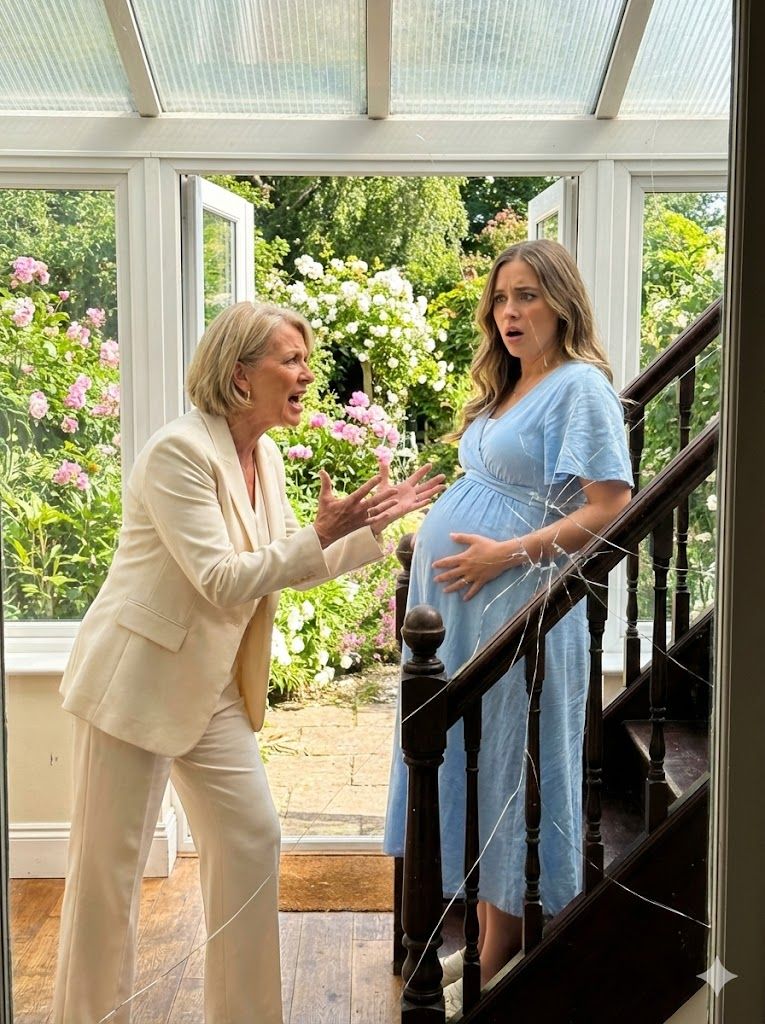
I was lying at the bottom of my grandmother’s mahogany staircase at 11:47 PM on a Tuesday night, my right leg bent at an impossible angle that made bile rise in my throat, when I heard my mother descending the stairs behind me with careful, measured steps—and realized with absolute horror that she wasn’t coming to help me.
She was coming to make sure I wouldn’t survive.
“Mom,” I gasped, my voice weak and thready with pain and shock. “Call 911. Please. I think my leg is broken. I can’t feel my foot. I need—”
“You shouldn’t have been so nosy, Bethany,” my mother said, her voice cold and emotionless in a way I’d never heard in my thirty years of life. It was like listening to a stranger. “If you’d just signed the papers like I asked three weeks ago, none of this would have been necessary. But you always were stubborn. Just like your grandmother.”
The papers. The transfer documents I’d found in her locked desk drawer just an hour ago when I’d come to Grandma Ruth’s house—now my mother’s house since Grandma had died six weeks ago—to collect some of my childhood photos. Papers transferring my inheritance from my late grandmother’s estate into my mother’s name. Papers that already had my signature on them.
Except I’d never signed them.
“You forged my signature,” I said, each word an effort through the white-hot pain radiating from my shattered leg. “You were going to steal my inheritance. The $450,000 Grandma Ruth left specifically to me—”
“It’s not stealing when I’m your mother,” she interrupted, standing over me now, backlit by the hallway light so I couldn’t see her face clearly. “I raised you. I sacrificed everything for you. That money should have been mine in the first place. Your grandmother was a vindictive old woman who never appreciated me, never gave me what I deserved. But she’s dead now and I’m taking what’s rightfully mine.”
“Grandma left it to me because she knew you’d waste it,” I managed, my vision starting to blur at the edges. “She knew exactly what kind of person you are. She told me before she died—she said you only cared about money, that you’d been pressuring her to change her will, that she couldn’t trust you—”
That’s when my mother had pushed me.
I’d been standing at the top of the stairs, holding the forged documents, confronting her about what she’d done. She’d tried to grab the papers from my hands. I’d pulled back. And then—one hand on my shoulder, one hard shove—and I was falling backward into nothing.
Fifteen hardwood steps. My body hit each one with sickening thuds—shoulder, hip, back, head—tumbling like a ragdoll until I crashed at the bottom in a heap of broken bones and disbelief.
Now my mother stood over me, and in her hand was the heavy crystal vase from the hallway table—Grandma Ruth’s favorite Waterford piece, worth at least $3,000. She was gripping it by the neck like a club.
“This is going to look like a tragic accident,” my mother said, her voice eerily calm. “You came to the house late at night to go through your grandmother’s things—you’ve been so emotional since she died, so grief-stricken. You were walking around in the dark, not thinking clearly. You tripped on the stairs. Fell. Hit your head on this vase that was sitting on the table. By the time I arrived tomorrow morning to check on the house, you were already gone. So sad. So tragic. Everyone will understand.”
“You planned this,” I whispered, the pieces clicking together even through my shock. “You asked me to come here tonight. You said you wanted to go through Grandma’s jewelry together, wanted my help deciding what to keep. But you wanted me here alone so you could—”
“So I could take care of the problem,” she finished. “The problem being you and your ridiculous sense of entitlement to money you didn’t earn. Do you know how much debt I’m in, Bethany? Do you know how close I am to losing everything? The house is mortgaged to the breaking point. My credit cards are maxed out. I need that inheritance. And legally, as your next of kin, if you die it comes to me anyway. So really, this is just… expediting the inevitable.”
“You’re going to murder me,” I said, the words surreal even as I spoke them. “Your own daughter. For $450,000.”
My mother’s face twisted with rage. “I gave you thirty years of my life! Thirty years of my youth, my beauty, my potential! Do you know what I could have been if I hadn’t gotten pregnant with you at twenty-two? The career I gave up? The marriage I could have had? I was going to be someone, Bethany. I was going to matter. But I got stuck raising you instead, and my life became nothing.”
“That’s not my fault—”
“Your grandmother always took your side,” she continued, as if I hadn’t spoken. “From the day you were born, she loved you more than she ever loved me. Her golden grandchild. Her little genius. She bought you everything, paid for your college, helped with your student loans. And what did she give me? Criticism. Judgment. Lectures about my spending habits and my choices. She made me feel like a failure my entire life. Well, now she’s gone, and you’re going to be gone, and finally—finally—I’ll get what I deserve.”
She raised the crystal vase above her head.
I closed my eyes, thinking about the phone in my pocket. The iPhone I’d slipped out when I first found the forged documents. The one I’d used to call my best friend Jessica and tell her I needed backup, that something was wrong. The one that had been livestreaming video to Jessica’s phone for the last twenty minutes because I’d had a terrible feeling about confronting my mother alone.
The phone that had captured everything—the forged documents, the confession, the push down the stairs, and now this murder attempt.
I heard the crash of breaking glass and splintering wood. My eyes flew open.
The front door had burst inward, hanging off its hinges. My best friend’s fiancé Marcus—a police officer with the Portland PD—was charging through with his service weapon drawn, tackling my mother to the ground before the vase could complete its downward arc toward my skull.
The crystal shattered on the hardwood floor inches from my head, spraying shards across my face.
“POLICE! DON’T MOVE!” Marcus shouted while my mother screamed and fought beneath him, clawing at his arms, shrieking that this was assault, that she was the victim, that I had attacked her.
“Bethany!” Jessica was beside me, her face white with terror, tears streaming down her cheeks. She was holding her phone—still livestreaming, still recording. “Oh my God, don’t move, honey. Don’t try to move. Ambulance is already on the way. I got everything. Every single word. The whole livestream recorded everything she said.”
More police officers were flooding into the house. Someone was reading my mother her rights while two officers held her arms as she continued to scream and struggle. Another officer was kneeling beside me, checking my vitals, telling me to stay still, that help was coming.
“The documents,” I managed, my voice barely a whisper. “In my jacket pocket. She forged my signature. It’s fraud.”
Jessica carefully retrieved the papers from my jacket, handling them like evidence, which they were.
“I’ve got them,” she said. “I saw them on the livestream too. You were recording when you found them.”
Marcus approached, having handed my mother off to two other officers who were forcibly restraining her in handcuffs while she continued to shriek.
“Ma’am,” he said to me, his voice professional but gentle. “I’m Officer Marcus Stone. Your friend Jessica called me when you started the livestream. She was watching it and saw what was happening. We got here as fast as we could. Can you tell me what happened here tonight?”
Despite the agony in my leg—and what I was increasingly certain was a concussion from hitting my head—I gave a clear statement. The forged inheritance papers. My mother’s confession. The deliberate push down the stairs. The attempted murder with the vase.
Another officer was photographing everything. The stairs where I’d fallen. The shattered crystal. My broken body. The forged documents.
A detective arrived—an older woman named Hernandez who knelt beside me and spoke with surprising gentleness. “Ms. Chen, we have the livestream recording. We have the forged documents. And we have approximately six officers who heard your mother’s confession. This is one of the clearest cases I’ve seen in twenty years. But I need you to know—this is going to be difficult. She’s your mother. Are you prepared to press charges?”
I looked across the foyer to where my mother was now handcuffed, still screaming. She saw me looking and her face contorted with rage.
“You ungrateful bitch!” she shrieked. “After everything I did for you! You’re going to send your own mother to prison? You’re going to destroy our family?”
“You tried to kill me,” I said, my voice steady despite the pain. “You pushed me down the stairs and tried to bash my head in with a vase. For money. You destroyed our family yourself.”
“Ma’am,” Detective Hernandez said to my mother, “you have the right to remain silent. I suggest you use it.”
But my mother couldn’t stop. “She’s lying! She attacked me! I was defending myself! She came here to rob the house—”
“Ma’am, we have video evidence of you confessing to forgery and attempted murder,” Hernandez said flatly. “You have the right to remain silent. I strongly suggest you exercise that right.”
The paramedics arrived. As they loaded me onto a stretcher, I heard Detective Hernandez formally arresting my mother.
“Linda Chen, you’re under arrest for attempted murder in the first degree, assault in the first degree, fraud, forgery, and theft. You have the right to remain silent…”
My mother’s screams followed me all the way to the ambulance.
Jessica rode with me to the hospital, holding my hand, crying.
“I thought we were going to lose you,” she sobbed. “When I saw her standing over you with that vase, I thought Marcus wouldn’t get there in time—”
“But he did,” I said. “You saved my life, Jess. If you hadn’t been watching that livestream—”
“I’ll always be watching out for you,” she promised.
At the hospital, doctors confirmed a compound fracture of my right tibia and fibula, a concussion, three cracked ribs, and extensive bruising. Surgery was scheduled for the next morning.
But I was alive. And my mother was in custody.
By morning, the story was everywhere.
The Backstory: A Lifetime of Narcissism
To understand how my mother became capable of attempted murder, you need to understand our entire relationship—thirty years of narcissism, manipulation, and emotional abuse that I’d normalized because it was all I’d ever known.
My mother, Linda Chen, was twenty-two when she got pregnant with me. She’d been a college sophomore, studying fashion design, dating my biological father—a man I never met because he disappeared the moment she told him she was pregnant.
My grandmother Ruth told me the truth when I was sixteen: “Your mother wanted to give you up for adoption. She didn’t want to be a mother. She wanted to finish school, move to New York, become a fashion designer. But I convinced her to keep you. I told her I’d help raise you, that she could still pursue her dreams. I thought having a baby would mature her, teach her responsibility and love.”
It hadn’t.
My earliest memories are of my mother resenting me. Sighing heavily when I asked for attention. Dropping me at my grandmother’s house for days at a time. Forgetting to pick me up from school. Making it clear through a thousand small cruelties that I was a burden she’d never wanted.
“Your mother loves you,” Grandma Ruth would say, making excuses. “She’s just young. She’s still figuring things out.”
But as I got older, I realized it wasn’t youth. It was narcissism.
My mother was obsessed with herself—her appearance, her status, her desires. I existed only as an extension of her. When I made her look good—got good grades, won awards, behaved perfectly—she paraded me around like a trophy. When I failed to reflect well on her, she punished me with cold silence or cutting remarks.
“You’re so selfish, Bethany. You never think about how your actions affect me. Do you know how embarrassing it is to have a daughter who’s overweight? People judge me.”
I was eleven. I weighed 90 pounds.
“You’re wearing that to the recital? You’re going to make us look poor.”
I was wearing a dress my grandmother bought me. It was beautiful. But it wasn’t designer.
“Your grandmother spoils you. She’s turning you against me. She always takes your side.”
This was her constant refrain. That Grandma Ruth loved me more than her own daughter. That it was unfair. That I was stealing the love she deserved.
The truth was more complicated. Grandma Ruth did love me fiercely—but it was because she was trying to compensate for my mother’s emotional absence. And she did criticize my mother—but only when my mother’s behavior was genuinely harmful.
Like when my mother got engaged to James, her third fiancé in five years, and tried to use my college fund to pay for an elaborate destination wedding.
“That money is for Bethany’s education,” Grandma Ruth had said firmly. “I set it up specifically for that purpose.”
“I’m her mother. I should have access to it.”
“No. You’ve proven you can’t be trusted with money.”
That conversation—which I’d overheard at age fifteen—had set the template for the next fifteen years. My mother felt entitled to everything my grandmother gave me. Every dollar, every gift, every opportunity was something she believed should have been hers instead.
When I graduated college debt-free thanks to Grandma Ruth’s college fund, my mother complained that it wasn’t fair she’d had student loans.
When Grandma Ruth helped me with the down payment on my first apartment, my mother demanded equal money for a “vacation fund.”
When Grandma Ruth took me to Europe for my thirtieth birthday, my mother didn’t speak to either of us for three months.
The resentment festered like an infected wound. And I—desperate for my mother’s love, still hoping she’d someday actually want me—kept trying to bridge the gap.
“Maybe if you spent more time with her,” Grandma Ruth suggested gently. “She’s your mother. She must feel left out.”
So I tried. Invited her to dinners. Included her in my life. Told her about my job, my friends, my hopes.
She responded with criticism. “That job doesn’t pay enough.” “Those friends aren’t good enough for you.” “You’ll never find a husband if you keep gaining weight.”
I was 130 pounds and healthy. But to my mother, I was always deficient.
The worst part? I’d internalized it. Believed I was the problem. That if I just tried harder, was better, achieved more, she’d finally love me.
Then Grandma Ruth got sick.
The Death of Grandma Ruth
Grandma Ruth was diagnosed with pancreatic cancer at age seventy-eight. Stage four. Inoperable. Six months to live, maybe less.
I took family leave from my job as a social worker to care for her. Moved into her house. Handled her medications, her doctor appointments, her pain.
My mother visited twice in six months.
“I can’t handle seeing her like this,” she told me when I begged her to visit more often. “It’s too painful. You don’t understand because you’re not her daughter.”
“I’m her granddaughter. I love her too.”
“It’s not the same.”
In Grandma Ruth’s final weeks, when she was mostly bedridden and heavily medicated, she called me to her bedside.
“I need to tell you something about the will,” she said, her voice weak but clear. “I’m leaving the house to your mother—she’s my daughter and she deserves to inherit the family home. But the money—$450,000 in savings and investments—I’m leaving that to you.”
“Grandma, you don’t have to—”
“I do. Your mother is terrible with money. She’ll waste it on luxury items and vacations, and within two years it’ll be gone. But you’re responsible. You’ll invest it, save it, use it to build a real future. And Bethany—” She gripped my hand with surprising strength. “Don’t let her manipulate you into giving her access to it. She’ll try. She’ll tell you it’s not fair, that as her daughter you should share. But that money is for YOUR future, not her present. Promise me.”
“I promise, Grandma.”
“There’s something else. Your mother has been pressuring me to change my will. She wants me to leave everything to her—says it’s traditional, that it should all go to the child first. She’s even brought lawyers here, tried to convince me I’m being manipulated by you. But I know what I’m doing. This will is how I’m protecting you after I’m gone.”
“Why would she do that?”
Grandma Ruth’s expression was sad. “Because your mother doesn’t love people. She loves what people can give her. And I finally accepted that includes me. Maybe especially me, because I raised her and she blames me for every disappointment in her life.”
“That’s not true. You were a wonderful mother—”
“I was an imperfect mother who did her best. But Linda needed something I couldn’t give her—she needed the world to revolve around her, and I couldn’t make that happen. So she resents me. And she resents you because I give you the love she thinks should be hers. But the truth is, Bethany, you’re easy to love. You’re kind and giving and thoughtful. Your mother is… not. And I’m done pretending otherwise.”
Two weeks later, Grandma Ruth died peacefully in her sleep with me holding her hand.
My mother arrived three hours after she died, dressed in designer black, crying dramatically for the hospice nurses but dropping the act the moment we were alone.
“When is the will reading?” she asked.
That’s all she wanted to know. Not how Grandma Ruth had died. Not whether she’d been in pain. Just when she’d inherit.
The Will Reading
The attorney read the will two weeks after the funeral. My mother, my grandmother’s attorney Richard Chen (no relation), and I sat in his office while he outlined the estate.
“To my daughter Linda, I leave my house and all personal property within it, with the exception of items specifically bequeathed to my granddaughter.”
My mother smiled. The house was worth at least $600,000.
“To my granddaughter Bethany, I leave all liquid assets, investment accounts, and monetary holdings, totaling approximately $450,000.”
My mother’s smile vanished. “What?”
“Additionally, I leave to Bethany my jewelry collection, my china, and my grandmother’s antique writing desk.”
“That’s not fair!” my mother burst out. “I’m her daughter! Everything should come to me first!”
“Mrs. Chen, your mother had the legal right to distribute her estate as she wished,” the attorney said calmly. “This will was properly executed, witnessed, and is entirely valid.”
“She was manipulated! My daughter manipulated a dying woman—”
“Mrs. Chen, I personally witnessed the creation of this will. Your mother was of sound mind and made her wishes explicitly clear. She anticipated your objections and left a letter explaining her reasoning. Would you like me to read it?”
“Yes,” I said before my mother could refuse.
The attorney opened a sealed envelope and read:
“To my daughter Linda: I’m leaving the house to you because it’s your childhood home and because you’re my daughter. But I’m leaving the money to Bethany because I trust her to use it wisely. You have spent your entire adult life in debt despite a good income because you prioritize luxury over stability. I enabled this behavior by bailing you out repeatedly, and I was wrong to do so. I’m not enabling it further from beyond the grave.
Bethany is not your retirement plan. She is not responsible for your financial mistakes. And she is not required to share her inheritance with you. I’m leaving her this money to secure HER future, not fund YOUR present.
If you’re angry reading this, Linda, I suggest you examine why you feel entitled to money I earned rather than being grateful for the valuable real estate I’m giving you. But I suspect that kind of self-reflection is beyond you. Regardless, my decision is final.
Bethany, use this money to build the life you deserve. Don’t let anyone—including your mother—make you feel guilty for having it.”
The attorney finished reading. The office was silent.
My mother’s face was white with rage. She stood abruptly, knocking her chair backward.
“This is bullshit. You poisoned her against me, Bethany. You manipulated her, stole my inheritance—”
“Linda, I’m going to have to ask you to leave,” the attorney said firmly. “The will is valid and will be executed as written.”
“I’ll contest it! I’ll get lawyers—”
“You can try. But I assure you, this will is ironclad. Your mother took great care to ensure it couldn’t be challenged.”
My mother stormed out, slamming the door hard enough to rattle the pictures on the wall.
“I’m sorry you had to witness that,” the attorney said to me.
“I’m used to it,” I said quietly.
What I didn’t know was that my mother was already planning to steal the inheritance anyway.
The Three Weeks Before
After the will reading, my mother’s behavior became increasingly erratic. She called me multiple times a day demanding I “share” the inheritance.
“It’s the right thing to do. I’m your mother. Family shares.”
“Grandma was very clear about what she wanted, Mom.”
“She was a bitter old woman who played favorites. But we don’t have to honor that. You and I can split the money evenly. That’s fair.”
“I’m not doing that.”
The calls escalated to texts. Then to showing up at my apartment. Then to threats.
“If you don’t share that money with me, I will make your life hell. I will tell everyone what a selfish, greedy person you are. I will make sure our whole family turns against you.”
“What family, Mom? It’s just you and me. And I’m not giving you my inheritance.”
That’s when the tactics changed. She started love-bombing me—suddenly acting like a loving mother, inviting me to lunch, asking about my life, pretending to care.
I was suspicious but hopeful. Maybe Grandma’s death had changed her. Maybe she was finally ready to have a real relationship.
I was so stupid.
Three weeks after the will reading, she called me.
“I’ve been going through Mom’s things at the house. There’s so much jewelry and personal items. Would you come over tomorrow night and help me sort through what you’d like to keep? I want to make sure you get the pieces that meant the most to you.”
It sounded reasonable. Loving, even.
“Sure, Mom. What time?”
“Come around eleven. I know it’s late, but I have a work thing until ten and I really want to do this together.”
I should have known something was wrong. Eleven PM was an absurd time for sorting jewelry. But I wanted to believe my mother was finally being genuine.
So I went.
And I walked into a trap.
The Confrontation
I arrived at Grandma Ruth’s house—now my mother’s house—at 11:15 PM. The porch light was on but the interior was dark except for a single lamp in the living room.
My mother answered the door looking tense.
“You’re late,” she said.
“By fifteen minutes. The traffic—”
“Just come in.”
Something felt off. The house was too quiet. Too dark. And my mother’s body language was wrong—stiff, nervous, like she was bracing for something.
“Where’s the jewelry?” I asked.
“Upstairs. In Mom’s bedroom. But first, I need you to sign something.”
She handed me a manila folder. Inside were legal documents—transfer papers for the inheritance Grandma Ruth had left me.
I read the first page. Then the second. My hands started shaking.
“These papers transfer my inheritance to you,” I said slowly.
“They formalize what should have happened anyway,” my mother said. “The money should be split evenly between us. These papers just make it legal.”
“No.”
“Bethany, be reasonable—”
“No, Mom. This is my inheritance. Grandma left it to me specifically. I’m not signing it over to you.”
My mother’s expression hardened. “I think you will.”
“Why would I?”
“Because if you don’t, I’ll make your life hell. I’ll tell everyone you manipulated Grandma Ruth. I’ll destroy your reputation. I’ll make sure—”
“You’ll do all that anyway,” I interrupted. “Because that’s who you are. But I’m not giving you my inheritance. I’m leaving.”
I turned toward the door.
“Bethany, wait—”
But I was already moving, pulling out my phone to call an Uber because something about this situation felt dangerous and I wanted to leave immediately.
That’s when I noticed the second folder on the hallway table. It was identical to the one she’d just shown me—same manila folder, same legal documents.
Except this one was already filled out. With my signature already on it.
I grabbed it and opened it. Transfer documents. Dated two weeks ago. With my signature—except I hadn’t signed it. I’d never even seen these documents before tonight.
“What the hell is this?” I demanded, holding up the forged papers.
My mother’s face went pale. “Where did you get that?”
“It was sitting right here. Mom, did you forge my signature? Were you planning to file these papers and steal my inheritance?”
“I wasn’t stealing anything—”
“THIS IS FRAUD!” I was shaking now, rage and betrayal flooding through me. “This is a crime! You forged legal documents to steal $450,000 from me!”
“You don’t understand the pressure I’m under—”
“I don’t care! You were going to commit fraud! You were going to rob me!”
I pulled out my phone and started photographing the forged documents. Then started recording video.
“What are you doing?” my mother asked, her voice rising.
“Documenting evidence. I’m calling the police—”
“You’re not calling anyone!” She lunged for my phone but I jerked it away, backing up—
Right to the top of the stairs.
“Mom, stop. We need to talk about this. You need to admit what you did—”
“I did what I had to do! That money should be mine! Your grandmother had no right to cut me out!”
“She didn’t cut you out! She gave you a $600,000 house!”
“I need cash, Bethany! I need money now! I’m $80,000 in debt! They’re going to foreclose on my condo! My credit cards are maxed! I need that inheritance!”
“Then you should have managed your money better! That’s not my problem!”
“You selfish little bitch—”
She grabbed for the phone again. I pulled back. And she—whether intentionally or in a moment of rage I’ll never fully know—shoved me.
Hard.
I fell backward into nothing, my arms pinwheeling, my body already twisting, knowing I was going to hit hard—
The stairs rushed up to meet me. Pain exploded through my body with each impact—shoulder, hip, ribs, head. The world spun. I heard myself screaming. Heard my mother shouting something I couldn’t process.
And then I was at the bottom, my leg screaming agony, my vision blurred, my thoughts slow and confused.
I heard my mother descending the stairs.
For one blessed moment, I thought she was coming to help me.
Then I heard her voice, cold and calculating: “You shouldn’t have been so nosy, Bethany…”
And I realized I was about to die.
But I also realized my phone was still in my pocket. The one I’d been using to record everything.
The one that was livestreaming to Jessica’s phone because I’d hit the “share” button when I started recording—a safety measure I’d set up months ago after reading too many true crime stories.
Thank God for paranoia and true crime podcasts.
I managed to croak out: “You forged my signature… you were going to steal my inheritance…”
And she confessed everything. Every word captured on video being watched in real-time by my best friend and her police officer fiancé.
When my mother raised that crystal vase to bash my skull in, I knew Jessica had heard everything. I knew Marcus would come.
I just had to survive long enough.
The crash of the front door breaking was the most beautiful sound I’ve ever heard.
The Arrest and Investigation
My mother was taken to jail still screaming. I was taken to the hospital with a shattered leg and a concussion.
But I was alive. And I had evidence.
The livestream video went viral. Within twenty-four hours, #MotherFromHell was trending on Twitter. News outlets picked up the story: “Portland Woman Attempts to Murder Daughter Over Inheritance.”
My mother’s attorney tried to spin it—she’d been defending herself, I’d attacked her, the whole thing was a misunderstanding.
Then the prosecution released portions of the livestream video. My mother’s voice, clear as day: “This is going to look like a tragic accident… by the time I found you in the morning, you were already gone… as your next of kin, it all comes to me anyway.”
The defense collapsed.
Detective Hernandez visited me in the hospital three days after my surgery.
“We’ve built an incredibly strong case,” she told me. “The forged documents, the video confession, the attempted murder—your mother is looking at twenty-five years to life if convicted on all counts.”
“Will she take a plea?”
“Her attorney has hinted at it. But she’d still be looking at ten to fifteen years minimum. This was premeditated, Bethany. She had those forged documents ready. She lured you to the house late at night. She tried to kill you when you discovered her plan. This wasn’t a momentary lapse—this was calculated murder.”
“I know.”
“I have to ask—and I know this is difficult—but do you want her to go to prison? Some families in your situation prefer to handle things privately, avoid the trial—”
“She tried to murder me,” I said flatly. “For money. I want her prosecuted to the fullest extent of the law.”
Hernandez nodded. “Good. Because frankly, people like your mother don’t stop unless they’re stopped. If she’d succeeded, she’d have gotten away with it. And she’d probably do it again to someone else.”
The Trial
Eight months later, my mother went to trial.
I testified from a wheelchair—my leg still healing, requiring three surgeries and ongoing physical therapy. I told the jury everything. The lifetime of narcissistic abuse. The obsession with money. The resentment over Grandma Ruth’s will. The forged documents. The push. The attempted murder.
The defense attorney tried to paint me as a manipulative granddaughter who’d poisoned my grandmother against her own daughter.
Then the prosecution played the livestream video.
The entire courtroom watched my mother confess to forgery and attempted murder. Watched her raise that vase over my broken body. Heard her calculated explanation of how she’d make it look like an accident.
Three jurors were crying. The defense attorney looked like he wanted to disappear.
My mother’s testimony didn’t help. She tried to claim she’d been temporarily insane with grief over her mother’s death.
“So grief made you forge documents two weeks after your mother died?” the prosecutor asked.
“I wasn’t thinking clearly—”
“Grief made you lure your daughter to an empty house late at night?”
“I just wanted to talk—”
“Grief made you push her down the stairs and then try to bash her head in with a vase?”
“She was attacking me—”
“Ms. Chen, we have video evidence of you admitting you pushed her and planned to kill her and make it look like an accident. Was that grief talking?”
My mother couldn’t answer.
The jury deliberated for ninety minutes.
Guilty on all counts. Attempted murder in the first degree. Assault in the first degree. Fraud. Forgery. Theft.
The judge sentenced her to twenty-five years in prison with no possibility of parole for fifteen years.
“You attempted to murder your own daughter for financial gain,” the judge said during sentencing. “You showed no remorse, no recognition of wrongdoing, and no empathy for your victim. You are a danger to society and to your family. This sentence reflects the severity of your crimes.”
My mother finally broke down. “I’m sorry! Bethany, I’m sorry! Please don’t let them do this to me!”
But I was done. I’d spent thirty years trying to earn the love of a woman incapable of loving anyone but herself.
I stood—still using a cane, still in pain—and looked at her directly.
“I hope you use these years to figure out why you’re like this,” I said. “I hope you get therapy and treatment and maybe, someday, become capable of actual human emotion. But I’m done trying to save you. You made your choices. Now live with them.”
I walked out of that courtroom and didn’t look back.
Five Years Later: Healing and Justice
It’s been five years since that night. Five years since my mother tried to murder me for $450,000.
I’ve had four surgeries on my leg. I still walk with a slight limp and I can’t run anymore. I have PTSD from the attack—nightmares, flashbacks, panic attacks when I’m near stairs.
But I’m alive.
I used part of my inheritance to buy a small house—nothing fancy, but it’s mine. The rest is invested, growing, securing my future just like Grandma Ruth wanted.
I wrote a book about my experience—”The Inheritance of Trauma: Surviving a Narcissistic Mother.” It became a bestseller and helped thousands of people recognize and escape toxic family dynamics.
I started a nonprofit that provides legal support to adult children dealing with financial abuse from family members. We’ve helped dozens of people escape situations like mine.
And I’ve built the family I deserved. Jessica and Marcus got married—I was the maid of honor. They have twin daughters who call me Auntie Beth. I’m dating a kind, gentle man named Thomas who works as a therapist and understands trauma. We’re taking it slow, but I think he might be the one.
I visit Grandma Ruth’s grave every month. “I used the money well,” I tell her. “Just like you wanted. I built a real life. Thank you for protecting me.”
My mother writes me letters from prison. Dozens of them. At first they were angry—blaming me for her incarceration, insisting she was the real victim. Then they became manipulative—apologizing profusely, claiming she’s changed, begging me to advocate for her parole.
I don’t respond. I have nothing to say to her.
She’ll be eligible for parole in ten more years. She’s fifty-seven now. She’ll be sixty-seven then if she gets parole, which her lawyer says is unlikely given her lack of genuine remorse.
Part of me feels sad about that. She’s my mother. Somewhere beneath the narcissism and the greed, there might be a human being capable of change.
But mostly I feel relief. She can’t hurt me anymore. She’s exactly where she belongs.
And I’m free. Free from the cycle of abuse. Free from the obligation to love someone who never loved me back. Free to build the life I deserve.
That’s the real inheritance Grandma Ruth gave me. Not the money—though that helped. But the message: You are worthy of protection. You deserve to be loved. Don’t let anyone—not even family—make you believe otherwise.
I carry that with me every day.
And I sleep soundly knowing my mother can’t hurt me or anyone else for a very long time.
Justice was served. I survived. And I won.