“Your son’s party is cancelled,” Dad texted.
I stared at the message as if staring long enough would change the words.
It was Thursday evening. I was standing at my stove, stirring pasta sauce that suddenly smelled like nothing. Gary was at the kitchen table doing homework, his pencil tapping a steady rhythm against his notebook, humming under his breath the way he always did when he felt safe.
My son was turning ten.
Ten.
The age where birthdays stop being simple cake-and-candles and start being memories you carry—proof you mattered to the people who were supposed to care.
I wiped my hands on a dish towel and read the message again.
Your son’s party is cancelled.
No question mark. No “can we talk?” No apology. Just a flat statement delivered like a weather report.
Another message followed immediately.
“Benjamin wants the trampoline park slot for the twins. Same day works better for him. You understand?”
I didn’t move for a second. The phone felt heavy in my hand. The letters blurred slightly, not because I couldn’t see them, but because my brain was trying to reject what it already knew was happening.
My name is Timothy.
I’m 32 years old.
And for most of my adult life I’ve been the dependable one—the one who shows up, the one who pays when rent comes up short, when car insurance lapses, when someone needs bail money at two in the morning.
I work as a data architect. I make good money.
My family knows this, and they’ve turned that knowledge into a permission slip.
Gary turned ten this year. He’s everything to me. Bright kid. Loves dinosaurs, basketball, and making terrible jokes that somehow always land. His birthday falls in late October, right when the leaves go gold and the air gets that crisp edge that makes everything feel sharper.
I’d been planning his party for six weeks.
Fifteen families confirmed.
Trampoline park booked under a corporate package I secured through my office connections.
Invitations sent.
Cake ordered.
Goodie bags assembled in my living room and stacked like a small warehouse operation.
I did all of it quietly, efficiently, like I always do—because in my life, if I don’t build the structure, nothing holds.
And I thought this party would be untouchable.
One afternoon where my son would be the center of attention. No drama. No family chaos. Just Gary and his friends bouncing on trampolines, eating pizza, laughing until their sides hurt.
I thought I’d finally carved out something safe.
I was wrong.
The family pattern
I grew up in a house where my brother Benjamin was the golden child.
He’s three years younger than me, always louder, always more charming in that specific way that makes parents blind. When Benjamin wanted something, it appeared. When I needed something, I was told to wait. To be patient. To understand resources were limited.
By sixteen, I’d stopped asking.
I worked weekends at a grocery store.
I saved for my own car.
I paid my own insurance.
My parents called it character building.
They called Benjamin’s lifestyle support.
That dynamic never changed.
I moved out at twenty-one.
Benjamin stayed until he was twenty-seven.
Rent free. Bills covered. Meals prepared.
When he finally left, it wasn’t because he got responsible. It was because he married Dorothy—Dorothy who came from money.
They had twins two years ago.
Loud, chaotic twins treated like royalty by my parents.
Gary, by contrast, has always been… the edge of the room.
At family gatherings he sits quietly while the twins take the spotlight—the best seats, the first servings of dessert.
And I’ve paid for things I should not have paid for.
My parents’ mortgage twice when Dad’s hours got cut.
Benjamin’s wedding venue deposit when his credit card maxed out.
Emergency vet bills for a dog that wasn’t even mine.
I never kept a running tally because that felt petty. I told myself family helps family. This is what you do when you have the means.
But there’s a difference between helping and being used.
I started noticing it more clearly after Gary was born.
The requests became demands.
The gratitude disappeared.
I would wire money and the next conversation would skip right past any acknowledgement, moving straight into the next crisis—the next bill, the next urgent expense that somehow always landed on my shoulders.
I stopped expecting thanks.
I stopped expecting fairness.
What I did not stop doing was showing up. Paying up. Keeping the peace.
And I worried what lesson my son was learning by watching me.
That quiet people get trampled.
That generosity is mistaken for weakness.
That love is measured in how much you can silently endure.
Gary’s birthday was supposed to be different.
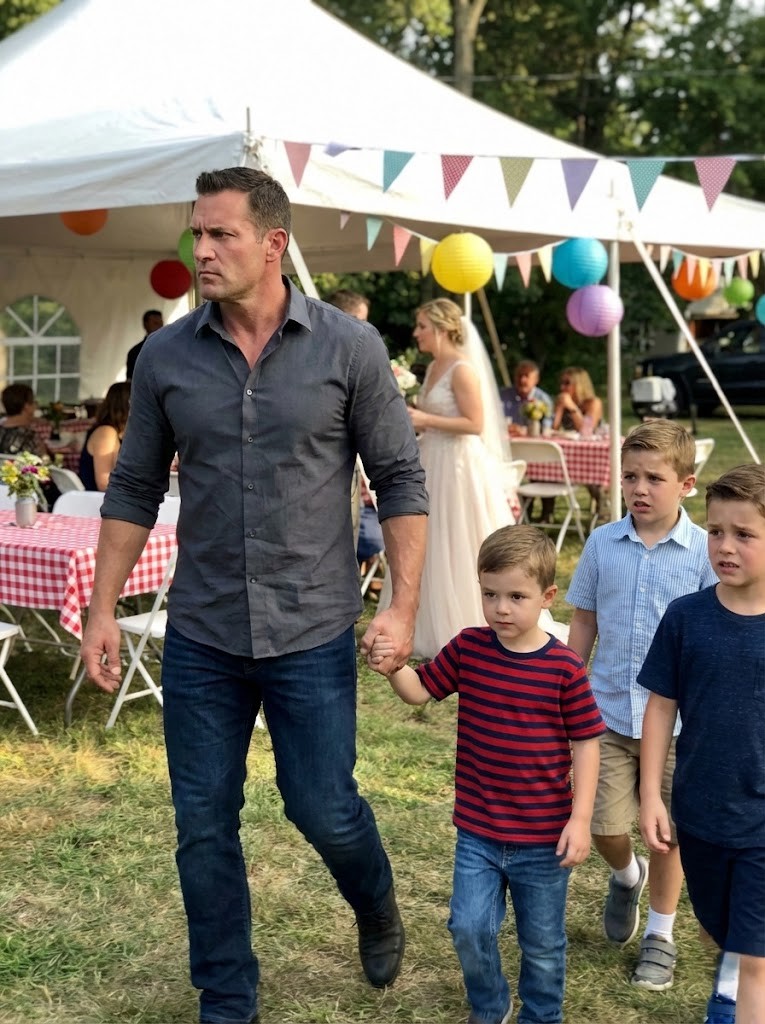
The text that erased my son’s day
I looked over my shoulder at Gary. He was still working, pencil tapping, face focused. He had no idea that his party—his day—had just been reassigned like a dentist appointment.
A third text came in:
“Benjamin already told people. Easier if you just move yours to next weekend. Thanks.”
Thanks.
As if I’d already agreed.
As if compliance was guaranteed.
My mouth went dry.
Six weeks of planning.
Fifteen families coordinating schedules.
Invitations already sent with a date and time.
And my brother decided his twins deserved that slot more.
My father decided my son’s tenth birthday could be moved.
I set the phone down on the counter carefully, like if I moved too fast I’d shatter.
Gary looked up, eyes bright and curious.
“Dad, is everything okay?”
I forced a smile. The kind that doesn’t reach your eyes but convinces a ten-year-old the world is stable.
“Yeah, buddy,” I said. “Everything’s fine.”
He went back to his math problems.
I turned toward the stove, stirring pasta sauce I couldn’t taste.
But my mind was moving too fast for food.
I pulled up my email on my phone and found the trampoline park confirmation.
Corporate package.
72-hour cancellation policy.
Non-transferable without written authorization from the booking party.
The reservation was under my name, my company code, my credit card.
Benjamin could want that slot all he liked.
He didn’t have it.
I did.
And in that moment, something in me went very calm.
Not soft.
Not forgiving.
Calm like a locked door.
I typed my response to my father.
Two words. No argument. No explanation.
That’s fine.
I knew exactly what those words would do.
They would confirm their assumption that I folded.
That I accepted the reassignment.
That I would quietly move my son’s party and let Benjamin take over.
They would feel satisfied.
Problem solved.
Timothy handled it.
I hit send.
Then I opened a new browser tab.
Within fifteen minutes, I researched every indoor party venue within a twenty-mile radius.
Trampoline parks.
Laser tag arenas.
Arcade centers.
Climbing gyms.
And I found it:
Apex Adventure Zone.
Brand-new facility. Three-story laser tag course. Full arcade. Private party suites with custom lighting and sound systems.
They had availability on the same day. Same time slot.
The price was double what I’d paid for the trampoline park.
I booked it immediately.
Deposit sent.
Confirmation email received.
Then I did something I rarely do.
I called every single family on Gary’s guest list.
Fifteen calls.
I kept it simple: venue change, new location, upgraded experience.
No one asked why.
No one hesitated.
They all said they’d be there.
I updated the invitations and sent a group text with the new address.
Gary looked up again, confused by the sudden phone activity.
“Did something happen with my party?”
I looked at my son—his tenth birthday, his one day—and I kept my voice light.
“Yeah,” I said. “We’re upgrading.”
His face lit up instantly.
He didn’t need to know the rest.
Not yet.
I deleted my father’s texts.
Then I sat down and helped Gary finish his math homework as if the world hadn’t just tried to steal his day.
But inside, my mind was already three steps ahead, calculating exactly how this was going to play out.
(Part 2) — Faithful to the transcript
That night, after I told Gary we were “upgrading,” I tucked him into bed like everything was normal.
He fell asleep fast—ten-year-old nervous excitement, brain buzzing with trampoline thoughts and pizza and friends. I stood in his doorway for a moment longer than usual, watching his chest rise and fall, trying to memorize the safety of it.
Because my own body didn’t feel safe.
My mind kept looping around the text my father sent as if it was a siren that wouldn’t turn off.
Your son’s party is cancelled.
The casual cruelty of it.
The assumption that I would simply comply.
The complete absence of any thought for Gary.
Not a single sentence like, “I know you planned a lot.”
Not a single “Sorry.”
Just: erased.
As if my son’s birthday was a placeholder event.
As if my brother’s wants were priority and my son’s joy was negotiable.
I lay in bed staring at the ceiling, replaying the words and the tone behind them, and I realized something that should have been obvious years ago:
This wasn’t new.
It was just the clearest version of the pattern.
I thought about the mortgage payments I made for my parents. Twice.
I thought about the wedding venue deposit I covered when Benjamin maxed out his credit card.
I thought about the car repairs I paid for when Benjamin’s transmission failed and he called me at midnight, stranded on a highway, expecting me to wire money before morning.
And I remembered how quickly I did it.
Not because it was easy.
Because I didn’t know how to do anything else.
I’d trained myself to show up.
To pay.
To keep the peace.
The transactions only moved in one direction.
I gave.
They took.
And after a while they stopped seeing it as generosity.
They saw it as my role.
My function.
I was the emergency fund.
The backup plan.
The silent system that kept their lives running while mine stayed on hold, waiting for the next crisis.
At 2:00 a.m., I rolled over and checked my phone.
No new messages.
My father probably assumed the issue was resolved.
Benjamin probably already had the trampoline park “secured” in his head.
My brother likely thought he’d won the slot the moment Dad texted me.
He didn’t understand contracts.
He didn’t understand reservations.
He understood pressure.
And he assumed pressure always worked on me.
I opened my email again and pulled up the trampoline park confirmation.
The cancellation clause was clear.
72 hours notice required.
Only the primary account holder could authorize changes or transfers.
That was me.
Not my father.
Not Benjamin.
Me.
I had not cancelled.
I had not transferred.
All I had done was type two words that made them comfortable.
That’s fine.
They read compliance into those words.
I let them.
Because the consequences were already scheduled for Saturday.
And for the first time in hours, I felt calm.
I didn’t need to argue.
I didn’t need to explain.
I just needed to let reality do what it does to people who assume they can take what isn’t theirs.
Saturday was going to be educational.
Friday morning: working from home, thinking backward
Friday morning I worked from home.
Gary was at school.
The house was quiet.
I should have been focused on project deadlines, but my mind kept drifting to old patterns I’d spent years trying to ignore.
When I was sixteen, I saved for eight months to buy a laptop.
Weekend shifts at a grocery store—bagging groceries, stocking shelves, minimum wage, every paycheck stashed away.
I was teaching myself Python.
Small projects.
Big dreams.
By March, I had enough.
I bought the laptop.
Not fancy. Just functional.
Two weeks later, Benjamin “needed” a car.
He was thirteen—too young to drive—but he decided he wanted to learn early and “be ready” the moment he turned sixteen.
My parents agreed.
They sold my laptop to contribute toward a used sedan.
A sedan that sat in our driveway for three years waiting for Benjamin to grow into it.
I came home and found my desk empty.
My mother explained it calmly like it was a simple household adjustment.
Family priorities.
Benjamin needed the car more than I needed the computer.
I could use the library.
I could wait.
I never got that money back.
The car became Benjamin’s the day he turned sixteen.
I took the bus to college.
That was the pattern:
My needs were temporary.
Benjamin’s wants were essential.
My savings were family resources.
His expenses were investments.
I learned not to show my parents anything I valued.
Because the moment they knew I cared, it became negotiable—transferable—available for reassignment.
When Benjamin got married, the wedding cost $40,000.
My parents covered half.
Benjamin asked me to cover the venue deposit because his credit cards were maxed and Dorothy’s parents were already paying for catering.
Three thousand dollars.
He promised to pay me back within six months.
That was four years ago.
I never saw a dollar.
At the wedding I sat at a back table with distant cousins.
Gary was five then, in a tiny suit, eating cake by himself while speeches toasted Benjamin like he was the center of the universe.
Benjamin thanked our parents for their “unconditional support.”
He didn’t mention me.
Not once.
I used to tell myself it didn’t matter.
That weddings are chaotic.
That he forgot.
But I knew the truth even back then:
I was invisible unless they needed something.
A bank account with a heartbeat.
A solution to a problem.
A backup plan.
Gary asked me once when he was eight why Grandma and Grandpa always talked about the twins but never about him.
I didn’t have a good answer.
I told him some families are just louder.
That it didn’t mean anything.
That he was loved.
He looked at me with those serious brown eyes and said quietly:
“It’s okay, Dad. You love me. That’s enough.”
That moment broke something in me.
My son had learned to accept being overlooked.
He’d internalized the hierarchy.
And I let it happen by staying silent.
Not anymore.
Friday evening: my mother calls
Friday evening, my mother called.
“Timothy, we need to talk about tomorrow.”
I was making dinner again.
Gary was in the living room watching a documentary about space.
I put the call on speaker and kept chopping vegetables.
“What about tomorrow?” I asked.
“Benjamin is worried you might cause a scene at the trampoline park,” she said.
“He wants to make sure you understand he has the reservation now. He doesn’t want any confusion.”
I set the knife down carefully.
My hand was steadier than I expected.
“Benjamin doesn’t have the reservation.”
There was a pause.
I could hear her inhale—the beginning of one of her lectures.
“Your father told you to move your party,” she said.
“Benjamin needs that time slot. The twins have been talking about it all week.”
“You can’t just be selfish about this.”
Selfish.
Their favorite word.
The one they always used when I hesitated, when I questioned, when I dared to prioritize my own child over Benjamin.
“I didn’t move the party,” I said. Calm. Flat.
“I upgraded it.”
Another pause.
Longer.
“What do you mean upgraded?”
“Gary’s party is at Apex Adventure Zone tomorrow,” I said.
“Same time. Better venue. I already informed all the guests. Everything’s set.”
I heard confusion harden into anger.
“But Benjamin is taking the trampoline park slot. Your father arranged it.”
“Dad can’t arrange something I never cancelled,” I said.
“The reservation is under my name. My corporate account. My authorization.”
“Benjamin doesn’t have access to any of that.”
“Timothy,” she snapped, “you’re being difficult. This is family. You need to share.”
Share.
Like birthdays were a resource.
Like my son’s celebration was a commodity to distribute based on who demanded louder.
“I’m not being difficult,” I said.
“Mom, I booked a venue for my son’s birthday six weeks ago. No one asked me to change it. Dad informed me it was cancelled. That’s not how reservations work.”
“Your brother already invited people,” she insisted.
“He’s been planning this.”
“For how long?” I asked.
“Since Thursday,” she admitted.
Silence.
Then she said it anyway, like Thursday planning outweighed six weeks of work:
“Timothy, if you don’t give Benjamin that slot, you’re going to ruin his twins’ party.”
“Those children will be devastated.”
I looked toward the doorway.
Gary sat on the couch, face lit by TV glow, unaware his grandmother was arguing his birthday should be sacrificed to protect his cousins from disappointment.
“Then Benjamin should have booked his own venue,” I said.
“This is ridiculous,” she hissed. “You’re acting like a child.”
“No,” I said. “I’m acting like a father.”
“My son has a party tomorrow at a venue I booked and paid for.”
“If Benjamin wants to take his twins somewhere, he can make his own arrangements.”
“You’re being selfish, Timothy. After everything this family has done for you—”
I cut her off, voice steady.
“What has this family done for me, Mom?”
The question hung in the air like a dropped plate.
I could hear her scrambling for an answer.
“We raised you,” she said finally.
“We supported you.”
“You sold my laptop to buy Benjamin a car,” I said.
“You asked me to pay for his wedding and never paid me back.”
“You borrowed money for emergencies that turned out to be vacations.”
“I’ve covered bills and deposits and repairs for years. I’ve never said no. Not once.”
“And now you’re asking me to give up my son’s birthday so Benjamin can take a venue he didn’t book.”
She tried to speak.
I didn’t let her.
“I’m done, Mom.”
“Gary’s party is tomorrow at Apex. You’re welcome to come or not. That’s your choice.”
And I ended the call.
My hands shook afterward.
Not from anger.
From relief.
I’d finally said it out loud.
The ledger: $63,000+
After Gary went to bed, I sat at my desk and opened a folder I’d avoided for years.
It was a digital file organized by year—every financial transaction I’d made on behalf of my family.
I track information for a living.
Of course I tracked this too.
Even when I told myself it didn’t matter.
The numbers were startling when I looked at them all at once.
Mortgage payments: $6,000 across two incidents.
Wedding venue deposit: $3,000, never repaid.
Car repairs for Benjamin: $4,200 over three breakdowns.
Emergency vet bills: $1,800.
Credit card payments: $2,400.
Tuition assistance for Benjamin’s night classes he never finished: $5,000.
Utilities. Insurance. Groceries. Last-minute travel.
Line after line.
Thirteen years of quiet support.
Total: $63,000+
I sat back in my chair staring at the screen.
I’d given them the equivalent of a down payment.
A new car.
A year’s salary for many people.
And I’d never asked for a dollar back.
I exported the file and created a clean summary spreadsheet: date, amount, purpose.
Sorted chronologically.
Then I pulled up every confirmation email and receipt.
Mortgage. Wedding. Cars. Utilities. Medical. Education. Misc.
I wasn’t planning to send it to anyone.
Not yet.
Maybe not ever.
But I needed to see it.
To understand the scope of what I gave and what I got.
And what I got was my father texting me that my son’s party was cancelled.
I opened a new document and wrote for myself:
“I have spent 13 years being the dependable one… the one who pays without questions… That pattern ends now.”
I saved it.
Didn’t send it.
Just needed it to exist.
Then I opened the Apex confirmation email again.
Party suite reserved.
Laser tag booked.
Arcade tokens prepaid.
Catering confirmed.
Everything locked.
The trampoline park reservation was still active under my name.
I had not cancelled it.
Benjamin would show up expecting to take over a party that didn’t exist under his name.
I didn’t call the trampoline park.
I didn’t warn anyone.
I closed my laptop, turned off the lamp, and stood in Gary’s doorway watching him sleep.
Tomorrow was his birthday party.
He was going to have the best party of his life.
And he was never going to know his celebration almost got stolen.
That was enough.
I didn’t need revenge.
I needed boundaries.
And tomorrow, my family was going to learn the difference.
(Part 3) — Faithful to the transcript
Saturday arrived clear and bright—perfect birthday weather.
Gary woke up buzzing like a live wire, already talking before his feet hit the floor.
He’d been counting down for weeks, and now the day was finally here.
He ate breakfast fast. He kept asking what time we had to leave. He kept checking the goodie bags like he didn’t believe they were real. He kept laughing at his own jokes.
And I watched him and felt that familiar tug of guilt—because a part of me still wanted to keep everything peaceful.
But peace that requires your child to be erased isn’t peace.
It’s surrender.
We loaded the car with the cake, the goodie bags, and the extra supplies I always bring because I’ve learned the world rarely runs as smoothly as you hope.
The drive to Apex Adventure Zone took twenty minutes.
Gary spent all twenty minutes asking questions.
“How big is the laser tag place?”
“Do we really get our own room?”
“What arcade games do they have?”
“Do you think they have that basketball shooter one?”
“Are my friends going to freak out?”
I kept my answers light.
“We’ll see.”
“You’ll love it.”
“Yeah, it’s going to be awesome.”
I didn’t tell him about the text.
I didn’t tell him his grandfather had tried to cancel his party.
I didn’t tell him his cousins were being handed his slot like a gift.
Because today was his day.
He didn’t need the weight yet.
Not on his tenth birthday.
When we pulled into the parking lot, Gary’s jaw dropped.
The building looked massive from the outside—bright signage, big windows, flashing colored lights inside.
“Dad,” he whispered, like he was afraid if he spoke too loud the place would disappear.
“This is insane.”
I smiled. A real one.
“It’s your birthday,” I said. “Let’s go.”
Checking in: “You must be Timothy.”
The inside hit us with noise and neon the moment we walked in.
Music thumped through hidden speakers.
Colored lights bounced off polished floors.
Kids ran past carrying arcade cards, laughing, yelling, completely absorbed in the chaos.
And it wasn’t the stressful kind of chaos.
It was pure kid joy.
I walked up to the front desk and gave our name.
The coordinator stepped forward with a clipboard and a bright smile.
“You must be Timothy,” she said.
Her name tag read Kathleen.
“We have your party suite ready.”
She glanced down at her notes.
“Sixteen kids total, correct?”
“Fifteen guests plus my son,” I said. “Sixteen total.”
“Perfect,” Kathleen said. “Laser tag starts at two. Arcade tokens are loaded on these cards. Pizza arrives at three. You have the suite until five.”
She handed me a stack of arcade cards.
Gary grabbed one like it was a golden ticket.
His hands were shaking with excitement.
Then he sprinted—literally sprinted—toward the nearest game station.
I watched him go and felt something loosen in my chest.
This was what childhood should look like.
Not quiet survival.
Not sitting at the edge of the table.
Not learning to be grateful for scraps.
Just… running.
The first guests started arriving.
Parents dropped off their kids and waved.
Kids ran inside wide-eyed, already yelling Gary’s name.
Within thirty minutes all fifteen friends were there.
The noise level rose into joyful chaos.
The kind of chaos that makes you smile even when you’re tired.
We started with laser tag.
Kathleen led the group toward the entrance of the course.
The kids lined up, bouncing on their toes.
Gary stood in the middle of them, his face lit up like he was glowing from inside.
The laser tag course was three stories tall.
Ramps, tunnels, glowing barriers.
Fog in some corners.
Flashing lights.
Music pulsing.
The kids scattered the moment they were released, laughter echoing through the structure.
Gary was in his element—running, ducking, shouting, spinning around to chase friends.
I stayed on the ground floor watching him move through the course like he belonged there.
And for the first time in weeks, I felt something close to peace.
Benjamin texts me while my son is thriving
My phone buzzed in my pocket.
I didn’t check it right away.
I kept my eyes on Gary.
He came down a ramp, tagged a friend, and laughed so hard he almost tripped.
Then my phone buzzed again.
And again.
I finally pulled it out and saw the name.
Benjamin.
One message:
Where are you?
Then another:
The trampoline park says they don’t have a reservation under my name.
I stared at the screen for a moment.
Felt… nothing.
No guilt.
No panic.
No urge to fix it.
Just calm.
The calm you feel when someone finally runs into the wall they built for someone else.
I typed back:
I’m at Gary’s party.
Like I planned.
Three dots appeared.
Disappeared.
Then appeared again.
Benjamin wrote:
You didn’t cancel the reservation.
I didn’t even blink.
No.
A pause.
Then:
Why would you?
Because that’s what they expected. Because Dad said it was cancelled. Because Benjamin’s twins “needed” it. Because they assumed my compliance.
I typed:
It’s my son’s birthday.
Benjamin responded:
Dad said you agreed to move it.
I answered:
I said that was fine. I didn’t say I was canceling.
The typing dots stopped.
Then another message came through:
You did this on purpose.
You screwed me over.
I looked up.
Gary was coming down the laser tag course, sweaty and grinning, surrounded by his friends comparing scores and laughing.
He saw me and waved like I was the best person in the room.
I waved back.
Then I typed my final message:
I booked a venue for my son. You assumed you could take it. That’s not my problem.
I muted the conversation.
Slipped my phone back into my pocket.
And went back to watching Gary’s face.
Because my brother’s meltdown didn’t deserve air on my son’s day.
Pizza, cake, and the kind of happiness they never gave him
Pizza arrived at three, right on schedule.
Six large pies.
The kids demolished them in under twenty minutes.
They ate like kids eat when they’ve been running and laughing for an hour.
Greasy fingers.
Cheese stretching.
Jokes flying over each other.
Gary was in the center, talking faster than usual, cheeks flushed, eyes bright.
Then the cake.
Chocolate frosting.
Vanilla cream filling.
The bakery he loved.
Gary stood in front of it while his friends sang off-key.
He closed his eyes for a second—just long enough to make a wish—then blew out the candles in one breath.
Everyone cheered.
He laughed and covered his face like he was embarrassed, but he wasn’t truly embarrassed.
He was happy.
Pure.
Uncomplicated.
And I realized how rare that had become in our family orbit.
Because around my parents and Benjamin, there was always a hierarchy.
Always a quiet pressure to not take up space.
Always a lesson that Gary wasn’t the main event.
Here—at Apex—he was.
And that was what mattered.
One photo
Before we left, I took one photo.
Just one.
Gary and his friends in the party suite.
Balloon clusters in the background.
Arcade prizes scattered on the table.
Everyone mid-laugh, mid-mess, mid-joy.
I posted it to my private social media with a simple caption:
Best birthday ever. Worth every upgrade.
I didn’t tag my family.
Didn’t send it to the group chat.
Didn’t announce anything.
I just let it exist.
And within an hour my phone started ringing.
My mother.
My father.
Benjamin again.
I silenced the phone.
Focused on cleanup.
The party ended at five.
Parents picked up their kids.
Everyone left smiling.
Gary hugged me in the parking lot hard enough to make my ribs ache.
“Dad,” he said, breathless. “That was the best party I’ve ever had.”
I hugged him back.
“You deserved it,” I said.
We drove home in comfortable silence.
Gary leaned his head against the seat and hummed quietly, still vibrating with happiness.
My phone stayed off.
Whatever chaos was unfolding in my family could wait.
Today was about Gary.
And today had been perfect.
Sunday: 47 messages
Sunday morning, I finally checked my phone.
The family group chat had 47 messages.
I scrolled slowly, watching the meltdown unfold like a predictable script.
Benjamin had shown up at the trampoline park at 1:30 with two screaming twins, twenty kids, and Dorothy.
The front desk had no reservation under his name.
No availability.
The venue was fully booked.
He tried to use my name.
Staff explained only the account holder could authorize access.
I had not given permission.
Benjamin called my father.
My father called the trampoline park demanding they honor the reservation.
The manager explained the reservation was active, but the primary account holder hadn’t checked in, hadn’t cancelled, and hadn’t authorized any transfers.
Benjamin argued in the lobby while parents checked their watches.
Kids started crying.
Dorothy finally took the twins to a nearby McDonald’s playground.
The party dissolved into chaos.
No backup plan.
No refunds.
Just public failure.
And in the group chat:
My mother’s messages were predictable—accusations of cruelty, guilt trips about ruining the twins’ day.
My father’s messages were shorter, angrier:
You embarrassed your brother.
You owe him an apology.
I read them all and felt only tired relief.
No shaking hands.
No urge to fix.
Just a quiet confirmation:
They still believed Benjamin’s disappointment mattered more than Gary’s joy.
They still believed I was obligated to smooth it over.
They still believed my role was to pay and comply.
I typed one response into the group chat.
Just one.
I booked a venue for my son’s 10th birthday. I did not cancel it. I did not transfer it. Benjamin assumed he could take what I planned without asking. That assumption was wrong. Gary had a great party. I hope the twins are okay.
Then I muted the chat.
Blocked the thread.
No more.
Pancakes and the new baseline
Gary walked into the kitchen still half asleep and climbed onto a bar stool.
“Dad,” he said, rubbing his eyes. “Can we have pancakes?”
I smiled.
“Yeah, buddy,” I said. “We can have pancakes.”
While I mixed batter, I thought about the last thirteen years.
The loans.
The bailouts.
The invisible labor.
I had spent over $63,000 keeping my family afloat.
And in return, they tried to cancel my son’s birthday.
That was the final transaction.
The last time I would let them take without asking.
The last time I would sacrifice what mattered to keep their peace.
I flipped the first pancake.
Gary watched, swinging his legs, humming the same tune from his party.
And I realized the truth didn’t need to be dramatic to be permanent.
I was done being the dependable one.
The backup plan.
The emergency fund.
I was just going to be Gary’s dad.
And that was enough.
the end