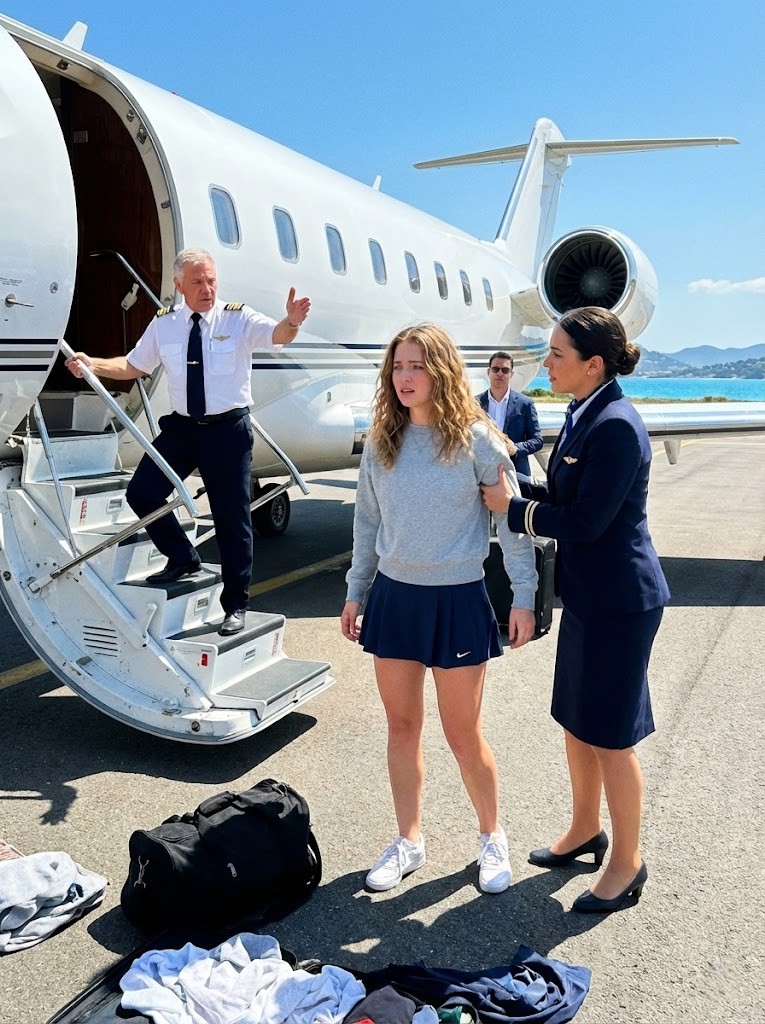
The flight attendant grabbed her arm so roughly that Victoria almost lost her balance in the aisle. First-class passengers watched with curiosity and slight disdain as the young woman, dressed in a simple gray sweatshirt, was literally dragged toward the exit. The captain, an arrogant man in his forties with his hair perfectly slicked back, stood by the steps, looking at her coldly. “People like you have no place here,” he muttered.
“You created a threat to flight safety.” Victoria wanted to say something, to explain that there had been a misunderstanding, but the words caught in her throat. Her bag was thrown behind her. Its contents scattered across the concrete runway at Nisa Airport. The steps were withdrawn. The plane door slammed shut, and there she was, alone under the scorching Mediterranean sun, watching as her own plane, one of her airline’s flagship aircraft, gained speed and lifted into the sky.
To understand how Victoria Holmes arrived at this humiliating situation, we need to go back three weeks to the luxurious office on the top floor of a glass skyscraper in London, which offered a breathtaking view of the Thames and the dome of St. Paul’s Cathedral. Victoria stood by the panoramic window, holding a cup of coffee, gazing at the city awakening to the first rays of sunlight.
She was only 28, but she had already spent five years running Asure Wings Airlines, one of the fastest-growing airlines in Europe. The company was founded by her father, Robert Holmes, a brilliant entrepreneur who started with a small plane chartering flights between London and Paris. In 25 years, he transformed the modest business into an empire with a fleet of 80 modern aircraft serving routes across Europe. When Robert died unexpectedly of a heart attack five years ago, Victoria was in her final year of business school at Oxford.
She was only 23. She always knew that sooner or later she would join the family business, but she never imagined it would happen so soon and so tragically. The board wanted to appoint a temporary administrator, but Victoria’s mother, Isabel Holmes, an elegant woman with an iron will, insisted that her daughter immediately take her father’s place. “This is your father’s company,” Isabel said, squeezing her daughter’s hand on the day of the funeral. “He built it for you.”
Don’t let strangers decide the fate of your legacy. And Victoria shouldered an incredible burden on her fragile shoulders. The first two years were a nightmare. She worked 18 hours a day studying every aspect of the business: finance, logistics, human resources, marketing. Many in the company doubted her. They said behind her back that the young woman couldn’t do it, that the business would collapse. But Victoria proved that she inherited not only the company from her father, but also his business acumen.
She optimized the route network, secured advantageous contracts with airports, implemented modern reservation technologies, and most importantly, never forgot that service is at the heart of everything. Her father always said that the airline exists for the passengers, not the other way around. Victoria made the customer experience her priority. Azur Wings became known for its impeccable service, punctuality, and attention to detail. Over the past year, the company’s revenue has grown by 30%. The stock price has soared.
Financial magazines hailed Victoria as one of Europe’s most promising young businesswomen. But success came at a price. She barely saw her friends, didn’t go on dates, and lived in her Kensington penthouse, almost like a hermit, completely immersed in her work. “Miss Holmes, we have a problem with the flight from Barcelona to Milan.” Her assistant Sofia’s voice pulled Victoria from her thoughts. She turned around. Sofia Dupont, a petite French woman of about 35, had been with her from the start.
Her father hired Sofia a year before his death, and she became not just an assistant, but a true support for Victoria. “What happened?” Victoria asked, setting her cup down on the table. “The lead pilot got sick an hour before takeoff. The backup is in Paris now. He won’t make it in time. The passengers are already on board. They’re starting to get nervous.” Sofia glanced at the tablet, quickly scanning the information. “Cancel the flight.” Victoria frowned.
She hated cancellations. They undermined the company’s reputation. We can, but there’s a business delegation. They have to be in Milan tonight for important negotiations. Plus, three families with children. If we cancel, we’ll be bombarded with negativity. Sofia looked up from the screen. Victoria pondered. Options raced through her mind. Contact other airlines. Too long. Find a freelancer. Unreliable. “Do we have pilots available in Barcelona?” she asked. “I’m checking.” Sofia’s fingers flicked across the screen.
“There is one, Tomás Clarkson, but he’s resting after a night flight from Bucharest. Contact him.” Offer him double pay for an urgent call. Victoria was already heading to her desk and told to keep me informed. The next few hours passed at the usual pace of work: meetings, calls, reports. By midday, the flight problem was resolved. Captain Clarkson agreed to go to work, and the plane took off only 40 minutes late. Victoria personally called the head of the business delegation, apologized for the inconvenience, and offered a discount on future flights.
The client was satisfied. That evening, when the office emptied, Victoria was still sitting at her massive dark wood desk, reviewing financial indicators. Charts and graphs flickered on the computer screen. Revenue was growing, but so were expenses. Fuel was getting more expensive, and competition was intensifying. A new budget airline, Skyfast, had begun aggressive dumping, luring passengers with low prices. Victoria leaned back in her chair and rubbed her tired eyes. Sometimes she felt incredibly alone at the top of this empire.
She had no one to share her doubts and fears with. Her mother lived on the country estate in the Cotswalls and rarely came to London. Her university friends had long since started their own families and careers, and Victoria was left alone with her planes, reports, and endless responsibility for thousands of people, employees and passengers. The phone vibrated. A message from Sofia. Don’t stay late, boss. Tomorrow is an important day. Board meeting, 9 a.m.
Victoria smiled. Sofia always looked after her like an older sister. She gathered her things, turned off the office light, and took the elevator down to the underground parking garage. Her Rover Ranch was waiting in her personal spot. Victoria sat behind the wheel but didn’t start the engine. Instead, she took out her phone and opened the photo gallery. She scrolled through the old pictures. There she was with her father at the opening of the new road to Athens. Roberto Holmes, a tall, gray-haired man with kind eyes and a broad smile, had his arm around his daughter’s shoulders.
They both looked happily at the camera. This was six months before her death. Victoria was still a student then. She came during the holidays, and her father drove her to the ceremony. “Someday all this will be yours,” Vicky said then, sitting next to her on the plane back to London. “But remember, business isn’t just about numbers and profits; it’s about people—our employees, our passengers. Never forget the people.” Victoria wiped away an involuntary tear and started the car. It was time to go home.
The board meeting the following morning was tense. Chief Financial Officer Ricardo Wilkins, a man in his fifties with a perpetually scowl, presented a grim forecast. “If SkyFast continues to cut prices at this rate, we’ll lose up to 15% of passenger traffic on key routes by the end of the year,” he said, pointing to a screen displaying charts. “We need to either lower our own fares or find other ways to retain customers.” “Lowering fares will kill our margin,” Victoria objected.
We can’t compete with low-cost carriers on price. Our strength lies in the quality of our service. But passengers don’t care about service if the price difference is €50. Jaime Collins, marketing director specializing in short-haul flights, chimed in. So, we need to show them that our service is worth those €50. Victoria got up and started pacing the room. Strengthen the loyalty program, improve the in-flight meals, expand online check-in options, make flying with Asure Wings not just a point-to-point transfer, but a pleasant experience.
All of this requires investment. Wilkins looked at her skeptically. “I know.” Victoria returned to her place at the head of the table. “But I’m willing to make it. Prepare a detailed plan. Calculate how much we need. We’ll discuss it next week.” The meeting ended. The directors dispersed, leaving Victoria alone with her thoughts. She understood she was taking a risk, but standing idly by and watching the competitors take over the market wasn’t in her nature. Victoria spent the next few days in continuous meetings and negotiations.
She personally visited the company’s training center where new flight attendants were trained to ensure service standards were met. She toured the hangars where aircraft maintenance was performed. She met with food suppliers to discuss menu improvements. But one morning, while reviewing reports, Victoria stumbled upon some strange information. Several passengers were complaining about rude treatment by the crew on flights from Nissa. This was unusual. Azur had always been known for its courteous staff.
Victoria asked Sofia to gather more details. By evening, the picture had become clearer. All the complaints concerned the same crew working the Nissan-London route. Captain David Hartley. Victoria frowned. She didn’t recognize that name among the pilots. She asked the Human Resources Department to send her his file. When the file arrived, Victoria studied it carefully. David Hartley, 42 years old, 10 years of experience in civil aviation. He previously served in the air force. He joined Asure Wings 8 months ago, hired by the regional manager in Nissan.
On paper, everything seemed clean, but something alerted Victoria. She called the head of security. “Pedro, I need an additional check on one of our captains. David Harley is based in Nisa. Gather everything you can find. I want to know who I’m dealing with.” Pedro Graves, a former police officer in his fifties, agreed without question. He had worked for Victoria’s father for over ten years and was one of the few people she trusted completely. Two days later, Pedro arrived at her office with a thick folder.
This is what I managed to unearth. He placed the folder on the table. David Harley did indeed serve in the Air Force, but he was discharged for a breach of discipline and a conflict with his superiors. The details are classified, but through unofficial channels I learned that the matter involved abuse of authority and rude treatment of subordinates. After that, he worked for a while with small charter companies. He didn’t stay long anywhere; conflicts abounded. There’s also information about his alcohol problems and how he came to us.
Victoria glanced through the documents. The regional manager at Nisa, Antonio Duboa, hired him without thorough vetting. Formally, all the paperwork was in order, the license was valid, but the references from previous employers were lacking. Pedro shook his head. Either they weren’t requested or they were ignored. Besides, Hartley and Duboa are friends. They spend time together frequently. We need to investigate. Victoria closed the folder. But I need facts, not rumors. I’ll go to Nisa myself. I’ll see what’s going on there. Victoria, that’s not your job.
Pedro frowned. “Send an inspector.” “Pedro, this is my company,” she said, looking at him firmly. “And if something bad is happening there, I want to see it with my own eyes. Besides, it’s been a while since I’ve been in the field. I need to understand how our flights really operate.” So, Victoria made the decision that would change her life. She decided to fly to Nisa incognito, not as the airline owner in a business suit and security detail, but as an ordinary passenger. She would buy a ticket on the flight commanded by Captain Harley and see how he really behaved.
Sofia was against it. Victoria, this is crazy. What if something goes wrong? What if they recognize you? No one will recognize me. Victoria was already thinking about the details. I rarely appear in public. Most employees only know me from corporate photos where I’m in business suits and have my hair done. I’ll wear jeans, a sweatshirt, my hair in a ponytail, minimal makeup. I’ll look like an ordinary tourist. Besides, I’ll be flying under my mother’s maiden name, Grant.
Victoria Grant is a common name. No one will connect the dots. But why all the fuss? Come officially, conduct an inspection. Then everyone will be on high alert, Victoria explained. Harley and her team will be angels. I won’t see the real picture. I don’t need to see them in their natural environment. Sofia sighed, realizing it was impossible to convince her boss. Fine, but at least take Pedro with you, so he can fly separately just in case. Victoria agreed. It was a reasonable compromise. Three days later, Victoria was at the Hidro airport terminal, feeling uneasy.
She was dressed in simple blue jeans, a gray hoodie, and white sneakers, her blonde hair pulled back in a messy ponytail, almost no makeup on her face, a small backpack slung over her shoulder, and in her pocket, her passport in the name of Victoria Grant, which she had obtained a year ago for private travel, using her mother’s maiden name. She really did look like an ordinary young woman flying to the French Riviera for a break. Pedro was sitting elsewhere in the waiting room pretending to read the newspaper, but Victoria knew he was watching her closely.
When boarding for the flight to Nisa was announced, Victoria joined the line with the other passengers. Her heart was beating faster than usual. It was a strange experience being a passenger on her own plane, yet remaining incognito. At the check-in counter, she handed over her ticket. The employee, a young woman in her early twenties, didn’t even look up at her; she simply scanned the boarding pass and wished her a pleasant flight. Victoria smiled to herself.
The plan was working. She boarded. Her seat was in the middle of the cabin by the window. Victoria settled in, fastened her seatbelt, and looked around. The cabin looked clean and new. This was one of the latest Airbus A320s to join the airline’s fleet six months ago. She remembered how she had been personally involved in the negotiations with the manufacturer. Flight attendants began circulating through the cabin, checking seatbelts and helping passengers stow their luggage.
Victoria watched them attentively. The girls were polite, smiling, and professional. So far, everything met the company’s standards. The plane filled up. Next to Victoria sat an elderly couple, a husband and wife in their sixties, clearly British and heading off on holiday. They were chatting amiably about what they would visit in Nisa. The engines roared. The captain’s voice came over the loudspeakers. “Good afternoon, ladies and gentlemen. This is Captain David Hartley. Welcome aboard Asure Wings flight to Nisa.”
Estimated flight time, 2 hours 10 minutes. The weather in Nisa is sunny, 24°C. Please make yourselves comfortable and have a pleasant flight. The voice was even, professional, nothing special. Victoria leaned back in her seat, trying to relax. Takeoff was smooth. The plane gained altitude. It entered cruise control. The flight attendants began serving drinks and light snacks. Victoria ordered coffee. The girl brought it with a smile. She placed a cookie and a napkin on the tray table.
“Thank you,” Victoria said. “You’re welcome.” The flight attendant nodded and continued on her way. For now, everything was fine. Perhaps the passengers’ complaints were exaggerated, perhaps they were just isolated incidents. But about an hour after takeoff, the atmosphere on board changed. From the back of the cabin came the sound of a child crying. Victoria turned around. A young mother was trying to soothe a baby who was clearly fussy. The child was about two years old. He was screaming and squirming in his mother’s arms.
One of the flight attendants approached them. “Ma’am, you need to calm the child down,” she said sternly. “He’s bothering the other passengers.” “I’m trying.” The mother looked bewildered and tired. “He’s just fussy, he’s teething. That’s no excuse.” The flight attendant crossed her arms over her chest. “You should have prepared for the flight, brought calming toys.” Victoria frowned. The flight attendant’s tone was harsh, completely unacceptable. This is not how Asure Wings employees should behave.
The mother grew even more agitated. The child cried louder. Other passengers began to turn away. Someone clicked their tongue in disapproval. Victoria wanted to get up, approach, intervene somehow, but she stopped herself. She’s here undercover. She can’t reveal herself. No, now she needs more information. The situation was resolved when another flight attendant, older, clearly higher in rank, approached the mother and kindly offered her warm milk for the child. The little boy gradually calmed down, but a bad taste remained.
Victoria mentally noted the rude flight attendant’s name. Her name tag read Clara Mitell; she’d have to deal with her later. The flight continued. Victoria dozed, gazing out the window at the clouds. Below, the green fields of France drifted by. Then mountains began to appear—the Alps. But with about 20 minutes to go before landing, what Victoria had embarked on this whole adventure for happened: turbulence. The plane shook quite violently. The passengers gasped in fear. Victoria knew this was normal.
especially as they approached the mountainous coast. But for ordinary passengers, it’s always stressful. Captain Hartley’s voice crackled over the loudspeakers. “Ladies and gentlemen, we have entered a zone of turbulence. Please take your seats and fasten your seatbelts.” His tone was irritated, almost annoyed, as if the passengers were to blame for the bad weather. The plane continued to shake. Someone among the passengers laughed nervously. The elderly woman next to Victoria took her husband’s hand. “Everything will be all right, my dear,” he reassured her.
Victoria glanced mechanically at the wings. They were flapping in the air currents, but this was normal. The aircraft’s structure was designed for such loads. There was no danger, but suddenly there was a loud crack. The cabin lights went out for a moment. Then the emergency lights came on. Passengers screamed. Someone yelled. “What happened?” voices called out. The flight attendants looked bewildered. They glanced at each other, clearly unsure what to do. Victoria felt adrenaline surge through her veins.
Something went wrong. She heard the engines running. They were running smoothly, so it wasn’t critical. Possibly an electrical problem. The captain’s voice came back over the loudspeakers. This time he sounded nervous. “We have a technical issue. There is no emergency. We are preparing to land and communication has been lost.” Victoria frowned. That was terrible communication. The captain should have calmed the passengers, explained the situation, not just spouted disjointed sentences. The plane began its descent.
The turbulence intensified. Passengers gripped the armrests. Some prayed. The woman next to Victoria sobbed softly. Victoria placed her hand on her shoulder. “Everything will be all right,” she said calmly. “It’s just turbulence. The plane is perfectly fine. A couple more minutes and we’ll land.” The woman looked at her gratefully. The landing was rough. The plane touched down with a loud thud. Passengers were jolted forward. The engines roared in reverse, but within seconds the speed dropped and the plane taxied down the runway toward the terminal.
The passengers breathed a sigh of relief. Someone even applauded. Victoria sat with gritted teeth. What she had just witnessed was unacceptable. Poor communication, crew panic, rude treatment from the flight attendant. These are not Asure Wings’ standards. This is a failure. When the plane came to a stop and they announced that they could unfasten their seatbelts, the passengers began to stand up and retrieve their luggage. Victoria also stood up, picked up her backpack, and slowly made her way toward the exit. The flight attendants were waiting at the door.
They were formally saying goodbye to the passengers. Victoria looked at them closely. Young women, tired, tense. One of them, Clara Mitell herself, wasn’t even looking at the passengers; she was simply muttering mechanically to God. Victoria left the plane. The warm Mediterranean air enveloped her. The sun was shining brightly. She went down the steps and headed for the terminal. Pedro appeared beside her in a matter of minutes. “Victoria, are you alright?” he asked quietly. “Yes, but did you see what happened there?” “I saw it. It was unprofessional.” Pedro frowned.
“What are you going to do? I need to speak with Antonio Duboa.” Victoria took out her phone. He’s the regional manager here. I want to hear what he has to say. They went through passport control, gathered their things. Victoria only had her backpack, and they went out to the arrivals hall. Victoria dialed Duboa’s number. He answered after the third ring. “Hello, Antonio Duboa,” came the voice. A lively voice with a slight French accent. “Antonio, this is Victoria Holmes.” She introduced herself with her real name. “Miss Holmes.” There was surprise in her voice.
How unexpected. She’s in Isa. Yes, I just arrived. I need to meet with you. There are some questions. Of course, of course. I’m in the office. Come, I’ll wait for you. Victoria took a taxi. The Asure Wings office in Nisa was located near the airport in a modern business center. Fifteen minutes later, she was already on the third floor. Antonio Debua greeted her personally. A man in his forties, not very tall, stocky, with a neatly trimmed mustache. He was wearing an expensive suit. Cufflinks gleamed on his cuffs.
A broad smile, but it seemed fake to Victoria. “Miss Holmes, what an honor.” He shook her hand. “Please come in.” “Coffee?” “Coffee.” “Thank you.” Victoria sat down in the chair opposite her desk. Pedro stayed at the reception desk. Dubo ordered coffee from his secretary and turned to Victoria. “So, to what do I owe your visit?” he asked, sitting down in his chair. “Antonio, I came here because I received several complaints about the quality of service on flights from Nisa.” Victoria spoke calmly, but firmly.
The complaints concern Captain David Hartley and his crew. Dubo grimaced. “Oh, yes, I heard about a couple of incidents, but you know, passengers sometimes exaggerate. Captain Hartley is an experienced pilot, perhaps a little strict, but a strict professional.” Victoria raised an eyebrow. “I just flew on his flight myself. What came across was severity, rudeness, and a lack of professionalism. The flight attendants behaved inappropriately. The communication was terrible, and during turbulence, the crew simply panicked.”
Dubo’s face tightened. “Victoria, I assure you this is an isolated incident. It was probably just a rough day. You know how it is.” “I know how it shouldn’t be,” Victoria interrupted. “Our passengers pay for quality service, and we are obligated to provide it every time, without exception.” The secretary brought coffee. There was an awkward pause. When the girl left, Victoria continued. “Antonio, I want you to conduct an internal review of Captain Harley and his team. Survey other passengers, gather feedback, and if it turns out the problems are systemic, action will have to be taken, up to and including dismissal.”
Dubo paled. “Victoria, this is very serious. Firing a captain will create problems. We need pilots, especially during peak season. I need professional pilots,” Victoria interrupted. “They’re the ones who ruin the company’s reputation. Run the check. I want a report in a week.” She finished her coffee and stood up. “Thank you for your time, Antonio. I hope we can come to an understanding.” Dubo also stood up, smiling tensely. “Of course, Miss Holmes. I’ll take care of this immediately.” Victoria left the office. Pedro was waiting for her in the lobby.
“Well?” he asked. “I didn’t like that Dubo,” Victoria admitted when they stepped outside. “He’s hiding something. He’s overprotective of Hartley. We need to dig deeper. What do you suggest? Let’s stay in Nisa for a couple of days. Observe. Talk to people. Maybe we’ll find out what’s really going on here.” Peter nodded. “Okay. Let’s rent rooms in a hotel.” They stayed in a small hotel near the Promenade des Anglais. Victoria didn’t want to draw attention to herself, so she chose a modest but decent place.
She spent the next two days talking with employees of the Cinta Movistar company: mechanics, ground staff, and flight attendants. Most were happy to chat with the owner, though surprised by her informal visit. And gradually, the picture became clearer. Captain Harley wasn’t just rude and unprofessional; he was a real tyrant. He humiliated the flight attendants, yelled at the technicians, and clashed with the air traffic controllers. They feared and hated him, but no one complained openly because Dubo always defended him.
Furthermore, Victoria learned that Dubo and Hartley were friends. They frequently dined together at restaurants. They went to the casino. Dubo covered up all of Hartley’s misdeeds. “Miss Holmes, you have no idea how happy we are that you’re here,” one of the flight attendants confided. A young woman named Natalia. They were sitting in a café near the airport. Harley makes our work a nightmare. He yells, he insults. Once he made a girl cry just before takeoff, and Duboa said it was her fault, that she was too sensitive.
Victoria clenched her fists under the table. “Why didn’t anyone report this to the head office?” she asked. “We were scared.” Natalia lowered her eyes. “Duboa said that if anyone complained, he’d fire them, that he has connections, that he can make sure we don’t get hired anywhere in the aviation industry. That’s not true,” Victoria said firmly. “No one can blackmail you. Asur Wings is my company, and I won’t allow employees to feel unsafe. Thank you for telling me. I’ll look into this.” That same evening, Victoria contacted the legal department in London.
She asked them to prepare paperwork for the dismissal of Hartley and Duboa for creating a toxic work environment and abuse of power. But someone among the employees leaked the information. Hartley and Duboa learned that Victoria was conducting an investigation and planned to fire them. The next day, as Victoria was preparing to fly back to London, something unexpected happened. She arrived at the airport and checked in for her flight. Her ticket was again in the name of Victoria Grant, in economy class.
She boarded, stepped aboard, and then her heart sank. The captain greeting passengers at the cockpit entrance was none other than David Hartley. Their eyes met. Something flashed in his gaze. Recognition, suspicion. Victoria quickly looked away and went to her seat, feeling her heart pound. The plane filled. The doors closed, the engines roared. The usual pre-takeoff procedure began, but suddenly the flight attendant approached Victoria.
“Ma’am, the captain wants you to come see him in the cockpit,” she said quietly. “Why?” Victoria was on her guard. I don’t know, he just asked me to relay it to him. The girl looked puzzled. Victoria stood up slowly. She had a bad feeling. She went to the cockpit. The door was ajar. Hartley was sitting in the seat. The co-pilot was next to him. “Did you want to see me, Captain?” Victoria asked, trying to sound composed. Hartley turned to face her. His eyes were bloodshot.
He had a faint smell of alcohol. Victoria Celo had been drinking before the flight. “Your voice was husky. I know you. I saw photographs. You’re that Holmes girl who thinks she can boss me around.” Victoria understood that he had recognized her, or rather, guessed. Dubo had probably warned him that the owner was in Nisa investigating, and Hartley had connected the dots. “Captain Hartley, you shouldn’t speak to passengers in that tone,” Victoria said, trying to remain calm. “I’ll return to my seat.”
“We’ll discuss everything when we get to London. We won’t discuss anything.” Hartley stood up. He was tall, broad-shouldered. He loomed over her. “Do you think you can just fire me?” A little girl whose daddy left her a toy. She has no idea how to run an airline, she’s just playing at being a businesswoman. Captain, you’re not in your right mind. Victoria smelled the alcohol more strongly. She’d been drinking. She can’t command this flight. Hartley’s face twisted with fury. How dare she?
He grabbed her arm. The co-pilot, a young man in his thirties, stood up. “Captain, perhaps you shouldn’t,” he began. “Shut up,” Hartley interrupted. “Call airport security immediately.” “What?” Victoria couldn’t believe what she was hearing. “This woman is creating a threat to flight safety,” Harley said coldly, releasing her arm. “She infiltrated the cockpit. She tried to threaten me, accused me of drinking alcohol. This is slander and provocation. As captain of the aircraft, I have the right to remove her from the plane.”
“Is he crazy?” Victoria was in shock. “This is absurd. I—” Silence. Hartley interrupted her. His eyes blazed with mental fire. The combination of alcohol, fury, and fear of being fired made him dangerous. “Dubo promised he had connections, that he’d fix everything with the board so they’d fire you. And in the meantime, in the meantime, you’ll be out of here as the latest offender.” The co-pilot, frightened and bewildered, was already contacting ground services. Within minutes, airport security boarded the plane.
Two burly men in uniform. “What’s the problem?” one of them asked. “This woman,” Hartley said, pointing to Victoria, “violated security rules, infiltrated the cockpit without permission, and threatened the crew. I demand she be removed from the plane.” “That’s a lie,” Victoria tried to explain. “I own this airline. I have every right to do so.” The guards looked at her skeptically. A young woman in a sweatshirt and jeans with a backpack. Airline owner? Unlikely. “Ma’am, do you have any documents to back up your claims?”
“One of the guards asked. Victoria reached into her pocket and pulled out passport number 180 in the name of Victoria Grant. B. Hartley smiled. “Even the name doesn’t match. Imposter or mentally ill person. In any case, she’s creating a security threat.” “No,” Victoria tried to explain. “Grant is my mother’s maiden name. I sometimes use it for personal travel, but I’m really Victoria Holmes. Call the head office. My assistant will confirm.” “Madam, can you resolve this at the airport building?” the guard said firmly.
Now, please come with us. The captain has the right to remove a passenger who poses a security threat. They took her by the arms. Victoria tried to resist, to explain, but they were already leading her toward the exit. The passengers watched with surprise and condemnation. Someone was whispering, someone was filming with their phone. Evbria probably heard Victoria’s voices, or some other agitated voice. Victoria felt overwhelmed by humiliation and powerlessness. She, the owner of the company, was being thrown off her own plane like a lawbreaker.
They led her to the steps. The flight attendant, that same rude Clara Mitell, was standing in the doorway, looking at her with poorly disguised satisfaction. “People like you have no place here,” whispered Captain Hartley, who appeared behind her. Triumph was written all over his face. Alcohol and fury gave him courage. “People like you have no place here,” he repeated, louder. “You created a threat to the safety of the flight.” “That’s a lie!” Victoria shouted. But they were already leading her up the steps.
Her bag was ripped from the overhead compartment and thrown onto the concrete. Its contents were scattered: phone, wallet, toiletries. Victoria knelt down, gathering her belongings. Tears of rage blurred her eyes. She couldn’t believe this was really happening. The boarding ladder was removed. The plane door closed. In a few minutes, the plane taxied to the runway. Victoria stood watching as the plane took off—her plane, her airline—and she was thrown out like the last one on board. The guards took her to an airport service room.
They began to fill out a report. Victoria tried to explain who she was. “Look,” she said, showing her passport. “Victoria Grant is my maiden name on my mother’s side. My real last name is Holmes. I own Azure Wings Airlines. You have a passport in the name of Grant.” The airport employee looked at her with tired eyes. “How can we confirm that you are who you say you are?” “Call London,” Victoria insisted. “Contact my office. My assistant, Sofia Dupont, will confirm it.” “Ma’am, please calm down. We will verify your information.”
But since the ship’s captain filed a complaint, we must process it. Captain. Victoria was on the verge of a breakdown. She drank before the flight. She’s in an unfit state and is getting revenge on me for firing her. That’s a serious accusation. The employee frowned. She has proof. I smelled alcohol. I saw her eyes reddened. That’s not enough for an official charge. I’m sorry, but it’s her word against yours. Victoria took out her phone and called Sofia. They answered after the first ring.
Victoria, what happened? Pedro called. He said you were taken off the flight. Sofia, I need help urgently. Victoria’s voice was trembling. Hartley turned everything against me. I was kicked off the plane. They’re accusing me of violating security. Don’t they believe I’m the owner because I have a passport with the last name Grant? Oh my God, that’s absurd. I know. I need proof of my identity and position. Can you urgently send documents, scans of contracts, orders, articles of incorporation, anything that confirms I am Victoria Holmes, owner of Asure Wings?
I’ll mail them now. I’ll also call Nisa Airport on behalf of the company. I’ll confirm your identity. Hang in there, Victoria. We’ll sort this out. Victoria spent another hour and a half in the airport’s service room. Sofia sent the documents. Victoria showed them to the employees on her phone screen. Articles of incorporation for Azure Wings, where she is listed as the owner and CEO, photos of her from corporate events, articles from business magazines. Then Sofia officially called on behalf of Azure Wings’ headquarters in London.
It was confirmed that Victoria Holmes is indeed the owner of the company, that she sometimes uses her mother’s maiden name, Grant, for personal travel, and that the whole incident was a huge misunderstanding. Airport staff eventually contacted Asure Wings’ head office. There, everything was confirmed. The charges against Victoria were dropped. An apology was issued. “Miss Holmes, we are so sorry,” said the airport’s head of security, clearly embarrassed. “We acted according to protocol. The captain filed a complaint, and we were obliged to react.”
“But of course, if we had known.” “I understand.” Victoria nodded wearily. “You were doing your job, but I demand a verification of Captain Hartley. I maintain that he was intoxicated. This is a threat to the safety of all passengers on board. We will definitely conduct an investigation,” the chief promised. “We will request a medical examination upon arrival in London.” Victoria left the security service building. Pedro was waiting outside. His face was grim. “Victoria, forgive me. I couldn’t keep an eye on things. I didn’t think it would go this far.”
It’s not your fault, Pedro. Victoria placed her hand on his shoulder. Hartley turned out to be more dangerous than I thought. Bebe, it’s inappropriate. And Duboa clearly promised him support. They decided to go on the offensive. What are we going to do? Return to London. Victoria’s voice sounded steely, like steel on another flight. And I immediately fire both of them, Hartley, Duboa, and everyone who covered for them. Furthermore, I will file a lawsuit for defamation, for abuse of power, for creating a security threat. I will cleanse this rotten mess from my company.
They flew on the next flight. Another airline, British Airways. Victoria couldn’t afford to run into the people from Hartley again. On the plane, she sat by the window, gazing at the Nisa coastline below. The blue sea shimmered in the rays of the setting sun. Beautiful. But Victoria didn’t notice the beauty. A swarm of thoughts swirled in her head. She took out her phone and began writing a letter to all the regional managers at Asure Wings, a firm, uncompromising letter, stating that a full audit was beginning at the company, that any instance of rude treatment of passengers or staff would be punished with immediate dismissal, that the era of permissiveness was over.
When Victoria returned to London, she acted swiftly and decisively. The very next morning, an official dismissal notice arrived at Antonio Duboa’s office at Nisa, citing serious breaches of employment obligations, favoritism towards employees in bad faith, and the creation of a toxic work environment. David Hartley was dismissed the same day. Furthermore, the results of the medical examination conducted immediately after landing in London showed a blood alcohol level—not critical, but sufficient to call into question his right to operate an aircraft.
Her pilot’s license was suspended for two years. The UK Civil Aviation Administration launched its own investigation. Victoria instructed lawyers to file a lawsuit against Harley for defamation, abuse of authority, and creating a threat to passenger safety. But the story didn’t end there. Just days after Harley and Duboa were fired, video footage of the incident at Nisa Airport surfaced online. A passenger had filmed Victoria being removed from the plane with their phone and uploaded it to social media.
The video began racking up views at an alarming rate. The headlines were outrageous. A girl was kicked off the plane for trying to stand up for her rights. Captain’s arbitrary actions. Passenger humiliated in front of everyone. Azur Wings. Scandal with passenger’s removal. People in the comments were indignant. Most sided with the girl in the sweatshirt, without even knowing who she really was. Sofia walked into Victoria’s office with the tablet in her hands. It was early morning, but they were both already there.
“Victoria, you need to see this.” He placed the tablet on the table. The video had already racked up 3 million views in a single day. The press was starting to investigate. They were asking for comments. Some journalists had already figured out that the girl in the video was you. Victoria looked at the screen. She saw herself in a sweatshirt and jeans, looking bewildered, being rudely escorted out by the guards. Captain Hartley stood behind her, his expression stony. The passengers watched as someone filmed. A humiliating, disgusting scene. “What are we going to do?” Sofia asked.
We can issue a press release, explain the situation, or remain silent and wait for things to calm down. Victoria considered this. Remaining silent would be easier, but it would be wrong. People will think that Sure Wings really mistreats passengers. The airline’s reputation will suffer, and the worst thing would be a lie by omission. Call a press conference, Victoria decided. Tonight I’ll tell everything. Who am I? What happened? Why was I on that flight? People need to know the truth. Are you sure? Sofia frowned.
That will attract enormous attention. Personal attention. Your life will become public. I know it. Victoria stood up and went to the window. But I can’t hide. Not after what happened. I own the company and I have to answer for everything that happens, including how passengers are treated, even if that passenger is me. That night the conference room at Asure Wings headquarters was full of journalists, cameras, microphones, and flashes. Sofia nervously arranged papers on the lectern.
Pedro stood by the wall, carefully observing the scene. The company’s lawyers took their places in the front row. Victoria entered. This time she was wearing a sharp, dark blue suit, her hair pulled back in an elegant bun, and light makeup. She looked exactly as the owner of a successful airline should: confident, composed, and professional. The complete opposite of that bewildered girl in a sweatshirt from the viral video. She boarded the tricycle. The journalists fell silent. Someone recognized her and gasped in surprise. “Good evening,” Victoria began.
Her voice was firm. “Thank you for coming. I want to address the incident that occurred three days ago at Nisa Airport. Many of you saw the video circulating on social media. I am the young woman who was removed from the plane.” A murmur of surprise rippled through the room. The journalists began typing rapidly. The cameras flashed even brighter. “My name is Victoria Holmes, and I am the owner and CEO of Azure Wings Airlines.” She paused, letting the information sink in.
I was flying incognito on that flight under my mother’s maiden name, Grant, as part of an internal investigation. We had received a number of complaints about the quality of service on flights from Nissa, about rude treatment of passengers, about unprofessional behavior by the crew, and I decided to personally investigate what was happening. The journalists’ hands went up. They all wanted to ask questions, but Victoria raised her hand. “Please let me finish; there will be questions later.” I continued. “During the investigation, I discovered systematic violations of corporate standards, rude treatment of passengers and staff, intimidation of employees, and favoritism toward bad-faith workers by regional management.”
When I tried to intervene, the flight captain, who recognized or guessed who I was and knew he was about to be fired for previous violations, decided to retaliate. Victoria looked directly at the cameras. She was intoxicated, which was later confirmed by a medical examination. She falsely accused me of creating a threat to flight safety and ordered me off the plane. It was a humiliating experience, very humiliating, but it showed me something important. She paused dramatically. It showed me that in my own company, which my father built over 25 years, there are people who respect neither the passengers, nor the corporate values, nor even the owners.
People for whom power and impunity are more important than safety and service. That’s why I made a decision. Captain David Harley and Regional Manager Antonio Duboa were fired. Harley’s license was suspended after he tested positive for alcohol. We are conducting a full review of all our regional divisions, implementing an anonymous employee complaint system, and strengthening hiring and oversight standards. We want to ensure that something like this never happens again. He paused again.
Asure Wings was founded by my father, Roberto Holmes, 40 years ago. He always said that the airline exists for the passengers, that every person on board our planes deserves respect, safety, and quality service. I intend to continue that tradition, and if that requires me to personally fly incognito and verify flights, I will do it, because for me, nothing is more important than the trust of our passengers and the well-being of our employees. Thank you. Now I will answer questions. A forest of hands rose.
Victoria pointed to a journalist in the front row. “Miss Holmes, why didn’t you reveal your identity immediately when the captain called security?” “I tried,” Victoria replied, “but I had a passport with my mother’s maiden name, Grant, which I use for personal travel.” Captain Harley acted very quickly and aggressively. He presented the situation to security as a threat. At that time, I didn’t have any documents with me to confirm my position. I was dressed as an ordinary passenger. It took me an hour and a half to contact the office in London and prove who I was.
Next question from a journalist at the Financial Times. She said the captain was intoxicated. Is that officially confirmed? Yes. Victoria nodded. Immediately after landing in London, Captain Harley underwent a medical examination. The results showed a blood alcohol level, not critical, but above the legal limit for pilots. The UK Civil Aviation Administration is conducting its own investigation. His license is suspended. Will you sue the captain? Our lawyers are preparing the lawsuit.
Victoria confirmed. Captain Hartley abused his authority. He falsely accused a passenger. He created a situation that could have seriously damaged the company’s reputation and endangered people’s safety. We will seek justice through legal channels. How will this incident affect Sure Wings? Aren’t you afraid of losing passengers? Victoria paused for a moment. Honestly, I don’t know, she admitted. Some passengers might decide that our company is unreliable, that we have poor controls, but I hope that the majority will see this for what it truly is.
A company owner who isn’t afraid to come down from the tower and personally check what’s happening on the field, who is willing to acknowledge problems and decisively correct them, who puts safety and quality of service above all else. These are the values on which Asure Wings was built, and I will defend them at any cost. The press conference continued for approximately another hour. Victoria answered all the questions openly and honestly. She didn’t try to hide or embellish anything.
She simply recounted what happened. The journalists were impressed by her frankness and courage. When it was all over and the last journalist had left, Sofia approached Victoria. “You were magnificent,” she said softly, hugging her friend—sincere, strong, convincing. “Thank you.” Victoria smiled wearily. “I hope it works. I hope people understand.” “They will understand,” Pedro said confidently, approaching them. “You made the right choice. Honesty always wins.” In the following days, the public reaction exceeded all expectations. Victoria’s story truly went viral.
Millions of views, thousands of shares, endless discussion on social media. People admired her courage: she wasn’t afraid to admit she’d been humiliated, she took responsibility and fired those responsible, and she didn’t just sit in the office, but personally verified the quality of the company’s work. The hashtag #RespectVictoriaHolmes trended on Twitter. People shared their stories of flying with Asure Wings, thanking them for the good service. Someone wrote about other cases of mistreatment on airlines and called on their owners to follow Victoria’s example.
Asure Wings’ stock, which had fallen 5% after the first video surfaced, rebounded sharply. Within a week, it had risen 15%. Ticket bookings increased by 30%. People were specifically choosing Asure Wings because they wanted to support a company with such an honest and courageous owner. But there were also negative moments. David Hartley gave an interview to a tabloid newspaper. He claimed that Victoria had fabricated the entire incident, that the medical exam had been falsified, that he was simply fulfilling his duties by removing a disruptive passenger, and that she was taking revenge because he hadn’t submitted to her whims.
Her lawyers were preparing a countersuit for wrongful termination and defamation. Victoria sat in her office that night, reading the interview on her tablet screen. Her hand trembled with anger. “He’s lying,” she muttered. “He’s just blatantly lying.” Sofia came in with another news item, but this time she was smiling. “Victoria, I have excellent news.” She sat down opposite her. “Several flight attendants from that flight and other Harley flights have agreed to give official testimony. They will confirm that he systematically behaved inappropriately, frequently drank before flights, and treated staff and passengers rudely.”
Furthermore, we have recordings of communications between pilots and air traffic controllers. You can hear Harley telling the co-pilot that he’s removing a passenger from the plane who, and I quote, is full of herself and thinks she can order the captain around. This is direct proof of her motives and her awareness of who you are. Victoria breathed a sigh of relief. Excellent. Hand everything over to the lawyers. Have them prepare the case. I want the truth to prevail. It will be done. Sofia nodded. And we’ve also been contacted by three major media companies.
Do you want to make a documentary or series about your story? Victoria smiled. Seriously, my life now deserves a series. Apparently so. Sofia smiled. A young woman takes control of the company after her father’s death. She battles doubts and prejudices. She personally verifies the quality of the work undercover. She faces betrayal and humiliation, but she doesn’t give up and achieves justice. It’s a ready-made script. Maybe later. Victoria shook her head. Right now I need to focus on the company, on the real work, not on Hollywood fantasies.
But while the lawyers worked on the case against Harley, Victoria didn’t sit idly by. She continued to reform the company from within. She held a series of meetings with regional managers across Europe. She tightened hiring and control standards. She implemented an anonymous employee complaint system where they could report any violations without fear of retaliation. She organized additional training for all crews on working with passengers, conflict resolution, and professional ethics. She also personally visited the Asure Wings training center.
She spent an entire day with a group of flight attendants in training. She told them her story. She explained why quality service and respect for passengers are so important. “Every passenger on board our planes is not just a ticket, not just a number on a report,” she said, standing in front of the young women in the training room. “They are a person with their hopes, fears, plans, and dreams. Someone is flying to a wedding, someone to a funeral, someone on a vacation they’ve dreamed about all year, someone to important negotiations that their entire career depends on.”
Your job is to make your flight safe, comfortable, and enjoyable. To create an atmosphere where you feel like valued guests, not a burden. If you ever encounter a situation where management demands otherwise, where you are ordered to be rude, discourteous, or ignore passenger needs, please know that you can contact me directly. My email address is in your contracts. I always respond, every single time, because nothing is more important to me than Asure Wings remaining a company where people are respected.
The flight attendants listened, holding their breath; some were wiping away tears. After the talk, a victory line formed, with people wanting to shake her hand, take pictures, and express their gratitude. One of the girls approached at the end. “Miss Holmes, I just want to say thank you,” she said softly. Her voice trembled with emotion, which made her unafraid to admit what had happened. Telling the whole world about her humiliation was so inspiring. It showed that strength lies not in never falling, but in always getting back up.
I am proud to work for your company. Victoria hugged her, feeling tears well up in her eyes. “Thank you,” she whispered. “That means so much to me, more than you can imagine.” Four months later, Harley’s case against Asure Wings went to court. The trial lasted two weeks. The evidence was irrefutable: recordings of communications with air traffic controllers, witness testimonies, flight attendants, mechanics, other pilots, a medical examination, documents on previous conflicts and grievances, and her Air Force dismissal history.
The court sided completely with Victoria and Asur Wings. Harley’s lawsuit was dismissed. Furthermore, he was ordered to pay Victoria compensation for emotional distress and defamation. His pilot’s license was permanently revoked. Antonio Dubo was also found guilty of favoritism toward a bad-faith employee and received a large fine. When Victoria left the courthouse that winter day, she was surrounded by reporters. Snow fell in large flakes, creating an almost fairytale atmosphere.
“Miss Holmes, how do you feel now?” Relief admitted, smiling at the cameras. Justice prevailed. But do you know what’s most important? Not the victory in court, but that in these four months we truly changed Asure Wings for the better. We implemented large-scale reforms. We improved staff training. We created a system where every employee feels protected and valued, where every passenger knows they are respected. That is the real victory. A victory not over one person, but over the system that allowed such people to thrive.
She plans to fly incognito again. Victoria Rio. Maybe occasionally, but now I don’t think there’s such an urgent need, because I’ve created a system where problems are resolved before they become critical, where every employee knows they can ask for help, where passengers always come first. But yes, I will always keep a close eye on things. This is my company, my father’s legacy, and I will never allow it to fade. That same evening, Victoria sat on her penthouse balcony, wrapped in a blanket with a glass of mulled wine in her hand.
London was blanketed in snow. City lights twinkled in the winter mist. The city slumbered beneath the white mantle. Her phone vibrated. A message from her mother. Vicky, I saw the news. Congratulations on your court victory. Your father would be so proud of you. You became exactly who he wanted you to be: strong, honest, fair, unwavering. I love you, darling. Victoria smiled through her tears. She typed a reply. Thank you, Mom. I tried for him, for the company, for everyone who believes in As Your Wings.
Come for Christmas, we’ll be together. I love you too. She put down her phone and gazed at the stars peeking through the clouds. Somewhere up there, high in the sky, their planes flew, transporting people from one place to another, helping them realize their dreams, reunite with loved ones, and begin a new life. And Victoria knew she had made the right choice, that all the trials she had endured—her father’s death, the burden of responsibility at 23, the doubts of others, the humiliation at the airport, the fight for justice—all of it had forged her.
It transformed her not only into a company owner but into a true leader, someone unafraid to admit mistakes and correct them, who puts people before profits. A year passed after the trial. Asure Wings continued to grow and develop. The company won several prestigious awards for service quality. It opened new routes to Scandinavia and the Middle East. It expanded its fleet of aircraft. It hired 200 new employees. Victoria was at the awards ceremony for the best European airline of the year.
The event was held in a luxurious hotel in Brussels. The hall was filled with representatives from the aviation industry across Europe, executives from competing airlines, officials from transport ministries, journalists, and investors. When the winner was announced and Asure Wings’ name was called, the hall erupted in applause. People rose to their feet. The ovation was long and heartfelt. Victoria walked onto the stage in an elegant dark blue evening gown, her hair styled in a chic updo.
Light makeup highlighted her natural beauty. She received the crystal trophy from the jury president. She approached the microphone. “Thank you,” she began. Her voice trembled with emotion. “This is an incredible honor. But this award is not my personal achievement. It belongs to every pilot, every flight attendant, every mechanic, every ground services employee at Asure Wings. It belongs to people who do their jobs every day with love, dedication, and professionalism, who understand that aviation is not just a business; it’s an opportunity to connect people, shorten distances, and make the world a little smaller and warmer.”
He paused, looking around the room. “A year and a half ago, I had an experience that changed me and my company. I was kicked off my own plane, publicly humiliated, but instead of breaking down or hiding, I decided to use that experience to make the company better, to ensure that no passenger, no employee, ever faces such treatment. And this award is proof that honesty, openness, and respect for people win; that you can build a successful business without sacrificing values.”
Thank you to everyone who believed in us. Thank you to everyone who chooses Ashure Wings. We will not betray your trust. The hall erupted in applause once again. The ovation lasted for several minutes. Victoria stood on the stage holding the trophy, feeling happiness and pride fill her heart. When the ceremony ended and the banquet began, an elderly woman approached Victoria—an elegant lady of about 70 in an expensive evening gown with a pearl necklace.
“Miss Holmes,” she asked with a slight French accent. “Yes, Victoria turned around. My name is Isabel Durán. I was on that flight a year and a half ago from London to Nysa. I saw how they treated her.” The woman took Victoria’s hand. “I want to apologize. I didn’t stand up for her then, I didn’t say a word, I just sat and watched like everyone else.” Victoria squeezed her hand. “You don’t have to apologize,” she said gently. “I couldn’t know what was going on. Nobody really could.”
But when I saw her at that press conference on television, I understood who she was. I was so embarrassed. Isabel Soló. She was so young, so bewildered, and we all just watched, we didn’t intervene. That’s all in the past now. Victoria hugged her. What matters isn’t what happened then, what matters is what happened afterward. We all learn, we grow, we become better. And her presence here today, her words mean so much to me. Thank you for daring to reach out. Isabel smiled through her tears. Now I just fly.
“Like your wings,” she admitted. “And I tell all my friends what a wonderful company they have. What an incredible woman you are, Victoria Río. So I thank you doubly for your trust and recommendations. You are a true brand ambassador.” They chatted a little longer. Then Isabel left with her friends. Victoria stood holding a glass of champagne, observing the room. There were people who ran the largest airlines in Europe, and they were all congratulating her.
The young woman who just a year and a half ago was publicly humiliated and now received the industry’s top award. That night, Victoria returned to her hotel room with the trophy in her hands. She sat on the edge of the bed and called her mother. “Mom, we won,” she said when Isabel answered. “I know, dear. I saw the online broadcast.” Her mother’s voice was filled with pride. “Your speech was beautiful. Dad would definitely be proud of you.”
“I hope so.” Victoria smiled. “I worked so hard to make the company the way he dreamed of seeing it. You’ve done more than he ever dreamed of.” Isabel said earnestly, “You didn’t just preserve his legacy, you developed it, you took it to a new level. You made Asure Wings not just a successful company, but a symbol of quality and humanity in aviation. This is more than business, Vicky. It’s a mission, and you’re fulfilling it brilliantly.” After the conversation with her mother, Victoria sat for a long time by the window, gazing at the lights of Brussels at night.
Tomorrow she would return to London, back to work, to meetings, to reports. But today, today she would simply allow herself to savor the moment, to realize that the journey she had undertaken had not been in vain. Another two years passed. Azur Wings was now one of the 10 largest airlines in Europe. The fleet had grown to 120 aircraft. The route network covered 60 countries on three continents. The number of employees reached 3,000. Profits were breaking all records. But for her, victory was still not the main thing.
The most important thing was the letters she received from passengers. Thank you notes for the excellent service. Stories about how the Asure Wings crew had helped someone in a difficult situation. Comments from employees about how much they enjoyed working for the company. One letter in particular touched her. It came from a young woman named Emma Clark. “Dear Miss Holmes, I want to tell you a story. Three years ago, I lost my job. I fell into a deep depression. I saw no meaning in life; I didn’t know what to do.”
And then I saw her press conference on television, where she recounted what happened to her, how she was humiliated, but she didn’t give up. She fought and she won. Her story inspired me more than anything else. I understood that falling down isn’t the end. It’s an opportunity to get back up and become stronger. I went to school, earned a new degree, found my dream job, and now I’m happy. I recently flew on her airline for the first time and felt that same warmth and respect she spoke about.
Thank you for showing me that strength lies not in never falling, but in always getting back up. With deep respect and gratitude, Emma Clark. Victoria sat in her office holding the printed letter in her hands, tears streaming down her cheeks. This was what it was all for, not for money, not for fame, but to inspire people, to show them that any difficulty can be overcome, that honesty, dignity, and perseverance always win. She wrote a reply to Emma, thanked her for the letter, invited her for a tour of Ashure Wings headquarters, and offered her a flight.
Free flights to any destination the company flies to, with a companion of her choice, because for Victoria, every person was important, every story had meaning, every life deserved respect and support. Another year and a half passed. Victoria was at the opening of Asure Wings’ new training center, a huge, modern building on the outskirts of London. State-of-the-art simulators, classrooms equipped with the latest technology, staff break rooms, a gym, a cafeteria—everything needed to train the best specialists in the aviation industry.
The entire team participated in the ceremony: pilots, flight attendants, mechanics, ground staff, management representatives—everyone who made Azure Wings what it was. “When my father founded this company 30 years ago,” Victoria said, addressing those gathered at the podium in front of the building’s entrance, “he had a dream: to create an airline where people feel like family, where every employee is valued and respected, where every passenger is important. Today, by inaugurating this center, we take another step toward realizing his dream.”
Here, the best specialists will be trained. Here, ideas that will change the future of aviation will be born. Here, the heart of Asure Wings is laid. Thank you to everyone who has been with us on this incredible journey, and welcome to the future. Applause, photographs, smiles. Victoria cut the red ribbon with scissors. The center’s doors swung open. People streamed inside, gazing in admiration. In the crowd, she noticed a familiar face: Natalia Briton. That same flight attendant who, five years ago, had helped her with research at Nisa, was now a senior cabin crew training instructor and director of the mentorship program.
They hugged. “Vicky, this is incredible.” Natalia looked around in admiration. Her eyes sparkled. “When I arrived at Asure Wings seven years ago, I never imagined we would reach such a scale, such recognition. We did it together. Victoria smiled at each of us, taking small steps, day by day, decision after decision. And here is the result. Do you remember that day in Nisa?” Natalia looked at her seriously. “When you came to the café, I was asking about Hartley. I was so scared then. I thought I would be fired if I spoke up, but you gave me courage and you gave me information that helped change everything.”
Victoria squeezed her hand. We were both brave that day. And look where it’s led us. Do you know what’s most amazing? Natalia smiled. Now all flight attendants dream of working for Asure Wings. People from all over Europe want to come with us because they know they’ll be respected here, that they’re not just service staff, but an important part of the team, that their voice will be heard. This is your father’s true legacy. Victoria gazed up at the sky through the atrium’s glass roof.
I will cherish it until the end of my days. I will pass it on to the next generation when the time comes. That evening, after all the ceremonial events had concluded, Victoria climbed to the roof of Asure Wings’ headquarters, her favorite spot in London. From there, a breathtaking view of the city unfolded before her. The Thames stretched out like a silver ribbon. Big Ben loomed in the distance. The City’s skyscrapers glittered with lights. The sun was setting behind the horizon, painting the sky in incredible shades of orange, pink, and violet.
Somewhere in the distance, she saw the silhouette of a plane taking off from Hathrrow. It was possibly one of their aircraft, one of the 120 planes that bore the Asure Wings logo. Her phone rang. “Mum, Vicky dear, I saw the broadcast of the center’s opening. It was beautiful. Dad would be so proud.” “Thank you, Mum.” Victoria smiled, gazing at the sunset. “How are you? When are you coming to London?” “Next week. I want to see you. It’s been a while since we’ve seen each other, and by the way, I have some news for you.”
“Which ones?” Victoria perked up. “I met someone,” Isabel said softly. “His name is Jaime. He’s a widower, a history professor at Oxford. We met at a charity event. He’s very nice. And I feel like I’m ready to start a new chapter in my life.” Victoria felt tears welling up in her eyes, but they were tears of joy. “Mum, that’s wonderful. I’m so happy for you. Dad would want you to be happy too, not to be alone.” “Thank you, darling.”
Isabel’s voice trembled. “That means so much to me. And what about you? Still immersed in work up to your ears, when will you find time for a personal life?” Victoria pondered. It was a painful question. For the past five years, she had dedicated herself entirely to the company. There had been no time for a personal life, for relationships, for herself. “I don’t know, Mom,” she admitted. “Maybe soon. The company is on solid ground now. The team is excellent. Perhaps it’s time to think about me too.”
“Definitely think about it,” Isabel insisted. “You’re only 33, Vicky. You have your whole life ahead of you. You’ve accomplished so much. But don’t forget simple human happiness, love, family.” After the conversation, Victoria stood on the rooftop, gazing at the setting sun. Her mother was right. She had reached incredible heights in business, but her personal life was empty. Perhaps it really was time to change something. Another six months passed, and Victoria’s life truly began to change.
She met Daniel Harrison, an architect designing airport terminal expansions for Asure Wings. A tall, calm man, around 35 years old, with kind brown eyes and a gentle smile. They began seeing each other for work, then they bumped into each other by chance at a café, then he invited her to dinner, and gradually, warmth, intimacy, and understanding entered Victoria’s life, something she hadn’t known for so long. Daniel didn’t try to compete with her work; he didn’t demand that she choose between him and the company.
He was simply there, supportive, a good listener, making her laugh. He reminded her that life isn’t just numbers, reports, and board meetings. A year after they met, on a cold December night, Daniel took Victoria to the roof of the building he was designing, the new terminal at Hatro Airport, being built specifically for Asure Wings. From there, a breathtaking view of the runways unfolded. Planes took off and landed like enormous metal birds. “Vicky,” he said, taking her hands.
“I know you’re a woman who dedicated her life to the sky, to airplanes, to the people who fly. And I’m not asking you to give that up. I never will. But I want to be a part of your life, not just a temporary part, but a permanent one. I want to support you in your dreams, share your victories and defeats, build the future with you.” He knelt, took out a small velvet box, and opened it. Inside, a diamond ring sparkled. “Victoria Holmes, will you marry me?” Victoria stood with her hands pressed to her chest.
Tears streamed down her cheeks. Behind her, an Asure Wings plane was taking off. Ahead of her was the man who loved her just as she was, who didn’t try to change her, who accepted her completely with her work, her responsibilities, her passion for the sky. Yes, she whispered then, louder. Yes, of course. Yes. Daniel stood up, slipped the ring onto her finger, and hugged her. They stood on the roof, kissing, while below, planes continued to take off, carrying passengers’ dreams to different corners of the world.
The wedding took place the following spring. A small, intimate ceremony at the Holmes family’s country estate in the Cotswalls. Only their closest family and friends were present: his mother with Jaime, Sofia, who became a bridesmaid, Pedro, Natalia, and several other employees from Asure Wings, who had become true friends over the years, as well as Daniel’s family. Victoria wore a simple yet elegant white dress, her hair loose, with light makeup. She looked happy, truly happy.
Not as a successful businesswoman, not as an airline owner, but simply as a woman who found her love when they exchanged vows and rings, when the priest declared them husband and wife. An airplane, one of Asure Wings’ aircraft, flew overhead on a sightseeing tour. The pilot, upon learning of the owner’s wedding, flew especially low over the estate and waved his wings in greeting. The guests laughed and applauded. Victoria looked up at the sky and waved to the plane.
Daniel put his arm around her waist. “Even on your wedding day, heaven won’t let go of you,” he joked. “And I don’t want it to let go of me.” Victoria smiled. “It’s part of me, part of us now.” “I know,” he kissed her, “and I love you for that.” Another three years passed. Victoria turned 36. Sure Wings celebrated its 35th anniversary. The company was at its peak: 150 aircraft, 80 routes, 5,000 employees—one of the most respected airlines in the world. But the most important event in Victoria’s life didn’t happen in the office or at an awards ceremony.
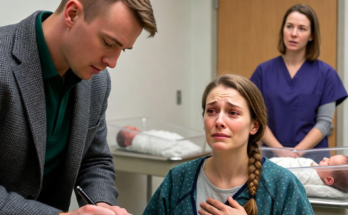
It happened in Chelsea maternity ward on a cold January morning. Victoria held a tiny bundle in her arms. Her daughter, Emilia Roberta Harrison, named after her grandmother Isabel and grandfather Roberto. A perfect little creature with tiny fingers and soft blond hair. Daniel sat beside her, his arm around his wife’s shoulders, gazing at their daughter with boundless tenderness. “She’s beautiful,” he whispered, “absolutely beautiful, just like her father.” Victoria smiled, her eyes never leaving the baby.
Isabel stood by the head of the bed, wiping away tears of joy. “Dad would be so happy,” she said, “to see his granddaughter. The continuation of the Holmes line is watching us.” Victoria raised her eyes to the ceiling as if looking through it to the heavens. I’m sure she sees us and smiles. That night, when Victoria was alone with her daughter, Daniel went home to change and get some things. She was sitting by the maternity ward window, rocking Emilia.
“You know, little one,” he whispered, “your grandfather was an incredible man. He built a huge company from nothing, but most importantly, he taught me that business isn’t just about money, it’s about people. I’ll try to teach you the same thing when you grow up. If you want, you can run Asure Wings, continue the tradition, but only if it’s your dream, not mine, not imposed on you, but your own. And in the meantime, just grow. Be happy, my love. Know that you can be anything you want, do anything you want, fly anywhere you want.”
The whole world is before you, and Mom and Dad will always be there, always. Little Emilia slept, breathing through her nose, not understanding words, but feeling the warmth and love. And outside the window, in the London night sky, the lights of airplanes twinkled. Somewhere there, the planes of Sure Wings flew. They carried people to their dreams, to their loved ones, to their destinations. And Victoria knew that her life had turned out exactly as it was meant to.
Through pain and joy, through falls and rises, through humiliation and triumph, she became who she wanted to be: not just a company owner, but a leader, a mother, a wife, a person who changed the world for the better. Another five years passed. Asure Wings celebrated its 40th anniversary. A grand ceremony in London. Thousands of guests, government representatives, aviation authorities, partners, and company employees from all over Europe. Victoria was on stage. Beside her, her family.
Daniel holding hands with five-year-old Emilia, who was wearing a white dress and a bow in her hair. Isabel with Jaime, Sofía, who became not only an assistant but also deputy general manager. Pedro, still faithfully protecting the company’s interests, Natalia, and dozens of other employees who became Asure Wings legends. “Forty years ago,” Victoria said into the microphone, addressing the room, “my father, Roberto Holmes, bought a small plane and started chartering flights between London and Paris.”
I had a dream of creating an airline that not only transported people, but connected them, making the world a smaller, kinder place. In these 40 years, we’ve come a long way, from one plane to 200, from two cities to 100, from 10 employees to 7,000. We’ve experienced crises and triumphs, falls and rises, but we never forgot what’s most important: people—our passengers, our employees, our family. She looked at her daughter, who was staring at her with wide eyes. I don’t know what will happen to Asure Wings in the next 40 years.
Maybe my daughter will take the reins, maybe someone else, but I know one thing: the company will thrive as long as we remember why we’re here. We’re not here for the profits, although profits are important, not for the fame, although recognition is nice. We’re here for the people, to help someone see the world, meet loved ones, start a new life, realize a dream. That’s what Azure Wings is for. And as long as we remember that, we’ll fly. The room erupted in applause.
The crowd rose to their feet. The ovation lasted several minutes. Little Emilia clapped along with everyone, even though she didn’t fully understand what was happening. After the ceremony, when the guests had dispersed, Victoria went up to the roof of the building, her favorite spot. Daniel and Emilia went with her. The three of them stood there, gazing at the sky. The sun was setting, painting the clouds in shades of gold and pink. Airplanes took off and landed, leaving contrails across the azure canvas.
“Mom, do you really own all those airplanes?” Emilia asked, pointing at the sky. “Not all of them, dear.” Victoria smiled, kneeling beside her daughter. “Only the ones that have ‘as your wings’ written on them. See that plane with the blue stripe on the side? It’s one of ours. Beautiful.” Emilia gazed in admiration. “And I’ll be able to fly in them.” “Of course.” Victoria hugged her daughter. “You’ll be able to fly wherever you want, to any point in the world. The sky is freedom, Emilia.”
The chance to see how vast and beautiful our world is. And when I grow up, I’ll fly planes too. Victoria exchanged glances with Daniel. He was smiling. If you want, Victoria said gently, you can become a pilot or a company owner like me, or an architect like Dad, or a doctor, or a teacher, or whatever you like. The main thing is to do what you love and never forget people—help them, respect them, make the world a better place. That’s what really matters. I’ll remember that, Mom. Emilia nodded earnestly.
They stayed a while longer on the rooftop, watching the sunset and the airplanes. Family, a happy, complete family. Victoria had it all. The job she loved, a loving husband, a beautiful daughter, a mother who had found her happiness, a thriving company, supportive friends. And she knew that all of this was the result of the choice she made many years ago, when she rose after falling, when she wasn’t afraid of humiliation, when she fought for justice, when she put people first.
Life is a series of choices, and each choice shapes us, makes us who we are. Victoria chose honesty, dignity, respect for others, and life rewarded her. She looked up at the sky where the first star peeked through the clouds. “Thank you, Dad,” she whispered, “for everything you taught me. I did everything you wanted, and even more. I hope you’re proud of me.” The wind carried the sound of an airplane engine taking off. Victoria smiled. That was her answer. The sky always answered her because the sky was her destiny, her calling, her love.
Asur Wings continued flying, connecting continents, shortening distances, helping people find each other, realize their dreams, and truly live. And in every flight, in every flight attendant’s smile, in every safe landing, lived the spirit of Roberto Holmes and the spirit of his daughter Victoria. People who believed that aviation is not just a business, it’s the art of making people happy, the opportunity to give wings to dreams. It’s a way of showing that the world is beautiful and vast, and everyone deserves to see it.