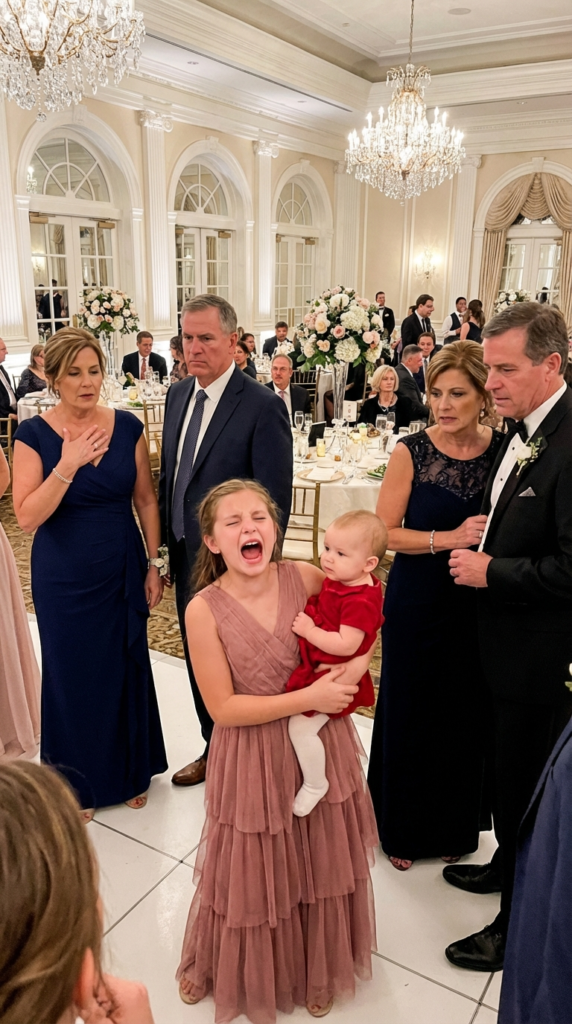
The Night the Truth Walked Into the Ballroom
The chandeliers in the Grand Marlowe Hotel shimmered like frozen stars, casting gold light over crystal glasses and silk gowns. It was meant to be a celebration—another triumph for Harold Whitman, the real estate magnate whose name stood on half the skyline of Crestwood Harbor, South Carolina.
He stood near the stage, smiling for cameras, shaking hands with investors, and accepting praise as if it were his natural right. For decades, Harold had been admired as a visionary, a builder of communities, a man who “brought prosperity” wherever he invested.
No one expected a child to interrupt the evening.
Yet at the edge of the ballroom doors stood a thin twelve-year-old girl clutching something wrapped in faded cloth. Her name was Lila Bennett, and she did not belong among tailored suits and polished marble floors.
But she walked in anyway.
A Promise Buried in Paper
Lila’s grandmother, Margaret Bennett, had once owned a stretch of fertile land just beyond the river—land filled with pecan trees and wild lavender that perfumed the air each spring. Margaret used to say the soil carried memory, that roots listened even when people did not.
Years ago, Harold Whitman had approached Margaret with promises of partnership and development. He had spoken of schools, parks, and opportunity. He had shaken her hand with confidence.
But shortly after, the land was no longer hers. Documents had been signed under pressure and confusion. Margaret never spoke of the details again. She simply said, “One day the truth will return.”
Before she passed, she handed Lila a small cloth bundle.
“Keep this safe,” Margaret had whispered, her voice fragile but steady. “It holds more than paper. It holds what is right.”
For years, Lila did not understand. Until the night she opened it.
Inside lay an old deed, sealed and signed decades earlier, and beneath it, a handwritten note in trembling ink:
He promised to help us, but he deceived us. This land is ours in spirit, and truth will find its way back. —Margaret Bennett
The date matched the year Harold began building his fortune.
Lila knew then that silence was no longer an option.
The Man Who Tried to Laugh It Off
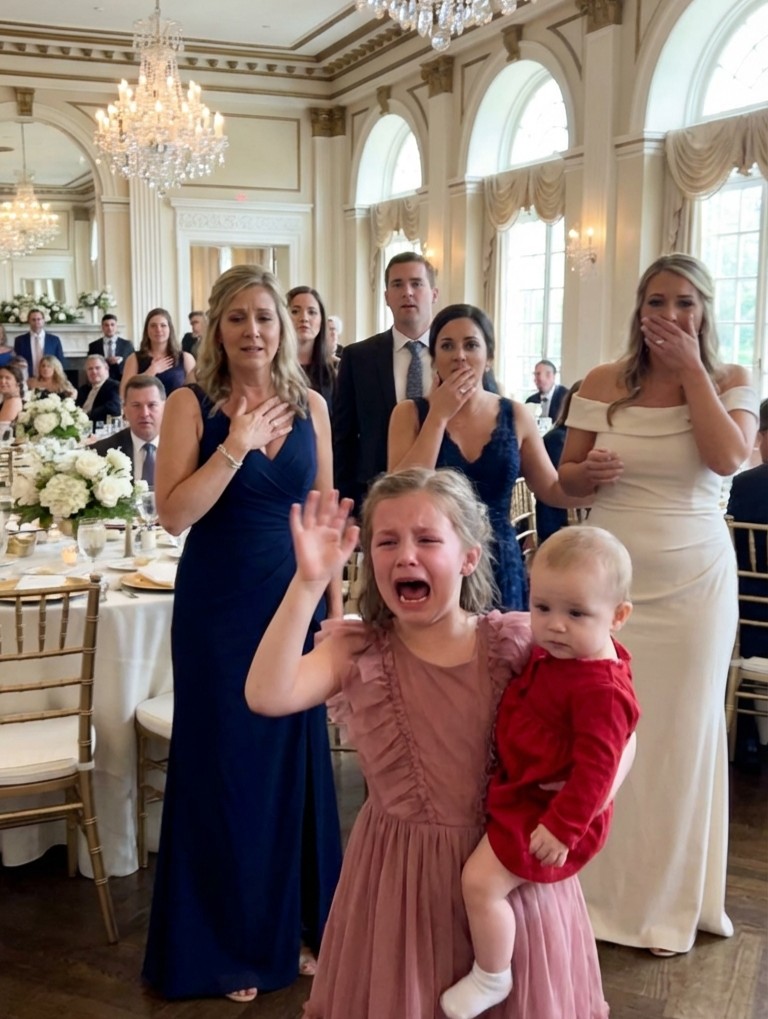
When Lila reached the front of the ballroom, the music faltered. Conversations thinned into murmurs. Harold Whitman turned, his practiced smile tightening when he saw her.
“Can I help you?” he asked smoothly, as if addressing a misplaced guest.
Lila stepped closer, her hands trembling but her eyes steady.
“You made a promise to my grandmother,” she said clearly. “And you broke it.”
A ripple moved through the crowd. Phones were raised discreetly.
Harold let out a short laugh meant to sound harmless.
“I believe you’re mistaken, young lady,” he replied. “Business agreements are handled properly and legally.”
Lila unwrapped the cloth and held up the parchment.
The paper looked fragile, but the seal was intact.
“Then explain this,” she said.
The Lawyer Who Could Not Look Away
Among the guests stood Daniel Harper, a respected attorney known for his careful judgment and quiet integrity. He had worked alongside Harold on several civic projects, believing the man’s reputation.
When Lila lifted the document, Daniel stepped forward, compelled by something deeper than curiosity.
“May I see that?” he asked gently.
Harold’s composure wavered.
“There’s no need for theatrics,” he said sharply. “That paper could be anything.”
But Daniel had already taken it.
He unfolded the deed slowly, examining the signatures, the official marks, the notations written in a different ink. His expression shifted from neutrality to concern.
“This is authentic,” Daniel said, his voice firm enough to quiet the room. “And the annotations suggest irregular transfer conditions.”
Gasps traveled like wind across dry grass.
Harold’s face drained of color.
“That is an outrageous interpretation,” he protested. “You’re twisting history.”
Daniel looked up at him, disappointment replacing respect.
“History does not twist itself,” he replied quietly. “People do.”
A Celebration Turned Courtroom
What had begun as a gala now felt like a public reckoning. Guests whispered openly. A society columnist near the stage typed rapidly into her phone.
Lila stood still amid the noise. She did not shout. She did not accuse beyond what the document already revealed.
“My grandmother didn’t want revenge,” she said, her voice cracking but strong. “She wanted truth. She said money can build houses, but it cannot build peace.”
The words landed harder than any accusation.
Harold tried to reach for the document, but security—no longer responding solely to him—held him back at the urging of anxious guests who demanded clarity.
Daniel folded the deed carefully.
“Mr. Whitman,” he said, measured and composed, “this matter requires formal review. I strongly advise you to prepare for legal examination. This will not disappear.”
Harold sank into a nearby chair, the glittering lights above him suddenly harsh instead of flattering.
Headlines by Morning
By sunrise, Crestwood Harbor was no longer celebrating a developer’s success. Every major news outlet carried a different version of the same story: Young Girl Questions Land Deal of Prominent Investor.
Talk radio hosts debated. Community leaders expressed concern. Former landowners came forward with similar experiences—promises made, contracts rushed, expectations unmet.
An official inquiry began within weeks.
The deed Lila presented became a cornerstone of the investigation. Experts confirmed the validity of the original ownership and questioned the fairness of the transfer. Records surfaced revealing shell companies and complex financial maneuvers that benefited Harold while leaving small property owners disadvantaged.
The narrative of untouchable success began to unravel.
A Long Road to Accountability
The legal process stretched across months, filled with testimony and scrutiny. Lila attended hearings with Daniel Harper by her side.
When asked why she had chosen to speak publicly, she answered simply:
“Because silence protects the wrong story.”
Her testimony was honest, unembellished, and powerful precisely because it came from someone with nothing to gain but clarity.
Eventually, the court ruled against Harold Whitman on multiple counts of fraudulent acquisition and unethical business practices. His assets connected to those properties were seized. Financial restitution was ordered for affected families.
The mansion overlooking the river—the symbol of his empire—was repurposed into a community resource center dedicated to legal education and land rights awareness.
Harold did not lose everything, but he lost the illusion of admiration. And sometimes that loss weighs heavier than wealth.
Seeds Planted Again
Lila received a portion of the restitution designated for her grandmother’s estate. She did not seek extravagance. Instead, she restored the Bennett orchard, planting new pecan trees where the soil had grown silent.
She enrolled in college years later, studying environmental law, determined to understand the system that had once confused her grandmother.
Daniel Harper remained a mentor, ensuring she navigated opportunities with confidence.
On the tenth anniversary of that night, Lila stood beneath a tree heavy with fruit. The air carried the same lavender scent her grandmother loved.
She touched the medallion Margaret once wore and whispered, “You were right.”
Because the land had not forgotten.
And neither had the truth.
Justice is not born from anger but from courage patiently sustained over time, and even the quietest voice can become thunder when it speaks with integrity.
Wealth without conscience may rise quickly, but it cannot stand forever against the steady weight of accountability and collective memory.
Promises are not temporary conveniences; they are moral commitments that shape generations long after signatures fade.
Communities thrive not because of towering buildings, but because of fairness woven into their foundations.
Silence may seem easier in the moment, yet it often costs far more than honesty ever could.
Children sometimes see what adults refuse to confront, and their clarity can restore balance to a world clouded by compromise.
True success is measured not by ownership but by the good left behind for others to inherit.
Integrity may bend under pressure, but when rooted deeply, it grows back stronger than before.
The past cannot be rewritten, yet it can be acknowledged, repaired, and transformed into wisdom.
And when truth is planted with patience, it always finds a way to bloom, reminding us that justice is less a transaction and more a harvest waiting for its season.