The Day the Car Stopped on Harbor Street
Julian Carter had built his adult life around precision, which was easier in his world because numbers behaved, schedules obeyed, and the kind of risks he handled for a living could be modeled and measured, while grief and memory could not. He worked as the founder of a cybersecurity firm in downtown Seattle, the sort of company that kept banks and hospitals from waking up to locked screens and panicked executives, and he was used to moving through days like a man carrying a glass of water without spilling it, careful, controlled, and always watching the surface for ripples.
That afternoon he was doing the simplest thing he did all week, which was picking up his five-year-old son from kindergarten, and even that felt like a small mercy because Owen’s chatter usually loosened something in Julian’s chest that work could not touch. The winter light was thin and pale, the sky a washed-out blue that made the city look clean from a distance, and the heater hummed softly as Julian turned onto Harbor Street, a stretch of road he typically avoided because it carried a different kind of silence, one that did not come from comfort but from being unseen.
Owen had been unusually quiet, not asleep, not sulking, just alert in that way children are when they are trying to make sense of something they do not yet have words for, and Julian was about to ask if anything had happened at school when Owen pressed his face against the window and inhaled sharply.
“Dad, stop the car. Please. Right now.”
Julian’s foot moved to the brake before his mind finished catching up, and he pulled to the curb with a careful smoothness, as if he were still protecting the fragile sense of order he carried through most of his days.
“What is it, buddy, are you feeling sick?” Julian asked, twisting in his seat to look back.
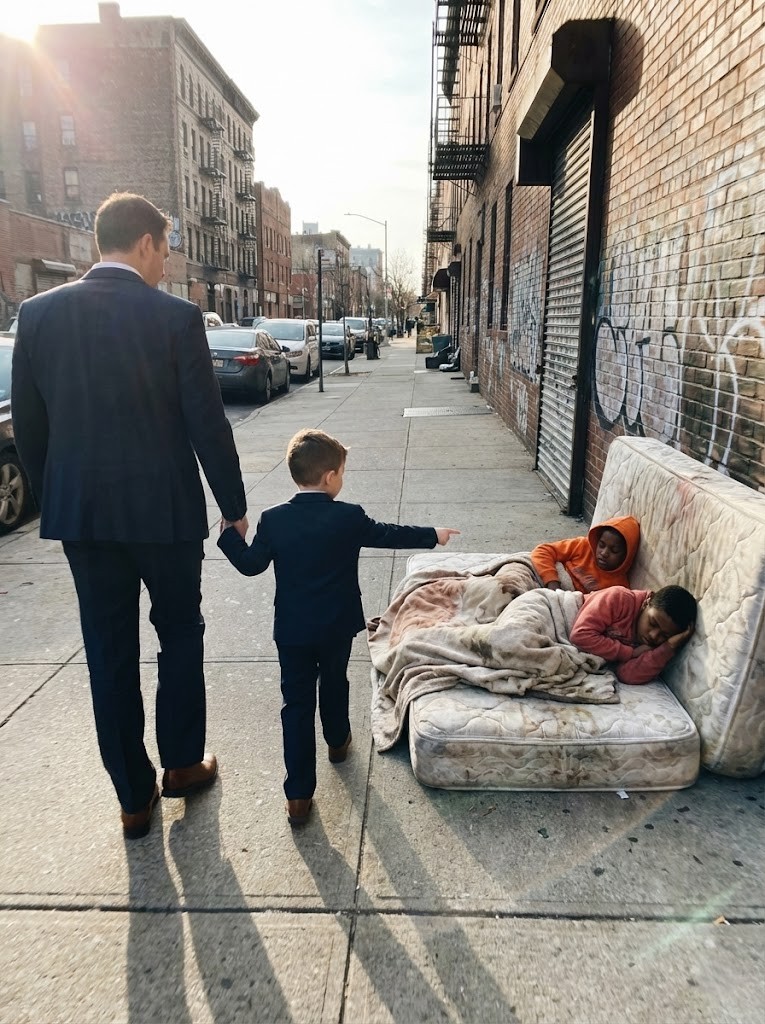
Owen didn’t look at him. His small finger was raised, rigid with certainty, pointing toward a closed storefront where cardboard and black plastic bags piled near a dumpster like a makeshift wall.
“Those kids,” Owen said, his voice tightening. “They look like me.”
Two Small Shapes by the Dumpster
At first Julian saw only the shape of a problem he had trained himself not to look at too closely, which was a pair of children huddled on flattened boxes, tucked into the shadows with their knees pulled up, their clothing layered in mismatched pieces that couldn’t possibly be warm enough. Then one of them shifted, lifting an arm as if to shoo away an insect, and Julian caught the side of the boy’s face in the slant of light from a passing car.
His breath stopped, not dramatically, not as a story beat, but the way a body reacts when something inside it recognizes danger before the mind forms a conclusion.
The profile was Owen’s, and the second child’s hair curled in the same loose ringlets Owen had inherited from Eleanor, Julian’s wife, whose absence still lived in the house like a door that never quite shut.
Julian opened his door and stepped out, and the sound of his shoes on pavement felt too loud in that part of town, like a private noise that didn’t belong there. The children startled awake immediately, moving with the practiced speed of kids who had learned that sleep can be interrupted for reasons that are not kind, and they pressed close together, one boy instinctively shifting his body to stand between the other and the approaching stranger.
The older one spoke first, barely above a whisper.
“We’re leaving, sir. We didn’t do anything.”
Julian tried to answer, but his throat felt tight, and for a second he was aware of every detail he normally never noticed, the cracked curb, the smell of damp cardboard, the thinness of the boys’ wrists, and the way their eyes never quite stopped scanning his hands, as if they were measuring what he might do next.
Owen’s Gift
Owen climbed out of the back seat before Julian could even turn around, dragging his backpack by one strap, and ran toward the boys with the kind of fearless sincerity Julian always forgot existed until he saw it in his own child. Owen dug into his bag and pulled out a small packet of chocolate cookies, the kind Julian bought without thinking because they were safe, sealed, and easy.
“Here,” Owen said, holding them out. “You can have these. My dad can get more.”
The two boys stared at the packet as if it were something that might disappear if they reached too quickly, and Julian noticed that even hunger didn’t erase their caution. The older boy accepted it carefully, then opened it and broke the first cookie in half with a deliberate slowness, handing the larger piece to his brother before taking the smaller portion himself.
“Thank you,” they said together, and the sound of their voices hit Julian in a place he did not know was still raw, because it wasn’t just the words, it was the cadence, the same slight rise at the end, the same tone Owen used when he was trying to be polite.
Julian crouched down so he wasn’t towering over them, and he forced his voice to stay steady.
“What are your names?”
The older boy swallowed, then lifted his chin as if naming himself was a kind of courage.
“I’m Aaron,” he said. “And he’s Miles.”
The names landed like stones in Julian’s mind, because years ago, on a night when Eleanor was pregnant and laughing softly in their kitchen, she had said those exact names, not as a plan, not as a promise, but as a playful what-if when they had been talking about how strange it was that love could make you imagine more than you could ever hold.
The Aunt Who Left Them
Julian’s hands were shaking, not visibly, but enough that he pressed them against his knees.
“Where are your parents?” he asked, already dreading the answer.
Miles answered first, his mouth still full of cookie, his voice small but matter-of-fact.
“We don’t have any. We had an aunt.”
Aaron’s arm tightened around Miles’s shoulders, a protective grip that looked older than five years.
“She said she couldn’t keep us anymore,” Aaron added. “She brought us here three nights ago and said someone would come back for us, and she said we had to stay quiet and not talk to strangers.”
Julian felt his stomach turn in a slow, controlled wave.
“What was her name?”
Miles blinked at him, confused by why it mattered.
“Aunt Lydia.”
The name was a door Julian had kept locked, because Lydia had disappeared after Eleanor’s memorial, drifting out of the family’s orbit with the kind of chaos that Julian, in his grief, had not had the strength to chase.
Julian looked at Owen, then back at Aaron and Miles, and in that moment, the question wasn’t whether they belonged to him, but how the world had allowed them to be separated so completely that one child sat in a warm car seat while the other two slept on cardboard.
He stood up, and his voice, when it came, surprised him with its firmness.
“Get in the car,” Julian said. “Nobody is sleeping outside tonight.”
The Ride Home
The drive back to Julian’s neighborhood felt surreal, like moving between two versions of the same city, and Julian kept checking the rearview mirror, not because he doubted what he saw, but because his mind needed repetition to accept it. Owen was talking excitedly, pointing out buildings as if he were giving a tour, and Aaron and Miles watched the passing streets with wide eyes, occasionally reaching toward the vent when a gust of warm air brushed their fingers.
“It’s like a hair dryer,” Miles said, his tone amazed.
“That’s the heater,” Owen explained solemnly, as if he were teaching a life skill.
Julian made calls with one hand on the wheel. He called Dr. Harris, a family physician who had known Eleanor, and he called Mira Sloan, a lawyer who handled sensitive matters for his company and whose greatest strength was that she did not panic when reality shifted under her feet.
When he pulled into his driveway, the house looked the same as it always did, large, quiet, tasteful, and Julian suddenly realized how cold it must have felt to him all these years, not in temperature but in spirit, because it had been built around absence.
A Housekeeper’s Stunned Silence
Mrs. Alvarez, who had been with the family since before Owen was born, walked into the entryway carrying a tray, then stopped so abruptly the tray tilted.
“Mr. Carter…” she whispered, her eyes moving from Owen to the other two boys. “What is this?”
Julian swallowed and kept his instructions simple because he did not trust himself with anything complicated.
“Warm baths,” he said. “Soft food. Nothing heavy. Please.”
The baths revealed what dirt had hidden but could not change. Aaron and Miles were not merely similar to Owen; they were near replicas, down to the faint freckle near the jawline and the small dimple in the chin that Eleanor used to joke was “the family signature.” When the boys sat at the table, they moved in tiny mirrored ways, passing salt without words, laughing at the same moment, yawning in a strange chain reaction that made Julian’s eyes sting.
The Doctor and the First Proof
Dr. Harris arrived in the evening with a nurse and a small kit, and he froze when he saw the three boys together.
“Julian,” he said quietly, “this doesn’t make sense. Eleanor’s records showed one baby.”
Julian’s voice came out rougher than he intended.
“Then the records are wrong,” he said. “Or someone made them wrong.”
The doctor did what Julian asked, taking samples, checking vital signs, speaking gently to the boys, and when he finished, Owen insisted they all sleep in one room, building a sloppy fortress of pillows and blankets that looked ridiculous and, at the same time, unbearably precious.
Julian didn’t sleep. He sat in the hallway outside the door, listening to the boys’ whispers fade in and out.
“Do you think he’s really our dad?” Aaron asked.
“He gave us food,” Miles murmured. “And the house smells like soap.”
Owen’s voice came last, steady and sure in a way Julian had never heard before.
“He is,” Owen said. “I know because my chest feels better when you’re both here.”
Julian covered his face with one hand, letting the quiet emotion come without theatrics, and he promised himself that whatever truth waited in the morning, he would not let these boys be lost again.
The Second Truth Behind the First
Dr. Harris returned early, his expression careful, the kind of careful that signals bad news wrapped inside good news.
“They’re related,” he said. “The preliminary results show they are Owen’s biological brothers. The match is extremely high.”
Julian’s chest loosened with relief, and then tightened again as the doctor hesitated.
“There’s another issue,” Dr. Harris continued. “I pulled older hospital archives through a colleague. There are anomalies, and the boys’ bloodwork shows signs consistent with early genetic intervention.”
Julian stared at him, the phrase sounding too clinical, too distant from the reality of two children sleeping on cardboard.
“Say it in normal English,” Julian said.
Dr. Harris nodded, choosing his words.
“Someone tried to ‘correct’ something before they were born,” he said. “As if the children were projects, not people, and the paperwork suggests the pregnancy was handled in a way meant to keep parts of it hidden.”
Julian felt anger rise, not hot, but cold and sharp, because it carried the weight of betrayal rather than simple outrage. He knew, with a certainty that did not require proof, where that kind of obsession lived.
Not in Lydia, who was chaotic, but in someone who valued control and reputation above tenderness.
His mother, Vivian Carter.
Tea in a Perfect Garden
Vivian lived in a manicured home across the lake, where everything looked polished, trimmed, and contained, and Julian realized as he walked up the path that the place resembled her personality so closely it was almost ironic. She was sitting in the garden with tea when he arrived, her posture straight, her hands steady, her expression composed in the way it always was, as if emotion were something she allowed in small doses only when it served her.
Julian didn’t sit.
“Where have my sons been?” he asked.
Vivian blinked once, slow and controlled.
“What are you talking about?” she replied.
Julian felt his voice soften into something more dangerous than shouting.
“Aaron and Miles,” he said. “The two children who look like Owen because they are Owen’s brothers.”
Vivian’s fingers tightened around her teacup, and the slightest tremor betrayed her.
“Julian, you’re upset,” she said. “You’re letting stress—”
“Don’t,” Julian interrupted. “Don’t talk to me like I’m confused.”
The silence stretched, and Julian pushed forward.
“Lydia didn’t invent this,” he said. “She’s not capable of planning it. She was paid, though, wasn’t she, because she always needed money, and you always knew how to turn someone’s weakness into a tool.”
Vivian set the cup down with a faint clink, and for the first time in years, her mask slipped.
“I did what I had to do,” she said, her voice tightening. “Your wife was fragile, Julian. Your family history isn’t perfect. I wouldn’t gamble the future of this family on luck.”
Julian’s hands curled into fists at his sides.
“They’re children,” he said. “Not a plan. Not a backup. Not a secret.”
Vivian’s eyes glistened, though whether it was regret or frustration Julian could not tell.
“Lydia was supposed to take care of them,” she said, as if that detail could wash her hands clean. “If she failed, that’s on her.”
Julian leaned forward slightly, and his voice grew even calmer.
“No,” he said. “It’s on you, because you started it, and then you looked away.”
He straightened, feeling something settle in him, a final decision.
“You will never see them,” Julian said. “Not Owen, not Aaron, not Miles.”
Vivian’s chin lifted, stubborn even now.
“You can’t do that,” she said.
Julian met her eyes.
“Watch me,” he replied. “And if you try to come near them, I will make sure every door you rely on closes.”
He turned and left, walking down the garden path without looking back, because he knew that if he turned around, he might see the woman who raised him, and he didn’t want to carry that image into the home where his children were waiting.
Learning Each Other, Day by Day
The months that followed were not neat. They were full of appointments, paperwork, therapy sessions that focused on safety and trust rather than labels, and long evenings where Julian learned how much of parenting is simply being present when a child tests whether you will disappear.
Mira Sloan handled the legal process with precision, ensuring Aaron and Miles were placed properly within Julian’s care, and Dr. Harris coordinated ongoing medical monitoring without turning the boys into a project, because Julian refused to let any professional treat them like a case rather than children.
The most important work, however, happened in ordinary moments.
Aaron, who had learned to be responsible too soon, struggled to let adults do things for him, and Julian had to teach him gently that a child should not have to guard the world with his own small shoulders. Miles, who watched everything with wide, sensitive eyes, flinched at raised voices even when nobody was angry, and Julian started speaking softer without realizing he was changing. Owen, who had once been an only child surrounded by adults, transformed into a boy who woke up excited because there were always two other people in the house who understood his jokes before he explained them.
One night Owen stood in the kitchen while Julian loaded the dishwasher, his face serious in a way that made Julian pause.
“Dad,” Owen said quietly, “are they staying forever?”
Julian wiped his hands on a towel and crouched so he was level with him.
“Yes,” he said. “They’re staying.”
Owen’s shoulders relaxed as if he had been holding his breath for weeks.
“Okay,” he whispered, and then he ran down the hall to find his brothers, like the word itself had given him permission to be happy.
Five Years Later, a Song in the Music Room
Time, in a home with children, moves in strange leaps, and one evening five years later Julian stood in the doorway of the music room, not wanting to interrupt what he saw. The triplets were ten now, taller, louder, more opinionated, and unmistakably bonded in a way that felt both natural and miraculous.
Miles sat at the piano, his fingers moving carefully, pulling a gentle melody out of the keys as if he were coaxing a story into existence. Aaron stood nearby with a notebook, his brow furrowed in concentration, and Owen leaned over his shoulder, laughing as he suggested rhymes that made no sense.
“Dad, come here,” Miles called, turning on the bench. “We made something for you.”
Julian walked in and sat between them, and they pressed close without thinking, like it was the most normal thing in the world.
“What is it?” Julian asked, his voice warm.
Aaron cleared his throat as if he were presenting a serious report, which made Miles grin.
“It’s a song,” Aaron said. “About a king.”
Owen nodded solemnly.
“He had a giant castle,” Owen added, “but it was kind of empty.”
Miles played a soft chord, then looked up.
“And three kids showed up,” Miles said, his eyes bright. “They were supposed to be lost, but they weren’t.”
Julian swallowed, feeling the past press against the present, not as pain, but as proof of how much can change when someone chooses to stop instead of driving past.
“That’s a good song,” Julian said, kissing each of their foreheads, one after another. “But it’s missing one part.”
All three looked at him at once, the same expression, the same tilt of the head.
“What part?” they asked together.
Julian smiled, and for once he let the emotion show without trying to manage it.
“The part where the king realizes he was the one who was lost,” Julian said, his voice gentle, “and the kids didn’t just find a home, they found him, too.”
The boys leaned into him, and Miles played a few more notes, and Aaron scribbled something down, and Owen laughed, and Julian sat there in the middle of it, feeling a quiet certainty settle into his bones.
He didn’t know what the future would bring, and he no longer trusted the idea that life could be controlled the way a business could, but he knew this much, as clearly as he knew his own name: family wasn’t something you engineered for pride, and it wasn’t something you kept for appearances, because real family was the place where you were seen, held, and brought inside when the world had left you out in the cold.
And in that moment, Julian Carter finally understood that the richest thing he had ever owned was not a company, not a reputation, not a carefully guarded name, but the weight of three small shoulders leaning against him as if they had always belonged there.