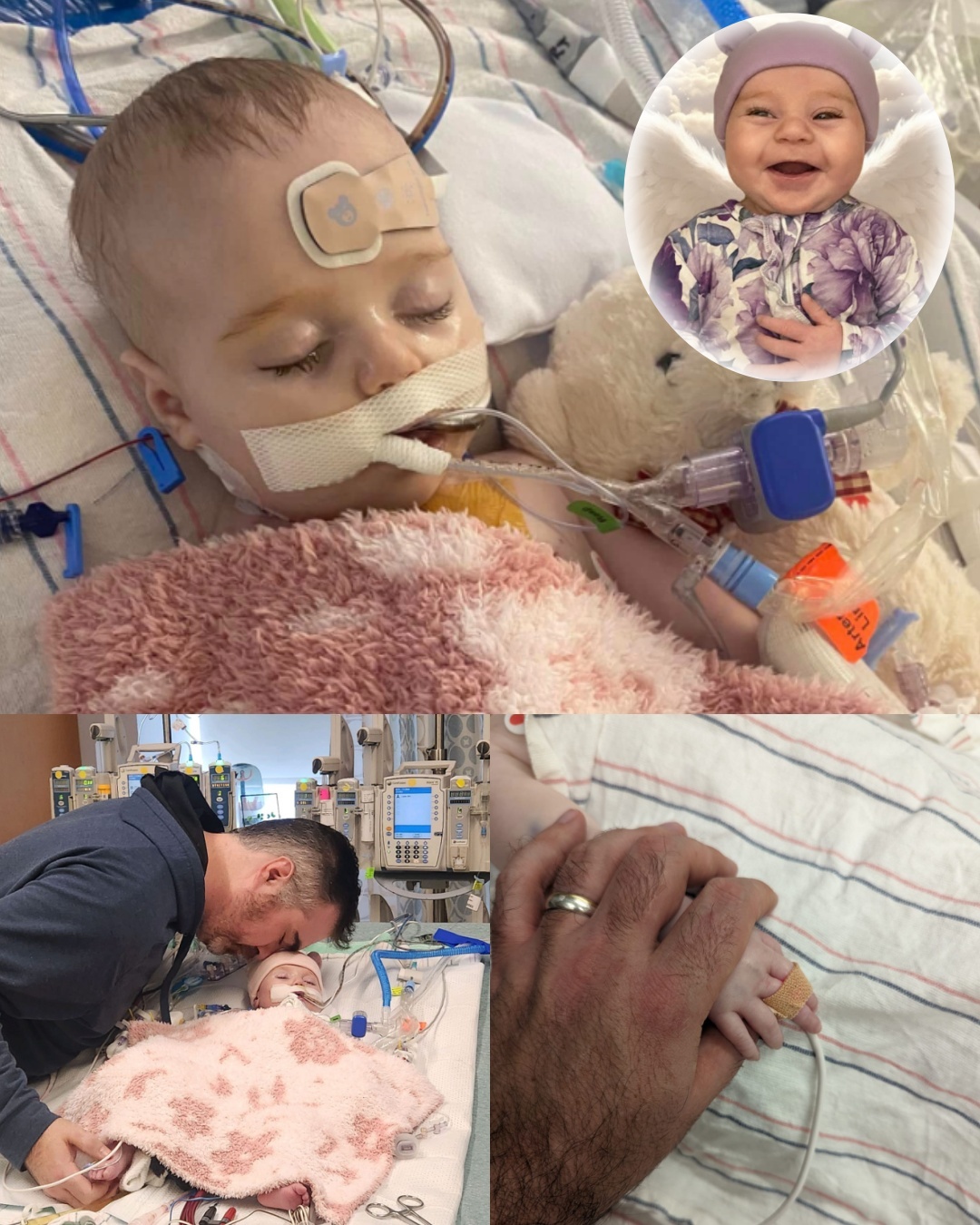
Ophelia Anne Delise was born on August 10, 2023, in Mansfield, Ohio, the kind of newborn who makes a house feel instantly warmer, as if light has finally found the right place to land.
She was healthy.
She was happy.
She was the soft beginning of a story her family believed would be measured in ordinary miracles—first smiles, first steps, first birthdays, and the slow, steady growing that most people only notice when it’s suddenly taken away.

For less than two weeks, the world stayed simple.
Then came a routine appointment, the kind parents walk into expecting reassurance and leave with nothing more than a reminder to keep doing what they’re already doing.
An echocardiogram was performed.
A screen glowed.
A technician studied shapes and movement that most people can’t interpret, and somewhere in that quiet room, the air changed.

The echocardiogram revealed that Ophelia was experiencing congestive heart failure, and in an instant, her parents’ lives split into “before” and “after,” because that phrase doesn’t just describe a diagnosis, it describes a new way of breathing.
From that moment on, Ophelia began a fight—one she did not choose, one she was far too young to understand, and one she met with a strength that would leave grown adults stunned again and again.
Doctors believed Ophelia had Endocardial Fibroelastosis (EFE) with HLHS complex and mitral valve stenosis, a cluster of words that sound like a foreign language until you’re forced to learn them because they now hold your child’s future.

In the simplest terms, the fibroblasts in her body—cells meant to help heal—worked too hard, laying down thick connective tissue around the left ventricle of her heart.
The left ventricle, which should stretch, fill, and push life forward, became stiff, constrained, unable to expand the way it needed to.
And when a heart cannot stretch and fill properly, everything downstream begins to suffer.
Blood cannot move the way it should.
Oxygen cannot arrive where it’s needed.

A baby’s body, which should be spending its energy on growing, ends up spending it on surviving.
As if that weren’t enough, Ophelia also developed pulmonary hypertension, caused by blood backing up into her lungs, increasing pressure where there should have been free, easy flow.
Her lungs—meant to be the place where breath becomes life—became another battleground, limiting oxygenation and restricting circulation through her small, determined body.
Medical explanations can sound cold.

They can read like reports, as if the situation is something you can manage with enough information and enough charts.
But for a family living inside this reality, those same explanations become the background noise of fear, the constant awareness that their child’s life depends on numbers and timing and decisions that never feel fully safe.
And yet, in the middle of all of it, Ophelia was still Ophelia.
Her life was never only a diagnosis.
She was not defined by the complexity of her heart, but by the fierceness of her spirit and the unmistakable presence she carried, even as a toddler.

Some children move through the world as if they’re simply learning it.
Others move through it as if they’re already teaching everyone around them what matters most.
People who loved Ophelia described her as determined, aware, and powerful in a way that seemed too big for her age—an energy that didn’t ask permission, an insistence on being here, on being seen, on being loved, and on loving back with everything she had.
Her parents learned a new vocabulary, but they also learned a new measurement of joy.
Joy became the days when her breathing was steady.

Joy became the moments when she looked comfortable, when she slept without struggling, when she opened her eyes and met theirs with that quiet kind of recognition that feels like a hand squeezing your heart.
Joy became the smallest wins, because in families like this, you stop taking “normal” for granted.
You learn that a peaceful afternoon is not ordinary.
It is a gift.
And the gifts are treasured like sacred things.

Behind the scenes, the fight is rarely dramatic in a way the outside world can recognize.
It is relentless instead.
It is appointments and monitoring and the constant calculation of how she looks, how she sounds, how she feels, whether that color in her cheeks is “good” or “not good,” whether that nap is restful or alarming.
It is living with one foot in love and one foot in fear, every single day.
It is the exhausting reality of being unable to relax, because the moment you relax, guilt arrives and whispers that vigilance is part of being a good parent.
But Ophelia’s story, even in its hardest chapters, was saturated with love.

Not polite love.
Not distant love.
The kind of love that rearranges a whole household around a child’s needs, that makes parents stronger than they thought they could be, that teaches them to celebrate breath and comfort the way other families celebrate milestones.
The kind of love that doesn’t cure, but refuses to let a child fight alone.
Then, on December 11, 2025, Ophelia passed away at the age of two.

Two years old—an age that should be filled with wobbling runs across living room floors, sticky fingers, half-pronounced words, and laughter that arrives in bright bursts for no reason at all.
Two years old—an age where childhood is just beginning to unfold, where the world is still mostly wonder.
But Ophelia’s two years, brief as they were, were dense with meaning in a way that many long lives never manage to hold.
Because some lives are not measured by length.
They are measured by impact.
By what they change in the people who love them.

By the way they make a family see time differently, love differently, pray differently, and hold each other tighter.
In the aftermath, people will sometimes say, “At least she’s not suffering,” or “At least you had her for two years,” because humans reach for language when they don’t know what else to offer.
But the truth is, there is no “at least” big enough to cover the space left by a child.
There is only the ache, and the memories, and the slow, painful work of learning how to carry love when it no longer has a place to land in the physical world.

Ophelia’s parents will carry the first days when everything felt normal and bright, when they thought the story would be uncomplicated.
They will carry the moment the echocardiogram changed everything, and how quickly they had to become strong.
They will carry the medical words they never wanted to know, and the endless trying, and the hope that rose and fell like a tide.
But they will also carry Ophelia’s presence—the way she filled rooms, the way she made people feel something larger than grief, the way her fierce spirit refused to shrink even when her body had every reason to be tired.

And that, in many ways, is what makes her life so powerful.
Her story is not only a story of heart failure and complex diagnoses.
It is a story of courage that arrived in a tiny body.
It is a story of parents who loved without limits, even when they could not control the outcome.
It is a story of resilience that didn’t look like victory in the usual sense, but looked like showing up, again and again, with tenderness, with strength, with devotion.

Ophelia’s time on earth was brief, but her presence was not small.
She mattered in every room she was in.
She changed the people who loved her.
And she left behind a spirit that will be felt forever—because some lights do not go out when a life ends.
They move instead.
They live on in the way a family says her name, in the way they remember her determination, in the way they love each other harder because she taught them how precious every heartbeat truly is.