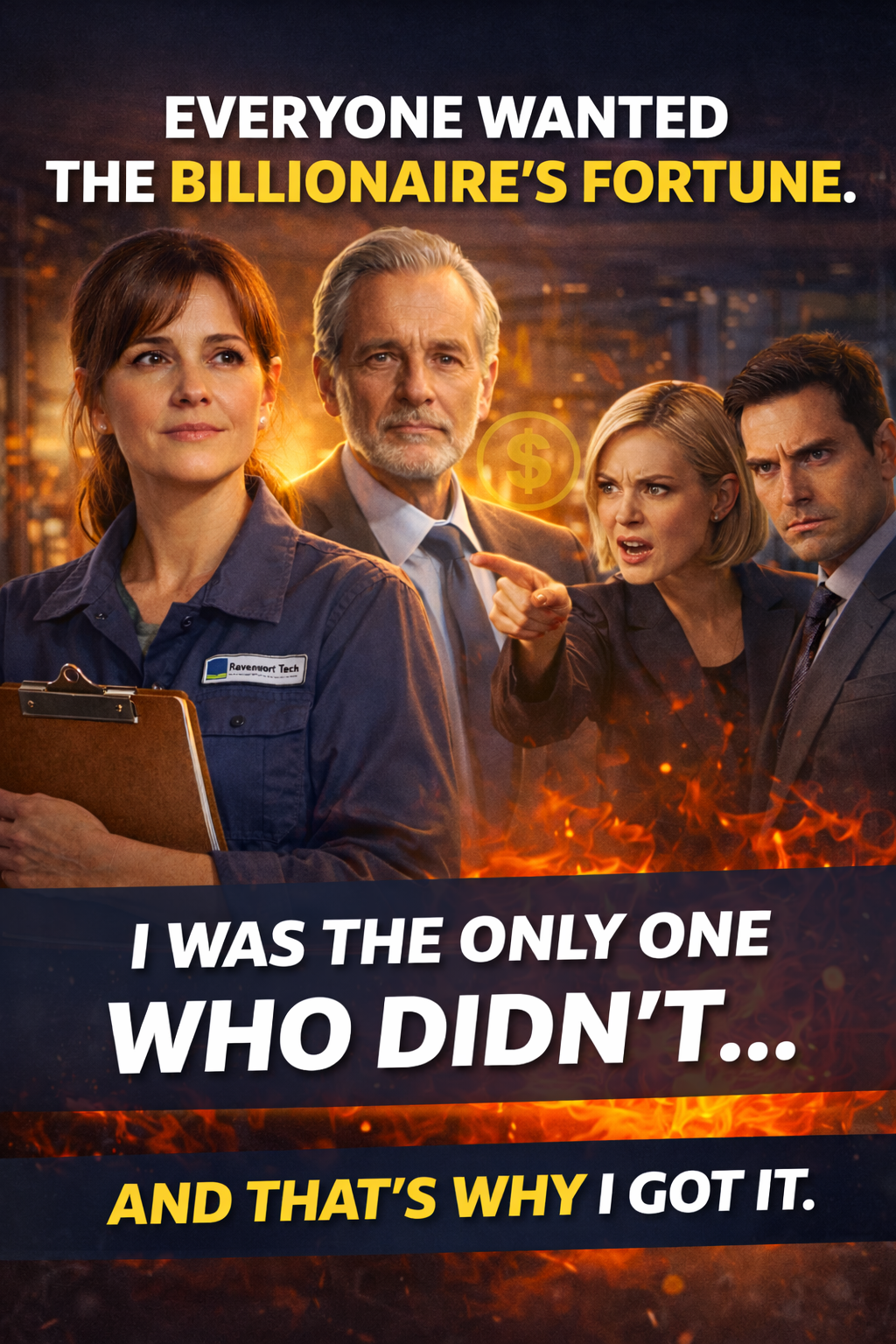
I never expected anyone in Raventon Technologies to remember my name.
I wasn’t a software engineer or an executive. I fixed leaking faucets, replaced broken drawers, and erased coffee rings from conference tables after midnight meetings. My uniform said Maintenance, and that’s exactly how people treated me — part of the building, not part of the company.
But the man who owned the building noticed me.
His name was Arthur Raventon.
The Billionaire Who Was Always Alone
Arthur built Raventon Tech from his garage into one of the most powerful tech firms in the country. Everyone knew his success story. What nobody saw was how lonely he had become.
His wife had passed years earlier. His two adult children — Margaret and Elliot — visited only when legal documents were involved. They talked about restructuring, about stock dilution, about exit strategies.
No one asked him how he was feeling.
Except me.
It started with small things. I fixed a stuck filing cabinet in his office. I brought him tea because he forgot to eat lunch again. I didn’t realize how much that mattered until one night he looked at me and said:
“You’re the only person in this building who doesn’t want something from me.”
A Question I Wasn’t Ready For
Weeks later, I was asked to join a meeting with Arthur, his lawyer, and his children.
It felt wrong being there in my uniform while everyone else wore expensive suits. Margaret looked like she was swallowing glass when she saw me sit down.
Arthur didn’t waste time.
“If I gave you everything I own,” he asked me, “what would you do with it?”
My heart started pounding.
“I wouldn’t take it,” I said.
The room froze.
His son laughed. His daughter’s face tightened. His lawyer stopped writing.
Arthur didn’t laugh.
He stared at me like I had just given him the one answer he never expected.
The Backlash
After that day, my life at Raventon Tech became uncomfortable.
My schedule changed without explanation. I was suddenly under review by HR. Margaret started warning me to “be careful” about how people might misunderstand my intentions.
Arthur noticed. He apologized for the pressure I was under.
“I spent my life building something powerful,” he told me quietly. “Now I’m trying to find someone I trust to protect it.”
I still didn’t understand what he meant.
The Envelope
One night I found Arthur sitting alone in the empty lobby, holding a sealed envelope.
“Don’t open this yet,” he said, placing it in my hand.
Two weeks later, he was gone.
The Will Reading
I almost didn’t go when his lawyer called me in. I was convinced I was being fired.
Instead, I walked into a room filled with lawyers, executives, and two furious heirs.
Arthur had left controlling authority of Raventon Technologies to me — not full ownership, but stewardship. Decision power. Oversight.
The room erupted.
Margaret accused me of manipulation. Elliot walked out without a word.
I couldn’t speak. I could barely breathe.
Why Me?
Arthur left letters explaining his choice.
He wrote about how everyone around him wanted his money, his influence, his position.
“But Lena never asked for anything,” one letter read. “She gave me dignity when I had nothing left to offer.”
What I Did With It
I didn’t become CEO.
I worked with the board to focus on transparency, worker treatment, ethical growth.
We rebuilt break rooms. We changed management culture. We introduced anonymous feedback systems.
Not because I was powerful — but because I remembered how it felt to be invisible.
The Lesson I Carry
People think money changes people.
I think money reveals them.
Arthur didn’t give me his fortune because I wanted it.
He gave it to me because I didn’t.
And every time I walk through those glass halls, sometimes still pushing a maintenance cart, I remember the man who finally saw me — not as an employee, not as a resource, but as a human being.
That was the real inheritance.