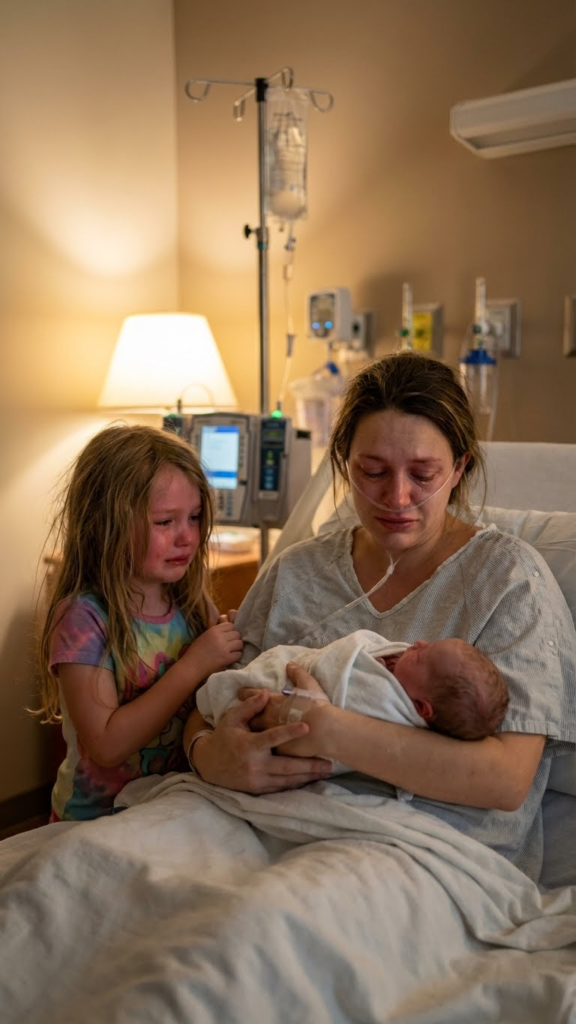
I always imagined the moment I met my second child would feel like a sunrise — warm, triumphant, clean. I’d hold her up to the light, cry happy tears, text my husband, and watch my older daughter beam with pride as she became a big sister.
What I didn’t imagine was needing oxygen to breathe while my five-year-old clutched my hospital gown, sobbing so hard she could barely stand, whispering, “Mommy please don’t die.”
I didn’t imagine wondering, with a brand-new baby in my arms, whether this might be the last night of my life.
The room smelled like antiseptic and warmed plastic. Machines hummed behind me, steady and uncaring. My head felt heavy, like it didn’t belong to my body anymore. A thin clear tube looped around my cheeks, pushing air into my nose. Every breath was work.
I was supposed to feel victorious. I had just given birth.
Instead, I felt like I’d been dragged back from somewhere dark — not fully returned, not fully here.
My daughter Lily stood on the right side of the bed. Her cheeks were soaked, her lip trembling so hard it looked painful. She had never cried like this before, not even when she broke her arm at daycare.
“Mommy,” she whispered, tugging the edge of my sleeve. “Please don’t let go of the baby. Please don’t fall asleep.”
I tightened my arm around the tiny bundle in my lap. My newborn daughter — Ava — was swaddled in a white blanket, her dark hair damp against her tiny forehead. She made a soft squeaking sound every few breaths, like a kitten.
“I’m here, sweetheart,” I said, though my voice sounded distant even to me. “I’m not going anywhere.”
But Lily didn’t believe me. Children know when something is wrong. They feel it in the air long before adults admit it.
And something was very wrong.
The labor had started like any other. I went in at midnight after my water broke at home. My husband kissed Lily goodbye while she slept, promising to be back by morning with pictures of her baby sister.
The contractions were strong but manageable. Nurses joked with me. My doctor told me I was progressing beautifully.
I remember thinking, This is it. This is the moment my family becomes whole.
Then, without warning, I couldn’t breathe.
It started as a tightness in my chest — a strange pressure, like someone sitting on me. I tried to inhale and nothing happened. The air just… stopped.
I told the nurse. She put a pulse ox on my finger. Her face changed instantly.
Within seconds the room filled with people. Someone put a mask over my face. Someone else was shouting numbers I couldn’t understand. My body started shaking violently. I felt like I was sinking into the bed, like gravity had tripled.
I don’t remember pushing.
I remember screaming that I couldn’t breathe.
I remember hearing my baby cry from very far away.
And then I remember waking up with tubes in my face and fear in every corner of the room.
They told me later I had suffered a pulmonary complication during delivery. Something about fluid, something about pressure, something about my oxygen dropping dangerously low.
What they didn’t say — what they didn’t have to say — was how close I had come.
I saw it in their eyes.
The nurses were gentle in a way that goes beyond politeness. Doctors don’t linger unless they’re worried. And my husband’s hands wouldn’t stop shaking when he finally came in holding Lily’s hand.
He tried to smile. He failed.
“You scared us,” he said, pressing his forehead to mine.
I wanted to apologize. I wanted to tell him I’d be okay. But I didn’t know if either of those things were true.
Lily climbed onto the edge of the bed as soon as the nurse allowed it. She leaned over Ava, staring at her with awe, then with terror.
“Is she going to be okay?” she asked.
“Yes,” I said automatically.
Then she looked at me. Really looked.
“Are you?”
That was when the tears started. Mine. Not hers.
I had no answer.
The night crept in slowly, like a threat. The hallway lights dimmed. The machines got louder in the quiet. The nurse told us visiting hours were ending.
Lily clutched my arm when they said she had to go.
“No,” she cried. “I need to stay. She needs me. Mommy needs me.”
My husband tried to reason with her, but fear isn’t logical. She wasn’t throwing a tantrum — she was terrified.
I pulled her close, careful not to disturb Ava. Lily pressed her face into my shoulder, sobbing so hard my gown grew wet.
“Please don’t leave me,” she whispered. “I don’t want you to disappear.”
The nurse hesitated. Then she said softly, “Let her stay a little longer.”
So there we were. Me, broken and barely breathing. My newborn, unaware of the chaos she had entered. And my firstborn, holding onto me like I was the last solid thing in a collapsing world.
At some point Lily lifted her head and looked at Ava.
“She’s so little,” she said. “What if she doesn’t remember you?”
I swallowed hard. “I’m planning on sticking around,” I said.
“But what if you don’t?”
Children ask the questions adults are too afraid to say.
I didn’t know how to answer without lying.
So I told her the truth.
“I’m trying really hard,” I said. “And I need you to help me.”
Her eyes widened. “How?”
“By being brave,” I said. “And by loving your sister enough for both of us if I get tired.”
She nodded solemnly, like I’d given her the most important job in the world.
The nurse came back with medication and told me I needed to rest. Lily protested immediately.
“She can’t sleep!” she cried. “She said she needs to try!”
I smiled weakly at the nurse. “She’s my bodyguard tonight.”
The nurse smiled back, sad and kind. “Then we’ll keep an eye on all three of you.”
At some point my husband had to take Lily home. School was in the morning. Life didn’t stop just because ours had cracked open.
Lily refused to let go of my hand.
“I’ll come back tomorrow,” she promised, tears dripping off her chin. “Don’t you go anywhere.”
“I won’t,” I said. “I promise.”
It felt like signing a contract I wasn’t sure I could honor.
When the door closed behind them, the room felt unbearably empty.
Just me. Ava. And the machines that didn’t care whether I lived or died.
I watched my newborn sleep.
Her chest rose and fell so easily. No fear. No questions. No understanding of how fragile everything really was.
I wondered if she would grow up hearing stories about how close she came to losing her mother on the day she was born. I wondered if Lily would always carry this night with her, even if she never talked about it again.
Mostly, I wondered if I would make it to morning.
The nurse adjusted my oxygen and told me to try to sleep.
I closed my eyes, but every time I drifted, Lily’s voice came back to me.
Please don’t disappear.
So I stayed awake, holding my newborn in the crook of my arm, listening to the machines, counting my breaths, fighting for the next one.
Because somewhere at home, a little girl was waiting for me to keep my promise.
And I wasn’t ready to let go — of either of them.