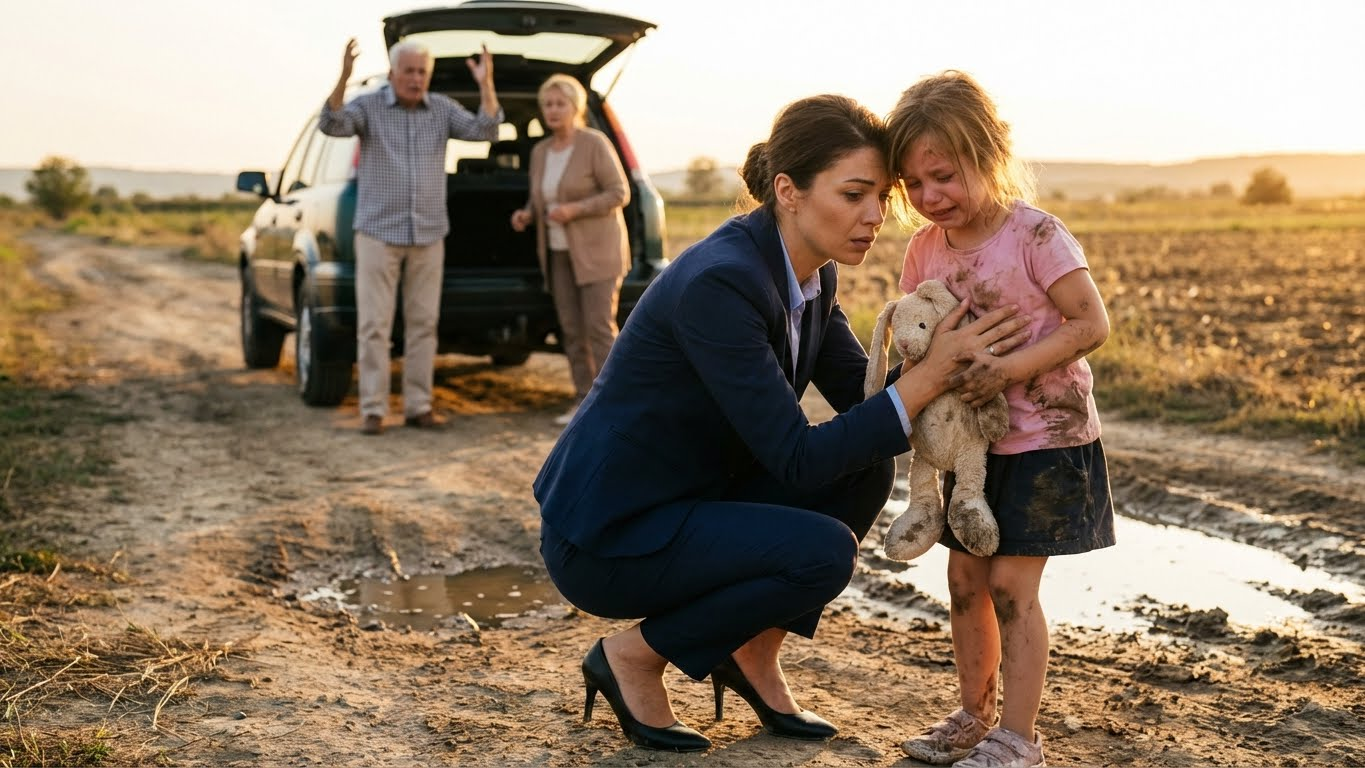
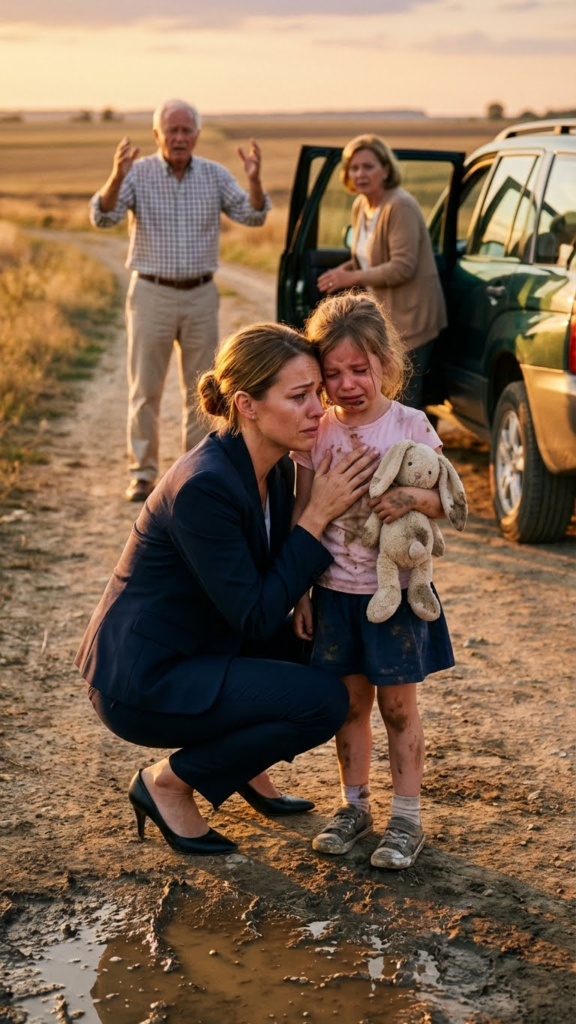
Emma was standing in a mud puddle on the side of Route 9, holding her stuffed rabbit and sobbing so hard she couldn’t catch her breath.
That’s the first thing I saw when I pulled up to my ex-husband’s parents’ house for our custody exchange at 6 PM on a Sunday evening in late September. Not my daughter running to greet me like she usually did after weekend visits. Not her smiling face or excited wave telling me about the cookies they’d baked or the park they’d visited. Just my six-year-old baby girl, covered in dirt from her knees to her hair, clutching Mr. Hoppy like her life depended on it.
I threw the car in park and ran to her, my heels sinking into the soft shoulder of the dirt road. “Emma! Sweetheart, what happened?”
She couldn’t speak. She just buried her face in my shoulder and cried harder, her whole body shaking with sobs that felt too big for someone so small. Her clothes were soaked through—not just damp, but completely saturated. Her hair smelled like old sweat and something else—something sour that made my stomach turn. The mud on her skirt was dried and cracking in places, which meant it had been there for hours. Not minutes. Hours.
“Emma, baby, look at me.” I pulled back gently, cupping her face in my hands, and that’s when I saw it clearly. Tear-streaked cheeks. Exhausted, bloodshot eyes. And an expression I’d never seen on my daughter’s face before—defeated. Hollowed out. Like something inside her had broken.
Behind us, I heard footsteps crunching on gravel. I turned to see my ex-mother-in-law, Linda, standing by their dark SUV with her arms crossed over her cardigan. My ex-father-in-law, Bill, was throwing his hands up in the air in exasperation, like I was the inconvenience here.
“Finally,” Linda called out, her voice dripping with irritation. “We’ve been waiting for twenty minutes. She wouldn’t stop that crying.”
I stared at her. At this woman who had demanded overnight visitation rights during our divorce proceedings. Who had told the family court judge she was a “stable, loving influence” for Emma. Who had sworn under oath she would treat her granddaughter with care and respect during her court-ordered visits.
“Why is she covered in mud?” My voice came out steadier than I felt.
“She was playing outside,” Linda said dismissively, waving her hand. “Kids get dirty. You’re being dramatic.”
“For how long?”
“I don’t know. A while.” She shrugged. “We had things to do.”
I looked down at Emma’s little socks—completely saturated, brown water squelching between her toes. At her shoes—caked with dried mud so thick I couldn’t see the original color. At the stuffed rabbit she refused to let go of, now just as filthy as she was, one ear torn and hanging by threads.
“Emma,” I whispered, kneeling down again so we were eye-level. “Did something happen at Grandma and Grandpa’s house?”
She nodded, her bottom lip trembling.
“Can you tell Mommy what happened?”
She looked over my shoulder at Linda and Bill, then back at me. When she spoke, her voice was so small I almost didn’t hear it:
“They locked me outside.”
The world tilted.
The divorce from Mark had been brutal. Not because we fought over custody—he barely wanted it—but because his parents fought like hell to make sure they got their piece of Emma.
“She’s our only grandchild,” Linda had told the mediator, dabbing her eyes with a tissue. “We’ve been in her life since she was born. Taking away our time with her would be devastating.”
My lawyer had advised against fighting it. “Grandparent rights are tricky,” she’d said. “Judges tend to favor maintaining family connections, especially if the grandparents can demonstrate a prior relationship.”
So I’d agreed. One weekend per month. Friday evening to Sunday evening. Supervised visits at their house in the country, forty minutes outside the city where Emma and I lived.
The first few visits went fine. Emma came home happy, talking about the chickens in their yard and the old swing set Bill had repaired. She showed me drawings she’d made. She seemed okay.
But around month three, things started changing.
She’d come home quieter. When I asked about her weekend, she’d shrug and say “It was fine” without elaborating. She stopped bringing drawings. She started asking if she had to go next time.
“Did something happen, baby?” I’d ask.
“No. I just miss you.”
I’d chalked it up to adjustment. Divorce is hard on kids. Maybe she just needed more stability at home.
But then came the nightmares. Emma would wake up crying, saying she’d dreamed about being stuck somewhere and nobody could hear her screaming. She started wetting the bed again—something she hadn’t done since she was three.
When I called Mark to express concern, he brushed me off. “My parents are fine. You’re just trying to limit my family’s access to her. Stop being vindictive.”
When I called Linda directly, she laughed. “Emma’s perfectly happy here. She’s just playing you for sympathy. Children do that when they want attention.”
So I started documenting. Taking photos when Emma came home. Writing down the things she said. Recording the times she’d come back with unexplained bruises (Linda said she’d fallen off the swing) or unusually hungry (Linda said she’d refused to eat dinner because she was “being picky”).
I was building a case. But I needed something concrete.
Then came the mud puddle.
“They locked you outside?” I repeated, my hands still cupping Emma’s face. “What do you mean, sweetheart?”
“I was bad,” she whispered. “I spilled my juice at lunch. Grandma said I was being careless. She said I needed to learn a lesson.”
Behind me, I heard Linda’s sharp intake of breath. “Now Emma, that’s not—”
“Don’t you dare interrupt her,” I said, not looking away from my daughter. “Emma, tell me what happened. All of it.”
The story came out in broken pieces. How she’d accidentally knocked over her cup at lunch. How Linda had yelled at her—really yelled, the kind of yelling that made Emma’s ears ring. How Linda had grabbed her arm (I made a mental note to check for bruises later) and marched her outside to the backyard.
“She said I had to stay outside until I learned to be more careful,” Emma said. “She locked the back door. I knocked and knocked but nobody came.”
“For how long?”
“I don’t know.” Emma’s tears started fresh. “A really long time. It started getting dark. And then it rained.”
My vision went red. “It rained? You were outside in the rain?”
Emma nodded. “I tried to find somewhere dry but there wasn’t anywhere. I got so muddy. Mr. Hoppy got muddy too. And I was so cold, Mommy. I was so, so cold.”
I stood up slowly, still holding Emma against my hip, and turned to face Linda and Bill.
Linda’s face had gone pale. Bill was looking at the ground, hands in his pockets.
“You locked my six-year-old daughter outside,” I said quietly. “In the rain. For spilling a cup of juice.”
“She needed to learn—” Linda started.
“How long?”
“It wasn’t that long—”
“HOW LONG?”
“Three hours!” Bill finally spoke, his voice cracking. “Linda, just tell her. It was three hours.”
Three hours. My baby had been locked outside in the cold rain for three hours. The sun set at 6:30. It was 6 PM now. That meant she’d been outside since 3 PM—through the afternoon rainstorm I’d driven through on my way here.
“You’re going to jail,” I said. It wasn’t a threat. It was a statement of fact.
“You’re overreacting,” Linda snapped, but I could hear the panic creeping into her voice. “I was teaching her responsibility—”
“You were abusing her.” I pulled out my phone with one hand, keeping Emma held tight with the other. “I’m calling the police. And then I’m calling my lawyer. And then I’m going to make sure you never see her again.”
“You can’t do that!” Linda’s composure shattered completely. “We have court-ordered visitation! You can’t just—”
“Watch me.”
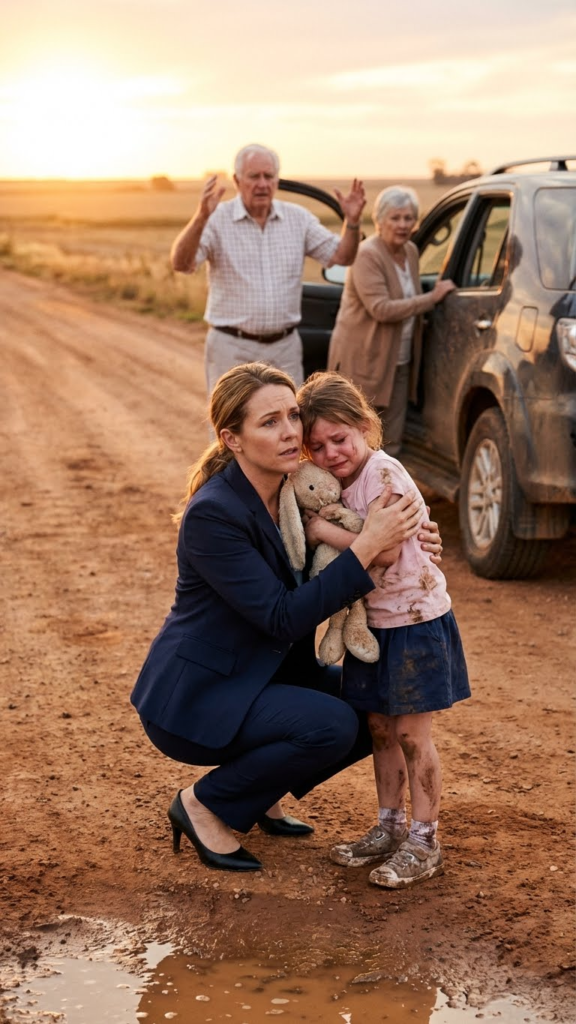
The county sheriff arrived within fifteen minutes. Deputy Martinez took one look at Emma—still shivering, still covered in mud, still clutching her ruined rabbit—and her expression hardened.
“Ma’am,” she said to Linda, “I’m going to need you to tell me exactly what happened here today.”
Linda tried to spin it. Said Emma had chosen to play outside. Said she’d checked on her multiple times. Said Emma was prone to exaggeration and that I was coaching her.
Then Deputy Martinez asked Emma directly, gently: “Sweetie, were you playing outside or did someone make you stay outside?”
“They locked the door,” Emma said. “I knocked but Grandma wouldn’t let me in.”
Martinez looked at Bill. “Sir, is that true?”
Bill, to his credit, couldn’t lie to a police officer. “Linda said she needed to learn a lesson about being careful.”
“By locking her outside in the rain for three hours?”
“It wasn’t three—” Linda started.
“Sir, I asked you a question.”
Bill’s shoulders sagged. “Yes.”
Martinez took photos. She documented Emma’s condition. She interviewed all of us separately. And when she was done, she looked at Linda and Bill with barely contained disgust.
“I’m filing a report for child endangerment,” she said. “Child Protective Services will be contacted. I strongly recommend you retain legal counsel.”
Linda actually laughed—a high, desperate sound. “This is ridiculous! We’re her grandparents! We were just disciplining—”
“You don’t have the right to discipline someone else’s child,” Martinez interrupted. “You have visitation rights, not parental rights. And what you did today crossed every line imaginable.”
I drove Emma home that night with the heat cranked up, her car seat adjusted so I could hold her hand while I drove. She fell asleep before we even hit the highway, exhausted from crying.
When I got her home, I ran a warm bath. I carefully documented every bruise, every scratch, every inch of her that had been hurt under their “supervision.” I sent the photos to my lawyer with a timestamp and a detailed account of everything Emma had told me.
Then I held my daughter while she slept, and I made a promise to her and to myself: they would never touch her again.
Linda and Bill hired an expensive lawyer. They claimed I was alienating Emma from her father’s family. They said I was using one isolated incident to destroy their relationship with their granddaughter. They brought character witnesses—friends from church, neighbors—who testified that they were “wonderful, loving people.”
Their lawyer painted me as a bitter ex-wife using my daughter as a weapon.
But I had something they didn’t: the truth, documented and undeniable.
My lawyer presented the police report. The photos of Emma’s condition. The medical examination that documented bruising on her arm where Linda had grabbed her. The statement from Emma’s therapist about the trauma and nightmares.
And then we showed the pattern. Every visit documented. Every time Emma came home different. Every red flag I’d noted and they’d dismissed.
The judge listened to all of it. Then she listened to Emma—in chambers, privately, with only the judge and a child advocate present.
When they came back, the judge’s decision was immediate and final.
“Visitation rights for the paternal grandparents are hereby terminated,” she said. “The evidence clearly demonstrates a pattern of emotional abuse and a singular incident of physical endangerment that cannot be overlooked. The child’s safety must be the primary concern of this court.”
Linda sobbed. Bill stared at the table. Their lawyer tried to argue for supervised visitation, but the judge shut it down.
“If the grandparents wish to pursue visitation in the future, they may petition the court after completing a parenting course and anger management therapy. Until then, they are to have no contact with the minor child.”
Mark didn’t even show up to the hearing. When I asked him about it later, he said, “My parents made their bed. I’m not fighting for people who hurt my kid.”
It was the first decent thing he’d said to me in three years.
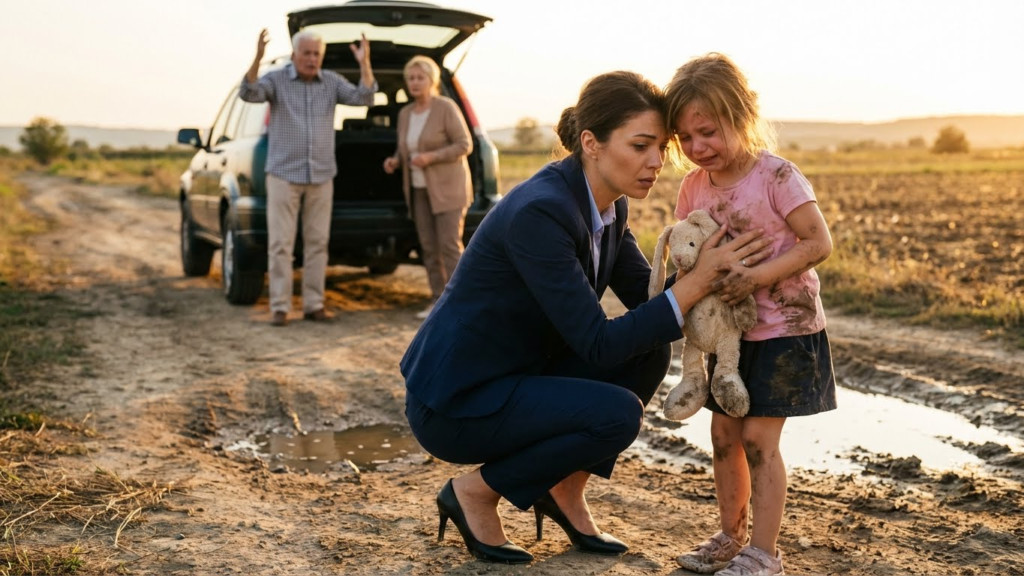
Emma is eight now. It’s been two years since that day on the dirt road. She still has nightmares sometimes, but they’re getting less frequent. We do therapy every week—both individual sessions for her and family sessions together.
She doesn’t talk about Linda and Bill much. When she does, it’s matter-of-fact: “Those are the grandparents who were mean to me.”
Last month, she asked if we could get a new stuffed rabbit. “Mr. Hoppy reminds me of being sad,” she explained.
We went to the toy store together. She picked out a purple bunny with soft fur and floppy ears. She named her Violet.
“Violet keeps me safe,” she told me that night as I tucked her in.
“You keep you safe too, baby,” I said. “You were so brave to tell me what happened. You saved yourself.”
She thought about that. “And you saved me too.”
“We saved each other,” I agreed.
Linda and Bill tried to petition for visitation last year. They completed the required courses. They wrote letters to the judge explaining how they’d “learned from their mistakes.”
The judge denied their petition. Emma’s therapist had submitted a report stating that any contact would be psychologically damaging. Emma herself had told the child advocate she never wanted to see them again.
The judge agreed. Some damage can’t be undone.
Sometimes I drive past that spot on Route 9 where I found Emma standing in the mud puddle. It looks different now—just a normal dirt road in the country. Nothing special. Nothing traumatic.
But I remember. I remember my daughter’s tear-streaked face and her hollow eyes and her voice saying “They locked me outside.”
And I remember the moment I decided I would burn down heaven and hell before I let anyone hurt her again.
That promise still stands.
My daughter is safe now. She’s healing. She knows she’s loved, protected, and believed.
And her grandparents—the ones who thought discipline mattered more than dignity—learned that some lessons are permanent.
They lost their granddaughter forever because they couldn’t see that a six-year-old child spilling juice isn’t a crime.
It’s just being six.
And being six should mean being loved, not locked outside in the rain like an animal.
Emma knows that now. And she’ll never forget which side her mother was on when it mattered most.