I used to believe kindness was something you could outsource.
Write a check. Attend a gala. Shake the right hands. Smile for the camera. That was what “doing good” looked like in my world.
My name is Daniel Harper. I’m forty-six years old, founder of a logistics software company that went public six years ago. On paper, I have everything people chase: multiple properties, a private driver, a calendar booked months in advance. I sit on boards that claim to change the world.
But none of that prepared me for a girl I met outside my office last winter.
The Morning Everything Shifted
It was a Tuesday. It always seems to be a Tuesday when things fall apart.
I had just closed a deal that added eight figures to my net worth. My assistant was already texting me congratulations before I’d even left the conference room. I remember staring at my reflection in the elevator mirror, adjusting my cufflinks, thinking, This is what success feels like.
Outside, the city was doing what it always does: rushing, honking, stepping around problems rather than solving them.
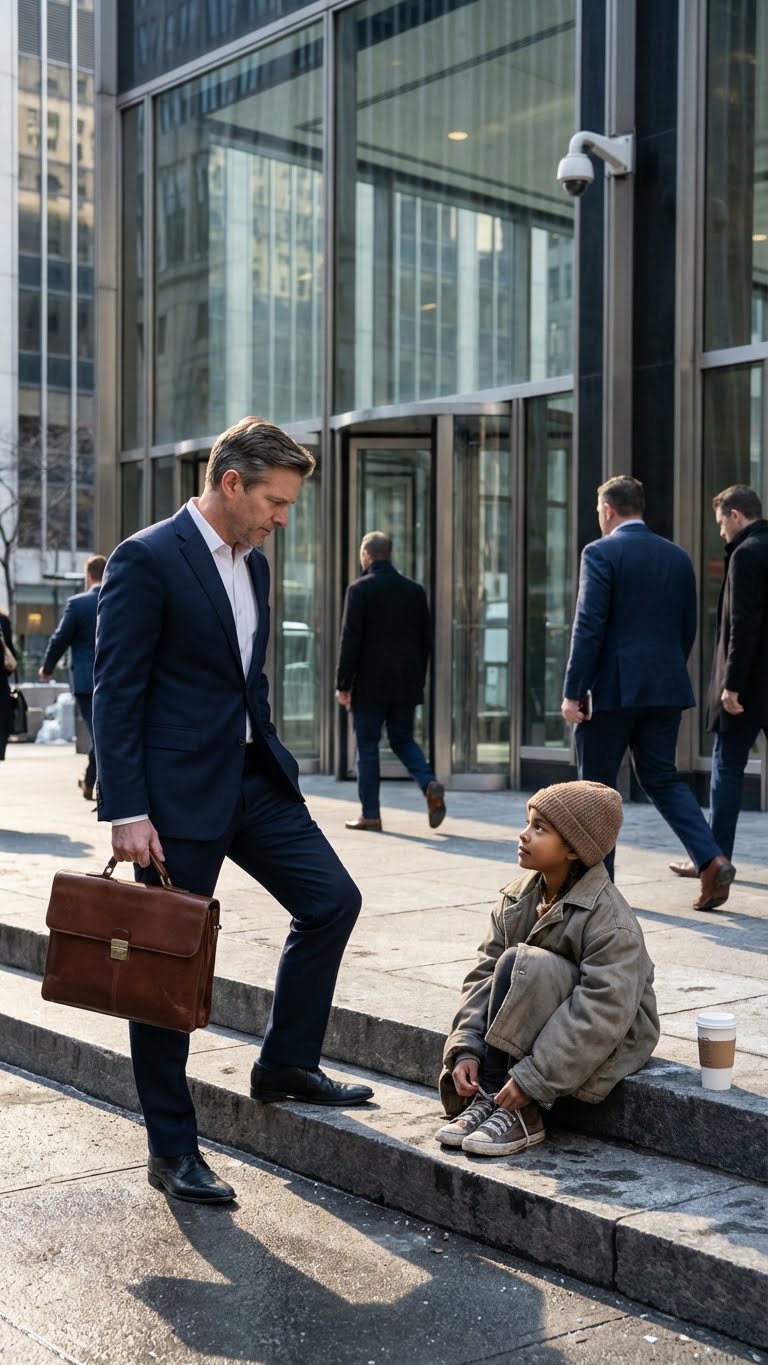
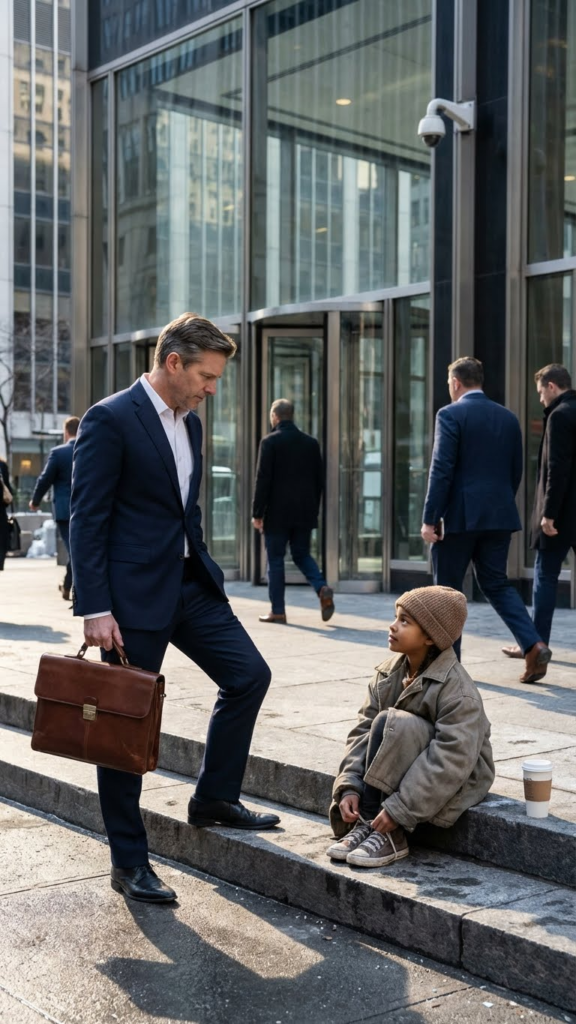
My building has a covered entrance with polished stone floors. People aren’t supposed to linger there. Security usually makes sure of that. But that morning, there was a small shape sitting against the glass wall.
A girl. Maybe nine or ten.
Her coat was too thin for the weather, sleeves pulled over her hands. She had a backpack that looked heavier than she was, and she was focused on tying the same knot in her shoelaces over and over again like it might solve something.
I noticed her.
I also noticed the security guard looking the other way.
The Choice I Pretended Not to Make
I slowed down, just a little. That tiny moment where you decide whether to stay in your lane or step out of it.
I told myself I didn’t want to embarrass her. I told myself I wasn’t qualified to help. I told myself someone else would handle it.
What I really told myself was that I had a driver waiting and a meeting in twenty minutes.
So I walked past her.
Not quickly. Not dramatically. Just enough that I could still convince myself I hadn’t done anything wrong.
She didn’t ask me for anything. That made it easier.
But as I passed, I heard her whisper, “Excuse me, sir?”
I pretended I didn’t.
The Rest of the Day
The meeting went great. Of course it did. Everyone wanted something from me — advice, introductions, approval. I was in my element, nodding, smiling, delivering rehearsed lines about impact and purpose.
Still, the girl’s voice kept echoing in my head.
Not loud. Not accusing. Just small.
That evening, I attended a charity dinner downtown. My company was sponsoring a table. The theme was “Empowering the Next Generation,” complete with glossy pamphlets and emotional speeches.
At one point, the host asked me to say a few words.
I stood up, glass in hand, and spoke about responsibility, about giving back, about how fortunate I’d been. People applauded. Someone wiped away a tear.
All I could see was that girl tying her shoelaces in the cold.
The Second Meeting
Two days later, she was there again.
Same spot. Same coat. Same backpack.
This time, I couldn’t pretend she was invisible. I felt like the building itself was holding its breath, daring me to make the same choice twice.
I approached her slowly, as if sudden movements might scare her away.
“Hi,” I said, feeling ridiculous for being nervous. “Are you okay?”
She looked up at me, eyes sharper than I expected. Not scared. Tired.
“I’m waiting for my mom,” she said.
I didn’t know what to say to that. The script I had prepared in my head — about shelters, about services — didn’t fit anymore.
“Does she work nearby?” I asked.
She shrugged. “Sometimes.”
There was a pause, heavy and awkward.
“Do you go to school?” I asked, hating myself for how stiff it sounded.
“Not right now.”
The Crack in My Story
I wanted to help her. I also wanted this to be quick. Something neat and contained, like writing a donation.
But real life isn’t neat.
She didn’t ask for money. She didn’t cry. She didn’t perform sadness for me. She just sat there, a child in a world that had learned to step around her.
I offered to get her something warm from the café inside. Her eyes lit up — not with gratitude, but with something closer to relief.
When I came back with a cup of hot chocolate and a sandwich, she took them carefully, like she wasn’t sure they were really for her.
“Thank you,” she said.
It was the simplest thing in the world.
And somehow, it undid me.
What I Didn’t Tell Anyone
That night, I canceled my dinner plans. I went home alone and sat in a penthouse that suddenly felt too big.
I kept thinking about all the times I’d congratulated myself for being generous. For funding programs I’d never personally seen. For believing that because I cared in theory, I was good in practice.
I didn’t tell my board. I didn’t tell my assistant. I didn’t even tell my wife, who was overseas for work.
I was afraid that if I said her name — the girl outside my office — I would have to admit how badly I’d failed a test I didn’t know I was taking.

Part 1 ends here.
Part 2 will continue with what happened next — the discovery that changed how I see my success, and the choice I can never undo.