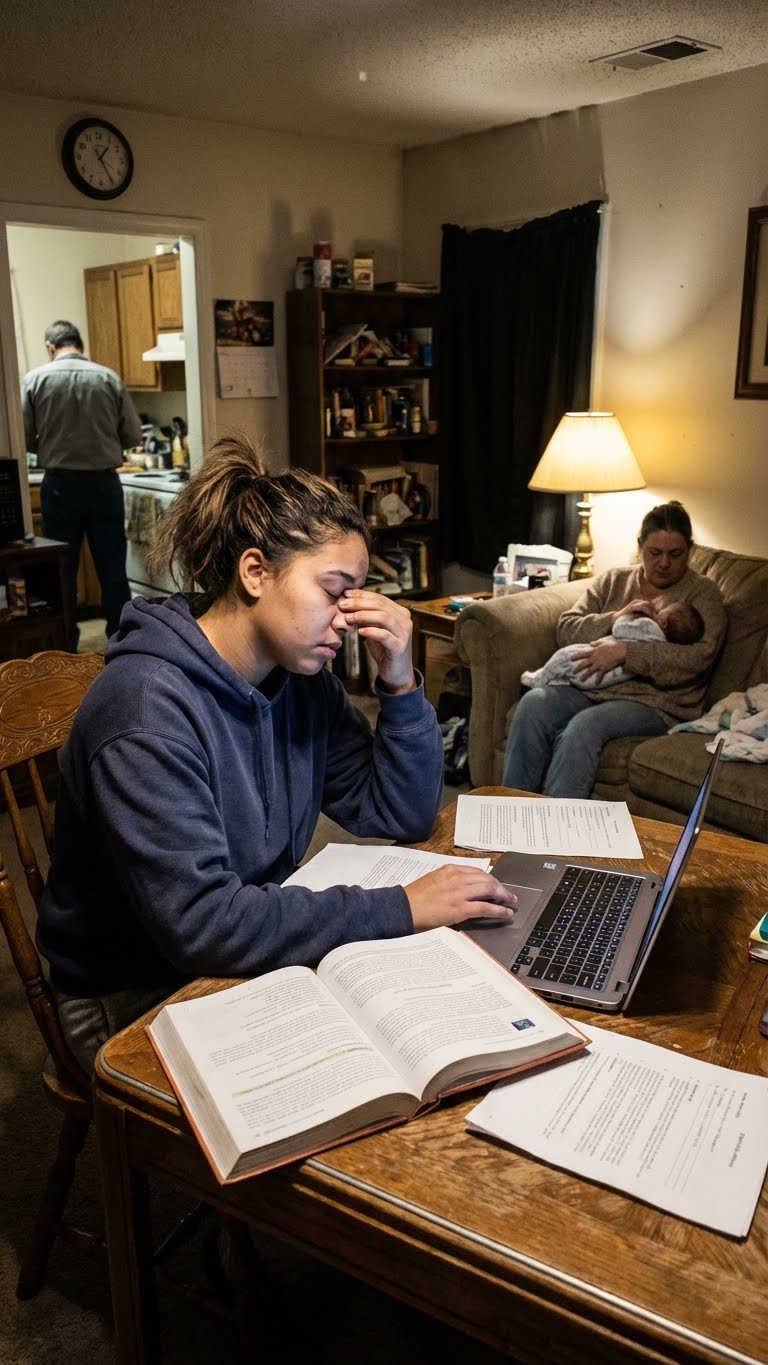
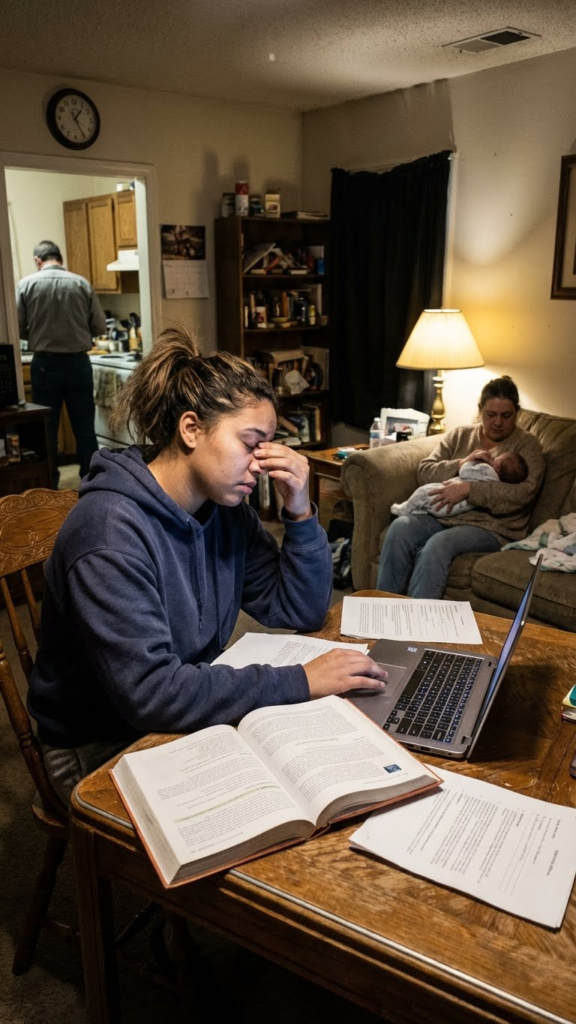
People at school think I have my life together.
I get decent grades. I show up to class. I don’t party much. I always seem tired, but that’s normal in college, right?
What they don’t see is that every exam I take, every lecture I attend, is balanced on a house that feels like it might fall apart if I breathe too loudly.
Growing Up Too Early
I was nineteen when my little brother was born.
Not my mother’s first child, but somehow the one who changed everything.
My mom had him after years of telling me she was done having kids. I didn’t blame her for wanting something good after everything she’d been through. But I also didn’t realize how much of that “good” would land on my shoulders.
By the time I started my second year at university, I wasn’t just a student. I was the alarm clock, the grocery planner, the quiet mediator when voices got too loud at home.
My dad used to be different. He used to laugh easily. He used to take me to the park when I was little, push me on the swings until I screamed with joy.
Now he mostly comes home heavy and angry, like the world has pressed too hard on him and he has nowhere else to put the weight.
I try to remember the man he was.
It’s getting harder.
The Double Life
Most mornings start before sunrise.
I wake up to the soft sounds of my baby brother stirring in his crib, his tiny sighs floating down the hallway. Mom is usually already awake, but tired in the way that never really goes away. I help her warm a bottle, then I iron my shirt for work while she feeds him.
By seven, I’m out the door with my backpack full of textbooks and my mind full of grocery lists.
I work at a coffee shop between classes. It’s not glamorous, but it pays just enough to keep the lights on when things get tight. I save every tip, every extra shift, because I never know when I’ll need to cover something my parents can’t.
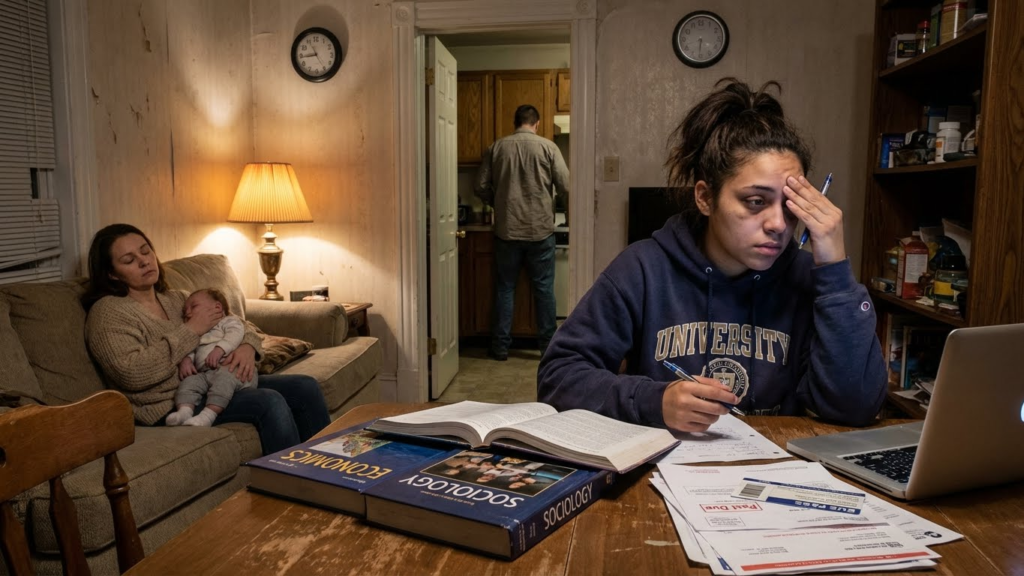
At school, I’m just another student. I sit in lectures about economics and sociology, raising my hand when I can, pretending my phone buzzing in my pocket isn’t a problem waiting for me at home.
The House No One Sees
Our house looks normal from the outside.
Two bedrooms, a small kitchen, a living room with mismatched furniture we’ve collected over the years. But inside, it feels like everyone is holding their breath.
When my dad comes home late, I can hear the front door before I see him. The sound is different. He moves like he’s arguing with something only he can see.
Mom tries to keep the peace. She always has.
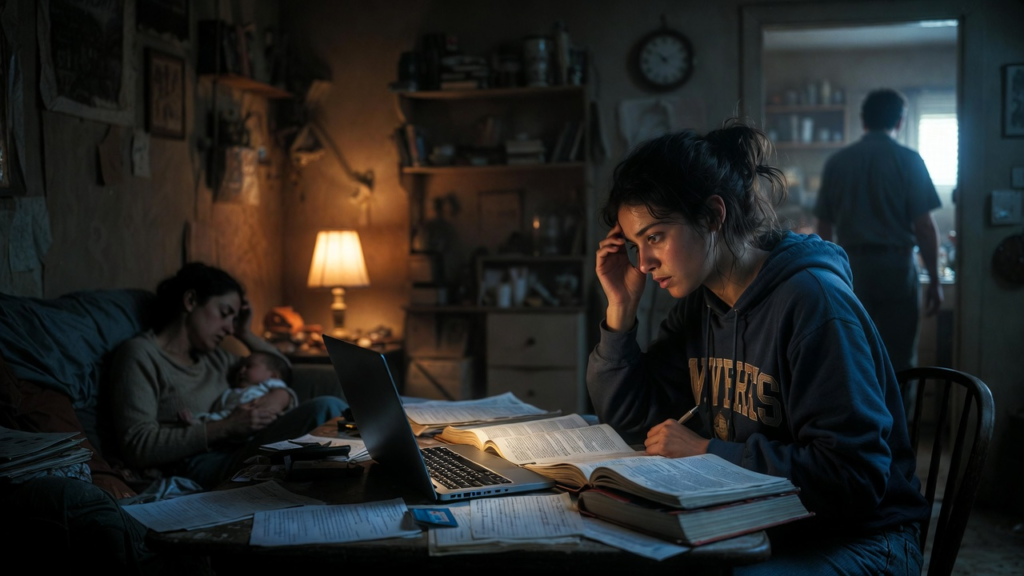
I sit in my room with my textbooks open, pretending to study, listening for changes in the tone of voices down the hall. I’ve learned to tell the difference between a bad night and a worse one.
On the worst nights, I pack my backpack early — charger, baby wipes, a spare bottle — just in case.
The Cost of Responsibility
I don’t tell my friends any of this.
When they complain about group projects or roommates, I nod and laugh at the right moments. I don’t tell them that I’ve missed exams because I was at home helping my mom figure out how to stretch twenty dollars across three meals.
I don’t tell them that sometimes I feel older than my professors.
Once, after a late shift, I fell asleep in the library with my head on a pile of flashcards. When I woke up, my phone had twelve missed calls from home. Nothing terrible had happened — not that time — but my chest ached like it had.
Being the reliable one sounds noble until you realize it means you’re never allowed to fall apart.
The Night Everything Slipped
It was midterms week when things tipped from hard to unbearable.
I had just finished a statistics exam I wasn’t sure I passed. My hands were still shaking when I checked my phone outside the lecture hall.
Five missed calls from Mom.
I ran to the bus stop without thinking, backpack thumping against my spine, mind racing ahead of my body. By the time I got home, the house felt like it was vibrating.
Mom was sitting on the couch with my baby brother asleep on her chest. Her eyes were red, but she tried to smile at me like everything was fine.
Dad was in the kitchen, not looking at either of us.
I didn’t ask what had happened. I didn’t need to.
That night, I sat on the floor of my bedroom with my back against the door, laptop open to a blank document, trying to write a paper about social mobility while wondering how far a family could bend before it broke.
The Promise I Keep Making
Every morning, I tell myself this is temporary.
That once I graduate, once I get a real job, I’ll move us somewhere quieter. Somewhere my brother can grow up without learning to read a room before he can read a book.
But then I remember how many times I’ve said that already.
I don’t know how long I can keep being the strong one. I don’t know what happens when I finally drop one of the things I’m carrying.
All I know is that I don’t have the luxury of choosing between my future and my family.
Not yet.
Part 1 ends here.
Part 2 will continue with the night I finally asked for help — and the choice that changed everything.