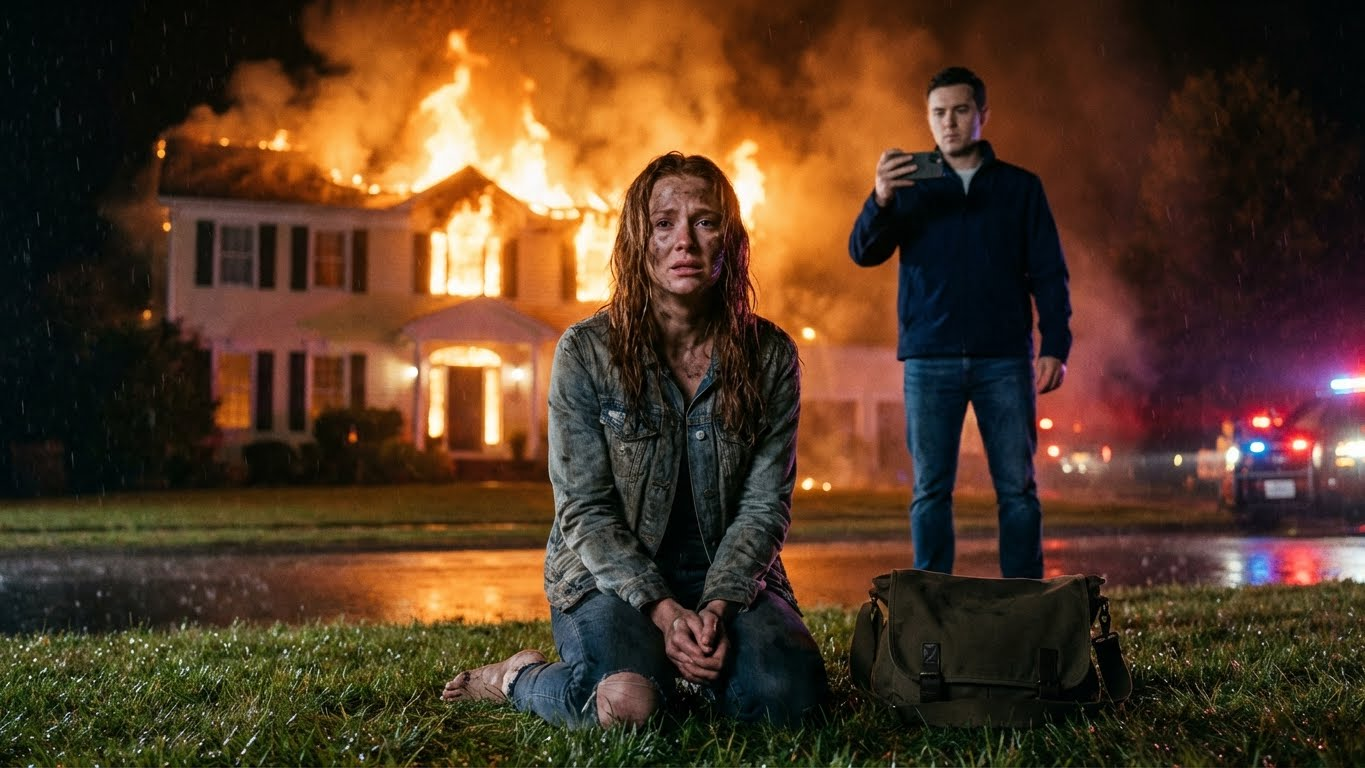
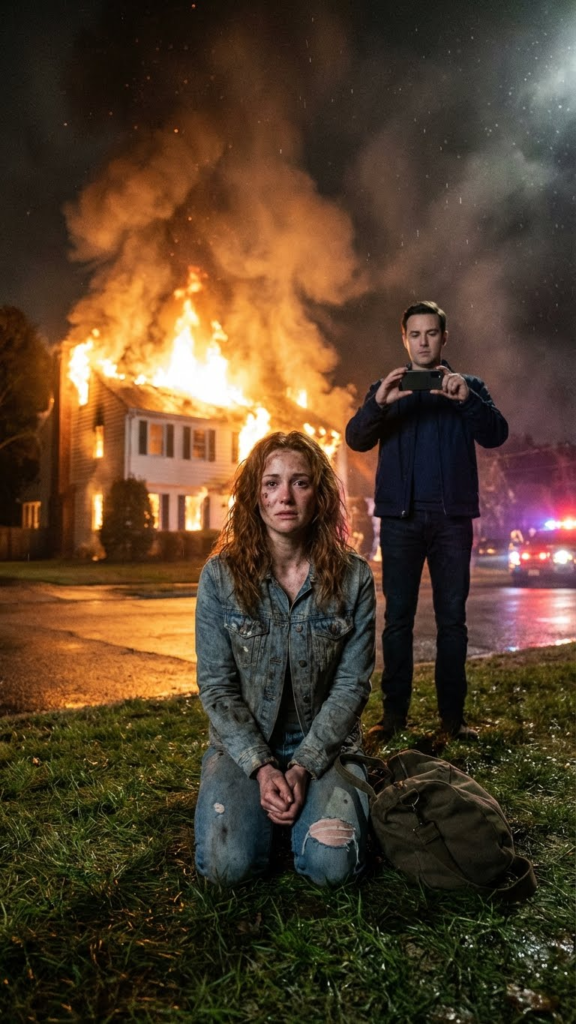
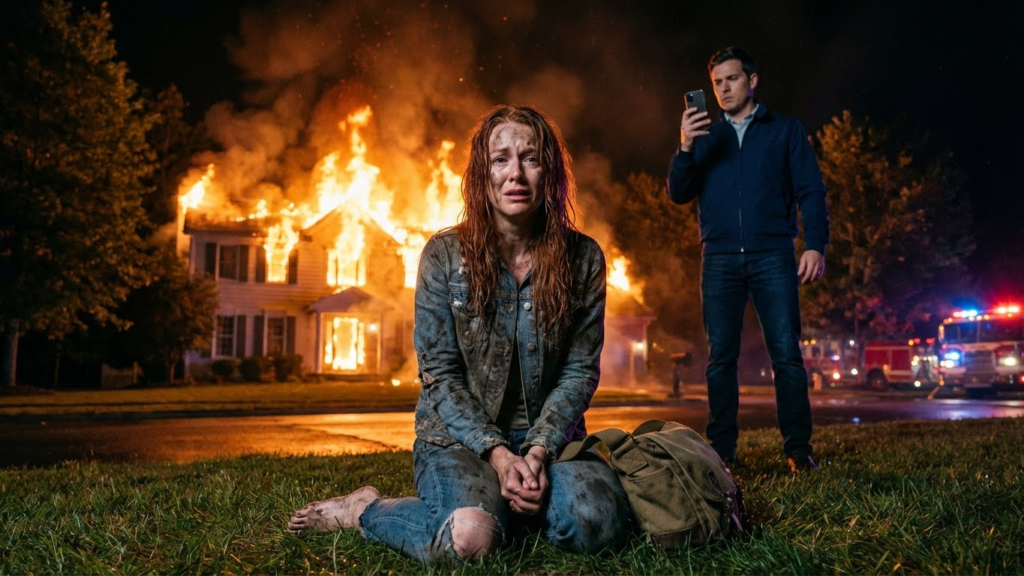
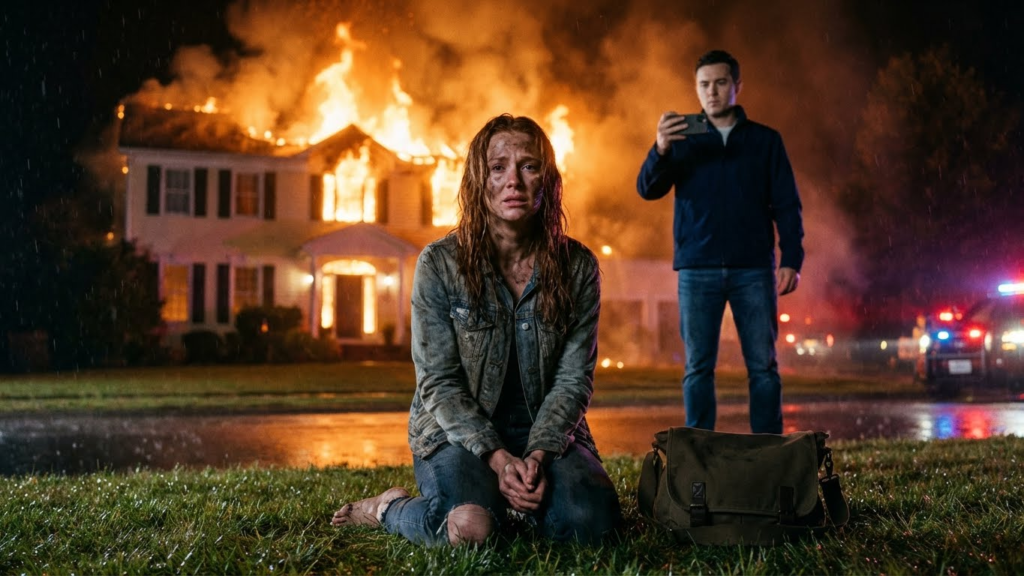
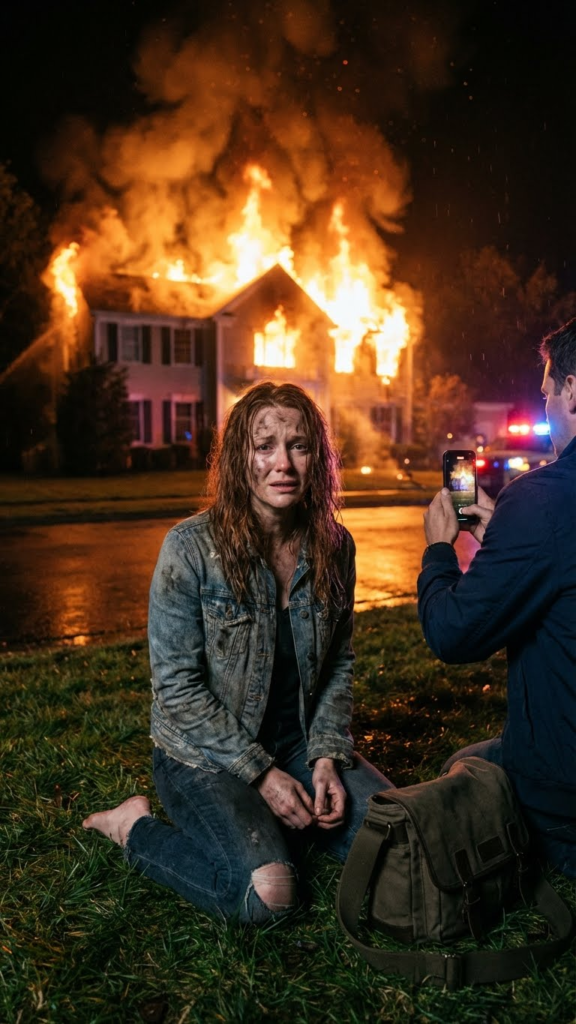
I was kneeling on the wet grass, watching everything I’d ever worked for burn to the ground, when I noticed my husband wasn’t crying.
He was filming.
The flames were everywhere—orange and yellow tongues licking out of our bedroom window, consuming the second-story roof, turning our two-story suburban dream home into a blazing inferno that lit up the entire street. Thick white smoke poured into the night sky, so dense I could taste it coating the back of my throat. My hands were shaking violently, covered in black soot, my hair matted with dirt and ash from my desperate attempt to grab what I could before the fire spread from the kitchen to the rest of the house.
And Jake—my husband of seven years—was standing three feet behind me with his iPhone out, recording it all in perfect horizontal HD like he was documenting a vacation sunset.
“Jake,” I choked out, my voice barely audible over the roar and crack of burning wood. “What are you doing?”
“Getting footage for the insurance claim,” he said, his voice steady and calm. Too calm. Like this was a completely normal response. Like our entire life wasn’t being incinerated in front of us.
That’s when I noticed his clothes. Clean. Dry. Not a single speck of ash on his dark navy jacket, no soot on his jeans, his face completely unmarked while I looked like I’d been dragged through hell backwards. The fire department hadn’t even arrived yet—I could hear the sirens wailing in the distance, still several blocks away—but Jake’s phone was already out, already recording, angled professionally to capture the destruction.
Like he’d been ready. Like he’d been waiting for this exact moment.
I turned to look at him, really look at him, and saw something in his face that made my blood run colder than the wet grass soaking through my ripped jeans. No panic. No devastation. No tears. Just… concentration. The kind of intense focus someone has when they’re checking important items off a critical to-do list.
“Jake,” I said slowly, my brain struggling through shock and smoke inhalation to process what I was seeing. “When did you call 911?”
He didn’t answer immediately. Just kept filming, adjusting his angle slightly to get a better shot of the roof as it began to collapse inward with a shower of sparks.
“Jake. WHEN did you call?”
“Ten minutes ago. Maybe fifteen.” He zoomed in on the flames bursting through what used to be our bedroom. “Wanted to make sure we got good documentation of the full damage for the claim. You know how insurance companies are—they’ll try to lowball you if you don’t have proof.”
Ten minutes. The fire had started at least twenty minutes ago. I’d woken up choking on smoke, stumbled into the hallway to find it filled with thick gray clouds, screamed for Jake, grabbed the emergency bag we kept by the front door, and run outside in my bare feet thinking he was right behind me.
But he hadn’t been behind me. He’d been… what? Watching? Waiting? Letting it burn while I panicked?
And that’s when I looked down at the olive canvas messenger bag clutched in my dirt-streaked hands—the emergency bag we’d prepared together three years ago after a neighborhood fire scared us into being prepared. The one that was supposed to contain our passports, birth certificates, social security cards, backup hard drives with all our photos and documents, some cash, and the external drive with my entire freelance design portfolio.
I unzipped it with trembling fingers.
It was completely empty. Every single item had been removed. Someone had cleaned it out entirely, leaving nothing but the empty bag.
My heart stopped. I looked up at Jake, and he was still filming, but now there was something else in his expression. Satisfaction. Like everything was going exactly according to plan.
That’s when I understood. This wasn’t an accident. This wasn’t a tragic house fire that would devastate us but we’d survive together.
My husband had burned down our house. And he’d made sure I’d lose everything in it.
Jake and I bought the house when I was 28 and he was 31. It was everything we’d dreamed of—a two-story Colonial in a good neighborhood, hardwood floors, updated kitchen, a yard big enough for the kids we were planning to have. We’d saved for years, combined our money, put both our names on the mortgage.
Or so I thought.
I was a freelance graphic designer, working from home, building my business slowly but successfully. Jake worked in commercial real estate—sales, acquisitions, property management. He made decent money, but not amazing money. Together, though, we were comfortable. Solid. Building a future.
The problems started about a year after we bought the house. Small things at first. Jake would “forget” to tell me about bills. I’d discover we were behind on the electric or that a credit card payment had been missed. When I asked about it, he’d get defensive.
“I’m handling the finances, Sarah. You focus on your design work. That’s what we agreed.”
Except we hadn’t agreed to that. We’d agreed to manage finances together. But somehow, gradually, Jake had taken over all our accounts. He’d convinced me it was “easier” if everything went through him since he “understood money better” from his real estate background.
I should have fought harder. I should have insisted on transparency. But I was busy building my business, and honestly, I trusted him. He was my husband. Why wouldn’t I trust him?
The other red flags were subtler. Jake became obsessed with insurance. He upgraded our homeowner’s policy twice, insisting we needed better coverage. He took out a life insurance policy on me—”just in case something happens, I need to be protected”—and pushed me to do the same for him.
He also became increasingly interested in my work. Specifically, in where I stored my files. He’d ask questions about my backup systems, whether I kept everything on the cloud or on physical drives, whether I had copies of my client contracts.
At the time, I thought he was just being supportive. Showing interest in my career.
Now I realize he was cataloging everything I had, everything I’d lose, everything that would be destroyed.
Six months before the fire, our marriage started falling apart. Jake became distant, cold. He’d come home late from “client meetings” smelling like perfume. He’d take phone calls in his car. He started talking about “simplifying our lives” and suggesting I should “scale back the freelance work.”
“You’re putting too much pressure on yourself,” he’d say. “Maybe you should just work part-time. Focus on the house. On us.”
But I loved my work. I’d built a solid client base, made good money—sometimes more than Jake, which seemed to bother him more and more. I’d recently landed a major contract with a tech company, a year-long retainer worth six figures. It was the biggest deal of my career.
Jake congratulated me, but his smile didn’t reach his eyes.
That’s when the sabotage started. Small things. My laptop would mysteriously lose battery overnight even though I’d plugged it in. Files would get corrupted. My backup hard drive stopped working—Jake said he’d “accidentally” knocked it off the desk.
I started keeping better backups, storing everything in multiple locations. I kept my most important external drive in my car. I uploaded critical files to three different cloud services.
I was protecting my work. I didn’t realize I should have been protecting myself.
Three months before the fire, I found the texts. Jake had left his phone on the counter while he showered, and a message popped up from a woman named “Christina – Listing Agent.”
“Can’t wait for tonight. Tell your wife you’re showing a property 😉”
I opened his phone—I knew his password, it was our anniversary—and found months of messages. Christina wasn’t a listing agent. She was his girlfriend. They’d been together for over a year, talking about their future together, about how Jake was “working on the Sarah problem.”
The Sarah problem. That’s what I was to him. A problem to be solved.
I screenshotted everything, sent it to myself, and confronted him that night. He denied it at first, then admitted it, then tried to make it my fault.
“You’re always working! You care more about your clients than your husband! What did you expect me to do?”
I told him I wanted a divorce. He agreed immediately—too immediately—and said we should “handle it amicably.” Split everything 50-50, no lawyers, keep it simple.
But there was nothing simple about it. The house was in both our names, but somehow, Jake had refinanced it without my signature—or with a forged signature, I later discovered. The equity we’d built up was gone, taken out as a loan for his “business investments” that didn’t exist.
My lawyer told me I’d been financially abused for years. Jake had been systematically draining our accounts, taking out credit cards in my name, building debt I didn’t know about. If we divorced, I’d be responsible for half of it—hundreds of thousands of dollars.
I’d be ruined. My business would be destroyed paying off debt I didn’t create.
Unless there was another way. Unless everything was just… gone.
I woke up at 2:47 AM to the smell of smoke. Not the subtle smell of something burning in a neighbor’s fireplace—thick, acrid, chemical smoke that burned my throat immediately.
I jumped out of bed, ran to the hallway, and saw gray clouds pouring out of the kitchen downstairs. I screamed for Jake, but he wasn’t in bed. I ran downstairs, saw flames crawling up the kitchen wall near the stove, and panicked.
The fire extinguisher was gone from its usual spot by the pantry. I looked everywhere—nothing. I tried to grab the garden hose through the back door, but the flames had already spread too far, the heat too intense.
I ran back upstairs screaming Jake’s name. He appeared at the end of the hallway, fully dressed in jeans and a jacket. At 2:47 AM. Fully dressed.
“The house is on fire!” I screamed. “We have to get out!”
“Grab the emergency bag,” he said, completely calm. “I’ll meet you outside.”
I grabbed the bag by the front door and ran out in my pajamas and bare feet. The wet grass shocked my feet—it had rained earlier that evening, everything was soaked. I turned back to see Jake walking out slowly, phone already in his hand.
Not running. Not panicking. Walking. Like he had all the time in the world.
That’s when I knelt on the grass, watching our house burn, and noticed all the wrong things. His calmness. His dry clothes. His immediate filming. The empty emergency bag. The missing fire extinguisher.
And then I remembered something else. Three weeks ago, Jake had asked me to sign some papers. “Just updating our homeowner’s policy,” he’d said. “Insurance company needs both signatures.”
I’d signed without reading them carefully. I’d trusted him.
The fire department arrived eight minutes after I realized what Jake had done. They swarmed the property, but our house was already a total loss. The fire had spread too quickly, burned too hot, destroyed everything.
While the firefighters worked, a fire investigator pulled up. Captain Morrison, a woman in her fifties with sharp eyes and a no-nonsense attitude. She walked the perimeter, took photos, asked questions.
“Where did the fire start?” she asked me.
“The kitchen. Near the stove, I think. I saw flames on the wall—”
“The stove wasn’t on when you went to bed?”
“No. I don’t think so. I mean, I didn’t cook anything last night—”
“And you, sir?” She turned to Jake, who was still holding his phone. “When did you first notice the fire?”
“Same time as my wife. The smoke alarm woke us up.”
That was a lie. I’d woken up to smoke, not the alarm. And I hadn’t heard any alarm at all.
Captain Morrison wrote something in her notebook. “Both smoke alarms in the house?”
“Yes,” I said. “One upstairs, one downstairs by the kitchen.”
“Interesting. Because neither of them went off. The fire was advanced enough that they should have triggered well before you woke up to smoke.” She looked at Jake. “Any idea why that would be?”
Jake’s face remained neutral, but I saw a muscle twitch in his jaw. “No idea. Maybe the batteries were dead?”
“Both of them? At the same time?” Captain Morrison didn’t wait for an answer. “We’ll be investigating this as a potential arson case. Standard procedure for suspicious fires. We’ll need both of you to come down to the station tomorrow for formal statements.”
That’s when Jake’s composure cracked, just for a second. “Arson? That’s ridiculous. It was obviously an electrical fire or—”
“We’ll determine the cause after our investigation,” Captain Morrison said firmly. She looked at me. “Mrs. Holloway, do you have somewhere safe to stay tonight?”
I nodded. “My sister’s place.”
“Good. We’ll be in touch.”
I didn’t go to my sister’s that night. I went to a 24-hour coffee shop, opened my laptop, and started digging.
I’d been suspicious for months, quietly documenting everything. Screenshots of our bank accounts before Jake changed the passwords. Copies of credit card statements. Records of the refinancing I hadn’t known about. The texts between Jake and Christina about “the plan.”
But I didn’t have proof of arson. Not yet.
Then I remembered something. Six months ago, paranoid about Jake’s strange behavior, I’d installed a hidden security camera in our living room. Not because I thought he’d burn the house down—I thought he might be stealing money or hiding assets. The camera had a cloud backup feature that saved footage for 30 days.
With shaking hands, I logged into the app. The camera would have stopped working when the fire reached the living room, but maybe, just maybe, it had caught something before that.
I pulled up the footage from earlier that evening. 11:47 PM: Jake and I going to bed. 1:23 AM: Jake coming back downstairs, moving around in the kitchen—the camera angle only caught part of the kitchen, but I could see him doing something near the stove. 1:47 AM: Jake going back upstairs. 2:15 AM: Jake coming back down with our emergency bag, opening it, removing items. 2:31 AM: Jake unscrewing something on the wall—the smoke detector. 2:38 AM: Jake in the kitchen again, and then—
The camera went dark. But I had enough.
I had video evidence of my husband disabling the smoke alarm, emptying our emergency bag, and doing something near the stove 80 minutes before the fire started. Something that must have been on a timer. Accelerant, maybe, or a device designed to spark once the house was quiet.
I downloaded everything, backed it up to three different services, and emailed copies to myself and my lawyer.
Then I called Captain Morrison.
The police arrested Jake at 6:30 AM as he was checking into a hotel—with Christina. Turns out they’d planned to stay together that night, celebrating the successful destruction of the house and my life.
Captain Morrison called me at 7 AM. “We have your husband in custody. The video evidence you provided, combined with what we found at the scene, is more than enough. He removed the smoke detector batteries, used a modified space heater with an accelerant to start the fire, and disabled the gas line to make it look like a kitchen accident. He also took out a massive insurance policy on the house three months ago. One that would only pay out for total loss.”
“How much?” I asked.
“Nine hundred thousand dollars. The house is worth maybe three-fifty. He over-insured by more than half a million and planned to collect it all, disappear with his girlfriend, and leave you holding the debt from the refinance he did in your name.”
My hands clenched into fists. “Can you prove all of that?”
“We have the receipts for the space heater, the accelerant purchase on his credit card, the insurance documents, and your video. Plus, we found text messages on his phone from Christina: ‘Can’t believe it’s finally happening tonight! Soon we’ll be in Costa Rica with all that money 🔥’ Heart emoji, fire emoji. They literally couldn’t help themselves.”
I almost laughed. Almost. “What happens now?”
“He’s being charged with arson, insurance fraud, attempted murder—since you were in the house when he started the fire—and financial elder abuse for the debt fraud. He’s looking at 15 to 25 years.”
Attempted murder. I hadn’t even processed that Jake had tried to kill me. The fire could have spread faster. I could have been trapped upstairs. I could have died in my sleep from smoke inhalation if I hadn’t woken up.
He’d been willing to murder me for insurance money and a fresh start with his girlfriend.
The trial was national news. “Man Burns Down House with Wife Inside for Insurance Fraud” ran on every major outlet. The video I’d captured went viral—millions of views of Jake methodically dismantling the smoke detector, emptying the emergency bag, preparing to destroy everything.
Jake’s lawyer tried to claim it was an accident, that Jake had been trying to fix the smoke detector and coincidentally the space heater malfunctioned. The jury deliberated for 90 minutes before convicting him on all counts.
Twenty-three years in prison. No parole for at least fifteen.
Christina was charged as an accessory—her texts proved she knew about the plan. She took a plea deal, testified against Jake, and got five years.
As for me? The insurance company paid out my renter’s insurance—I’d kept a separate policy Jake didn’t know about. My critical files were safe in the cloud and on the drive in my car. My business survived.
The house investigation revealed that Jake had forged my signature on the refinance. I wasn’t legally responsible for any of the debt. His assets—including his half of the destroyed house’s insurance payout that the court seized—went toward restitution.
I rebuilt my business, moved to a different state, and started over. Clients who’d seen the news reached out in support. I got more work than I could handle, hired two assistants, tripled my income.
Jake sends letters from prison sometimes. Apologies, explanations, excuses. I burn them without reading them. Seems fitting.
Three years later, I own my own house again. Smaller, simpler, but it’s mine. Just mine. No one else’s name on the deed. No one else controlling my finances. No one else planning my destruction.
I got remarried last year to someone who thinks my independence is attractive, not threatening. Someone who celebrates my success instead of resenting it. Someone who would never, ever watch me kneel in the grass while everything I owned burned.
The night of the fire changed me. I learned that the person sleeping next to you can be your greatest threat. I learned that trust without verification is just willful blindness. I learned that financial independence isn’t selfish—it’s survival.
I also learned that sometimes, the worst thing that happens to you is also the thing that saves you.
If Jake hadn’t burned down the house, I might have stayed in that marriage for years, slowly being drained and controlled and destroyed in less visible ways. The fire forced everything into the open. It exposed his fraud, his cruelty, his willingness to hurt me for money.
In trying to destroy me, he freed me.
Now I teach other women about financial abuse, about protecting themselves, about recognizing the warning signs I missed. I speak at conferences. I’ve written a book. I help people escape situations like mine before they escalate to arson.
And every time I tell my story, I start the same way:
I was kneeling on wet grass, watching my house burn, when I realized my husband wasn’t crying. He was filming.
And that’s when I decided I wasn’t going to be his victim. I was going to be the one who survived, who fought back, who won.
Some people try to burn your life down. But if you’re smart, if you’re prepared, if you refuse to give up—you rise from those ashes stronger than ever.
Jake learned that lesson the hard way. From a prison cell. Where he’ll be for the next two decades.
And I learned it too. Standing in my new house, built with my own money, secured by my own success, protected by my own strength.
Fire destroys. But sometimes, it also refines. And I came out of those flames pure steel.