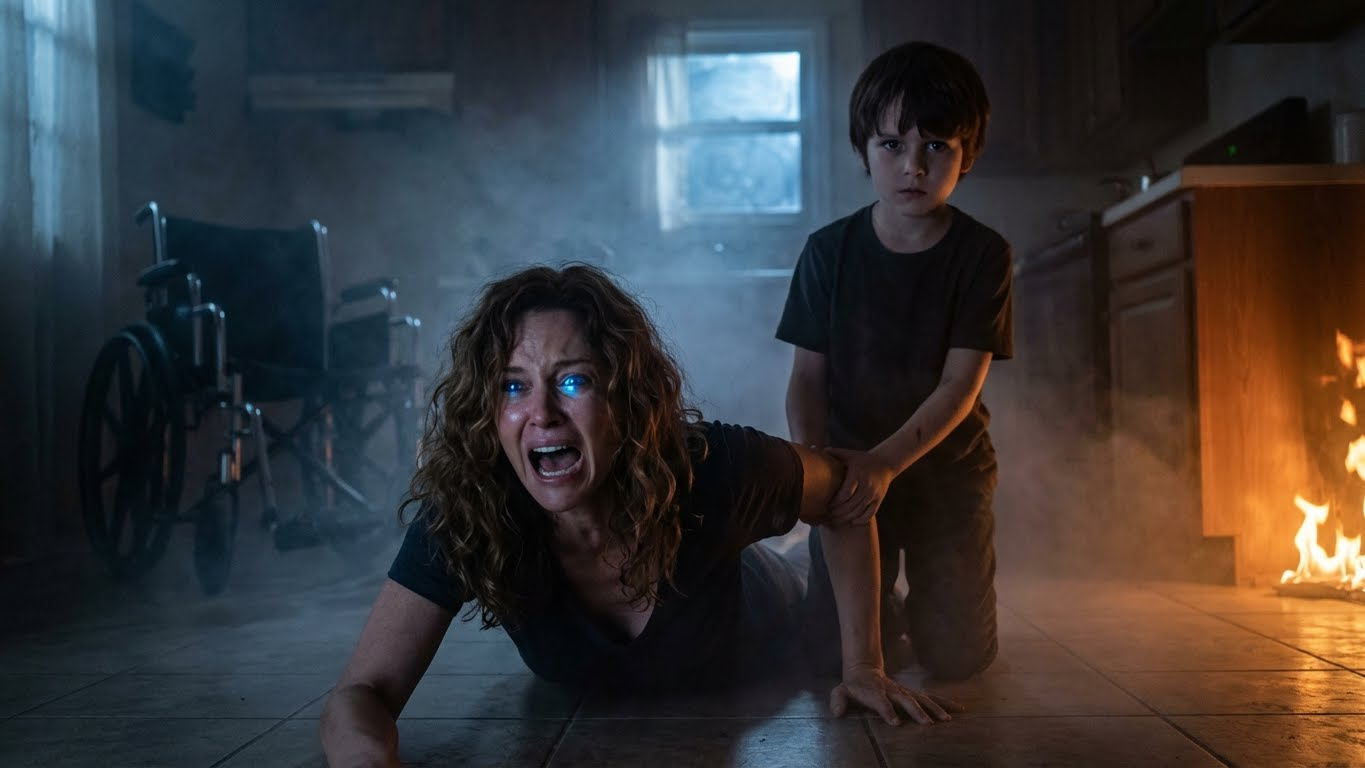
The smoke alarm screamed through the house at 2:47 AM, but that’s not what woke me. It was the heat—unbearable, suffocating heat crawling up the hallway toward my bedroom. I could hear the crackling before I even opened my eyes.
Fire.
I tried to stand, but my legs wouldn’t cooperate. They never do. Not since the accident three years ago that left me in this godforsaken wheelchair. Or at least, that’s what everyone believed.
I rolled toward the door, my hands shaking as I gripped the wheels, and that’s when I smelled it—gasoline. This wasn’t an accident. Someone had done this deliberately.
The hallway was a tunnel of smoke and orange light. I could barely see two feet in front of me. “TYLER!” I screamed for my son. “TYLER, WHERE ARE YOU?”
No answer.
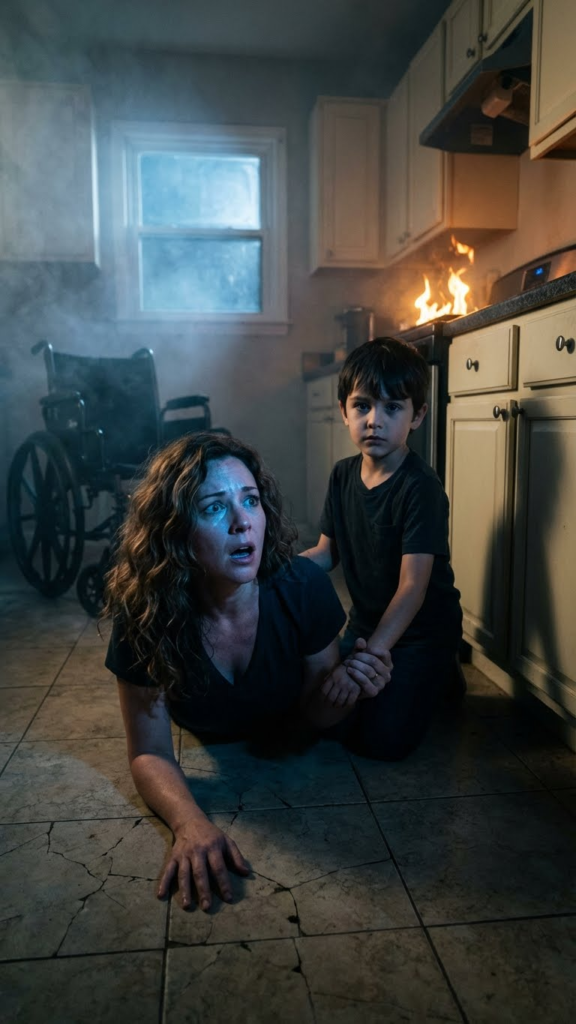
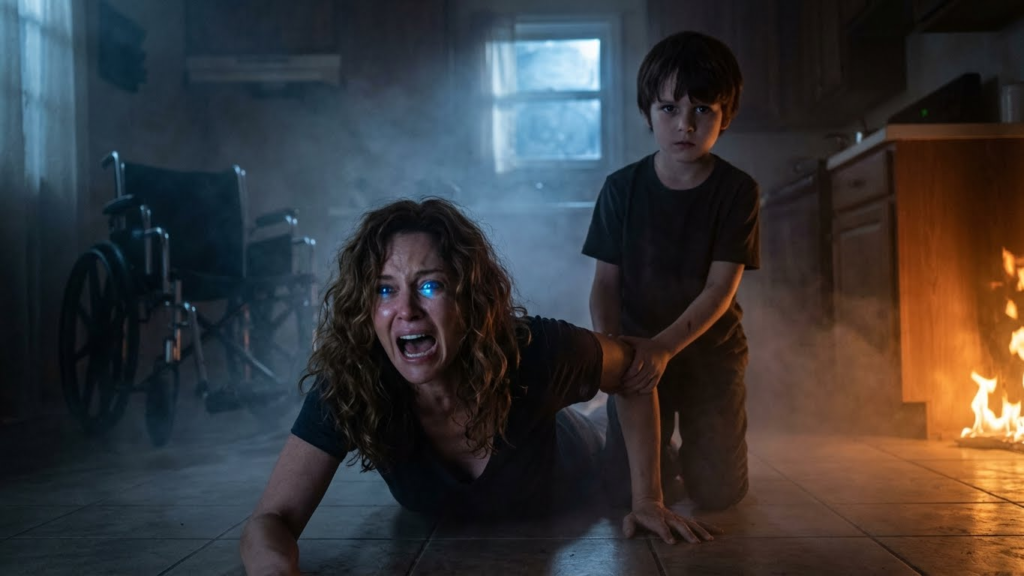
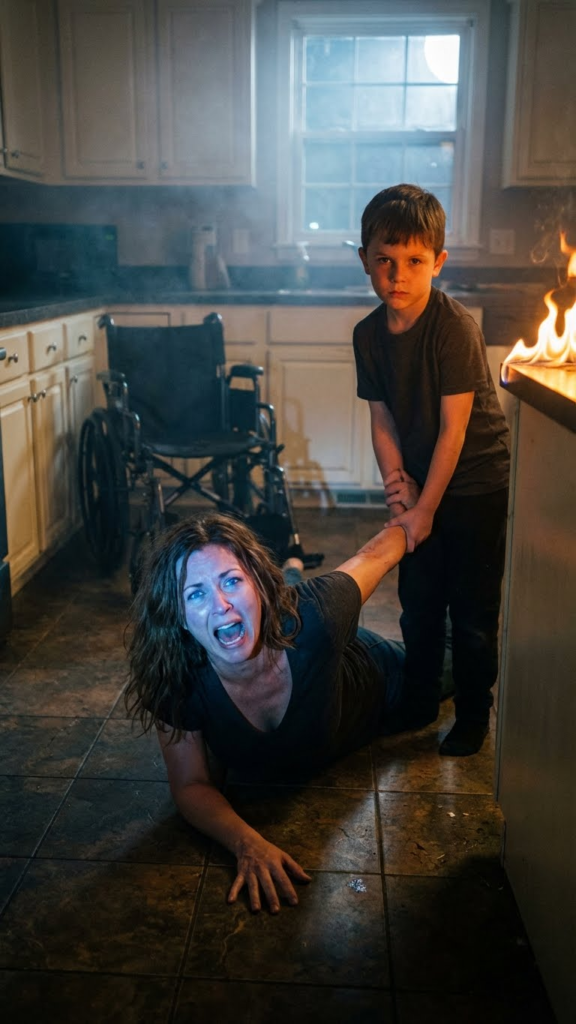
My wheelchair hit something—debris, maybe part of the ceiling—and I went down hard. The impact knocked the wind out of me, and suddenly I was on the floor, dragging myself forward like an animal. The tiles were hot against my palms. Every breath felt like inhaling razors.
That’s when I heard footsteps behind me.
I turned my head, and through the smoke, I saw him. Tyler. My eight-year-old son, standing there in his pajamas, staring at me with eyes I’d never seen before. Not scared. Not panicked.
Knowing.
“Tyler, help me!” I reached for him, my voice breaking. “Please, baby, help Mommy!”
He didn’t move. He just stood there, looking between me and the empty wheelchair lying on its side three feet away. His face was illuminated by the flames, and in that flickering light, I saw it—the moment a child realizes his mother is a liar.
“You can walk,” he whispered.
My blood went cold. Colder than the fire was hot.
Three years earlier, I wasn’t crawling across a burning floor. I was standing in a lawyer’s office, signing divorce papers with hands that worked just fine.
Marcus had left me for his secretary. Cliché, right? Except it wasn’t just about the affair. It was about the money. His family’s money. The trust fund. The properties. The investment portfolio that his grandmother had built over decades.
When we got married, I was 24 and stupid enough to sign a prenup that left me with almost nothing if we divorced. His mother had insisted. “Just a precaution,” she’d said with that condescending smile. “You understand.”
Seven years of marriage. One beautiful son. And I was about to walk away with $40,000 and shared custody.
I couldn’t let that happen.
The idea came to me two weeks after the divorce was finalized. I was watching a documentary about insurance fraud when it hit me—disability benefits. Long-term care. The kind of support that would make Marcus’s wallet bleed for years.
I researched everything. Spinal cord injuries. Mobility impairments. The legal requirements for disability payments. Marcus’s insurance policy from when we were married still covered me for another six months—a small clause his lawyer had overlooked.
All I needed was an accident.
The car crash was real. I made sure of it. I drove my Honda Civic into a concrete barrier on Route 7 at exactly 23 miles per hour—fast enough to cause damage, slow enough to control the impact. I’d practiced the location a dozen times.
The EMTs found me slumped over the steering wheel, crying. “I can’t feel my legs,” I told them. “Oh God, I can’t feel my legs.”
At the hospital, I committed to the role completely. I let them run every test. I failed the nerve response evaluations on purpose, having studied exactly how to suppress reflexes. The MRI showed bruising and inflammation around my lower spine—real damage, but not the kind that would actually cause paralysis.
But the doctors couldn’t prove I was faking. Pain is subjective. Nerve damage is complex. And I was so convincing.
The insurance payout was $340,000 for long-term disability. Marcus was ordered to pay an additional $4,000 per month in alimony and child support, adjusted for my medical needs. His mother nearly had a stroke when she heard the numbers.
For three years, I played the part perfectly. Physical therapy sessions where I “tried so hard” but could never quite stand. Tyler watching me struggle with doorways and curbs. Friends bringing groceries and helping with household tasks.
I even started dating again—a nice man named David who felt like a hero every time he helped me transfer from my chair to his car.
The only time I walked was late at night, after Tyler was asleep. I’d slip out of the chair and pace the kitchen, stretching my perfectly functional legs, making sure I maintained the muscle tone so I could stand when this was all over.
I’d planned everything. In two more years, I would stage a “miraculous recovery.” Some experimental treatment. A misdiagnosis. By then, I’d have saved enough money to disappear if I needed to. Maybe move to Portland. Start fresh.
Tyler would understand eventually. He was just a kid.
Except kids see more than we think.
“Mom, I need a glass of water.”
I froze. It was 11:47 PM on a Tuesday, and I was standing at the kitchen counter, stretching my calves. I’d been walking around for twenty minutes, and I hadn’t heard Tyler’s bedroom door open.
I turned slowly. He was standing in the hallway, silhouetted by his nightlight, staring at me.
For three seconds, neither of us moved.
Then I collapsed. I let my legs buckle and I went down hard, gasping, making it look like they’d given out suddenly. “Tyler!” I cried out. “Baby, help me! My legs—they just—I don’t know what happened!”
He ran to me. His little hands grabbed my arm. “Are you okay? Should I call 911?”
“No, no,” I said quickly. “I just—sometimes they spasm. Sometimes I can stand for a few seconds before they give out. The doctors said it might happen.”
I watched his face carefully. He was only eight. Surely he believed me.
“Okay,” he said quietly. He helped me back into the wheelchair that I’d left by the table. He got me my water.
But something had changed in his eyes.
The night of the fire, I was dreaming about beaches. About a place where nobody knew me and I could walk freely without pretending. Then the smoke alarm tore me back to reality.
When Tyler found me on the floor, crawling, my legs working perfectly fine because adrenaline makes you forget your lies—that’s when I saw it in his face. He’d known all along.
“You can walk,” he said again, his voice stronger now. The flames were getting closer. The heat was unbearable.
“Tyler, please,” I begged. “We have to get out of here. We can talk about this later, but we have to go now.”
“Dad was right,” he said. “He told me you were lying. Grandma said you were a thief.”
My heart stopped. “What?”
“They said if I could prove it, I could come live with them. They said I should watch you.”
The ceiling cracked above us. Embers fell like deadly snow.
“Tyler, baby, listen to me—”
“Did you start the fire?” he asked.
“What? No! Of course not!”
But then I saw it. Saw him looking toward the kitchen, where I kept the emergency supplies. Where I kept the gasoline for the lawnmower.
Where the fire had started.
“Tyler… what did you do?”
His eyes filled with tears. “I wanted to see if you’d run. I wanted to prove to Dad that you were lying.”
My eight-year-old son had tried to burn down our house to expose my fraud.
And he’d succeeded.
In that moment, I had two options. I could stand up, grab my son, and run. Save both of us. Prove to him that I could walk, that I’d been lying all along, that I was exactly the monster his father said I was.
Or I could stay in character and hope the fire department arrived in time.
I looked at Tyler—really looked at him. At the guilt and terror warring in his small face. At the child I’d lied to for three years. The son I’d manipulated and used as a prop in my scheme.
I stood up.
“Come here,” I said, my voice clear and strong.
He stepped back, shocked. “Mom—”
“Come here, Tyler. Now.”
He ran to me, and I scooped him up. My legs were strong. My back was straight. I carried him through the smoke and flames, kicked open the front door, and we collapsed on the lawn just as the fire truck rounded the corner.
The neighbors were already out, filming on their phones. The evidence of my lie was everywhere—me, standing and walking, carrying my son to safety.
The insurance company investigated. The fraud charges came quickly. I lost everything—the settlement money, the house, custody of Tyler.
Marcus’s lawyer had a field day. I was sentenced to two years in prison for insurance fraud and perjury. David stopped returning my calls before I was even arraigned.
But here’s the thing nobody talks about: prison gives you time to think. Time to face what you’ve done.
I used my time to get a degree in accounting. I worked in the prison library. I wrote letters to Tyler—dozens of them. Most came back unopened.
When I got out, I moved to a studio apartment in a bad part of town and got a job doing bookkeeping for a small nonprofit. I paid back every cent I could to the insurance company. It’ll take me another decade, but I’m doing it.
Six months after my release, Tyler’s therapist contacted me. He wanted to try supervised visits.
The first time I saw him, he was eleven years old. Taller. Quieter. The guilt of what he’d done—starting that fire—had left scars deeper than any burn.
“I’m sorry,” I told him. “For all of it. For lying to you. For teaching you that manipulation was okay. For making you feel like you had to prove I was a monster.”
“I’m sorry too,” he whispered. “For the fire. I didn’t think—I just wanted—”
“I know.” I took his hand. “We both made terrible choices. But we’re going to be honest now. Starting today.”
It’s been two years. We have dinner once a month. It’s awkward. Sometimes he doesn’t talk much. Sometimes he asks me questions I don’t want to answer.
But I answer them anyway. Honestly.
Because the night our house burned down, we both learned the same lesson: lies will always consume you. The only question is whether you’ll let them burn you alive, or whether you’ll walk through the flames and face the truth on the other side.
I chose to walk. Finally.