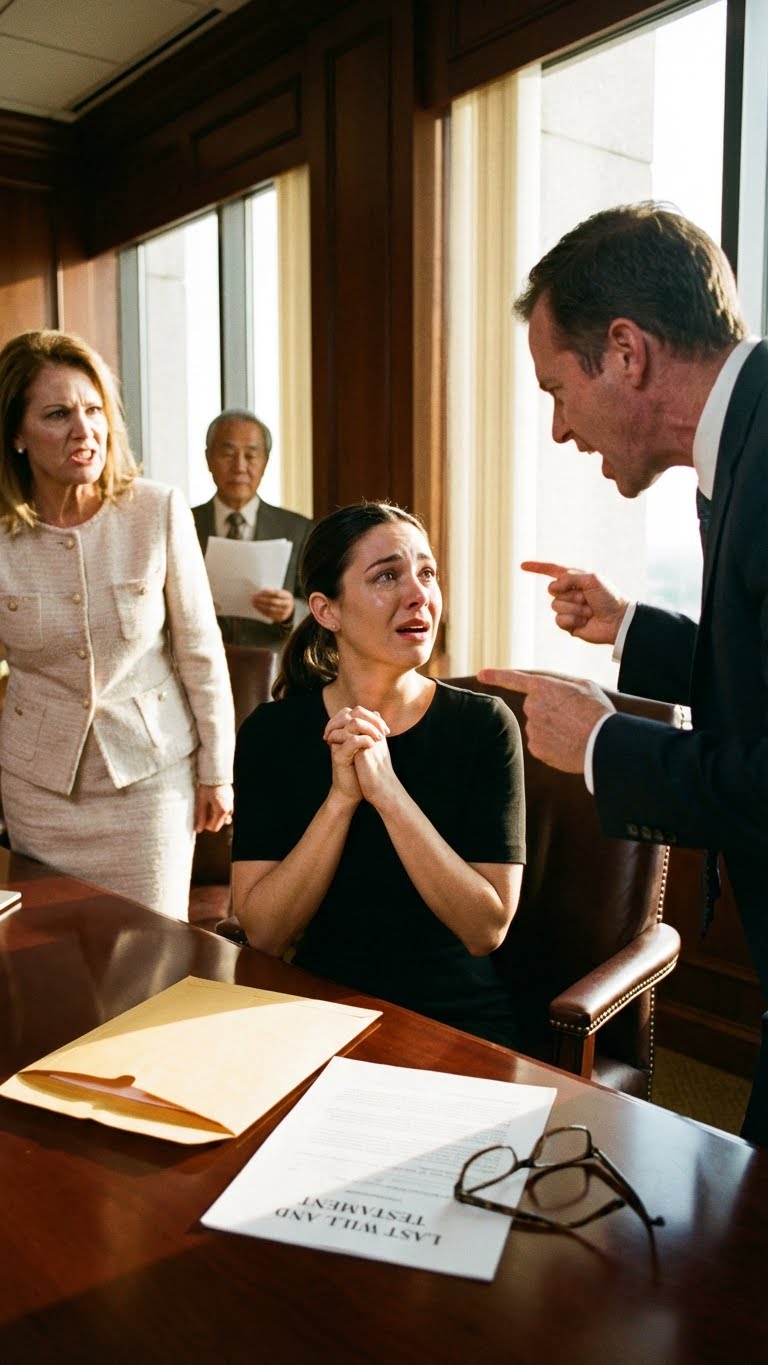
I was standing in the parking lot of St. Michael’s Cathedral, still wearing my black funeral dress, when my sister Lauren physically shoved me toward my car. My brother Marcus stood behind her, arms crossed, his face twisted with disgust.
“You need to leave,” Lauren hissed. “You didn’t contribute anything to Dad’s funeral. You didn’t help plan it. You didn’t pay for anything. You don’t deserve to be at the reception.”
I stared at them both, my throat tight. “I’m his daughter too.”
Marcus laughed—that cruel, mocking laugh I’d heard my entire life. “Barely. You abandoned him for ten years, Claire. You don’t get to show up now and play the grieving daughter. We did everything. We took care of him. We paid for this funeral. You? You’re just here for the will reading.”
The will reading. That’s what this was really about.
“I visited Dad every week,” I said quietly, my hands shaking. “I was there when he—”
“Bullshit,” Lauren cut me off. “We were his real family. You were too busy with your ‘teaching job’ to care about him. Now get out before I call security.”
Other mourners were watching now. Dad’s friends, distant relatives, people from his country club. All staring at the spectacle of his children fighting in a church parking lot two hours after burying him.
I wanted to scream. I wanted to tell them the truth—about the hospital visits they never made, about the nights I sat beside Dad’s bed while he struggled to breathe, about the conversations they’d never bothered to have. But my voice was gone, choked by grief and rage and ten years of being treated like I didn’t matter.
“Fine,” I whispered. “I’ll leave.”
Marcus smirked. “Good. And don’t bother coming to the lawyer’s office Monday. We already know what the will says. Dad left everything split three ways. You’ll get your third, and then we never have to see you again.”
I walked to my car, tears streaming down my face. I sat in the driver’s seat for twenty minutes, watching through my rearview mirror as my siblings greeted guests, accepted condolences, played the role of devoted children.
They had no idea what was coming.
The Will Reading That Changed Everything
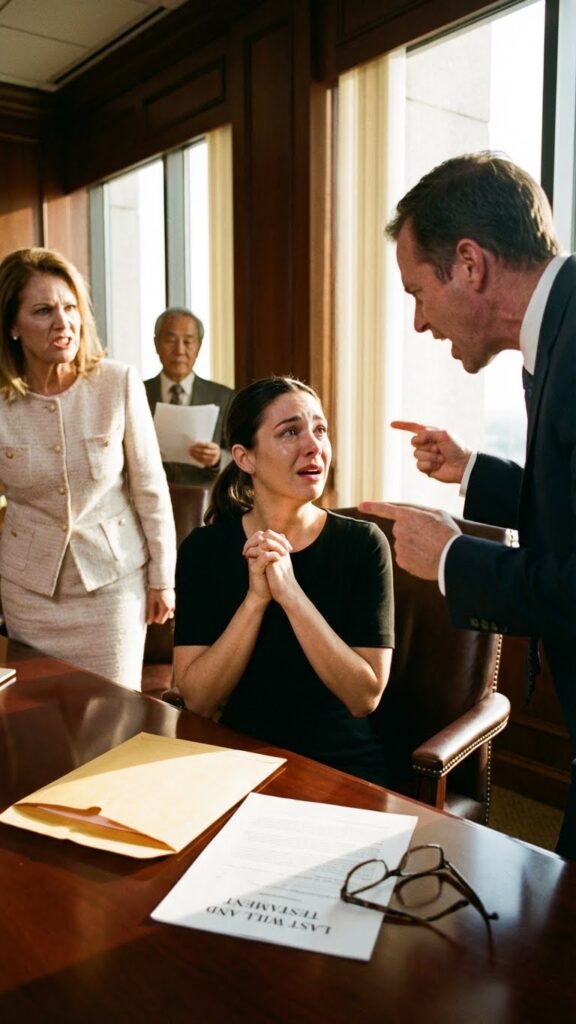
Monday morning, I walked into Harold Chen’s law office—Dad’s attorney for thirty years. The building was downtown, glass and steel, the kind of place that screamed old money and serious business. Lauren and Marcus were already there, sitting in the expensive leather chairs like they owned the place. They barely looked at me when I entered.
Lauren was wearing a designer suit that probably cost more than my monthly rent. Marcus had on his usual investment banker uniform—tailored, expensive, aggressively confident. I’d worn a simple black dress from Target.
“Now that we’re all here,” Harold said carefully, adjusting his glasses, “I’ll read the last will and testament of Robert James Patterson.”
Marcus leaned back, confident. Lauren checked her phone, bored. They’d probably already planned how to spend their inheritance. Lauren had mentioned wanting a beach house in the Hamptons. Marcus had been talking about expanding his investment portfolio.
Harold cleared his throat and began: “To my daughter Lauren Patterson, I leave the sum of one dollar.”
The room temperature seemed to drop twenty degrees.
Lauren’s head snapped up, her perfectly styled blonde hair whipping around. “What?”
“To my son Marcus Patterson, I leave the sum of one dollar.”
Marcus lunged forward in his chair, his face turning from tan to deep red. “That’s not—there must be a mistake—Harold, check the date on that will. Dad changed his mind, he must have—”
“To my daughter Claire Patterson,” Harold continued, his voice steady, professional, “I leave my entire estate, including all properties, investments, and liquid assets, totaling approximately forty million dollars.”
The silence that followed was absolute. I could hear the clock ticking on Harold’s wall, the distant hum of traffic outside, my own heartbeat pounding in my ears.
Marcus exploded out of his chair. “This is fraud! She manipulated him! Dad had dementia, he wasn’t in his right mind—”
“Your father was of sound mind when he executed this will six months ago,” Harold said calmly. “I have medical documentation confirming his mental competency, signed by three different physicians. I also have video footage of the signing, per your father’s request, where he explicitly states this is his true wish and that he is not under any duress or undue influence.”
Lauren stood up, shaking. “Six months ago? He changed his will six months ago and didn’t tell us?”
“He told you,” I said quietly. Everyone turned to look at me. “He told you at Thanksgiving. He said he was updating his estate plan and wanted to have a family meeting about his wishes. You said you were too busy. Marcus had a business trip. Lauren had a charity gala.”
“That’s not—” Lauren started.
“There’s also a letter,” Harold interrupted, pulling out a cream-colored envelope with my father’s distinctive handwriting on the front. “Your father requested that I read it aloud.”
The Letter That Revealed Everything
Harold opened the envelope carefully, unfolded two pages of handwritten text, and began to read my father’s final words:
“To my children,
If you’re hearing this, I’m gone. And if Harold is reading this letter aloud, it means I’ve done what I should have done years ago—acknowledged the truth that I was too cowardly to say while alive.
Marcus, Lauren: I’m leaving you each one dollar not because I hate you, but because I failed you as a father. I made you believe that money and status were the most important things in life. I rewarded you for your achievements and ignored your character. I taught you to value appearances over authenticity, success over compassion, winning over integrity.
And you learned those lessons perfectly.
For the last decade of my life, you visited me exactly fourteen times. I counted. Marcus, you came eleven times, always with your phone in hand, always leaving after twenty minutes because you had a ‘meeting.’ Lauren, you came three times, twice to ask for money and once to take photos for your social media showing what a devoted daughter you were.
Neither of you called on my birthday last year. Neither of you visited me in the hospital during my first cancer scare. Neither of you asked how I was feeling, what I was afraid of, or whether I needed anything beyond your financial planning advice.
Claire: You’re probably reading this through tears, because that’s who you are. You cry at commercials and stray dogs and the thought of disappointing people. I used to think that was weakness. I was wrong.
Ten years ago, when you told me you were dropping out of law school to become a teacher, I said you were throwing your life away. I said you’d never amount to anything. I said you were an embarrassment to the Patterson name. Those were the last words I spoke to you for three years, and they’re the words I regret most in my entire life.
You didn’t abandon me, sweetheart. I abandoned you. And when you came back, when you showed up at my door with flowers and forgiveness I didn’t deserve, you saved my life in ways that have nothing to do with medicine.
You visited me every Sunday for seven years. You brought groceries and cooked meals. You sat with me through chemotherapy and made terrible jokes to distract me from the nausea. You read to me when my eyes were too tired. You held my hand during the scary test results and celebrated the good ones.
You never asked for anything. You never mentioned money. You just loved me, consistently, patiently, despite everything I’d done to push you away.
The others will tell you I’m being unfair. They’ll say they were busy, they were building careers, they sent checks. They’ll claim they showed their love in different ways. They’re lying to themselves.
Love isn’t a check. Love isn’t an annual visit. Love is showing up when it’s inconvenient. Love is being present during the unglamorous, difficult, boring parts of life. Love is staying when everyone else leaves.
Claire, you were the only one who stayed.
The money I’m leaving you isn’t a reward. It’s an acknowledgment. It’s me saying, finally, what I should have said ten years ago: You were right. Being a teacher who changes children’s lives is worth more than being a lawyer who pads corporate bank accounts. Living modestly but authentically is better than living expensively but empty. Choosing compassion over ambition is the harder path, and the better one.
You don’t need this money. You’ve built a beautiful life without it. But I’m giving it to you anyway because I want your final years to be easier than your first ones. Travel. Help your students. Support the causes you believe in. Live without fear of bills and rent and all the small tyrannies of financial stress.
And maybe, when you think of me, you’ll remember that I finally learned what matters. Too late, but I learned.
To Marcus and Lauren: Your one dollar is symbolic. It means you’re still my children, still in my will, but you don’t get to claim I forgot you or that this was an accident. I’m leaving you nothing because you already took everything that mattered—my time, my pride, my identity—and you never gave anything back except disappointment.
If you’re angry, good. Use that anger to look at yourselves. Ask why your sister earned everything and you earned a dollar. If you’re honest—truly honest—you’ll know the answer.
Claire, my darling girl: You were always enough. I’m sorry it took me so long to see it.
With more love than I showed you in life,
Dad”
Harold finished reading and carefully folded the letter. The silence in the room was crushing.
The Aftermath They Didn’t See Coming
Lauren was crying—not pretty, photogenic tears, but ugly, choking sobs. Marcus had his face in his hands, shoulders shaking.
I sat frozen, processing words I’d never expected to hear. My father, who’d called me a disappointment, who’d hung up when I called to tell him about my teaching award, who’d made me feel small and worthless for a decade—had written this.
Had seen me. Had understood. Had loved me.
“This is bullshit,” Marcus said finally, his voice raw. “He was sick. He was manipulated. We’re contesting this will. We’ll tie it up in court for years if we have to.”
Harold sighed. “Mr. Patterson, I have to advise you that contesting this will would be extraordinarily difficult and expensive. Your father anticipated this reaction. He left detailed documentation: journals describing his reasoning, video testimonials, witness statements from his medical team, caregivers, and friends. He spent six months building an airtight case.”
“We’ll still fight it,” Lauren said, wiping her eyes, her voice hardening. “We deserve that money. We’re his children too.”
“You are,” I said quietly. Both of them turned to look at me. “You’re his children too. And he loved you. He just… he loved who he wanted you to be, not who you actually are.”
Marcus’s face twisted. “Don’t you dare act superior. You think you’re better than us because you’re poor? Because you ‘stayed’? You were unemployed and desperate. You hung around Dad because you needed money, and now you’re being rewarded for it.”
Something inside me snapped.
“I was never unemployed,” I said, my voice steady now. “I’m a fourth-grade teacher at Washington Elementary. I make $52,000 a year. My apartment costs $1,100 a month. I drive a 2012 Honda Civic with 180,000 miles on it. And you know what? I was happy. I didn’t need Dad’s money. I didn’t even want it.”
“Then give it to us,” Lauren said immediately.
I laughed—a short, bitter sound. “No.”
“You just said you didn’t want it!”
“I don’t want it for what it is. But I’m keeping it for what it represents. It represents the fact that Dad finally saw me. That he finally understood that I chose meaning over money, and that was the right choice. You two spent your whole lives chasing his approval by becoming what he wanted. I got his approval by becoming who I am.”
“You’re a sanctimonious bitch,” Marcus spat.
“Maybe. But I’m a sanctimonious bitch with forty million dollars. And Dad’s love. Which is worth more than all of it.”
The Truth About Those Ten Years
Here’s what my siblings never knew, because they never asked:
When I dropped out of law school to become a teacher, I wasn’t running away from success. I was running toward meaning. I’d spent two years memorizing case law and drafting contracts, and I felt like I was dying inside. Every day was gray, purposeless, a march toward a career I didn’t want but thought I should want.
Then I volunteered at an after-school tutoring program. I worked with a kid named David—third grade, reading at a first-grade level, parents working three jobs between them. I spent six months teaching David to read. The day he finished his first chapter book, he looked up at me with tears in his eyes and said, “Miss Patterson, I’m smart.”
That’s when I knew.
I dropped out the next semester. My father didn’t speak to me for three years. He told relatives I’d had a breakdown. He told his golf buddies I was “finding myself” in a tone that made it clear he thought I was finding failure.
I became a teacher. I lived in a 400-square-foot studio apartment. I bought my clothes at thrift stores and my groceries at discount chains. I was happier than I’d ever been.
My siblings, meanwhile, climbed their respective ladders. Marcus became an investment banker pulling in $800,000 a year. Lauren married a plastic surgeon and became a “philanthropist” who organized charity galas but couldn’t name a single person her charities helped.
They visited Dad at Christmas and his birthday. They sent expensive gifts. They called every few months for ten minutes of small talk. They thought that was enough because they were busy, important, successful.
When Dad got diagnosed with stage three colon cancer four years ago, I got the call from his housekeeper. Not from Marcus or Lauren—they didn’t know yet because Dad hadn’t wanted to “bother” them with bad news.
I drove to his house that afternoon. He answered the door looking smaller than I remembered, older, frightened.
“Claire,” he said, surprised. “What are you doing here?”
“Rosa called me. She said you were sick.”
“I’m fine. I don’t need—”
“Dad,” I interrupted. “Can I come in?”
He hesitated. Then stepped aside.
The Reconciliation Nobody Believed
Those first few months were awkward. Dad didn’t know how to accept help. I didn’t know how to offer it without seeming like I was gloating or pitying him. We barely spoke during my visits. I’d bring groceries, stock his fridge, leave.
Then came his first chemotherapy session. Marcus and Lauren both promised to take him. Both canceled at the last minute. Marcus had a client meeting he “couldn’t reschedule.” Lauren had a migraine.
Dad called me, his voice small and ashamed. “I know I don’t have any right to ask, but—”
“I’ll be there in twenty minutes.”
I took him to chemo. I sat with him for six hours while poison dripped into his veins, killing the cancer and part of him along with it. When he vomited into a basin, I held his hand. When he cried—this proud, stubborn man who’d never shown weakness—I didn’t look away.
On the drive home, he said quietly, “I’m sorry.”
“For what?”
“For everything. For what I said when you quit law school. For not calling you. For being ashamed of you when I should have been proud.”
I pulled over into a parking lot. “Dad—”
“I was wrong,” he continued, tears streaming down his face. “You were right about everything. Your career, your choices, your life. You’re happy. You’re doing something that matters. And I… I built an empire and forgot to build relationships. I have all this money and nobody to share it with who actually gives a damn about me rather than what I can give them.”
“I give a damn about you,” I said.
“Why? After how I treated you?”
“Because you’re my dad. And because people deserve second chances.”
He cried harder then. I held him in that parking lot for thirty minutes while he grieved everything he’d lost by valuing the wrong things.
After that, I came every Sunday. We developed a routine: I’d cook dinner, we’d watch old movies, we’d talk. Really talk. About his childhood, my childhood, his regrets, my hopes. He told me about growing up poor, how he’d built his construction company from nothing, how he’d confused wealth with worth because for so long he’d had neither.
“I wanted you kids to never struggle like I did,” he said once. “But I think I made you struggle in a different way. I taught you that money was the answer to everything. And it’s not. It can’t buy love. It can’t buy meaning. It can’t buy time.”
I told him about my students. About the kid who’d been homeless and was now reading at grade level. About the girl with autism who’d learned to make friends. About the impact that showing up, day after day, could have on young lives.
“You were right to become a teacher,” he said. “I’m proud of you. I should have said that ten years ago, but I’m saying it now. I’m proud of you.”
Those words—words I’d waited my whole life to hear—came in a hospice room that smelled like antiseptic and dying flowers. But they were real. And they were enough.
The Final Days
Marcus and Lauren showed up when Dad entered hospice. Suddenly, they were around—visiting, making decisions, talking to doctors. They started referring to themselves as “the primary caregivers” despite having been absent for years.
I didn’t argue. I just kept coming every day after school, sitting with Dad, reading to him, telling him about my students’ latest antics.
Two days before he died, when Marcus and Lauren had left for the night, Dad squeezed my hand.
“I updated my will,” he whispered, his voice weak.
“Dad, don’t worry about that. Just rest.”
“No. I need you to know. I’m leaving everything to you.”
“Dad—”
“They’ll be angry. They’ll fight it. But I need you to let them. I need them to understand what they lost. Not the money—they have plenty of money. I need them to understand they lost me. They lost you. They lost what family actually means.”
“I don’t need your money,” I told him.
“I know. That’s why you’re getting it. Not because you need it, but because you’re the only one who understands what it really represents. It’s not wealth. It’s time. It’s freedom. It’s the ability to keep being exactly who you are without worrying about bills or survival. Keep teaching. Keep changing lives. Keep being better than I raised you to be.”
He died two days later, holding my hand, with me singing the lullaby his mother used to sing to him.
Marcus and Lauren arrived an hour after he passed. They cried. They grieved. But they grieved a different man than the one I’d known these past four years. They grieved the successful father, the provider, the patriarch. I grieved the flawed, struggling human who’d finally learned to be vulnerable.
Six Months Later
I’m writing this from my new house—nothing extravagant, just a comfortable three-bedroom in a good school district. I still teach at Washington Elementary. I still drive my Honda Civic. I still buy my clothes at Target.
But I’ve set up a foundation in Dad’s name. It provides college scholarships for students who choose teaching careers. I’ve funded fully stocked classrooms for five different schools in low-income areas. I’ve paid off student lunch debt for three entire school districts.
And every Sunday, I visit Dad’s grave and tell him about my week. About the kids I’m teaching. About the lives that are changing because he finally changed his mind about what matters.
Marcus and Lauren did try to contest the will. It lasted three weeks before their lawyers told them they had no case. They haven’t spoken to me since the reading. I’ve seen Lauren’s social media posts—she’s telling friends I “stole” her inheritance through manipulation and lies.
I don’t bother correcting the record. The people who know the truth know the truth. The people who believe her lies would believe anything that confirms their worldview.
But sometimes I think about that letter Dad wrote. About him saying I was always enough. About him finally seeing that I’d chosen the harder, better path.
My siblings spent their lives chasing Dad’s approval by becoming what he wanted. They succeeded. They made money. They impressed people. They won by every external metric.
And they lost everything that actually mattered.
I spent ten years being a disappointment. Then I spent four years just loving my father without expecting anything in return. And in the end, I got more than money. I got reconciliation. I got understanding. I got closure.
I got to know my father as a person, not a provider. I got to forgive him. I got to be forgiven.
And on his deathbed, he looked at me and said, “You were right all along.”
That’s worth forty million dollars.
That’s worth everything.