The last thing I remember before everything went white was the sound of my own brakes failing me.
One second I was driving, knuckles stiff on the steering wheel, headlights cutting a narrow tunnel through the swirling snow. The next, my foot sank uselessly to the floor. The pedal went straight down with no resistance, like stepping through air. No squeal. No grind. Just nothing.
I pumped the pedal once, twice, three times. It was instinct more than thought. The car didn’t respond. The road curved, the guardrail gleamed faintly under the ice, and the world started to slide sideways.
People always say moments like that happen in slow motion. They’re wrong. It wasn’t slow. It was violent and sudden, like being picked up and flung by an invisible hand.
The back of the car fishtailed first. Snow screamed under the tires. The steering wheel jerked in my hands. Headlights smeared into white streaks across the windshield. Somewhere I heard my own voice, a sharp, animal noise I didn’t recognize as a scream.
The guardrail came faster than any rational thought.
Metal shrieked. The hood buckled like paper. Glass exploded inward in glittering sheets that cut my face and arms. My head snapped sideways, the seat belt bit brutally into my chest, and the world flipped, rolled, and then stopped with a bone-rattling crunch that seemed to split my spine in half.
Silence.
The kind of silence you only get after a catastrophe, when the universe pauses to see if you’re still here.
My ears rang. My vision stuttered: dark, light, dark, light, as my eyelids fluttered without my permission. I tasted copper intensely, as if I’d bitten into a handful of pennies. Something hot and wet trickled down the side of my face.
It took me a few seconds to understand why I couldn’t move. The dashboard was in my lap. Or I was in its. The front of the car had concertinaed. Metal and plastic were shoved back into the cabin, pinning my legs from mid-thigh down. I couldn’t feel my feet. I couldn’t quite feel anything below the hips, but I could see the wrong angles. My brain registered that much.
I sucked in a breath and it hurt, red-hot knives hot, down both sides of my ribs. Each inhale was a war. I tried to turn my head to look around, but pain lanced up my neck and I stopped.
Snow drifted silently through the shattered windshield, landing in delicate flakes on the crumpled hood, on the torn fabric of the seats, on my exposed skin. It melted quickly where it touched me, turning red where the blood had already soaked through.
Somewhere, a car drove past on the highway above. I couldn’t see it, but I could hear the hum of tires over ice.
And then I saw her.
At first my brain refused to process the shape on the other side of the guardrail. A shadow, slightly darker than the night, standing still. My eyes stung. I blinked the blood away and the shadow resolved into a person.
A woman in a long, dark coat. Hat pulled low. Scarf around her neck.
She was standing at the edge of the road, just beyond the twisted metal where my car had punched through the barrier, looking down at me. The overhead lights from the highway picked out familiar features, familiar posture.
My mind reached for the most comforting answer: a stranger. A Good Samaritan.
Then she took one small step closer, and I recognized her.
“Bonnie,” I croaked. Or tried to. My voice came out as a cracked whisper that barely reached my own ears.
My sister stared down at me through the jagged hole where the windshield used to be. Her face was expressionless, almost calm. Snow clung to her dark hair and glittered on the shoulders of her coat.
Relief flared in my chest. It was ridiculous and automatic. I’d just been in a crash, I was bleeding out in the snow, and my first instinct was the childish one: my big sister is here. I’m not alone.
My vision tunnelled. I forced it wider with sheer stubbornness. Bonnie’s gaze flicked away from my face, down to something at her wrist.
Her watch.
She was checking the time.
I didn’t understand, not at first. The moment was too strange, too surreal. I waited for her to fumble in her pocket for her phone. To look back at me with horror, hands flying to her mouth. To shout my name. To scramble down the slope and grab my hand through the broken glass, tell me, “It’s okay, Han, it’s okay, I’ve got you, I’m calling 911, just stay with me.”
She did none of that.
She just… looked.
Her eyes moved over me clinically, from my face to the crushed metal pinning my legs, to the darkness pooling on the snow beneath the front of the car. Her expression never shifted to panic. No tremble in her jaw. No wildness in her eyes.
She tilted her head slightly, like she was assessing damage on a piece of property. Like she was judging whether a totaled car was worth salvaging.
I felt a slow, terrible understanding crawl up my spine.
“Help,” I wheezed, blood bubbling in the back of my throat. “Bonnie. Help me.”
Her gaze snapped back to my face. For a second, I thought I saw something burn in those blue eyes—panic, fear, love, anything human—and I held on to that like a lifeline.
But what I saw there wasn’t fear. It was calculation.
She didn’t move. She didn’t shout for help. Her hands stayed put, still tucked in her pockets, as if she were watching a movie she’d already seen and knew the ending.
My heart pounded. My breaths got shorter and shallower. The cold sank claws into my fingers and toes, except I couldn’t feel my toes at all. I tried to reach out toward her, but my right hand barely lifted off the steering wheel before pain slammed through my side and blackness washed over the edges of my vision.
She didn’t flinch.
She had cut my brakes.
The knowledge wasn’t a lightning strike. It crept into my mind, quiet but certain, filling in the blanks in a pattern I hadn’t let myself see. The tension in her shoulders all week. The questions she’d asked about my schedule. The way she’d hugged me goodbye in the driveway that morning, lingering a fraction too long, squeezing just a little too tight.
I’d ignored all of it. Because that’s what I was trained to do.
A thin line of steam rose from the mangled engine, swirling with the falling snow. I couldn’t feel my legs anymore. My fingers were going numb, even as they clung to the wheel like a lifeline.
Bonnie shifted her weight from one foot to the other. Behind her, another car swept past, its occupants oblivious to the scene below. The wind picked up, carrying with it the distant wail of a siren from somewhere miles away. Not for me.
She looked at her watch again.
I realized she wasn’t just the one who’d done this. She was waiting.
Waiting for my chest to stop moving. Waiting for my eyes to glaze over. Waiting for me to die.
The betrayal burned hotter than the pain.
I tried to speak again, to spit some final word at her—why, maybe, or please—but my tongue felt too big for my mouth. My head swam. The cold, the blood loss, the shock; they all crowded in at once.
Bonnie’s face blurred, then sharpened again, like a picture trying to find focus. Her lips pressed into a thin line. For the first time, I saw the faintest flicker of emotion in her eyes, but it wasn’t grief.
It was irritation. Impatience.
As if I were late to my own funeral.
Rage screamed inside me, hot and useless. My body didn’t care. It was already pulling away from the world, retreating to some colder, quieter place where pain couldn’t reach. The sirens that weren’t for me faded. The wind softened to a whisper. The snow falling through the shattered windshield became gentle, almost tender, dusting my lashes.
Then the world tilted and slid away.
The steady, insistent beep of a monitor dragged me back.
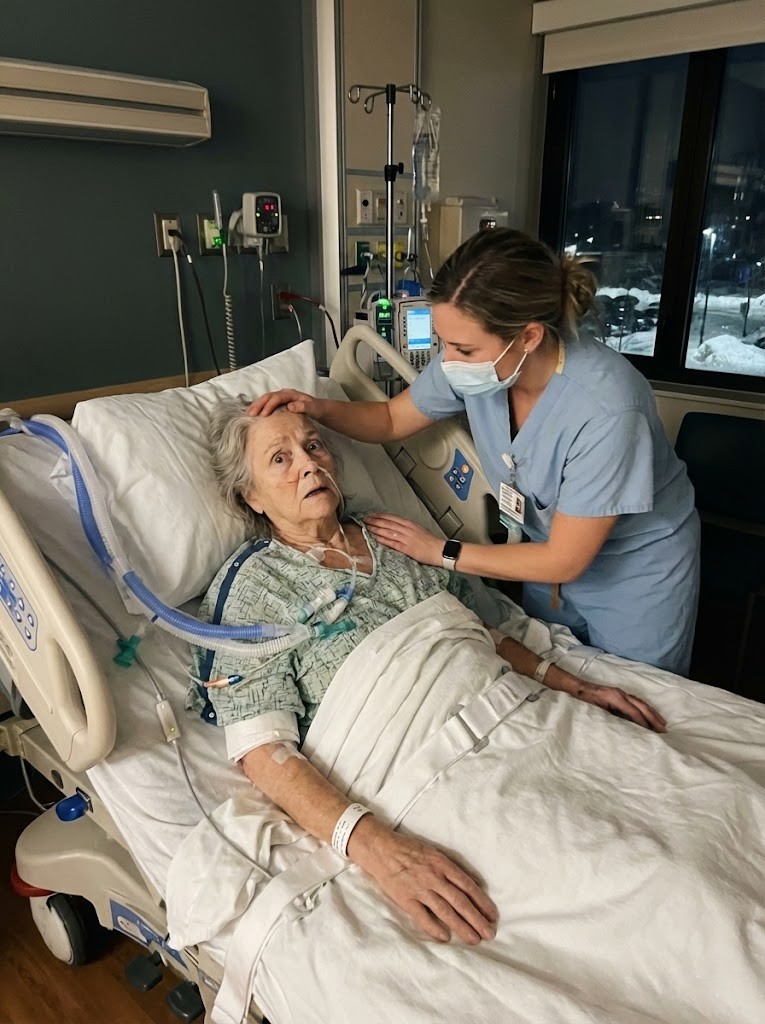
For a moment I didn’t know where I was. I didn’t know who I was. The ceiling above me was a glaring white blur. The smell of antiseptic and plastic filled my nose. Something tugged at the skin on the back of my hand.
I tried to move and a bolt of pain shot through my ribs, sharp enough to make my vision go white again. I gasped, and that hurt too.
“Easy, easy,” a voice said. Soft, urgent. Feminine.
A face swam into view, framed by a halo of fluorescent light. A woman in scrubs, dark hair pulled back in a bun, a pale blue surgical mask looped under her chin. There were faint smile lines around her eyes, the kind that came from years of reassuring strangers in pain.
“You’re in the hospital,” she said, her voice low and steady. “You were in an accident. You’re okay. Well.” She winced slightly. “You’re alive. That’s the important part.”
Alive.
The word landed heavily in my chest. Behind it, like a shadow, came another: why?
Trying to speak felt like trying to lift a car with my tongue. All that came out was a rasp.
She leaned closer, her hand adjusting something by my side. “Water?”
Coolness kissed my lips, and I tasted plastic and the ghost of chlorine. I swallowed, each movement of my throat measured in needles.
“W-what… happened?” I whispered.
The nurse glanced at the door, then back to me. Something tight flickered across her face.
“Car accident,” she said. “You went over a guardrail. Broken ribs, punctured lung, both legs pretty badly crushed. But the surgeons did good work. You’ve been in and out of surgery and sedation for the last two days.”
Two days.
My mind tripped over that. Time, which had last existed in seconds counted by my sister’s watch, suddenly stretched out in hours I hadn’t been conscious for.
Two days alive meant two days that Bonnie had not succeeded.
I licked cracked lips. “My… sister?”
The nurse hesitated.
It was a small pause. Most people wouldn’t have noticed it. But I manage logistics for a global shipping firm. I spend my life reading the spaces between words, the delays in emails, the unreturned calls. In my world, hesitation is a tell, a sign of an incoming problem.
Her eyes slid again to the door, as if checking that we were alone.
“She’s been here,” the nurse said carefully. “Every day.”
A tiny part of me relaxed—traitorous reflex, worn into me since childhood. Of course she’d been here. Of course she’d—
“But not… not in the way you’d expect,” the nurse added in a rush, like ripping off a bandage.
I frowned, which sent pain skittering across my forehead. “What does that mean?”
The nurse wet her lips. For a second, she looked as if she might say, “Never mind,” pat my hand, and walk out of my life forever. Then she drew in a breath, like a woman about to step out onto thin ice.
“She’s not been sitting by your bedside,” she said. “Or talking to you. She hasn’t asked to see you awake.” Her eyes flicked to the monitors, to the IV line in my arm. “She’s been talking to the doctors. Almost constantly. Asking a lot of questions about… uh… brain activity. Legal definitions.”
My mouth went dry, which was impressive, considering how little moisture I had in my body to begin with. “Legal… definitions?”
“Of, um, brain death,” the nurse said. The words left a bitter taste in the air between us. “She’s been asking when they could… legally declare you unresponsive. When it would be… appropriate… to consider you beyond recovery and allow your next of kin to make decisions.”
The room tilted.
The steady beeping of the heart monitor sped up and got louder, as if it were being pulled closer to my ear. The nurse’s face blurred at the edges.
“Hey, hey,” she said quickly. “Breathe for me, okay? Slow. In, out. You’re safe right now.”
Safe. The word felt flimsy and paper-thin.
The nurse’s fingers tightened around mine, anchoring me. “I probably shouldn’t be telling you this,” she murmured. “But I saw the way she looked at you when you first came in. I heard… some of the things she said to the doctors. So I asked around. There’s a note in your file. Her power of attorney kicks in if you’re declared non-responsive.” She swallowed. “She’s been… very interested in when that could happen.”
She wasn’t waiting for me to wake up.
She was waiting for the legal system to declare me spoils.
My skin crawled. The IV tugged at the back of my hand as my muscles tensed. Memories flickered hot and fast behind my eyes, unspooling like film.
Bonnie smiling at me through the snow.
Her eyes on her watch.
The whisper of something in the lines of my car that morning, something I hadn’t quite noticed.
In the blinding white of the hospital room, another image rose unbidden: a different fire, a different night. Curtains blooming into flames like orange flowers. My own arm, small and skinny at ten years old, raised to shield my face. The sharp, sickening heat, the roar of our father’s voice.
I looked down.
The hospital gown had slipped a little off my left shoulder, revealing my forearm. A pale, ropey scar ran from my wrist almost to my elbow, jagged and white against my skin.
I reached for it with my right hand, tracing the raised line with my fingers. The feel of it pulled me backward through time.
Smoke in the hallway. Bonnie in her nightgown, a matchbook in her hand and a grin on her face brighter than the flames climbing the wall. Our parents bursting in, my mother’s shriek, my father’s fury. Bonnie’s tears—instant, perfect, weaponized.
“Hannah did it,” she’d choked out, pointing at me with a trembling finger. “She was playing with the matches. I told her to stop!”
My father’s eyes had locked on me. Not on the matches that clearly came from his jacket pocket. Not on Bonnie’s smile that had lingered a half-second too long. On me.
I’d taken the blame. I’d always taken the blame.
My parents had trained me to be her shield, her scapegoat, her crash test dummy. When she lit fires, literal or metaphorical, I was the one who got burned.
I stared at the scar and watched the past and present overlap—the flames from our childhood hallway superimposed over the image of my car, crushed and smoking at the bottom of the embankment. Bonnie’s voice crying fake tears for our parents. Bonnie’s silent, waiting stare through the broken windshield.
Whatever softness I’d kept for her all these years, whatever secret part of me had believed she might one day choose me instead of choosing herself, shriveled and died right then.
My parents were gone now, claimed by a car accident of their own on a slick highway three winters ago. I’d mourned them, grieved the good moments, forgiven the bad. But the legacy they left behind lived in my sister—the golden child who had grown into something much darker.
The nurse squeezed my hand again, pulling me back to the present.
“I’m sorry,” she said quietly. “I don’t know your situation, but… when I saw the way she was talking about you, it didn’t feel right. So I wanted you to know. Just in case.”
“What…” I had to pause for breath, chest aching. “What’s your name?”
Her eyes softened. “Marisol.”
“Marisol,” I said, tasting the syllables. “Can you… can you… take my name off the system?”
She blinked. “Excuse me?”
My mind, sluggish a moment ago, snapped into a clarity I recognized from my job. Crisis mode. Logistics mode. Different battlefield, same instincts.
“If my sister’s been… hovering,” I said, forcing the words out, “if she’s waiting for something, I need to… disappear. At least for a little while. Is there a… a protocol? A way to make me… anonymous? No record she can access?”
A crease appeared between Marisol’s eyebrows. She glanced around again, then back at me. “We do have… protections,” she said carefully. “For patients in danger from family. Domestic violence situations, stalking… we can flag a file, restrict access. Sometimes we use a pseudonym. Jane Doe protocol, unofficially.”
“Do that,” I said. My voice came out stronger than I felt. I clung to it. “Please. Put me under… whatever you have. No name, no info. As far as she knows, I’m… gone.”
Marisol studied my face for a long moment. Whatever she saw there convinced her. “Okay,” she said finally. “I’ll see what I can do. We’ll move you to a different floor under a different ID. And I’ll… make sure certain visitors are told as little as possible.”
“Tell her…” I closed my eyes briefly, then opened them again. “Actually, don’t tell her anything. Let her ask.”
A tiny, fierce smile tugged at the corner of Marisol’s mouth. “You got it.”
She slipped out of the room, and a few minutes later, a different nurse came in with a clipboard, a neutral smile, and instructions about signing a form to confirm some minor detail. The name on the form wasn’t mine. I signed anyway.
To Bonnie, I was a ghost.
Good.
Because ghosts can haunt.
I asked for a phone.
Marisol looked surprised, and then impressed. “You sure you’re up for that?”
“I don’t have to run a marathon,” I said. “I just have to dial.”
My hands shook as I tapped in the number, but it wasn’t from the pain meds.
The first call I made was to Paul.
Paul Hastings had been our parents’ attorney for twenty years, and then mine alone after their deaths. He’d handled the estate, the house, the investments, the tedious grind of probate. He was broad-shouldered, perpetually slightly rumpled, and had the weary eyes of a man who’d seen too many families tear each other apart over money.
He picked up on the second ring.
“Hastings,” he said, brisk and professional.
“Paul,” I whispered.
There was a pause. Then, cautiously, “Hannah?”
“Yeah.” My throat tightened. “Still alive. Surprise.”
There was a muffled sound, like he had covered the receiver with his hand to swear under his breath. When he came back, his tone had changed completely.
“My God, kid,” he said, all the lawyerly cool scrubbed out of his voice. “Do you have any idea how good it is to hear your voice? We were told… I mean, your sister said…”
“I know what she said,” I cut in. “We can compare notes later. Right now I need you to listen.”
“Anything,” he said. Papers rustled faintly in the background; I could picture him already pulling a notepad closer out of habit.
“I need you to look at my power of attorney,” I said. “And the life insurance, the estate documents. All of it. I need to know exactly what my sister gets if I die. Or if I’m declared brain dead. And I need you to tell me how fast it moves.”
He exhaled slowly. “That’s not the first thing I expected you to ask from a hospital bed.”
“It’s not the first thing I wanted to ask,” I said. “But it’s the only thing that matters right now.”
There was another pause, but this time it wasn’t hesitation. It was calculation.
“You think she had something to do with the accident,” he said.
“I don’t think,” I replied. “I know. I saw her on the scene, Paul. She watched me bleed and did nothing. She’s been here harassing the doctors about declaring me gone so she can take control. This wasn’t bad luck. It was hostile takeover.”
“And you want to turn it into a hostile defense,” he murmured. I could practically hear the gears turning. “All right. I’ll pull your file. And, Hannah?”
“Yeah?”
“I believe you,” he said quietly.
The second call I made was to Ryan.
Ryan Moore owed me a favor. We’d worked together two years earlier when my company got entangled in a smuggling incident—someone hiding illegal pharmaceuticals in legitimate shipments. I’d hired him as a private investigator to track down where the leak was. He’d done it in half the time the internal team predicted, without fuss and without fanfare. He was good at patterns. Good at secrets.
He picked up with his usual laconic, “Moore.”
“It’s Hannah,” I said.
“Hey,” he said. “Long time. What’s—”
“I need you to find out if my sister hired someone to kill me,” I said.
That shut him up.
There was a small, sharp silence. “I’m going to need you to back up and walk me through that,” he said eventually, voice lower now.
“I don’t have the lung capacity to give you the full speech,” I said, closing my eyes briefly as a wave of exhaustion passed over me. “Short version: my brakes failed on a snowy road, I went through a guardrail, my legs are currently more metal than bone. My sister was on the scene, did nothing, and is now circling my hospital bed like a vulture waiting for inheritance. I need proof. Or I need to know if I’m paranoid.”
“You’re not paranoid,” he said, immediately. “Or at least, let’s assume you’re not and work from there. Do you give me permission to access your insurance records, your bank accounts, and anything else relevant?”
“Yes.”
“And to look into hers?”
“I’ll get Paul to give you any legal cover you need,” I said. “He’s in.”
“Good.” I could almost hear him reaching for his keys. “I’ll start with the impound lot, see if the car’s been processed yet. If the brake line was cut, I’ll get photographic proof. You focus on not dying. Leave the rest to me.”
He hung up.
I stared at the ceiling and let the monitors beep, the IV drip, the machines breathe alongside me.
I knew how to handle a crisis. My job trained me for it. I orchestrated the movement of ships and trucks and containers across continents. When something went wrong—a storm, a strike, a busted engine in the middle of nowhere—I didn’t have the luxury of panic. I rerouted. I replanned. I used what I had.
Bonnie thought she had me cornered. She thought I was lying here helpless and oblivious, waiting for her to flip the switch on my life and cash the check.
She’d spent our whole childhood learning that she could light fires and I would put them out.
She didn’t understand that this time, I was going to stand back and let the flames take her.
Ryan called back four hours later.
By then I’d had more tests. Someone had moved me to a different room with a different number on the door. The charts on the wall had been updated with a fake last name. No visitors had been allowed in.
“Talk to me,” I said as soon as I heard Ryan’s voice.
“I just sent you a picture,” he said. “Check the phone.”
My fingers fumbled with the screen, but eventually the image opened. It was grainy, taken in bad lighting, but I recognized the twisted wreck of my car. The hood peeled back like a sardine tin. The front wheels bent at angles that would make a mechanic weep.
He’d zoomed in on the underside of the chassis. The brake line was a dark snake running along the frame.
Except it didn’t run anymore. It stopped.
The end of the line was clean. Not frayed. Not corroded. Not snapped.
Cut.
“My contact at the impound lot let me have a look,” Ryan said. “He thinks the mechanic’s going to file it as a clean sever. Not wear and tear. Not accident damage. A cut.”
My heart thudded against the ache in my chest. “Could that ever be… accidental?”
“I suppose if you had a very determined rodent with a grudge,” he said dryly. “But the edges are too neat. This was done with a tool.”
“Okay,” I said. “What about Bonnie?”
“I started with public records,” he went on. “Your parents’ estate, the insurance payouts from their accident, your joint account with your sister from back when you two still tolerated each other. It looks like you were the responsible one—which tracks—because your assets are intact and growing. Hers… aren’t.”
A rustle of paper. A keyboard clacking in the background.
“She’s got three credit cards maxed,” Ryan said. “Two personal loans. And she recently took out a high-interest loan from a private lender that operates in the gray area between ‘bank’ and ‘people who break kneecaps for a living.’ Amount due: one hundred eighty-five thousand dollars.”
I whistled softly, then winced at the pull on my ribs. “That’s… impressive.”
“Due date on that balloon payment?” he added. “Forty-eight hours from now. Well. Forty-four now.”
The hospital room felt colder.
“So,” I said slowly, “she needs a lot of money, very fast, or some very unpleasant people are going to ask her where it is.”
“And unless she’s got a winning lottery ticket up her sleeve,” Ryan said, “I’m guessing she’s looking at you. Or more accurately, at what she gets when you’re gone.”
Bonnie wasn’t just greedy.
She was cornered.
My accident wasn’t a crime of passion. It wasn’t a drunk driver running a red light or a random patch of black ice.
It was a business decision.
She had calculated my net worth, the timing of the payout, the likely speed of a medical declaration, and decided that the quickest way to save herself from the loan sharks was to erase me.
A crash, a funeral, a tearful sister in black.
It had probably looked perfect in her head.
Unless, of course, I refused to follow the script.
“Can we prove she knew about the timing?” I asked Ryan.
“I’m working on tracking her communications with the lender,” he said. “But even if we can’t get that neatly tied up in a bow, the brake line photo plus the financials will make any investigator’s eyebrows hit their hairline. Especially once they know she was asking about brain death definitions before you even woke up.”
“Good,” I said. I took a breath. It hurt, but less than it had earlier. “Keep digging. And send copies of everything to Paul. We’re going to need him to set a stage.”
“A stage?” Ryan repeated.
I shut my eyes, picturing Bonnie’s face at the side of the road, lit by the cold glow of the streetlights, gaze on her watch as I bled. “She wants a tragedy,” I said. “Let’s see how she likes being in the starring role.”
Paul met me in a small, neutral-feeling conference room on a floor of the hospital that wasn’t technically mine. His tie was crooked, his hair a little more disheveled than usual. He looked older than he had three weeks ago when we last met to discuss some boring tax matter.
“You look terrible,” he said frankly as he sat down.
“Thanks,” I said. “You should see the car.”
He barked a short, involuntary laugh, then sobered. “I’ve reviewed your documents,” he said, adjusting his glasses. “As your parents’ attorney, I can say with authority that they did one thing right.”
“Only one?” I said dryly.
“They made you the primary,” he said. “Bonnie doesn’t get anything outright if you’re alive. When you die, your assets are split between the two of you, but in the event that you are incapacitated, your power of attorney defaults to your closest living relative. Which, unfortunately, is her.”
“So if I had stayed under my real name, she could have walked in here, had a few somber conversations, and start making decisions on my behalf,” I said. “Including financial ones.”
He nodded. “But now that your status has been changed and your access restricted, she’s… shut out. She’s been told as much. She’s not happy.”
“Good,” I said. “I’d hate to think she was having a relaxing week.”
Paul’s gaze softened. “This is a lot, Hannah,” he said. “You don’t have to handle it all yourself.”
I smiled without humor. “With Bonnie, I’ve always handled it all myself,” I said. “That’s sort of the problem. I should’ve stopped years ago. Consider this my late correction.”
We spent the next hour going over the plan.
It was simple in theory, complicated in execution, like all the best logistics puzzles.
We would invite Bonnie to Paul’s office under the pretense of resolving the “issues” surrounding my accident and the insurance payout. Paul would present her with two options.
Option A: The truth. A potential homicide investigation triggered by the discovery of the cut brake line. Thorough, lengthy, with the insurance company freezing all payouts for years.
Option B: A lie that looked like salvation. A narrative where my accident was a result of my own supposed mental instability. A suicide attempt. Sad, tragic… and quickly processed by insurance.
“All she has to do,” I said, resting my head back against the pillow, “is sign a sworn statement testifying that I was depressed and suicidal. That I’d been talking about ending things. That the crash was self-inflicted.”
Paul nodded grimly. “We’ll word it so there’s no wiggle room,” he said. “Perjury baked into every line if she’s lying.”
Ryan would be in the adjoining conference room, overseeing the recording equipment—video, audio, multiple angles. I would be there too, though Bonnie wouldn’t know that until the moment we chose.
“If she takes Option A willingly,” Paul said, “if she refuses to lie about you, we still have enough to open an investigation: the cut brake line, the debt, her behavior at the hospital. It might take longer, but we’ll get there.”
“But you don’t think she’ll take Option A,” I said.
He sighed. “I’ve known your family a long time,” he said. “I’ve watched Bonnie cry her way out of consequences since she was sixteen. My money’s on B.”
Mine too.
The day we set the trap, the sky over Paul’s office was heavy and gray, the kind of sky that made everything look flat and slightly unreal. I wasn’t cleared to leave the hospital in any official capacity yet, but Marisol and a sympathetic doctor helped me sign out under Jane Doe’s temporary identity for a “necessary legal appointment.”
Wheelchairs were treacherous contraptions, I decided, as Ryan pushed me down the hallway. Every bump in the floor sent jolts of protest up my damaged legs and into my spine. My lung still felt fragile, every deep breath a negotiation.
“You okay?” Ryan asked quietly, leaning down a bit so he didn’t have to raise his voice.
“I’ve been better,” I said. “But I’ve also been worse. So let’s call it an upgrade.”
He snorted. “You sure you want to be in the room when she walks into that office?”
“Absolutely,” I said. “I want to see her face when her ghost stands up.”
Paul’s office looked the same as always: walls lined with shelves of law books no one had pulled in years, a big mahogany desk that probably cost more than my car had, two leather chairs facing it, one slightly more worn than the other. A credenza with a tray of coffee and water bottles.
We set the cameras discreetly: one in a potted plant, one in a bookshelf cut-out, a microphone tucked into a decorative bowl on the desk. Ryan checked the feeds on his tablet, making minute adjustments until he was satisfied.
“Okay,” he said finally. “We’re rolling. I’ll be next door monitoring. If anything goes sideways, we’ve got two cops in unmarked cars a block away, ready to walk in.”
“Perfect,” I said. “Let’s hope she does exactly what she always does.”
Paul looked at me with a mixture of concern and admiration. “For the record,” he said, smoothing his tie, “I’d rather be on your side than hers. Any day.”
“Good,” I said. “Now go get my monster.”
He went.
I sat in the adjoining room, listening through a speaker as his receptionist called Bonnie to confirm her appointment. Her voice floated faintly through the wall—a bright, pleasant chirp I’d heard a thousand times growing up, whenever she was getting something she wanted.
She arrived right on time. Of course she did. She needed the money too badly to be late.
Through the small gap in the door, I could see a sliver of her as she walked down the hall: the familiar swing of her coat, the flash of her hair. My heart clenched automatically, then I forced it to stop.
She stepped into Paul’s office. The feed on Ryan’s tablet showed her face clearly.
She looked… beautiful, in the way she’d always been. That was part of the problem. Bonnie had been born with the kind of face that made people want to forgive her. Wide blue eyes, a heart-shaped jaw, a mouth that curved easily into smiles and easily into sobs.
Today, though, the beauty was strained. There were shadows under her eyes, a tightness around her mouth. Her hands fluttered briefly with the strap of her bag before she controlled them.
“Bonnie,” Paul said, rising to greet her, voice heavy. “Thank you for coming in on such short notice.”
“Of course,” she said, slipping into the chair opposite his desk with practiced grace. “I’m glad you called. I’ve been so worried about everything. Poor Hannah…”
The words sounded right. The tone almost did. But her eyes were too sharp, flicking over the papers on his desk, trying to see numbers.
“I’m afraid there have been some… complications,” Paul said.
Her posture tensed.
“Complications?” she repeated. “What kind of complications? I thought… I mean, the hospital said Hannah’s… they said she’s not—” She let her voice break delicately, licking her lips as if holding back tears. “I just want to get things in order for her. For… for us.”
“You’re her only immediate family,” Paul said. “And under the documents your parents arranged, in the event of Hannah’s incapacitation, you would be the one to manage her affairs. However…”
He tapped one of the stacks of papers on his desk. Stack A.
“The insurance company has opened a preliminary investigation,” he went on. “There are irregularities with the vehicle. Preliminary reports suggest the brake line may have been… tampered with.”
Her face went still.
“Tampered with?” she echoed.
“The police are involved,” Paul said. “Given that possibility, the insurance carrier is obligated to initiate a homicide investigation protocol. Which means no disbursement of funds, no changes to existing accounts, until the matter is fully resolved. We’re talking months at a minimum. Possibly years.”
Color drained from Bonnie’s face. She covered it quickly with a hand pressed to her mouth, eyes shimmering.
“Oh my God,” she whispered. “You think… someone did this? To Hannah?” Her voice trembled. “That’s… terrible. But… but what does that mean for… her care? For the house? I’ve already spoken to some of the hospitals about her… long-term prognosis…”
“I understand this is upsetting,” Paul said, his expression all professional sympathy. “Which is why I did some digging. There may be… another way.”
He tapped Stack B.
Bonnie latched onto the motion like a drowning person to a life ring. “Another way?” she repeated.
He gave a small, pained nod. “If the accident is determined to be self-inflicted,” he said, choosing his words carefully, “that changes things. The insurance company has clauses for situations where the insured was mentally unstable. If there is evidence that Hannah was… suicidal, depressed, expressing a desire to end her life, the case can be closed as a non-criminal incident. The funds can be released much sooner. As her next of kin, you would be able to access them to cover medical costs, make arrangements, that sort of thing.”
Bonnie’s pupils dilated slightly. Her fingers tightened on the arm of the chair.
“What kind of… evidence?” she asked, voice low.
“A sworn statement would help,” Paul said. “From someone close to her. Someone who can testify that they observed a pattern of depressive behavior. Talk of self-harm. Maybe even… previous attempts. As her sister, your testimony would carry weight.”
She glanced at the papers. “And if I don’t sign?”
“Then we proceed with the suspicious circumstances protocol,” he said. “And everything is frozen until the investigation concludes.”
Three years.
She didn’t have three years.
She barely had forty hours.
Her mind was doing the math, I could see it in the tightening of her jaw, the way her gaze flicked back and forth as if looking for an escape hatch. She tried, briefly, to play for time.
“Couldn’t… someone else sign?” she asked, a hint of desperate brightness in her tone. “A doctor? A friend?”
“The doctors can attest to her current condition,” Paul said smoothly. “But they can’t speak to her state of mind before the crash. The only person who really qualifies as a close personal witness is you.”
His voice softened. “I know this is painful to admit, Bonnie. To acknowledge that your sister might have been struggling. But if she was… wouldn’t you want to make sure her suffering actually… meant something? That her… choice… took care of the people she loved?”
Bonnie’s lips trembled. It would have been a perfect performance if I hadn’t known her since we shared a crib.
“Of course,” she whispered. “Of course I would.”
She reached for Stack B.
Her fingers didn’t even hesitate.
She didn’t ask what this would do to my reputation. Didn’t flinch at the idea of me being recorded forever as someone who’d tried to kill herself. She didn’t take a single second to wonder if this was true.
She just saw a shortcut through the problem, and she took it.
She signed the first line. Then the second. Then the third. Her pen scratched across the paper, carving out a story where I had been spiraling, where I’d talked about ending it, where I had been reckless, unstable, a danger to myself.
When she finished, she placed the pen neatly on top of the stack and looked up at Paul, eyes big and wet.
“That was… really hard,” she said, her voice husky. “But if it means we can take care of everything for Hannah, it’s worth it. When will… the funds… be available?”
Paul’s hand hovered over the affidavit.
“Given the nature of this statement,” he said, “we’d need to verify your account, of course. And there is another small formality.”
He pressed a button on the underside of his desk.
In the adjoining conference room, Ryan gave me a quick nod.
“Showtime,” he murmured.
My hands were slick on the wheels of the chair. My whole body felt too light and too heavy at once. But I pushed forward.
The door from the side room into Paul’s office opened.
Bonnie turned, annoyance flickering across her features at the interruption. It died instantly when she saw me.
For a second—just one second—it felt like time stopped.
Her mouth fell open. The color drained from her face. She looked like she’d seen a ghost, which, in her mind, she had.
I rolled into the doorway and stopped, letting the silence do the work. I was pale, bruises blooming along my jaw and collarbone, my left arm in a cast, IV tape still clinging to the back of my right hand. It hurt to sit up, but I sat up anyway.
“Hi, Bonnie,” I said.
Her lips worked soundlessly. Her gaze flicked to the papers on the desk, to Paul, to the cameras she hadn’t noticed before but now seemed to sense. Her chest rose and fell rapidly.
“You’re—” she choked out. “They said—you were— I was told…”
“Yeah,” I said. “You were told a lot of things, I’m sure. Almost all of them lies. You must be exhausted from keeping track of them.”
I lifted the small digital recorder Ryan had placed in my lap, letting it catch the light.
“We’ve been listening,” I said. “To everything.”
The silence in the room turned electric. I could hear the ticking of the clock on the wall, the faint hum of the heater, the rasp of Bonnie’s breath.
“You… you set me up,” she whispered. The words came out strangled, more animal than human. “You set me up.”
“You cut my brakes,” I said evenly. “You stood there and watched while I bled in the snow. You came to the hospital to ask when I’d be declared dead enough for you to take over. All we did was… give you a little push and see which way you fell.”
Her face twisted, the shock boiling over into something uglier. Fury.
“This is your fault,” she spat, surging to her feet. “If you had just helped me—if you’d just given me what I needed—I wouldn’t have had to—”
“Try to kill me?” I supplied.
“You were supposed to take care of me!” she shouted, stepping toward me, eyes wild. “That’s what you’re for, Hannah. You’ve always taken care of me. You took the heat, you took the blame, you took the money. That’s your job. You were supposed to—”
“To die?” I asked softly. “For you?”
Her mouth snapped shut. For the first time, truth flickered, naked and ugly, behind her eyes.
She lunged, not to hug me, not to reach for my hand or my face, but to grab the recorder. Her fingers curled into claws. Paul moved instinctively, stepping between us, but she shoved at him.
The door to the hallway burst open.
Two uniformed officers and a detective in a suit stepped in, their presence shrinking the room instantly. It was amazing how much space a badge could take up.
“Bonnie Larson?” the detective said, voice level.
She froze, half-turned toward me, hair disheveled, breathing hard.
“Who are you?” she demanded.
He held up his badge. “Detective Alvarez,” he said. “You’re under arrest for attempted murder, insurance fraud, and first-degree perjury.”
The click of the handcuffs closing around her wrists was louder than her scream.
She tried to pull away. Tried to twist out of their grip. The sweet, grieving sister mask she’d worn at the hospital, in our community, in Paul’s office minutes earlier, shattered completely.
“You can’t do this to me!” she shrieked, thrashing. “She’s lying! They’re setting me up! Hannah, tell them! Tell them you’re unstable! Tell them you—”
Her gaze met mine.
For the first time in our lives, I didn’t flinch.
“No,” I said.
Just that. One word, small but solid. A door closing.
They dragged her toward the hallway. She kept shouting, spitting accusations at everyone in the room: me, Paul, the cops, the phantom loan sharks waiting outside.
None of it mattered.
For years I had tried to fix her, to absorb the shockwaves of her bad decisions. I had thrown my body between her and consequences so many times I’d lost count.
Watching her now, I didn’t see my sister.
I saw a fire I had finally stepped away from.
After they took her, the room felt achingly quiet. Paul sank into his chair like someone had let the air out of him. Ryan slipped in, flipping off the cameras with efficient movements.
“You okay?” he asked me.
I took stock of my body. Everything hurt. My ribs were throbbing, my legs were a chorus of dull echoes, my head felt like it had been cracked open and taped together. But beneath all of that, under the pain and the exhaustion, there was something else.
Relief.
“I think so,” I said. “For the first time in a very long time.”
I’d like to say that was the end of it.
That Bonnie was led off in handcuffs, justice was served swiftly, and I walked away clean. Life doesn’t work that way.
She posted bail six hours later.
They shouldn’t have given it to her, in my opinion. But the wheels of the system turn slowly. They saw a first-time offender with no prior record, a well-dressed woman with tearful eyes and a lawyer who spun a story about misunderstandings and grief. The judge fell for it. Or maybe he just believed in second chances.
Either way, they let her out on a bail bond she had no business being able to afford.
The bail bond company didn’t care about her sob story. They cared about collateral. She gave them everything she had left—her Mercedes, the diamond necklace she’d stolen from our grandmother’s jewelry box years ago and somehow managed to hang onto.
She walked out of that jail with no car, no jewelry, no money, and a looming criminal case that was going to chew her up and spit out whatever was left.
If she had any ability to step back and reassess, that would have been the moment. She could have run. She could have tried to cut a deal. Instead, she doubled down.
She came for me.
She knew I had moved back into our parents’ house temporarily after the crash, mostly because it was closer to the hospital and I couldn’t handle stairs yet. She also knew the house itself was worth a significant amount, and that destroying it would hurt me in a way money never could.
So she did what she’d done when we were children. She went back to fire.
Ryan and I were in his unmarked sedan three houses down the night she came.
It felt strange, being on a quiet suburban street in the dark, watching my own home like it was a crime scene instead of the place where I’d learned to walk, where we had celebrated Christmas and birthdays and graduations.
The house looked peaceful. Snow on the roof. A soft glow in the upstairs window where a lamp was on a timer. To anyone else, it was just another postcard of domestic calm.
To Bonnie, it must have looked like a promise.
“Gas line is off,” I said, double-checking the notification on my phone. The smart home app showed a little gray icon where the gas used to be blue. “Furnace too. House is as empty as it can be without technically being condemned.”
“Good,” Ryan said. “The last thing we need is you getting caught in your own sting.”
We watched the thermal feed on his dashboard monitor, the outlines of the house in faint blue. A warm blob appeared at the edge of the screen, moving along the fence line.
“She’s here,” Ryan murmured.
The thermal image picked out Bonnie’s heat signature as she slipped into the backyard. Even without color, I could tell it was her by the way she moved—confident, entitled, like the whole world was her living room.
She paused by the back door, then moved toward the small basement window that had always stuck. I remembered us as kids, trying to wriggle through that window to sneak out after curfew. I remembered getting stuck, getting yelled at, while Bonnie pouted in the kitchen and got away with it.
The window glowed briefly on the screen as she forced it open. Then she slid inside, her heat signature shifting from outside to in.
“Here we go,” Ryan said softly, speaking into the mic clipped to his collar. “Subject has entered the property. Units, stand by.”
Inside the house, her heat blob moved steadily through the rooms. A minute later, a second signature appeared—heat pouring from a heavy container, sloshing as she tilted and poured.
Gasoline.
She moved like she was painting. The couch, the curtains, the old wooden banister on the stairs. Little arcs of liquid that left a warmer trail on the thermal feed, like she was drawing lines of intent through the history of our family.
She wanted to erase me.
She wanted to erase everything.
“She’s not exploring,” I said quietly. “She came with a plan.”
“Most arsonists do,” Ryan said. “Even the stupid ones.”
We watched her move back to the center of the living room, bend over. A tiny flare of heat appeared in her hand, bright on the screen.
“She’s lighting it,” Ryan said into the mic. “Units, go.”
Bonnie flicked the match.
I knew the physics of what should have happened. Gasoline vapors catching, flame racing along the fumes, quick and violent. When I was ten, that’s what had nearly killed me in the hallway. This time I had made sure it wouldn’t.
She threw the lit match onto the soaked rug.
Nothing happened.
On the thermal feed, the match’s brief flare snuffed out into darkness.
She stared down at it, head cocked. Bent, picked it up, tried again.
Flick. Flare. Snuff.
Confusion radiated off her even without seeing her face. The plan in her head was simple: toss fire, watch it spread. She hadn’t considered the possibility of interference.
Outside, the quiet suburban street exploded into white.
Floodlights roared to life, turning night into harsh, artificial day. Police cruisers surged in from both ends of the block, tires crunching on snow. Doors flew open. Shouted commands cut through the air.
“Police! Step away from the house!”
Inside, Bonnie spun, her heat signature jerking wildly as she tried to figure out where the voices were coming from. The front door burst open as the tactical team entered, weapons drawn.
They dragged her out in cuffs, gas can still sitting accusingly in the living room like a confession. She was screaming before she even hit the porch, words jumbled and furious.
“This is harassment! You can’t do this to me! It’s my house! She did this! She’s the crazy one!”
The neighbors’ curtains twitched. Someone’s porch light flicked on. In a small town, this was better than television.
I watched from the car, heart pounding, hands trembling on my lap. When the squad car door slammed on her protests, the sound echoed down the quiet street.
No bail this time.
Attempted arson. Breaking and entering. Violation of a protective order that the judge had hesitantly granted after her initial arrest.
The system moved faster now. Bonnie had shown them who she was when she thought no one was looking. Now everyone was looking.
The next morning, I walked—well, rolled—into a realtor’s office.
“I’d like to sell a house,” I said.
The realtor was a cheerful woman with a too-bright smile and a flair for patterned scarves. She perked up immediately.
“Oh, wonderful!” she said. “Tell me about the property.”
“It’s a four-bedroom colonial in the old part of town,” I said. “Good bones. Terrible history.”
She laughed, thinking I was joking.
We put it on the market. The house where my parents had fought and made up, where Bonnie had learned that tears could get her anything, where I had learned to take responsibility for things that weren’t mine, had always been both sanctuary and prison. I realized, sitting in that wheelchair across from the bright-eyed realtor, that I’d never truly considered leaving it until now.
A young couple bought it. Newlyweds, so in love they practically glowed. They walked through the rooms holding hands, talking about where they’d put the crib, how they’d decorate the dining room for holidays.
I watched them from the doorway, leaning heavily on my cane by then, my physical therapy having progressed enough to get me out of the chair.
They had no idea about the gasoline stains in the living room carpet, now scrubbed away. They didn’t know about the match-scarred hallway stairs from twenty years earlier. They didn’t see my ten-year-old self standing in the smoky hallway, or my twenty-nine-year-old self pinned in a twisted car at the bottom of a snowy embankment.
That was the point.
I signed the deed, handed them the keys, and walked away without looking back.
People asked if I regretted what I’d done. They didn’t phrase it that way, of course. They couched it in soft words, tilted their heads, their voices full of concern.
“Do you ever feel guilty?” they asked. “About your sister? She’s still your family.”
They said “family” like it was a magic word. Like the syllables themselves were a spell that could negate everything she’d done.
They asked how I slept at night, knowing my only sibling was in a six-by-eight cell, wearing a prison jumpsuit and eating meals off plastic trays.
“I sleep well,” I said. “Better than I ever have.”
The day of the sentencing, the courtroom was full.
Small-town life meant everyone knew everyone’s business eventually. Bonnie’s case was sensational: pretty local girl accused of trying to murder her sister for money, caught on tape lying and trying to burn down the family home. It was the kind of story people whispered about in grocery store aisles and after church.
I sat in the second row, cane resting against the bench, Marisol on one side and Ryan on the other. Paul sat at the front with the prosecutor, legal pad in front of him even though the real work was done.
Bonnie shuffled in wearing an orange jumpsuit and handcuffs. For a wild second, I thought she would look diminished, somehow. Smaller. Contained.
She didn’t.
She still walked like the world owed her something. Her chin was up, her gaze sweeping the room, darting to see who was watching. When her eyes landed on me, they flared briefly.
She had tried, through her public defender, to spin a story about being overwhelmed, about making “bad choices” under the pressure of debt and grief. I’d read the letters she’d sent to the court, every one a masterpiece of words like “mistake” and “misunderstanding” and “poor judgment.”
The judge wasn’t buying it.
He was a man in his sixties with silver hair and a face that had seen more than its share of pleas. He had sat on the bench for decades, listening to people explain why they weren’t responsible for the damage they’d done.
He’d had enough.
“Ms. Larson,” he said, peering at her over his glasses as he shuffled the sentencing documents. “I’ve reviewed the evidence in this case. I’ve listened to hours of testimony. I’ve watched the video recordings of your conversations with Mr. Hastings, with the investigators, and with your sister. I’ve read the psychological evaluations.”
He set the papers down and folded his hands.
“What strikes me most,” he went on, “is not just the planning that went into your crimes. It is the utter lack of remorse you have displayed. You did not make a mistake in a moment of panic. You made a series of cold, calculated decisions over weeks. You tampered with your sister’s vehicle, watched her nearly die, then attempted to profit off her suffering. When that failed, you attempted to destroy her home, again in an effort to cause harm and gain financial benefit.”
Bonnie opened her mouth, but he held up a hand.
“No,” he said. “You’ve spoken enough. It’s my turn.”
The courtroom was so quiet you could hear the hum of the fluorescent lights.
“Your actions were predatory,” he said. “They were cruel. And they were devoid of humanity. This court has a responsibility not only to punish wrongdoing, but to protect the public from those who show no regard for others’ lives.”
He picked up the sentencing form.
“For the charge of attempted murder in the first degree,” he said, “I sentence you to fifteen years in state prison. For insurance fraud and first-degree arson, additional terms to be served concurrently. You will not be eligible for parole until you have served at least twelve years.”
He paused, then added, “Furthermore, you are ordered to pay restitution in the amount of two hundred forty-five thousand dollars to cover damages, legal fees, and emotional distress.”
A murmur rippled through the courtroom. Bonnie’s lawyer sagged slightly. Bonnie herself seemed frozen, as if the numbers hadn’t quite reached her.
She didn’t have two hundred forty-five thousand dollars. She barely had negative one hundred eighty-five thousand. From now until the day she died, every paycheck she tried to earn would come with a smaller number at the bottom than she expected.
Consequences, finally, with teeth.
The bailiff led her away. She twisted once, trying to look back at me. I stayed seated. I didn’t stand. I didn’t wave. I didn’t give her the satisfaction of seeing any visible triumph or rage.
I just watched her go.
In our small community, her name stopped being a topic of juicy gossip and became a cautionary tale. Parents used it when warning their kids about greed, about betrayal. “Don’t be a Bonnie,” they said, shaking their heads.
She had wanted attention. She’d wanted to be the star.
She got what she wanted.
Six months after the sentencing, a plain beige envelope showed up in my mailbox.
It was one of those cheap envelopes you buy in bulk, the kind that always feel slightly damp. The return address was the Department of Corrections. My name was written in looping, familiar handwriting, the letters the same as when we passed notes under the table in grade school.
I stood in my kitchen, the afternoon light slanting across the countertop, the taste of coffee still lingering on my tongue, and stared at it.
The old Hannah—the girl who had stepped in front of our father’s anger, who had taken the blame for fires and broken vases and missing jewelry, who had believed that if she just loved her sister hard enough, well enough, cleverly enough, she could fix her—would have torn it open immediately.
She would have looked for apologies in every line. For explanations. For a crack in the armor of Bonnie’s entitlement that she could slip forgiveness through.
She would have read every word, then read them again, searching for proof that she hadn’t been wrong to love her sister so fiercely.
I wasn’t that girl anymore.
I didn’t have to guess what was inside. I knew. It would be a manifesto of blame. A list of ways I’d ruined her life by not dying on schedule. A catalogue of the injustices she suffered in prison, every one somehow my fault. She would use our parents as weapons, invoking their imagined disappointment like a curse. She would tell me that God or fate or the universe would punish me for what I’d done.
She would try to hook her claws into my old guilt and drag me back down.
I looked at the trash can. The lid was already open where I’d tossed a used coffee filter. Eggshells and coffee grounds lay in a messy heap.
I dropped the envelope in.
No drama. No speech. No ritual burning. No triumphant shred.
Just… garbage. Another piece of waste to be taken out on Tuesday night.
That was the moment I knew, truly, that I had won.
Not because she was in prison. Not because of the sentence or the restitution or the way people said her name now with a grimace instead of a smile.
I had won because she didn’t matter anymore.
Hate is a connection. It keeps you tied to the person you’re hating, your energy wrapped around theirs. It’s hot, consuming, exhausting.
Indifference is cold. Clean. A vacuum where their gravity used to be.
That’s what I had in that kitchen. A quiet space where she used to live in my head, now taken up by nothing more dramatic than the question of what to make for dinner.
I’m not telling you this story because I want applause for my revenge. I’m not a movie hero. There was no soundtrack swelling when the handcuffs clicked shut, no neat epilogue rolling over the screen.
I’m telling you because I want you to understand something about monsters.
They are almost never born that way.
Bonnie was made.
She was the forever child. The golden one. The daughter who could do no wrong, whose tantrums were called “spirited,” whose lies were waved away with indulgent smiles. When she stole, it was “just borrowing.” When she broke things, it was “an accident.” When she hurt people, they told those people to “be the bigger person.”
My parents taught her that her wants outranked everyone else’s needs. They taught her that the world would bend rather than risk her displeasure.
They taught me that my job was to make that happen.
I was the one who apologized for her. The one who cleaned up her messes in the middle of the night. The one who took blame, took hits, took on debt.
I became very, very good at catching falling glass before it shattered on the floor. I was trained to anticipate the slap before it landed and lean into it. If I was just a little faster, a little better, a little more accommodating, maybe she’d finally stop breaking things.
If I just loved her enough, maybe she’d stop hurting me.
That is the lie that almost killed me on a snowy road.
If you grew up like I did—in a family where one person’s chaos sets the weather for everyone else—maybe some of this feels uncomfortably familiar. Maybe you’re reading this and thinking of your own Bonnie.
Maybe your Bonnie is a parent, a sibling, a partner, a friend you’ve known since kindergarten. Maybe they’ve never cut your brakes or tried to burn down your house. Maybe their harm is quieter: a thousand small cuts of manipulation and guilt, of always making you the problem.
Maybe you’re still standing between them and the consequences of their actions, holding up the sky so it doesn’t fall on them.
If that’s you, I want you to hear three things. Not suggestions. Not gentle affirmations. Rules.
Rule number one: Blood is biology. Loyalty is a choice.
We’re taught that DNA is destiny. That “family” is a magic word that obligates you to endure almost anything. You don’t turn your back on family, they say. Family comes first, they say.
Okay. But what happens when family turns their back on you? When the hand that’s supposed to help you up is the one that pushed you down the stairs? When the person who should be your safe harbor is the storm trying to sink you?
Sharing a last name, or a childhood, or a wedding photo doesn’t give someone the right to destroy you.
A title like “mother,” “father,” “sister,” “spouse” is earned by behavior, not guaranteed by biology or legal paperwork. If they threaten your safety, your peace, your future, they forfeit that title. They become just another person out in the world—a person you are allowed to walk away from.
You don’t owe your abuser anything. Not explanations. Not access. Not forgiveness.
Rule number two: Silence is your sword.
For years, I fought with Bonnie. I explained. I justified. I tried to negotiate. I thought that if I could just find the right words, if I could present my case like a well-organized report, she would finally understand how much she was hurting me and decide to stop.
That’s not how it works.
People like her don’t listen to understand. They listen to reload. Every explanation you give them is a bullet they save for later. Every argument is an opportunity to twist your words, to poke your bruises, to drag you back into the ring and make your pain the main event.
The most devastating thing I did to Bonnie wasn’t the trap in Paul’s office. It wasn’t the thermal cameras or the protective orders or the courtroom testimony.
It was standing in front of her in that office and refusing to play.
I didn’t scream. I didn’t beg. I didn’t try to get her to see me, finally, as a human being.
I let her show everyone who she already was.
When you stop engaging, you stop feeding the monster. You stop providing the drama it craves. You force it to sit alone with its own echo.
Silence isn’t surrender. It’s strategy.
Rule number three: Healing isn’t forgiveness. It’s indifference.
We’re told, especially if we grew up steeped in certain stories and religions and pop psychology, that forgiveness is mandatory for healing. That forgiveness is noble, and without it, you’ll stay stuck forever.
Forgiveness, real forgiveness, requires repentance. It requires the person who hurt you to understand what they did, to feel genuine remorse, and to change. You can’t forgive someone for burning you if they’re still standing there with a lit match, insisting the fire is your fault.
I didn’t forgive Bonnie.
I accepted her.
I accepted that she is the kind of person who will always put her wants above anyone else’s safety. That she sees people as tools or obstacles, not as equals. That she is capable of loving the attention she gets when she’s “the victim,” but not capable of loving another human being in the everyday, boring, sacrificial way that real love requires.
Once I accepted that, I stopped trying to make her into something she wasn’t. I stopped offering her chances to hurt me again.
My healing didn’t come from some grand moment where I stood outside the prison and proclaimed my forgiveness into the sunset. It came from smaller, quieter things.
From waking up and realizing my first thought wasn’t what Bonnie might do today. From cooking dinner in my own kitchen without flinching at the sound of a car backfiring outside. From laughing with new friends who knew me as Hannah, not as Bonnie’s sister.
From dropping a letter into the trash can and going back to my coffee.
These days, my life is… ordinary. I go to work. I argue with shipping companies about delays. I send far too many emails. I have standing game nights with friends who bring snacks and leave without making me feel small.
I text Marisol pictures of my cat. She sends me photos of her kids covered in spaghetti sauce.
Ryan occasionally emails me articles about other spectacularly bad criminals, with subject lines like, “You think your sister was dumb?” and notes about how grateful he is this one isn’t trying to kill me.
Paul grumbles about tax season and complains that his other clients aren’t nearly as interesting as my case was.
I sleep at night.
The breaks on my car work every time I press them.
Sometimes, when I’m stuck in traffic or walking down the street or standing in line at the grocery store, I look at the people around me and wonder how many of them are holding up the sky for someone else. How many of them are still convinced that if they just give a little more, bend a little further, forgive one more unforgivable thing, the person they love will finally change.
If that’s you, I’m not going to tell you it’s easy to walk away. It isn’t. It took me almost thirty years and a nearly fatal crash to cut the cord. It took me recognizing that if I didn’t let go, Bonnie would eventually succeed.
Toxic people escalate. If you keep absorbing the damage, they keep increasing the pressure. It’s a pattern as reliable as gravity.
If you don’t cut the cord, they will.
Maybe not by cutting your brakes or lighting a match.
Maybe by slowly eroding your sense of self until you don’t recognize yourself in the mirror. Maybe by draining your bank account so effectively that you can’t imagine living without them. Maybe by isolating you from everyone who might tell you the truth.
They will keep taking until there is nothing left of you that isn’t in service of them.
You’re the only one who can decide when enough is enough.
You don’t have to wait for a guardrail and a snowstorm and the sound of your own brakes failing. You don’t have to wait for a courtroom or a prison sentence.
You can decide, today, to step away from the fire.
Cut the cord. Walk away. Lock the door. Block the number. Tell the truth to someone safe. Build a life where their name doesn’t sit in the center of your thoughts like a stone.
Because here’s the thing I learned lying in that hospital bed, listening to the beep of a monitor that insisted on measuring each heartbeat, as if it mattered how many I had left.
Your life is yours.
Not your sister’s. Not your parents’. Not your abuser’s. Not the person who made you believe that love and pain are the same thing.
Yours.
My name is Hannah.
I almost died believing my purpose was to save someone who would never save me.
I didn’t.
And now I live for me.
THE END.