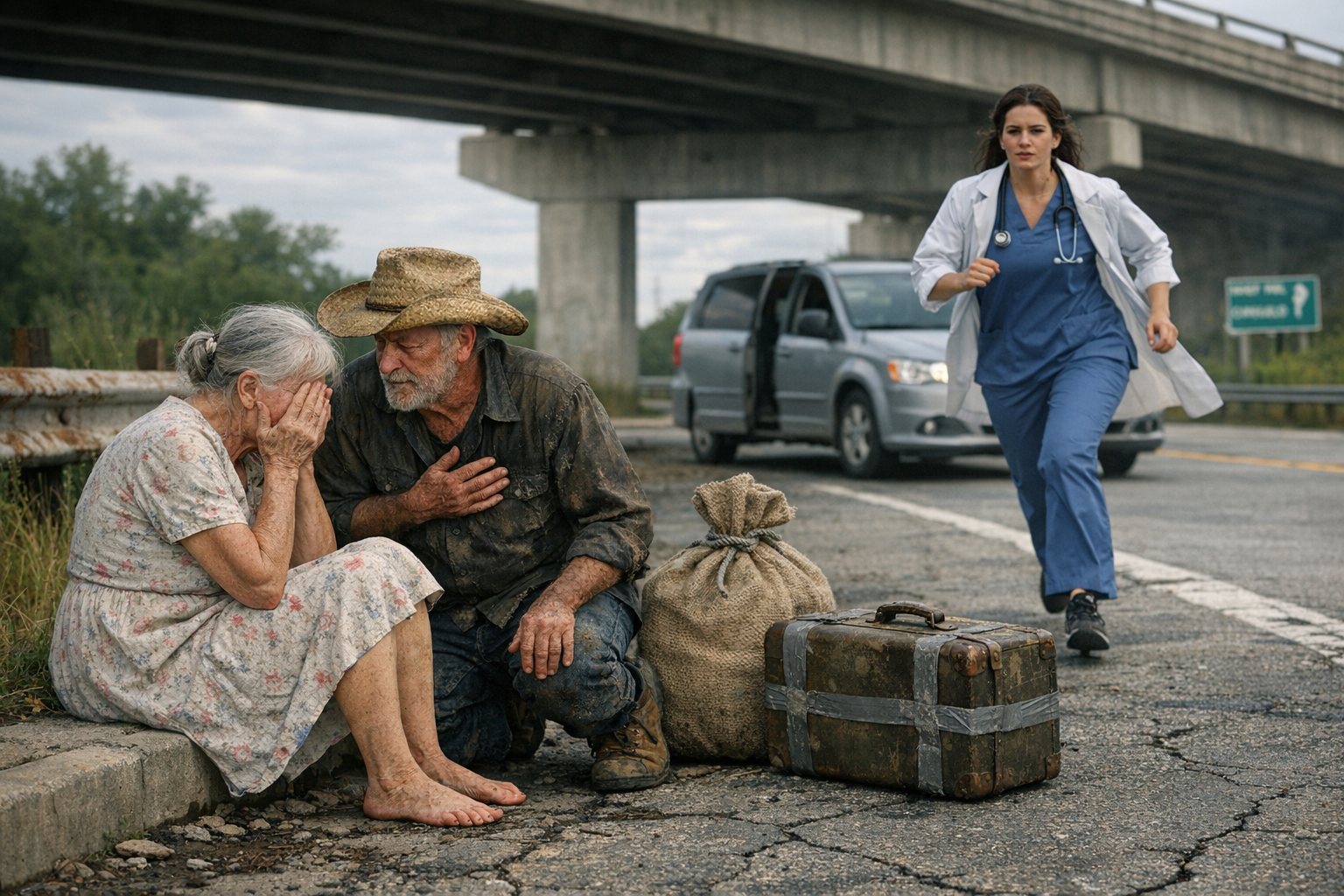
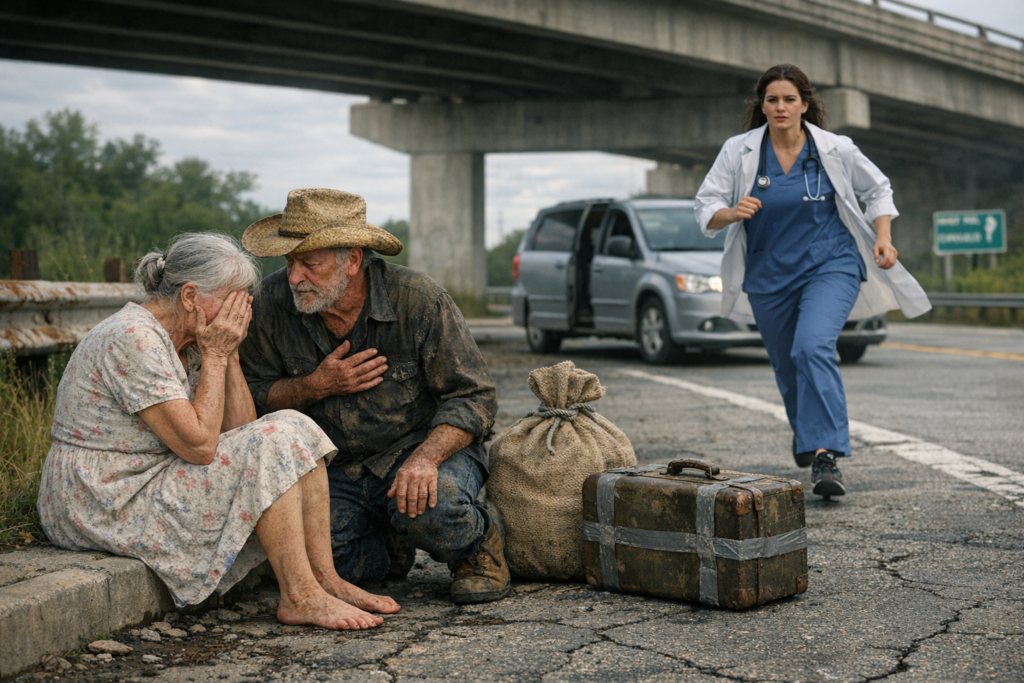
My mother collapsed onto the gravel shoulder of Route 27 and started screaming, not from pain but from something I couldn’t see. Cars were flying past us at sixty miles an hour, and she kept clawing at her own face like she was trying to erase herself. That was the moment my life split into before and after.
We weren’t even supposed to be there.
We had been driving back from a routine doctor appointment in the next county. She’d insisted on taking the back roads instead of the interstate, said the traffic made her nervous. My mom had always been anxious about highways. She used to make my dad pull over if he drove faster than the speed limit. But this time it wasn’t panic. It was something else.
She had gone quiet about five minutes earlier. Not the normal quiet where she stares out the window and hums to the radio. This was like the sound had been turned off inside her.
Then she jerked the steering wheel hard to the right.
I screamed her name. She didn’t answer. The car bounced onto the shoulder, gravel hitting the underside like hail. She slammed the brakes, threw the car into park, and before I could unbuckle my seatbelt she was out of the car, on her knees, hands over her face.
People think breakdowns are loud and dramatic. This one was silent at first. No crying. No words. Just her body folding in on itself like it had been unplugged.
I stood there with my door open, semi-trucks roaring past, wondering if she was having a stroke or if I should call 911 or if I was about to lose her right there.
When I touched her shoulder she flinched so hard she almost fell over.
“Don’t,” she said. Her voice was hoarse, like she’d been screaming for hours.
“Mom, what’s wrong?” I said. “Are you in pain?”
She shook her head, still not looking at me.
“I can’t do this anymore,” she whispered.
“Do what? Drive?”
She let out this broken laugh that made my stomach drop.
“Drive,” she repeated. “Yeah. That’s it.”
I called my dad from the side of the road while she sat on the curb staring at her hands like they weren’t hers. He kept asking what her symptoms were. Chest pain? Dizziness? Was she slurring her words?
I said no to all of it, because I didn’t know what I was supposed to say.
We waited forty minutes for him to get there. She never stood up once.

The doctor said there was nothing physically wrong with her. Blood pressure was normal. No signs of a stroke. No heart issue. They chalked it up to stress, dehydration, a “panic episode.”
My mom nodded through the whole appointment, polite and quiet. She even made a joke when the nurse apologized for the long wait.
On the drive home she stared straight ahead, hands folded in her lap like she was a passenger in her own life.
That night she didn’t come down for dinner.
The next morning she didn’t go to work.
By the end of the week she had taken a leave of absence from the elementary school where she’d taught second grade for twenty years.
Everyone thought it was burnout. That’s what she told people when they called. That’s what my dad told the neighbors. That’s what I told myself when I lay awake at night replaying the way her hands shook on that roadside.
But nothing about her looked burned out.
She looked like she was waiting for something.
The changes were small at first.
She stopped driving.
She stopped answering her phone.
She started carrying her purse everywhere, even into the bathroom. She locked the bedroom door at night, something she’d never done in thirty-five years of marriage.
My dad tried to act normal. He’d make coffee in the morning, talk about the news, ask her what she wanted for dinner. She’d nod or shake her head, but she rarely spoke more than a sentence.
Sometimes I’d find her sitting in the dark living room in the middle of the day, no TV on, just staring at the front door.
When I asked her what she was thinking about, she’d say, “Nothing,” and I could tell it was a lie because she never used to lie to me.
At least I thought she never had.
Two weeks after the roadside incident, I came home early from work and heard voices in the kitchen.
Not arguing. Whispering.
I stood in the hallway listening to my parents have a conversation that stopped the second I opened the door.
My dad was leaning against the counter, his hands braced like he needed to hold himself up. My mom was sitting at the table with her purse open in front of her.
They both looked at me like I’d walked in on something I wasn’t supposed to see.
“Hey,” I said.
My mom closed her purse too quickly, knocking it onto the floor. Lipstick, keys, a folded envelope spilled out.
I bent down to help her pick it up and she grabbed my wrist hard enough to hurt.
“I’ve got it,” she said.
My dad cleared his throat. “How was work?”
“Fine,” I said, staring at the envelope on the floor between us. It didn’t have a stamp. It was thick, stuffed with something.
My mom slid it under the table with her foot.
That night I couldn’t sleep.
I kept thinking about how she’d reacted. How scared she looked over a piece of mail.
People don’t realize how long you can live with something being wrong without knowing what it is. Weeks turned into months. Holidays came and went. My mom smiled in photos again. She went back to school part-time. She even started driving short distances.
But there was this thin layer of tension over everything. Like one wrong word would tear the room in half.
My dad lost weight. He stopped inviting people over. He drank more in the evenings. Not drunk, just enough to take the edge off.
One night, after he’d had a couple beers, I asked him about the breakdown.
He stared at the TV for a long time before answering.
“Sometimes people carry things longer than they should,” he said.
“What things?”
“Things that don’t belong to them anymore.”
He went to bed right after that.
The next time my mom broke down, it wasn’t on the highway.
It was in the grocery store.
We were in the cereal aisle when a man in a baseball cap walked past us. He didn’t even look at her. But my mom went pale, dropped the box of Cheerios, and backed up into the shelves like she’d been cornered.
“Mom?” I said.
She kept shaking her head.
“No,” she whispered. “No, no, no.”
I looked at the guy. He was already halfway down the aisle, pushing a cart like nothing had happened.
I told the store manager my mom wasn’t feeling well and we left the cart behind. She cried the entire way home, her face turned to the window like she didn’t want me to see.
When we got into the driveway she said, “If anyone asks, I slipped.”
“Slipped on what?”
“Anything,” she said. “Just say I slipped.”
After that, I stopped believing this was about her health.
I started believing this was about something she was running from.
I don’t know how long I would have gone on guessing if my dad hadn’t called me from work one afternoon and said, “You need to come home. Now.”
I found my mom in the bedroom, sitting on the edge of the bed with that same envelope from the kitchen table months earlier. It was open this time.
My dad was standing in the doorway, his face gray.
“She was going to throw it out,” he said. “I found it in the trash.”
My mom didn’t look at me. She just said, “I didn’t want you involved.”
“Involved in what?” I asked.
She finally met my eyes. For the first time since the highway, she didn’t look scared.
She looked resigned.
“I don’t have a choice anymore,” she said.
I picked up the envelope and saw the return address. No name, just a PO box in a town I’d never heard of.
Inside were photocopies of old documents. Birth certificates. Hospital forms. One of them had my mother’s maiden name on it.
The dates were wrong.
I didn’t understand what I was looking at, and when I asked her to explain, she shook her head.
“Not today,” she said. “I just needed you to know it exists.”
“Know what exists?”
She took the papers from me and slid them back into the envelope.
“That I didn’t imagine it,” she said.
My dad put his hand on her shoulder and she leaned into him, something she hadn’t done in months.
“I’m sorry,” she said to both of us. “I really am.”
“For what?” I asked.
She looked at the door, then at the window, then at me.
“For what comes next.”
That was the last normal conversation we ever had.
Two days later she didn’t come home from school.
Her car was found in the teacher parking lot. Her purse was inside. Her phone was inside. The envelope was gone.
And when the police asked if she had any reason to disappear, my dad and I looked at each other and realized neither of us actually knew who she was anymore.
I still don’t.
Not really.
Because whatever happened to her on the side of the road wasn’t a breakdown.
It was a trigger.
And I still don’t know what it triggered.