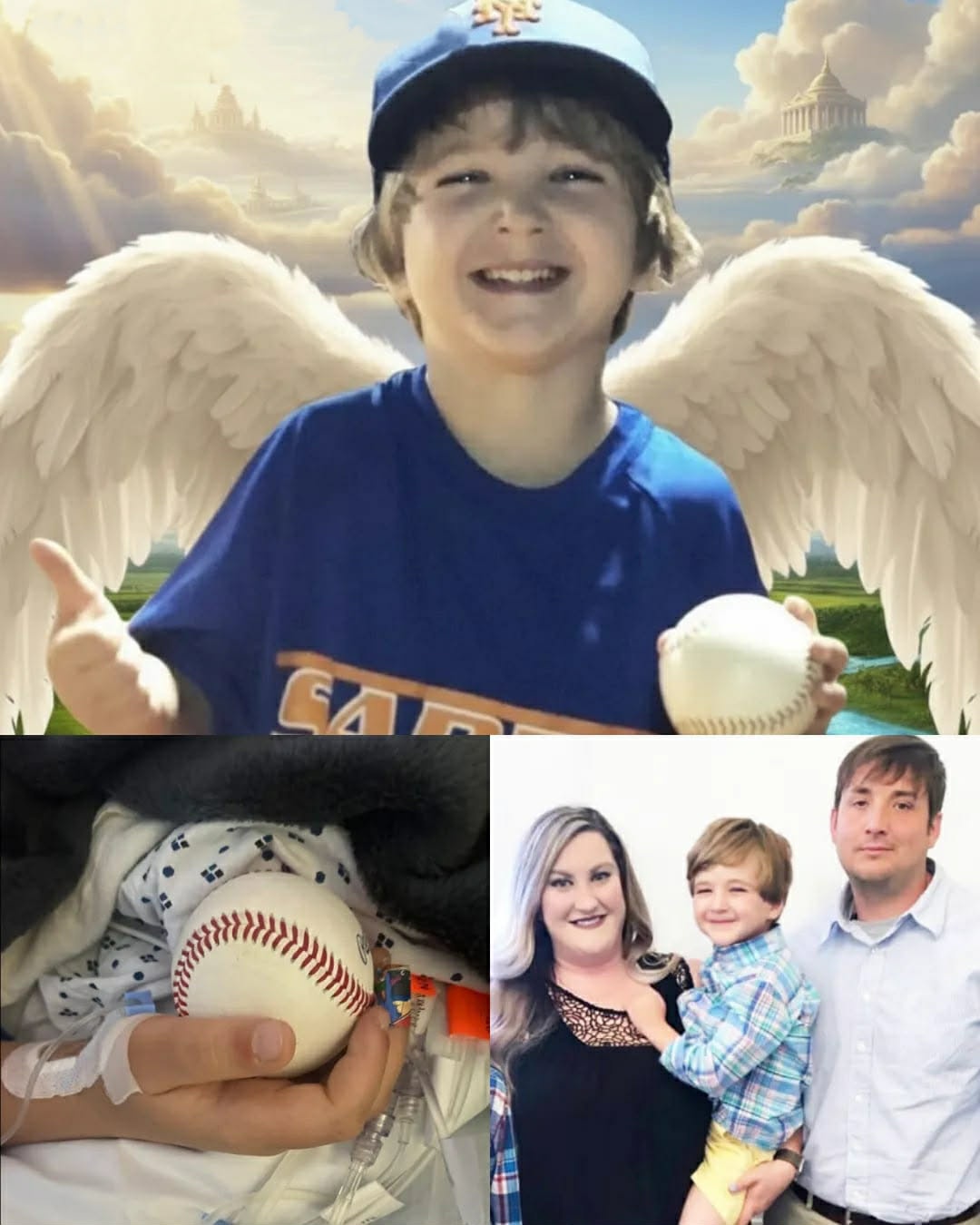
He was only five years old, small enough to still fit perfectly in his mother’s arms, yet big enough to leave a mark on an entire community that will never fade.
His name was John Luke Carver.
To the people of Sardis City, he was the little boy with the sunshine smile, the child who ran barefoot across the yard, laughing as if the world itself was a miracle.
To his family, he was everything — the heartbeat of their home, the spark that brightened even the quietest mornings.
No one could have imagined how quickly that light would be taken from them.
No one could have imagined how deeply his story would touch the world.

It began on a quiet Thursday afternoon, March 27th — a day that was supposed to be ordinary, simple, gentle.
The sun hung softly over Smith Chapel Road, where the Carver boys loved to play.
John Luke and his older brother had spent the morning riding their four-wheelers, something they had done countless times before.
They knew every inch of their yard, every dip in the ground, every stretch of grass where the wheels rolled smoothly.
It was freedom to them.
A small, joyful adventure that made them feel alive.
But in the space of a breath, everything changed.
According to Sardis City Police Chief James Harp, the boys were riding together as they always did.
The older brother rode ahead, fully expecting to hear the familiar hum of John Luke’s four-wheeler behind him.
But the hum never came.
He turned around.
His heart dropped.

His little brother was nowhere in sight.
At first, he probably thought it was a playful trick — maybe John Luke had slowed down or taken a different path, giggling at the idea of surprising him.
But as seconds passed, fear crept in.
He searched the yard, calling his name, scanning the places they normally played.
Then he saw him.
Still.
Silent.
Floating facedown in the nearby pond.
A moment no child should ever have to witness.
A moment that would forever divide life into “before” and “after.”
The older brother ran to him, adrenaline and terror pushing his feet forward faster than they had ever moved.
He pulled John Luke from the water with trembling hands, calling for help, crying, screaming — words lost in panic and heartbreak.
Their father, Ben Carver, was mowing the lawn when his oldest son reached him.
A father’s world can collapse in a single sentence.
And his did.

Ben did not hesitate.
He was not just a father — he was a paramedic.
He had spent years saving lives, calming chaos, restoring hope.
But nothing prepares a parent for the moment the life that needs saving is their own child.
He ran to the pond.
He saw his baby boy.
He dropped to his knees.
And he began CPR.
Breath after breath.
Compression after compression.
A father fighting against time itself.
Neighbors would later say they had never seen courage like that.
They had never seen love so fierce.
When the A-Med ambulance arrived, the crew immediately joined the battle.
They continued CPR.
They intubated him.
They worked tirelessly until they brought back a heartbeat — a tiny rhythm of hope pulled from the edge of impossibility.

John Luke was rushed to Marshall Medical Center South, where doctors stabilized him before he was airlifted to Children’s Hospital in Birmingham.
The next hours stretched endlessly for the Carver family.
Waiting rooms are strange places during emergencies.
Time slows.
Hope becomes a breath-to-breath prayer.
Fear becomes a shadow that clings to every corner.
Yet even in those hours of uncertainty, people began to gather around them.
Friends created a Facebook page — “Prayers for John Luke.”
The community rallied instantly.
Hundreds prayed.
Then thousands.
Messages poured in from surrounding towns, from other states, from strangers who had never met the Carvers but felt the weight of their story.

Everyone prayed for a miracle.
Everyone prayed for one more sunrise with him.
But despite every prayer, every ounce of fight, every moment of medical effort, the news came gently, heartbreakingly, from his mother.
On Facebook, through tears and trembling hands, she wrote what no mother should ever have to write.
“In the heaviest of my heart, John Luke has went to be with the Lord. My precious angel is walking on the streets of heaven.”
The world fell silent for a moment.
A silence of grief.
A silence of love.
A silence of disbelief that such a bright little soul could be gone so soon.
Yet in that same message, his mother shared something extraordinary — something that revealed the depth of her strength, her faith, and her compassion.
The Carver family chose to donate their son’s organs.
In the midst of unimaginable grief, they chose life.
They chose to turn tragedy into hope.
They chose to let their little boy’s heart continue beating in another child’s chest.
They chose to let his story ripple outward, touching families they had never met.

Johanna wrote again:
“I ask you to pray for the families whose children will receive his organs. Pray they feel this miracle is coming.”
What kind of love does it take to think of other families in that moment?
What kind of courage does it take to offer such a gift?
Only the kind that grows in the deepest part of a mother’s heart.
She continued:
“And I pray that one day I can come to meet these sweet children who John Luke’s organs will live on in them.”
The idea brought tears to countless eyes across the community.
The idea that John Luke’s story was not ending — it was continuing.
Living.
Breathing.
Helping others find a future they might not have had.
In her final message of that night, she wrote:
“These coming days are going to be so hard, so much heartache. But I am so thankful, that this is not my home. I am only passing through. And I will see my sweet, funny, precious boy again.”
Faith became their anchor.
Love became their reminder.
Hope became their way forward.

As news spread, Sardis City seemed to collectively pause.
Children held closer.
Parents hugged longer.
People donated to the family’s GoFundMe.
They brought meals.
They sent letters.
They lit candles.
All for a boy many had never met, but all felt connected to.
Some said he had the kind of spirit that made strangers care as if he were their own.
Others said that perhaps his purpose on Earth had been fulfilled in five short years — a purpose of teaching people to love harder, hold tighter, and cherish every moment.
His older brother struggled, as any child would.
He had lost not just a sibling, but a best friend.
A playmate.
A companion in every backyard adventure.
But his family wrapped him in support, reminding him that he had done everything right.
He had been brave.
He had tried to save his brother.
He had been the hero John Luke needed in those final moments.
As for Ben and Johanna, grief became a companion they never wanted but learned to live beside.
Some nights the house felt too quiet.
Too still.
Too empty without the patter of small feet or the echo of little-boy laughter.
But they held onto the one thing that tragedy cannot take — memory.
They remembered his silly jokes.
His fascination with frogs.
His habit of running into the living room every morning with bed-hair sticking in all directions.
They remembered waking up to his voice.
Now they prayed to dream of it.
The town also remembered.

People began leaving small blue ribbons around Sardis City — blue for the color of John Luke’s favorite T-shirt, blue for the softness of his gentle smile.
At the pond near the home, flowers appeared.
Handwritten notes.
Stuffed animals.
A child’s drawing of an angel with messy blond hair.
One note said simply:
“We didn’t know you, but we loved you.”
It was signed by a seven-year-old girl.
Grief united people who had never spoken to each other before.
Love built bridges where strangers had once stood.
John Luke had done that.

A five-year-old boy had done what politicians and leaders often fail to do.
He brought people together.
He made a town feel like a family.
As days passed, Johanna’s Facebook updates became reflections — pieces of a mother’s love shared with a community who held her up like extended family.
She spoke of heaven often.
Not as an idea.
But as a promise.
A certainty.
A place where her little boy now ran freely, more alive than ever.
Some said they could almost picture him — barefoot, laughing, racing through fields of gold.

Others imagined him sitting in the lap of God Himself, giggling as angels tried to keep up.
His story continued to spread far beyond Alabama.
People in other states wrote to the Carvers.
Some were parents of sick children who received organ transplants.
Others were grieving parents who found comfort in Johanna’s faith.
Some were simply moved.
Some changed the way they lived.
Some promised to love their children a little more fiercely.
Some said they were inspired to become organ donors.
One small boy had changed more lives after his passing than many do in a lifetime.
And perhaps that was why God called him home so early.
Because his purpose was not measured in years.
It was measured in love.
And he had given enough to fill a thousand lifetimes.
Now, when people in Sardis City speak of him, they do not speak only of loss.
They speak of a legacy.
A legacy carried in the hearts of his parents.
A legacy carried in the courage of his older brother.
A legacy carried in the children who now breathe, live, and grow because of the gift he left behind.
A legacy carried in every person who whispers his name in prayer.
John Luke Carver may have lived only five years on Earth.
But he will live forever in the lives he saved.
Forever in the hearts he touched.
Forever in the town that will never forget the little boy with the sunshine smile.
And when his mother says, “I will see my sweet, funny, precious boy again,” the whole town believes her.
Because endings are only for stories written by humans.
This one was written by heaven.