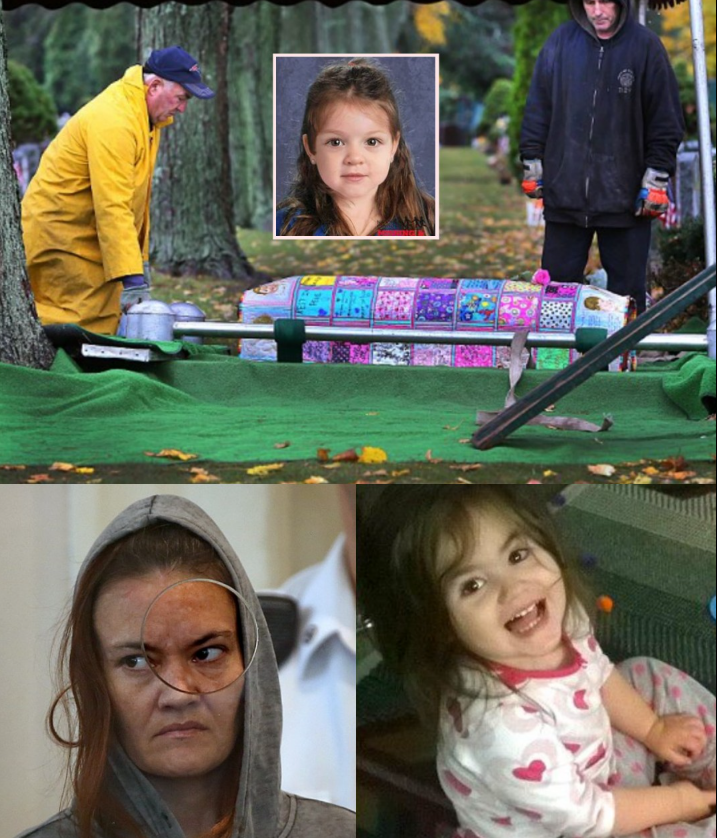
She was only two years old when the world failed her.
A child whose smile could have brightened any room, whose laughter once echoed softly through a small Boston apartment, was silenced long before she ever had a chance to understand what love truly meant.
Her name was Bella Neveah Amoroso Bond—but for months, the world knew her only as “Baby Doe.”
On the morning of June 25, the ocean tide carried a secret onto the rocky shore of Deer Island, Boston.
A woman walking her dog noticed something strange by the waterline—a trash bag caught between seaweed and stones.
Inside was the lifeless body of a little girl.

She was wrapped in the innocence of her tiny pink leggings and polka-dot blanket, still dressed as though she might wake up at any moment.
The woman trembled, clutching her dog’s leash as the sound of the waves mixed with the sirens that soon arrived.
Boston police and medical examiners moved carefully, as though afraid to disturb her peaceful stillness.
They had no name, no history, no family stepping forward to claim her.
So they called her “Baby Doe.”

Investigators released a computer-generated image of her—a digital portrait of a cherub-faced girl, about two or three years old, with round cheeks and wide brown eyes that seemed to look right through the screen.
That image swept across the internet, reaching nearly 50 million people in just two weeks.
People shared her picture with captions filled with heartbreak and outrage.
They wanted to know who she was.
They wanted to give her back her name.
But for weeks, no one came forward.
No one recognized her.
It was as if she had existed in silence—unseen, unloved, forgotten.

Detectives followed hundreds of leads, visiting homes, checking daycare centers, and cross-referencing missing-child reports.
They examined the records of more than 200 young girls in the region.
Every clue led to another dead end.
The little girl remained a mystery, a haunting face that Boston couldn’t erase from its conscience.
Until one man, Michael Sprinsky, called the police.
He said he knew the child’s mother—and that the truth was worse than anyone could imagine.

Bella had lived in Dorchester, a working-class neighborhood of Boston, with her mother, Rachelle Dee Bond, and her mother’s boyfriend, Michael P. McCarthy.
Neighbors described the family as “quiet but strange.”
Few people had ever seen the little girl outside.
Some said the curtains were always drawn.
According to court documents later released, Rachelle Bond and McCarthy were deep in drug addiction—living in chaos, paranoia, and cruelty.
Sprinsky, who had once shared the apartment, told investigators that the couple often locked Bella in the bathroom for hours as punishment.
He had heard her tiny fists pounding on the door, her voice screaming for her mother to open it.
But no one came.

They claimed, he said, that Bella was “possessed by a demon.”
It was a phrase repeated so many times that it became a justification for every bruise, every harsh word, every moment of neglect.
Sprinsky eventually couldn’t bear to stay.
He packed his belongings and left, haunted by the image of the little girl left behind.
One night in late May, the nightmare reached its end.
Bella was crying in her bedroom.
McCarthy told Rachelle he would go calm her.
The apartment fell silent.
Minutes passed.

Then Rachelle walked in and froze.
McCarthy’s hand rested on the child’s small abdomen; her head was swollen, her skin pale and bruised.
Rachelle’s voice shook as she asked, “What did you do?”
McCarthy looked up and whispered coldly, “She was a demon anyway. It’s time for her to die.”
Rachelle later told investigators that he threatened to kill her if she went to the police.

In the following hours, McCarthy placed Bella’s body into a trash bag and stored it in the refrigerator.
Then he left the apartment, bought heroin, and came back to inject it into Rachelle’s neck.
They stayed high for days while their daughter’s small body lay frozen a few feet away.
Eventually, McCarthy carried the bag to Boston Harbor, placed it inside a duffel bag, and tossed it into the water, weighted down with stones.
And the tide took Bella away.
When her body washed ashore weeks later, the city wept.
Memorials appeared across Boston—tiny teddy bears, pink flowers, and candles left at the gates of Deer Island.
Strangers came to kneel, whispering prayers for a child they had never met.
They called her an angel, a symbol of every lost child who deserved better.

On September 18, the truth was finally revealed.
The child known as Baby Doe was identified as Bella Neveah Amoroso Bond, two and a half years old.
Her name, when spoken aloud, carried both grace and tragedy—“Neveah,” heaven spelled backward.
Perhaps her mother had once believed that name would protect her.
But heaven, it seemed, was the only home she had left.
When Rachelle Bond and Michael McCarthy appeared in court on September 21, the room was heavy with fury and sorrow.
Prosecutor David Deakin described months of torment that Bella had endured—yelling, starvation, and long periods locked away.
Reporters scribbled notes while the public gasped in disbelief.
Then, a voice broke through the silence.
A woman named Megan Fewtrell, who identified herself as Bella’s godmother, shouted from the gallery, “I hope you rot in jail!”
She clutched a small yellow stuffed duck, the same one Bella had once slept with every night.
Tears streamed down her face as she was escorted out of the courtroom.

Afterward, Joe Amoroso, Bella’s biological father, who had returned from Florida hoping to finally meet his daughter, shouted at McCarthy as he was led away in handcuffs:
“Mike McCarthy, your time is up! Don’t expect to live another day!”
He later told reporters that Rachelle had confessed weeks earlier, saying McCarthy killed Bella because he believed she was “a child of Satan.”
Joe had never met his daughter in person—only heard her voice on the phone, a tiny giggle that now haunted his dreams.
He had come home too late.
The courtroom saga continued through the fall.
McCarthy remained behind bars without bail; Bond’s bail was set at one million dollars.
In public, she wept and said she had been afraid to stop him.
But for many, her tears came too late.
Outside the courthouse, mourners placed a photo of Bella beside a handwritten note that read: “You were never a demon. You were light.”

Over time, the name “Baby Doe” became a reminder of both justice and failure.
Justice, because the world refused to forget her.
Failure, because the system had missed every warning sign.
People who knew the family said they had called social services, reported neglect, and begged someone to check on Bella.
But the reports were either lost, ignored, or never filed.

Boston held a vigil by the harbor.
Hundreds gathered under the evening sky, candles flickering in the wind.
The tide was gentle that night.
Parents held their children close, whispering promises to never let them go unheard.
A pastor read softly: “Every child deserves a name, a home, and love.”
The crowd repeated it, their voices trembling, their faces lit by the fragile glow of remembrance.

Months later, as the case moved slowly through the courts, the world began to learn more about who Bella really was.
She loved picture books.
She danced when music played.
She used to hold her blanket like a cape and call herself “Super Bella.”
A neighbor remembered seeing her once on the porch, twirling in the sunlight, her curls bouncing with every spin.
“She was joy,” the neighbor said. “Pure joy.”
That was how they chose to remember her.
Not the way she was found—but the way she once lived, laughing, innocent, alive.

In the end, Bella’s story became a mirror held up to society—a reflection of how easy it is to look away until it’s too late.
She was not invisible; she was ignored.
She was not a mystery; she was abandoned.
And yet, in death, she reminded millions of people around the world to see the unseen, to listen to the cries behind closed doors, to never let silence bury a child again.
Bella Neveah Amoroso Bond.
Born with a name that meant “beautiful heaven.”
Taken too soon, but never truly gone.
Her short life, though wrapped in tragedy, awakened compassion across nations.
Today, a memorial stone by the harbor bears her name—proof that she was here, that she mattered, and that her light, though small, will never go out.