THE INTRUDER
The alarm on my phone screamed at 2:14 AM. Motion detected. Garage.
My blood turned to ice, then instantly boiled into rage. This was the third time this month. The first time, they took three thousand dollars worth of Snap-on power drills. The second time, they smashed the window of my 1967 Mustang—my restoration project, my baby—just for the fun of it.
I didn’t call the cops. The cops in this neighborhood take forty minutes to show up, and by then, the thieves are gone. I was done being a victim.
I grabbed the Louisville Slugger baseball bat I kept next to the nightstand. My wife, Linda, sat up, clutching the duvet, her eyes wide in the dark. “Jack, don’t,” she whispered. “It’s just stuff. Let them take it.”
“It’s not just stuff, Lin,” I growled, pulling on my boots with trembling hands. “It’s my livelihood. It’s the only thing I have left to leave to the kids.”
I crept down the hallway, the wood floor cold against my feet, the bat heavy in my hand. I could hear the sounds coming from the garage—clink, scrape, clink. Metal against metal. They were bold. They weren’t even trying to be quiet. They were probably stripping the Mustang for copper wire right now.
I reached the heavy fire door connecting the kitchen to the garage. I could hear breathing on the other side. Shallow, jagged breaths.
I took a deep inhale, gripped the handle, and threw it open, flipping the fluorescent light switch in one violent motion.
“Get on the ground or I swear to God I will—”
I stopped mid-roar. The air left my lungs. The bat wavered in my hand, dropping inches.
I was expecting a meth-head looking for a catalytic converter. I was expecting a gang of teenagers in hoodies looking for a joyride.
Instead, I was looking at a boy.
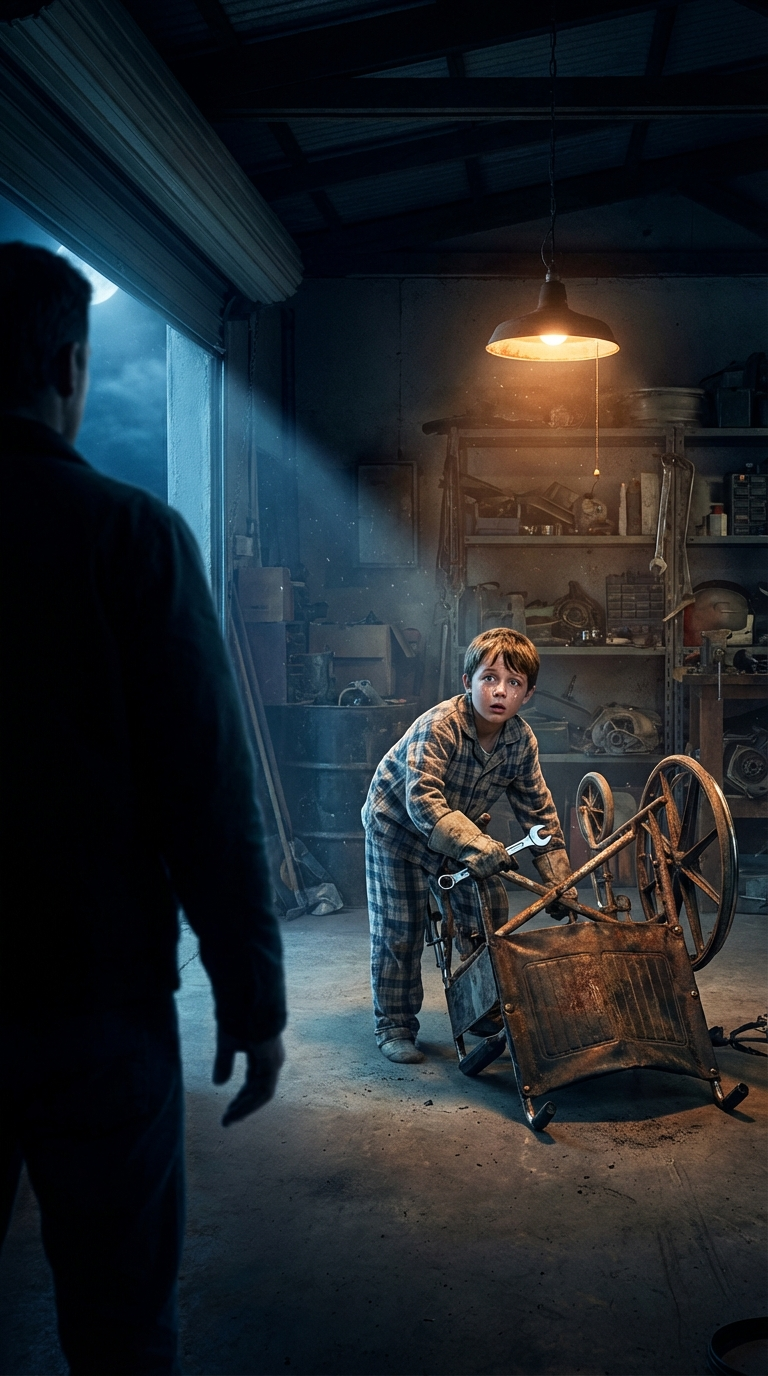
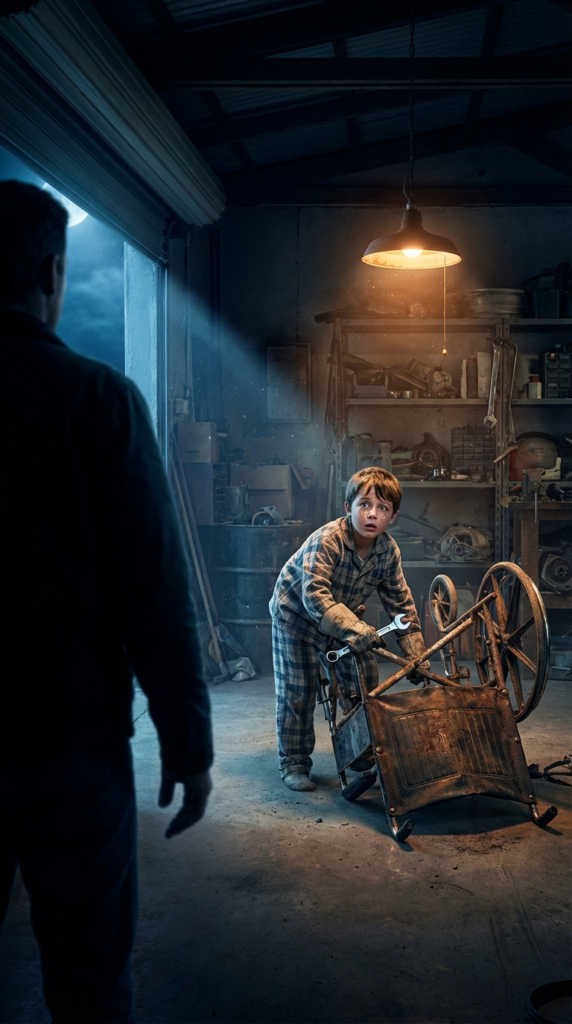
He couldn’t have been more than nine years old. He was skinny, malnourished-skinny, wearing superhero pajamas that were frayed at the hems and too small for his limbs. On his hands, he wore a pair of my oversized leather work gloves that swallowed his tiny fingers.
He wasn’t near the Mustang. He wasn’t near the tool chest. He was huddled on the greasy concrete floor near my workbench, under the harsh hum of the fluorescent tube.
He froze, his eyes wide with absolute terror, trembling like a leaf in a hurricane. In one hand, he held my heavy socket wrench.
But he wasn’t stealing it.
In front of him, flipped upside down like a dead beetle, was a rusted, battered, falling-apart wheelchair. The vinyl seat was duct-taped in a dozen places. One of the large rubber wheels was completely detached, lying on the floor with its bearings spilled out. He had been trying to jam a bolt back into the bent axle.
“I… I’m sorry,” the boy stammered, tears instantly spilling over his dirty cheeks, cutting clean lines through the grease on his face. “I tried to be quiet. Please don’t call the police. Please. She can’t walk without it.”
THE GHOST IN THE GARAGE
I lowered the bat until the tip touched the floor. The adrenaline that had pumped me up for a fight was replaced by a confusing, heavy ache in my chest.
“Who can’t walk?” I asked, my voice rougher than I intended.
“My mom,” he whispered. He dropped the wrench. It clattered loudly, and he flinched as if I’d hit him. “She has a job interview tomorrow. At the diner. If she can’t get there, Mr. Henderson is gonna kick us out.”
Mr. Henderson. The name tasted like bile. Everyone in our zip code knew Henderson. He was a slumlord who owned three crumbling apartment complexes down the street. He raised rent indiscriminately and evicted single mothers for looking at him wrong.
I looked at the wheelchair. It was a piece of junk. A standard hospital issue from maybe twenty years ago. The bearings were shot, the frame was bent, and the axle was sheared. No amount of jamming a bolt in there was going to fix it.
“What’s your name, son?” I asked, leaning the bat against the wall.
“Toby,” he sniffled.
“Okay, Toby. I’m Jack.” I stepped into the garage. Toby scrambled back, pressing himself against the workbench. “Relax. I’m not gonna hurt you. And I’m not calling the cops.”
I knelt down next to the wheelchair. Up close, it was even worse. This was the vehicle of a life lived on the edge of poverty. Every scratch and dent told a story of struggle.
“You brought this here… why?”
“I saw you working on the car,” Toby said, wiping his nose on his sleeve. “I saw you fixing things. I thought… I thought maybe your tools had magic in them.”
That broke me. It shattered the hard shell I’d built up over twenty years of being a mechanic, of dealing with angry customers and unpaid bills and a world that seemed to want to grind me down.
“Magic,” I repeated softly.
I looked at the Mustang. I had spent two years restoring it. I polished it every Sunday. I guarded it with my life. But looking at this kid, terrified and desperate, trying to be the man of the house at nine years old… I realized I had been guarding the wrong things.
THE OVERHAUL
“It’s not magic, Toby,” I said, standing up. “It’s mechanics. And you’re doing it wrong.”
Toby looked down, defeated. “I know. I’m stupid.”
“No,” I said firmly. “You’re not stupid. You just don’t have the right parts. That axle is sheared. You can’t bolt it back. You need a new one.”
I walked over to the Mustang. My pride and joy. I popped the trunk. Inside, I had a stash of spare parts I’d been hoarding. High-grade steel, custom bearings, leftovers from a racing modification I never finished.
I grabbed a piece of high-tensile steel rod.
“Grab that stool,” I pointed. “Sit down. If we’re gonna do this, we’re gonna do it right.”
For the next three hours, my garage wasn’t a crime scene. It was a workshop.
I didn’t just fix the wheel. I overhauled the entire chair.
I cut the steel rod to replace the axle. I replaced the rusted bearings with ceramic ones I had been saving for the Mustang’s transmission—they were frictionless, silent. I welded the cracked frame, reinforcing the stress points.
Toby watched me, mesmerized. I taught him how to hold the welding torch (with assistance). I showed him how to grease the hubs.
“Pass me the 10mm,” I’d say, and he’d hand it to me with the seriousness of a heart surgeon.
By 5:00 AM, the chair looked different. It wasn’t pretty—it was still scarred and taped—but it was solid. It glided across the concrete floor with a silent, deadly smoothness.
“Hop in,” I said.
Toby climbed in. I gave it a gentle push. He flew across the garage, spinning in a circle, laughing.
“It’s fast!” he yelled.
“It’s safe,” I corrected. “Now, where do you live?”
THE WALK HOME
We loaded the chair into the back of my pickup truck. I drove Toby the three blocks to the dilapidated apartment complex Henderson owned.
The sun was just starting to crack the horizon, painting the gritty streets in soft pinks and oranges.
“That one,” Toby pointed to a ground-floor unit with peeling paint.
I helped him unload the chair. The front door of the apartment opened before we reached it. A woman stood there, leaning heavily against the frame. She was pale, thin, and her eyes were wild with panic. She was supporting herself on the wall because she couldn’t stand without the chair.
“Toby!” she screamed, lunging forward and almost falling. “Oh my god, I woke up and you were gone! I thought—”
She saw me. Her eyes went to my size, my grease-stained clothes. She pulled Toby behind her, trembling.
“I’m sorry,” she said rapidly. “Whatever he did, I’m sorry. He’s just a boy. Please don’t hurt him.”
“Mom, look!” Toby broke free and spun the wheelchair toward her. “Jack fixed it! He made it fast!”
The woman—Elena—stopped. She looked at the chair. Then she looked at me, confusion warring with fear.
“I didn’t steal it, Mom,” Toby said. “I just borrowed his garage.”
“He broke in,” I said gently. Elena flinched. “But he didn’t take anything. He just wanted to make sure you made your interview.”
Elena looked at the chair, then covered her mouth. Her legs gave out, and I caught her, guiding her into the newly reinforced seat.
She sat down. She spun a little. It moved effortlessly.
“It doesn’t squeak,” she whispered. “It’s been squeaking for two years.”
“Ceramic bearings,” I said, feeling a lump in my throat. “And a reinforced axle. It’ll hold.”
She looked up at me, tears streaming down her face. “Why? Why would you do this?”
“Because he’s a good kid,” I said. “And because I hate squeaky wheels.”
Just then, a heavy door slammed nearby. A man in a cheap suit walked out of the manager’s office. Mr. Henderson.
He saw Elena outside. He checked his watch.
“Rent’s due by noon, Elena!” he shouted across the parking lot, ignoring the fact that it was 5:30 AM. “And get that junk out of the walkway! If you’re late again, I’m changing the locks!”
I felt that familiar rage from earlier in the night bubbling up. But this time, it wasn’t directed at a thief. It was directed at a bully.
I walked over to Henderson. I’m six-foot-two and I lift engines for a living. Henderson was… not.
“Who are you?” Henderson sneered, though he took a step back.
“I’m the guy who maintains the equipment,” I said, my voice low and dangerous. “Elena is going to her interview. She’s going to get the job. And she’s going to pay you. But if I hear that you threatened to lock a kid and a disabled woman out of their home again, I’m going to come back.”
“Is that a threat?”
“No,” I smiled, wiping grease from my knuckles. “It’s a maintenance schedule. Fix your attitude, or I’ll fix it for you.”
I turned around. Elena was smiling. A real, hopeful smile. Toby gave me a thumbs up.
THE RETURN
I drove home. I walked back into my garage. It was a mess. Tools were scattered, metal shavings were everywhere, and I had used about $400 worth of rare parts on a twenty-dollar chair.
Linda was standing in the doorway, holding two cups of coffee. She had watched the whole thing from the window.
“You didn’t use the bat,” she said softly.
“No,” I took the coffee. “I used the welder.”
“You used the bearings for the Mustang,” she noted, looking at the empty box on the bench.
“Yeah, well,” I shrugged, looking at the spot where Toby had sat, learning how to hold a wrench. “Mustang wasn’t going anywhere anyway. That kid… he needed to go places.”
A week later, I was working under the hood of the Mustang when I heard a noise. I grabbed a wrench, instinctively tense.
I looked up. Toby was standing in the driveway. Elena was with him, sitting in the chair. She was wearing a waitress uniform.
“I got the job!” she called out. “I start today!”
Toby ran up to me. He held out a hand. In it was a crisp, brand new $10 bill.
“What’s this?” I asked.
“Payment,” Toby said proudly. “For the garage rental. Mom said we pay our debts.”
I took the ten dollars. It was more valuable to me than the entire car behind me.
“Deal,” I said. “But if you’re gonna rent the space, you gotta work. I need someone to hold the flashlight who doesn’t shake. Think you can handle it?”
Toby beamed. “Yes, sir!”
I didn’t lose a car that night. I didn’t lose my tools. I gained an apprentice. And for the first time in years, the garage didn’t feel like a fortress to keep people out. It felt like a place where broken things came to get fixed.