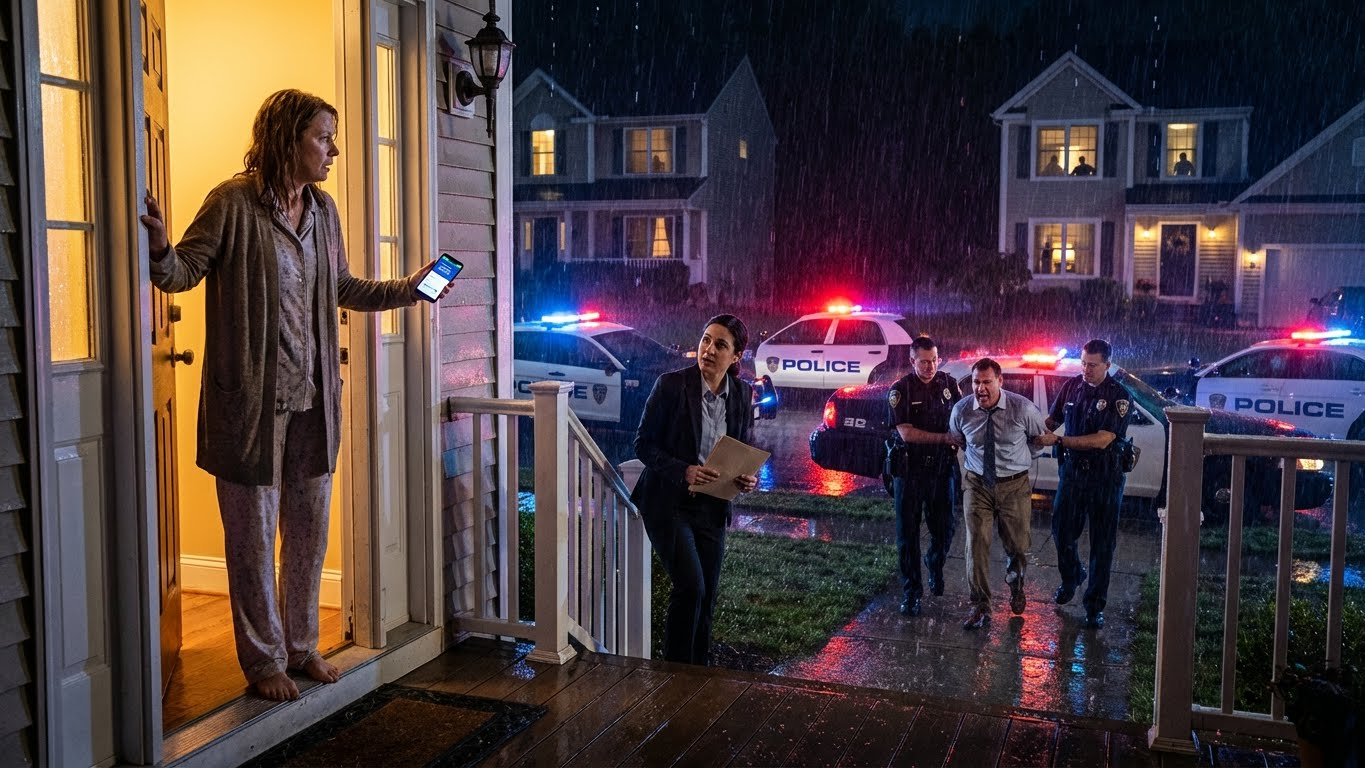
The rain was relentless that November evening, the kind of cold, driving storm that makes you grateful for a warm house and the illusion of safety. I was curled up on the living room couch with a book I wasn’t really reading, waiting for Mark to finish his conference call and come downstairs so we could eat the dinner I’d reheated twice already.
Then I saw the lights. Red and blue, flashing through our rain-streaked windows, painting the walls of our suburban Connecticut living room in alternating colors of emergency and chaos.
Three police cars rolled to a stop in front of our house—silent, no sirens, but unmistakably deliberate. My heart started pounding before my brain could catch up to process what I was seeing. Police cars at our house. At 9:15 on a Thursday night. For us.
I set down my book with shaking hands and walked to the front door, opening it before they could knock. The lead detective was a woman in her mid-forties, dressed in a dark suit despite the rain, with tired eyes that had seen too much and a professional courtesy that immediately made me more afraid.
“Mrs. Patterson? I’m Detective Sarah Chen.” She held up a badge and a folded document. “We have a warrant for the arrest of Mark Patterson. Is he home?”
The words landed like physical blows. “A warrant? For what? There must be some mistake—”
“Ma’am, we need to speak with your husband immediately.”
I heard footsteps on the stairs behind me. Mark appeared on the landing, still wearing his wireless headset, still in his “work from home” uniform of button-down shirt and sweatpants, his face shifting rapidly from confusion to concern to something else—something I’d later recognize as calculation.
“Can I help you officers?” he asked, his voice steady and reasonable, the same tone he used to explain why he’d missed our anniversary dinner, why he’d cancelled our vacation, why I was being paranoid about the charges on our credit card.
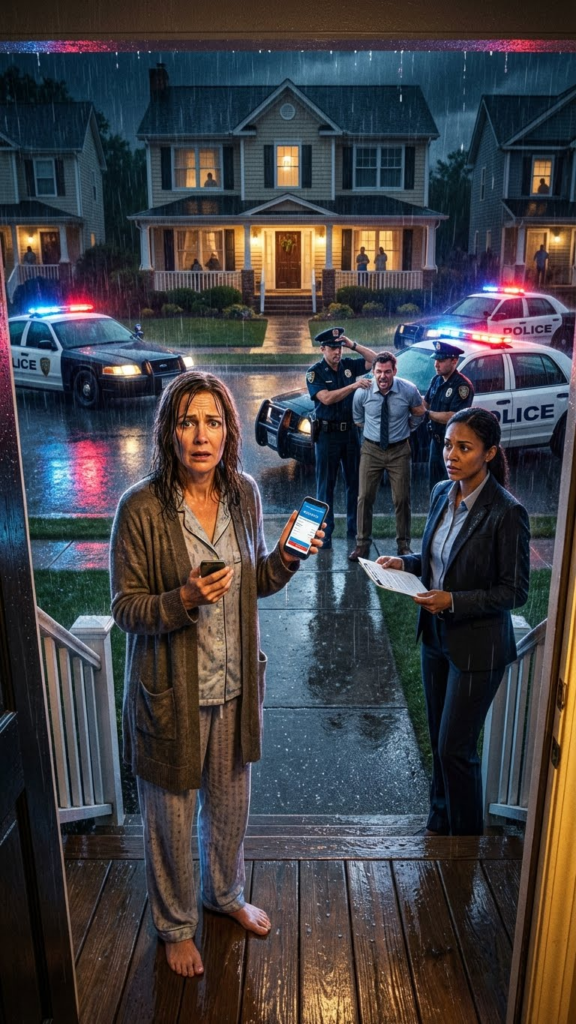
“Mark Patterson, you’re under arrest for multiple counts of fraud, embezzlement, and conspiracy to commit wire fraud.” Detective Chen stepped forward with handcuffs, her partner moving to flank her. “You have the right to remain silent. Anything you say can and will be used against you in a court of law—”
“This is insane!” Mark’s composure shattered like glass. “I haven’t done anything! This is a mistake! Rebecca, tell them! Tell them I’m being set up!”
I stood frozen in the doorway, rain starting to blow in around me, as they cuffed my husband of fifteen years. Mark was shouting now—about his lawyer, about wrongful arrest, about his rights, about how I needed to call his brother who was an attorney, about how this was all some massive misunderstanding.
The neighbors’ porch lights were coming on one by one, faces appearing in windows, the quiet suburban street we’d lived on for a decade suddenly transformed into a spectacle.
“Mrs. Patterson,” Detective Chen said quietly while her partner led Mark toward the squad car, his voice still echoing protests into the rainy night. “You might want to come down to the station tomorrow morning. We have quite a bit of evidence we need to discuss with you regarding your husband’s activities.”
“What activities?” My voice sounded like it belonged to someone else.
“And you should know,” she continued, seeming to weigh her words carefully, “your neighbors’ Ring doorbell cameras have been extremely helpful to our investigation. Very helpful.”
My brain struggled to make sense of that. “What does that mean?”
“It means we have extensive footage of your husband engaging in activities he very likely told you he wasn’t doing. Multiple cameras, multiple angles, dating back approximately eight months.”
Eight months. The timeline hit me like cold water. Eight months ago was when Mark had insisted we install a Ring doorbell “for security.” Eight months ago was when he’d started having regular “late conference calls.” Eight months ago was when he’d suddenly become very interested in which of our neighbors had doorbell cameras and what direction they faced.
Detective Chen handed me a business card. “Come by the station tomorrow at 10 AM. Bring any financial documents you have access to—bank statements, credit cards, investment accounts, anything. And Mrs. Patterson?” She looked at me with something that might have been pity. “You might want to check your joint accounts tonight. Just to be safe.”
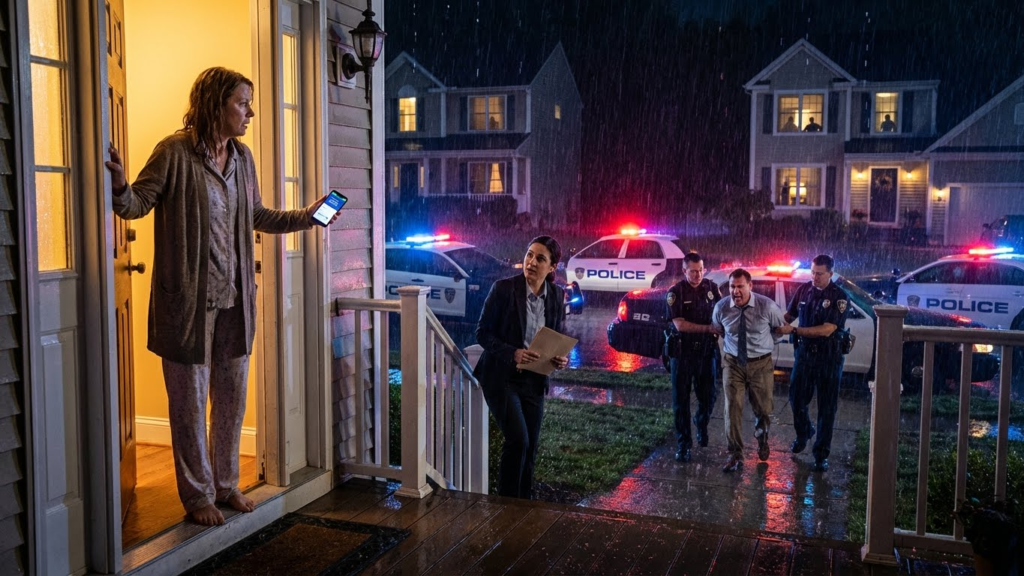
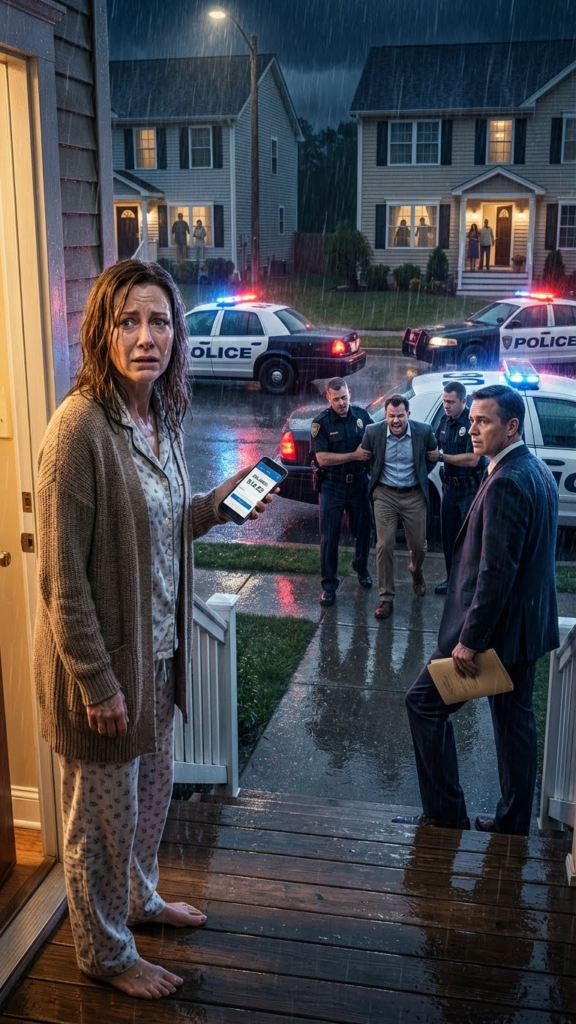
They drove away with Mark in the back seat, his face visible through the rain-streaked window, twisted with an rage I’d never seen before. I stood in the doorway as the taillights disappeared, neighbors still watching, rain soaking through my cardigan, phone clutched in my hand.
With trembling fingers, I pulled up our bank app. The joint checking account we’d maintained for fifteen years. The account Mark had been “building our retirement fund” in. The account he’d told me not to worry about because he “had it handled.”
Current balance: $347.12
There should have been $180,000.
My vision blurred. I refreshed the app, certain I’d made a mistake, certain the app had glitched. The number didn’t change.
$347.12
One hundred and eighty thousand dollars. Gone.
My phone buzzed with a text from an unknown number: “Check your email. You deserve to know the truth. -A concerned neighbor”
I opened my email with hands that wouldn’t stop shaking. Twenty-three video files. All from residential security cameras. All labeled with dates spanning the last eight months. All showing my house, my driveway, my husband.
I clicked on the first one. Dated May 15th, six months ago, timestamp 11:47 PM. Mark’s silver BMW pulling out of our driveway. But I could clearly see a figure in the passenger seat. A woman. Not me.
I clicked on the second video. May 22nd, 10:15 PM. Mark’s car again. Same woman.
June 3rd. June 18th. July 2nd. On and on. Different cameras, different angles, same story. My devoted husband, sneaking out after he thought I was asleep, with a woman I’d never seen before.
I was shaking so violently I almost dropped the phone. But I couldn’t stop. I had to see.
The later videos were different. July 29th showed Mark meeting a man in a parking lot, exchanging what looked like documents and a briefcase. August 12th showed him loading boxes into a storage unit across town. September 5th showed him meeting with three different people in what looked like some kind of transaction.
Whatever I’d thought my husband was doing during his “late conference calls” and “emergency work meetings,” the reality was clearly worse.
Let me take you back fifteen years, because this story doesn’t start with an arrest. It starts with a wedding, a career, and a man I thought I knew.
I met Mark Patterson when I was twenty-six, fresh out of graduate school with a master’s in library science and a job at the local public library. He was twenty-nine, a financial analyst at a mid-sized investment firm, charming and ambitious with a smile that made me feel like I was the only person in the room.
We dated for two years before he proposed. The wedding was perfect—small, elegant, everything I’d dreamed of. Mark’s family was wealthy and connected, and they welcomed me warmly. His father Richard was a successful real estate developer. His mother Patricia threw charity galas. His younger brother James was in law school.
I felt like I’d married into the life I was supposed to have.
Mark and I bought a house in suburban Connecticut—a beautiful colonial with a two-car garage and a yard where we’d someday watch our children play. I kept working at the library. Mark climbed the corporate ladder. We were the picture of suburban success.
Except we never had children. I wanted them. Mark said he wanted them too, but it was never the right time. First he needed to establish his career. Then he was up for a promotion. Then the market was unstable. Then, then, then.
After ten years, I stopped asking.
Around year twelve, things shifted. Mark became distant. He started working late more often. He was always on his phone, always stressed about “work issues” he couldn’t discuss because they were confidential. He stopped planning vacations with me, saying he couldn’t take time off.
When I suggested couples counseling, he laughed. “There’s nothing wrong with our marriage, Rebecca. I’m just busy. This is what it takes to provide the life we have.”
The life we had. Our nice house. Our nice cars. Our nice neighborhood where everyone smiled and no one asked hard questions.
I started noticing other things. Charges on our credit cards I didn’t recognize. Money moving between accounts. When I asked about it, Mark would pat my hand condescendingly and say, “I handle the finances, honey. Don’t worry about it.”
So I stopped worrying. Or rather, I pushed the worry down deep and pretended everything was fine.
Last year, Mark’s father Richard died suddenly of a heart attack. At the funeral, Mark’s mother pulled me aside and said something strange: “Watch him carefully, Rebecca. He’s more like his father than he knows. And Richard always had secrets.”
I’d thought she was just grieving, saying things that didn’t make sense. Now I wondered what she’d been trying to warn me about.
Eight months ago, Mark had come home excited about a “security upgrade”—Ring doorbell cameras, supposedly to make us safer after a string of package thefts in the neighborhood. He’d even helped several neighbors install their own cameras, being unusually helpful and neighborly for someone who usually couldn’t be bothered with community events.
I’d thought it was sweet. Now I realized he’d been mapping the surveillance, figuring out blind spots, planning escape routes.
The “late conference calls” had started around the same time. Mark would close himself in his home office after dinner, sometimes until midnight or later. When I’d knock to ask if he wanted tea or just to say goodnight, he’d wave me away impatiently, the blue glow of multiple monitors reflected in his face.
“Important work, Rebecca. Can’t be disturbed.”
So I’d go to bed alone and wake up to find him already gone to “early meetings.”
Our sex life had dried up completely. When I tried to initiate, Mark would claim he was exhausted, stressed, not in the mood. After enough rejections, I stopped trying.
I’d been lonely in my own marriage for years. I just hadn’t admitted it to myself.
The next morning, I went to the police station with three banker’s boxes full of every financial document I could find in Mark’s home office. Bank statements. Credit card bills. Investment account printouts. Tax returns. And a USB drive with copies of all the Ring camera footage the mysterious neighbor had sent me.
Detective Chen met me in an interview room that smelled like bad coffee and fluorescent lights.
“Thank you for coming in, Mrs. Patterson. I know this must be overwhelming.”
“Just tell me what my husband did,” I said flatly. “And tell me how much of my life has been a lie.”
She opened a thick folder. “Your husband has been running an elaborate fraud scheme for approximately three years. He was stealing money from his employer—a boutique investment firm—and from several of their high-net-worth clients. Total estimated theft: approximately 4.2 million dollars.”
I couldn’t breathe. “Million?”
“He created fake investment accounts, forged signatures, produced fraudulent statements. He’d skim money from real accounts, move it through shell companies, and eventually funnel it into offshore accounts. His employer only caught on six months ago when a client asked about an account that didn’t exist.”
“But Mark doesn’t have access to that kind of—” I stopped. Of course he did. He’d been promoted to senior portfolio manager three years ago. Three years. Right when this started.
“Once we started investigating,” Detective Chen continued, “we realized the scope was much larger than the firm suspected. Your husband wasn’t working alone. He had accomplices. Including a romantic partner.”
There it was. The woman in the car.
“Who is she?”
“Her name is Victoria Lang. She works—worked—at the same firm. She was in on the scheme from the beginning. We believe she was also the one managing the offshore accounts.”
“Were they…?” I couldn’t finish the question.
“Having an affair? Yes. We have evidence suggesting they’ve been involved for at least two years, possibly longer.”
Two years. While I’d been sleeping alone in our bed, thinking he was just stressed about work, he’d been with her.
“The Ring cameras,” I said numbly. “The neighbor who sent me those videos.”
Detective Chen smiled slightly. “That would be Mrs. Harden, three houses down. She’s eighty-two and watches her camera feeds like television. She noticed your husband’s unusual patterns and started keeping records. When she saw the news about fraud investigation at his company, she put two and two together and contacted us. Then she reached out to you.”
Eighty-two-year-old Mrs. Harden, who I’d always thought was just a sweet lady who loved her garden. She’d been running surveillance on my cheating husband for months.
“What about the money? Our money? Is it gone?”
“From your joint accounts? Mostly, yes. He drained them systematically over the past year, probably preparing for an escape. We’re working with federal prosecutors and forensic accountants to trace and recover what we can, but—” She paused. “I won’t lie to you, Mrs. Patterson. Most of it is likely gone or hidden where it will take years to find.”
Years of savings. My inheritance from my parents. The life insurance payout from my grandmother. All gone, stolen by the man who’d promised to love and protect me.
“What happens now?” I asked.
“We have enough evidence to convict him on multiple federal charges. He’s looking at fifteen to twenty years in prison, possibly more. The trial will be public. It won’t be easy for you.”
“I want to testify,” I said immediately.
Detective Chen looked at me carefully. “Against him?”
“I want to tell the court what he did. To me. To our life. I want everyone to know that he didn’t just steal money. He stole fifteen years of my life.”
“That can be arranged.”
Mark’s trial began four months later. The prosecution had built a fortress of evidence: financial records, email communications, video surveillance, testimony from Victoria Lang who’d flipped on him to save herself, and dozens of Ring camera videos showing his late-night activities.
I sat in the courtroom every single day, wearing my best professional clothes, making eye contact with the jury, letting them see the wife who’d been betrayed.
Mark’s defense tried to paint me as complicit, suggesting I must have known, must have been involved. Their theory collapsed when the prosecution showed I’d been systematically cut out of our finances for years, that Mark had moved money, forged my signature on documents, and actively concealed his activities from me.
On the witness stand, I told the truth.
“I believed my husband when he said he was working late. I believed him when he said our finances were secure. I believed him when he said he loved me. Every word was a lie. He stole my money, my time, my trust, and fifteen years of my life. While I was being a faithful wife, he was being a criminal.”
The jury deliberated for six hours.
Guilty on all charges.
At sentencing, the judge gave Mark eighteen years in federal prison. Victoria Lang got twelve years for her cooperation. Mark’s face when the sentence was read—pale, shocked, finally understanding that his charm and connections couldn’t save him—is an image I’ll carry forever.
I’m writing this from my new apartment in a different state, far from Connecticut and the suburban neighborhood where everyone knew me as “Mark Patterson’s wife.” I’m no longer that person.
The financial recovery is ongoing. Federal prosecutors managed to trace and freeze about 1.3 million dollars of the stolen funds. After legal fees and restitution to Mark’s other victims, I received approximately $200,000—a fraction of what was taken, but enough to start over.
I went back to school for a library administration degree. I got a job as director of a small town library that pays better than my old position and actually values my work. I joined a support group for spouses of white-collar criminals and found a community of people who understand what it’s like to discover your entire marriage was a facade.
I started dating again—carefully, slowly, learning to trust my instincts after years of ignoring them.
Mrs. Harden, the neighbor who’d started it all, sends me holiday cards. “Trust your gut and check the cameras,” she wrote in last year’s Christmas card. “Love, your favorite spy.”
Mark writes me letters from prison. Long, rambling things about how sorry he is, how he wants another chance, how if I just wait for him, we can rebuild. I don’t read them anymore. My attorney handles them now, filing them away as evidence in case we need them for the divorce proceedings still grinding through the courts.
Mark’s family tried to reconcile with me—his mother claiming she “always knew something was wrong,” his brother offering to “help with the legal situation.” I declined. They’d known what kind of man Mark was. His mother had tried to warn me at the funeral. They’d all watched him become his father, Richard, who I later learned had also been involved in fraud before he died.
The apple hadn’t fallen far from the tree. And I wasn’t interested in remaining part of that orchard.
The police showed up with a warrant for my “devoted” husband, and the Ring cameras our neighbors never knew they were documenting caught everything. But the truth is, I’d had warning signs for years. I just hadn’t wanted to see them.
The late nights. The distance. The financial secrecy. The sex life that disappeared. The deflection and condescension every time I asked questions. All of it had been there, waving red flags I’d chosen to ignore because acknowledging them would mean admitting my perfect suburban life was a lie.
Here’s what I learned: Devoted husbands don’t need to hide their phones. Loving partners don’t drain joint accounts. Honest people don’t panic when you ask about their day. And marriage isn’t supposed to make you feel lonely in your own home.
I also learned that sometimes your neighbors know more about your life than you do. That eighty-two-year-old women with Ring cameras are better detectives than you’d expect. And that starting over at forty-one isn’t the end of your life—it’s the beginning of the one you deserved all along.
Mark is six years into his eighteen-year sentence. I’m six years into my new life. Only one of us is actually free.
The Ring cameras caught everything. And I’m grateful they did, because the truth—however painful—is always better than living in a beautifully decorated lie.