He had seen many tragedies in his career, but nothing could prepare him—or anyone—for the December morning in 2021 when the sky above a small Tasmanian school fair suddenly turned into a scene that would haunt families forever.
It was the last day of term.
Children laughed, teachers exhaled, parents felt the soft relief of holidays drawing near.
For hundreds of families, Hillcrest Primary School’s end-of-year celebration in Devonport was supposed to be the most ordinary, gentle moment of childhood—sunshine, games, and happy noise floating across the oval.

No one could have imagined that within minutes, six children would lose their lives and three more would be fighting for their future.
No one could have imagined that a gust of wind—one violent, spiralling twist of nature—would change Tasmania forever.
On that morning, a bouncy castle stood on the grass, brightly colored, filled with the excitement that only 11- and 12-year-olds could bring.
Rosemary Anne Gamble, the operator from Taz-Zorb, had set it up the way she understood, following the manual she had downloaded, using the pegs she had been given, believing—truly believing—that everything was safe.
But at 10 meters above ground, all certainty collapses.

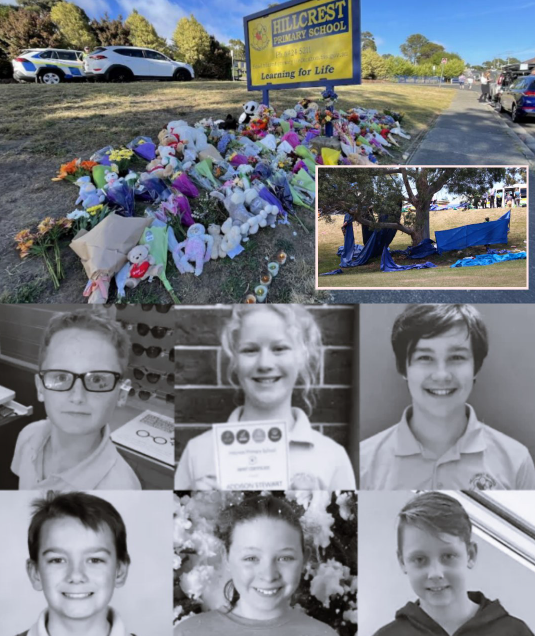
The children—Addison, Zane, Jye, Jalailah, Peter, and Chace—had only climbed in to play.
They were laughing, waiting their turn, trusting the adults around them, trusting the world itself.
Some were talking about Christmas.
Some were talking about holidays.
Some were simply enjoying being young and alive.
And then the wind came.
Witnesses would describe it later as a dust devil—an upward-spiralling vortex powerful enough to rip tents from the earth and hurl debris skyward.
It formed suddenly, violently, without warning, like a fist descending from the sky.
Parents nearby heard the shift in the air before they saw anything.
A strange silence.
Then screams.
Screams so sharp they pierced through everything.

The bouncy castle lifted.
Not inches.
Not a gentle sway.
It tore upward—five children inside—caught in a rising column of wind they had no way to understand or escape.
Teachers ran.
Parents ran.
Some froze in terror.
Some shouted names that would never answer again.
As the inflatable rose and twisted, the blower attached to it broke free.
A child waiting in line—excited, innocent, unaware—was struck in the head by it.
Another life ending in milliseconds.
Ten meters.
Thirty-three feet.
A fall no child could survive.

The castle came down across the school oval like a broken bird.
The children inside were found scattered, still, silent.
The world narrowed into flashing lights, sirens, medics running, parents collapsing onto the grass screaming for God, for help, for a miracle that refused to come.
Tasmania cried that day.
A city of 30,000 felt as though the sun itself had gone out.
News spread around Australia like a nation holding its breath.
There were vigils.
Flowers.
Candles.
Six small faces that no one would ever forget.
And there was grief—deep, clawing, unrelenting grief.

For the families left behind, the days that followed were not days at all.
They were fragments of time, broken and unbearable.
Christmas trees suddenly looked wrong.
Empty bedrooms felt colder.
Schoolbags still sat where children had last dropped them.
Parents moved through their homes like ghosts, unsure how to breathe in a world where their child no longer existed.

In the months that followed, questions rose like smoke.
How?
Why?
Could it have been prevented?
Someone must be responsible.
Someone must be held accountable.
Nearly two years later, in November 2023, the operator—Rosemary Gamble—was charged.
Families felt it as hope.
Not hope for healing.
That was impossible.
But hope for answers.
Hope for acknowledgment.
Hope that someone, somewhere, would say the words every grieving parent longs for:
“Your child mattered. Your pain matters. This should never have happened.”

The case went to court.
Prosecutors claimed the castle had not been anchored adequately—that four pegs were used when eight were recommended.
The parents listened with trembling hands, believing for a moment that maybe this was the path to justice.
But the defence presented evidence that complicated everything.
The Chinese manufacturer, they said, had provided no instructions.
They supplied only four pegs.
The rest had been improvised by Gamble using a short online manual.
She had done what she believed was right—what she believed was enough.

And above all, expert after expert spoke of the weather itself.
A dust devil.
Powerful.
Unpredictable.
Unprecedented.
A force no one could foresee, no matter how carefully they prepared.
In March 2025, the courtroom held its breath as Magistrate Robert Webster delivered his verdict.
He did not read the full findings aloud—only the final truth:
“The charge is not proven.
It is dismissed.
Ms Gamble, you are free to go.”

Gasps broke through the room.
Crying.
Shaking.
Disbelief so heavy it felt like the walls themselves were grieving.
For Andrew Dodt, father of 12-year-old Peter, the words were like knives.
“All I wanted,” he said later, his voice fractured, “was an apology for my son not coming home.
And I’m never going to get it.
And that kills me.”
Other parents echoed the same pain—an ache without edges, impossible to contain.

Rosemary, through her lawyer, gave a statement:
“I am a mother.
I can only imagine the pain that other parents live with every day.
Their loss is something I will carry with me for the rest of my life.”
But for the parents of Addision, Zane, Jye, Jalailah, Peter, and Chace, imagination is nothing compared to reality.
They live with a silence that will never lift.
They live with birthdays that will never be celebrated.
They live with empty chairs at the dinner table.
They live with regrets, memories, and a grief that feels endless.

Devonport continues to mourn them.
Schoolmates grew older while six children remain forever 11 and 12.
Teachers still pause at playgrounds, remembering the laughter that once echoed across the grass.
The oval where the tragedy happened is a place no one walks across without feeling a weight in the air.
The inquest remains paused.
A class action continues.
Families still fight—not for revenge, but for recognition, for change, for something to ensure no other child rises into the air and falls from the sky on a day meant for joy.

The story of the Hillcrest tragedy is not one of villains and heroes.
It is a story of nature’s cruelty, human vulnerability, and grief too large for words.
A story where everyone lost something—families lost children, a community lost innocence, an operator lost peace, and a nation lost its sense that such things could never happen here.
And yet, the story endures because love endures.
Because remembrance endures.
Because six names—Addison, Zane, Jye, Jalailah, Peter, Chace—continue to echo gently across Tasmania like soft voices carried by the wind.
They were children.
They were joy.
They were loved more than words can ever hold.
And they will never be forgotten.