The Night the Sky Caught Fire
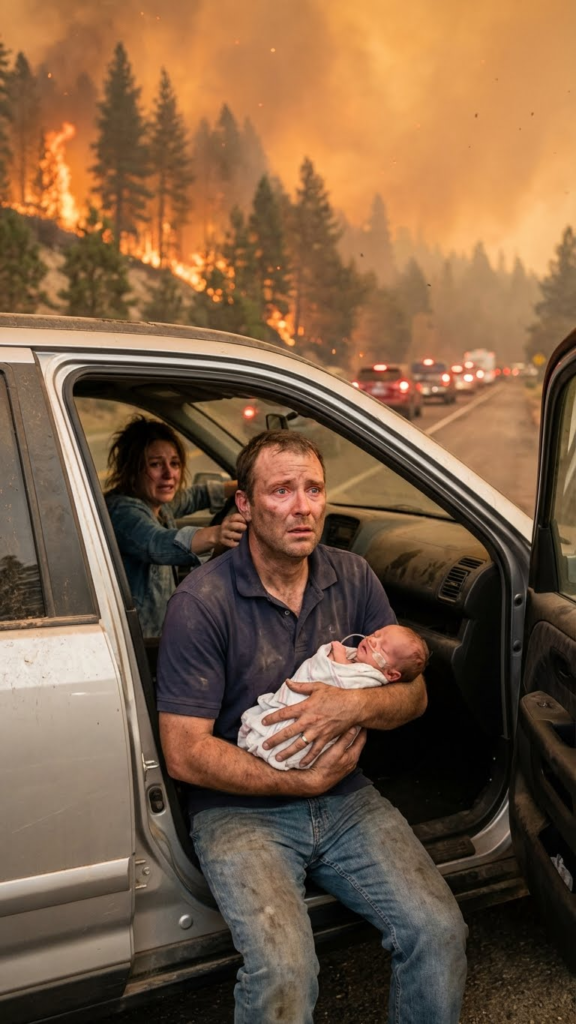
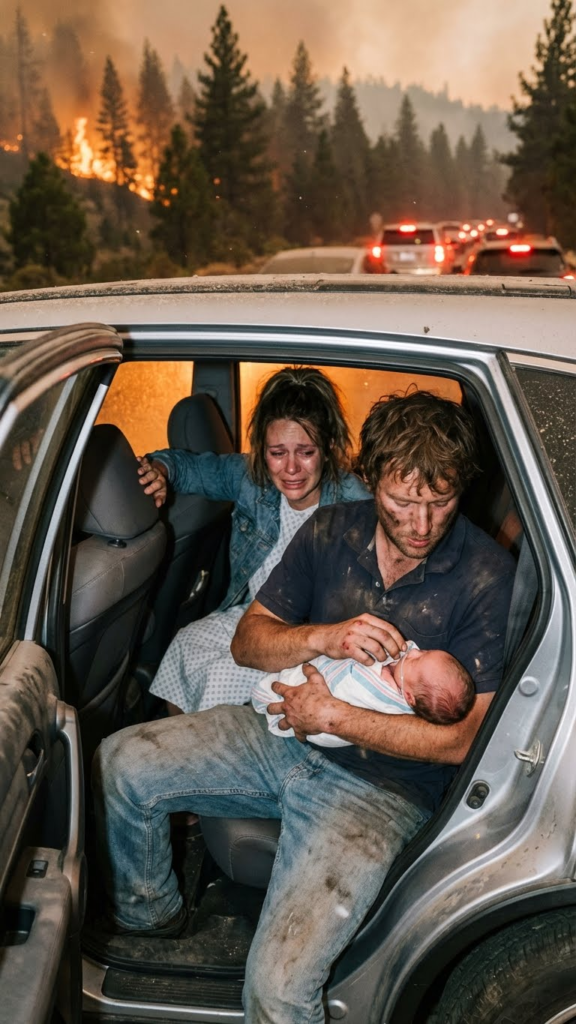
A newborn baby screamed in my arms while the world outside our car glowed the color of hell.
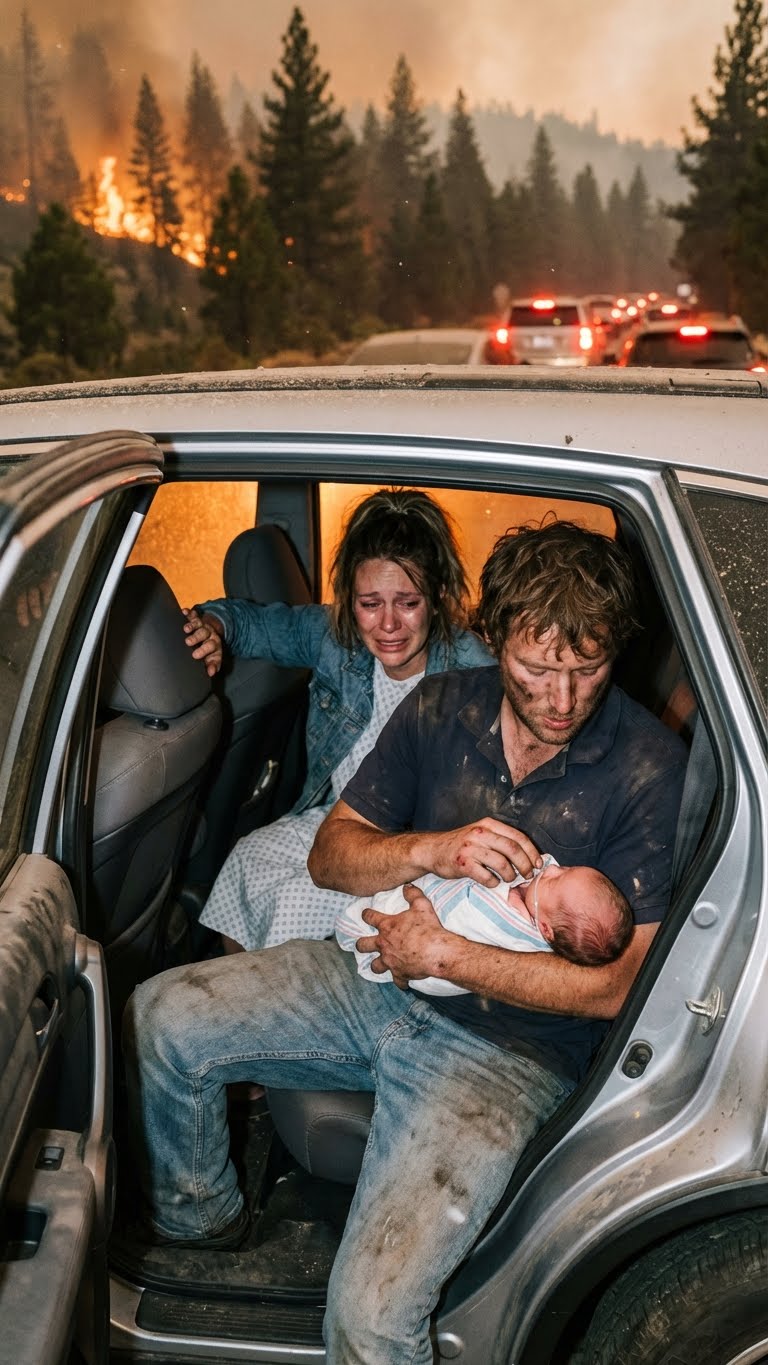
The sky wasn’t black anymore—it was orange, an angry, shifting orange that turned the smoke into a living thing. Ash floated like gray snow, clinging to the windshield and the wipers that had long since given up. The highway we were on, the one the sheriff’s deputy had confidently called “the safest route out,” had turned into a graveyard of cars—bumper-to-bumper, horns blaring, people leaning out of windows to scream at each other, at the sky, at no one.
In the backseat, my daughter was dying.
“She’s turning blue, Ethan!” my wife, Hannah, sobbed, her voice shattering in the thickening smoke. “She can’t breathe, she can’t—oh my God—”
I twisted in the driver’s seat and saw our three-day-old baby—our too-early, too-small, still-fragile daughter, Lily—thrashing weakly in her car seat. Her chest heaved in tiny, desperate gulps. Her lips had gone from pink to purple. Her eyes, those cloudy newborn eyes that had barely had time to learn what light was, rolled back for a second.
The inside of the car smelled like melting plastic and fear. The A/C had died ten minutes earlier when the engine overheated from idling too long. Sweat ran down my back in rivers. The heat was coming not just from outside, but from below, radiating up through the floorboards from the burning hillside.
“We have to turn around,” Hannah gasped, clawing at her seat belt as if she could climb out of the car with her bare hands and outrun the fire. “We have to go back to the hospital—”
“There is no hospital to go back to!” I shouted, the words ripping out of my throat like shrapnel. “They evacuated, remember? They were already packing up when we left. You saw the flames. There’s nothing left.”
Just thirty minutes earlier, a nurse had wheeled us through a corridor thick with tension and half-packed supply carts. The NICU alarms had been silent, the incubators already empty, the staff moving with that frantic, focused fear that only shows up when the worst-case scenario stops being hypothetical.
“First-time parents?” one nurse had asked, trying for a smile as she tucked a blanket tighter around Lily’s too-thin legs.
“Yeah,” I had said, trying to sound like my chest wasn’t a collapsing building. “You can probably tell.”
She’d squeezed my arm. “You’re doing great, Dad. Get her somewhere safe, okay?”
Somewhere safe. As if such a place still existed.
Now, trapped on an unmoving highway with flames racing along the hills like they were fueled by pure hate, I watched my daughter’s tiny mouth open in a soundless cry. Then even that stopped.
Her head slumped to the side.
“Hannah,” I whispered, my voice suddenly hollow. “She’s not—”
“NO.” Hannah’s scream was louder than the sirens in the distance. She ripped off her seat belt, hands shaking so badly she almost couldn’t unclip Lily’s. She scooped our daughter up, cradling her to her chest, fingers pressing desperately against that feather-light ribcage.
“Come on, baby,” she begged, rocking her. “Breathe. Breathe for Mommy. Please, Lily. Please—”
No sound. No movement.
The traffic stayed frozen. A man two cars ahead stepped out, looked up at the ridge, and started to pray out loud. Somewhere, a dog barked hysterically from the back of a truck. A tree to our right ignited all at once, the bark bursting into sparks like a firework turned inside out.
My phone buzzed. Another evacuation alert.
IMMEDIATE DANGER. SHELTER IN PLACE IF ESCAPE NOT POSSIBLE. LIE LOW, COVER NOSE/MOUTH, AWAIT RESCUE.
Rescue from where? From who?
In that suffocating, impossible moment, a thought slammed into me so hard I almost gagged.
There was one building out here that wouldn’t burn. One place the fire would hate more than anything. One place they’d always told us never to go unless we had permission.
The old hydro tunnel.
I grabbed Hannah’s wrist.
“Get in the back,” I said hoarsely. “Hold her. Don’t open the doors until I tell you.”
“Ethan, what are you—”
“I have one shot at getting her air.” My voice surprised both of us—it sounded calm, even as my hands trembled so hard the keys jingled. “You trust me?”
She looked from Lily’s limp body to my face. In that second, whatever was left of our arguments, our resentments, our half-spoken threats from the past year, all of it burned away.
“I trust you,” she whispered.
Before the Fire
To understand why that moment on the highway mattered, you need to know what came before it—the quiet war that was already burning inside our house long before the hills did.
Hannah and I were not the fairy-tale couple our Instagram made us look like. On screen, we were “that” outdoorsy pair: matching hiking gear, filtered sunsets, captions about gratitude and mental health. We lived in a small Northern California town that tourists visited for wineries and redwoods. Our followers saw only the curated version—two people on top of mountains, not two people fighting in parking lots about bills and fertility treatments.
We met six years ago at a wildfire relief fundraiser, ironically. I was volunteering on logistics; she was there with a camera, doing a freelance piece on “communities rebuilding after disaster.” She interviewed me. I stumbled through answers and fell in love with the way she frowned when she was concentrating.
From day one, we were surrounded by fire stories. Her older sister, Maddie, had lost her home in the big blaze five years earlier. My uncle had been a volunteer firefighter; he died of a heart attack on the line when I was in college. We both lived with that weird, Californian double-think: wildfires are inevitable, but they always happen to someone else.
Our relationship looked perfect from the outside, but the cracks started early.
- Hannah wanted kids immediately. I wanted to wait until we were more stable financially.
- She wanted to keep building her following as a “lifestyle content creator,” which meant every moment was potentially content. I wanted some parts of our life to stay just ours.
- And under it all was her family.
Hannah’s parents survived the fire that took Maddie’s house, but it took something else from them too—their sense of safety, their patience, their ability to be kind. Where my parents told stories about “your uncle the hero,” hers told stories about “the county that failed us,” “neighbors who didn’t help,” “people who care more about trees than families.”
They judged everything.
“Still renting?” her dad would say, looking around our townhouse with a grimace. “You know interest rates are going up, right?”
“Still working retail?” her mom would sigh when Hannah talked about freelancing again. “Content isn’t a real job, sweetheart.”
When we found out we were pregnant, it wasn’t the pure joy I’d imagined. It was a storm. A messy, loud storm of:
- Relief (Two years of trying. Two miscarriages. A near breakup.)
- Terror (Money was tight. The town was drier than ever. Sirens had become background noise.)
- Pressure (Her parents immediately started sending us listings for “proper family homes” in their neighborhood, like that would fix everything.)
We finally found a compromise house: a little place just outside town, up against the canyon. Cheap because of its location. Beautiful because of the view. Risky because of the fuel—dry grass, old pines, and a canyon that channeled wind like a loaded gun.
I hesitated. Hannah didn’t.
“If anything happens,” she said, “we leave early. We’ll be smart. We’re not like those people on the news who wait.”
We signed anyway.
The Family Secret
The hydro tunnel was part of why we justified it.
Ten minutes from our house, carved straight into the canyon wall, an old concrete tunnel diverted water from the river to the tiny hydro plant that powered half our town. When we first moved in, I’d go running down there, listening to the roar of the water and the echo of my footsteps.
One night at dinner, my uncle’s old friend, Ray—a retired firefighter who’d become the unofficial town historian—told us something over beers.
“You know that tunnel?” he said. “We used it as a shelter back in ’97. Fire came down that canyon like a freight train. We put twenty people in there. Concrete, water on one side, nothing much to burn. Didn’t lose a single one.”
Hannah’s eyes lit up. “So it’s like… a secret bunker?”
Ray shook his head. “Don’t go romanticizing it, kid. It’s dangerous. Slippery. No ventilation to speak of. Officially, they don’t let anyone near it now. Liability and all that. But if it’s concrete against open air?” He shrugged. “Concrete wins.”
The county put up fencing. “No Trespassing” signs. Rumors spread anyway. Parents joked about “the tunnel” as a last resort. Kids dared each other to sneak down there at night.
Hannah made me promise we’d never actually use it.
“That’s not a plan,” she said. “That’s a horror movie. We leave early. We don’t get stuck.”
We both believed that… until the day we didn’t.
The Day Everything Ignited
The fire started on a Tuesday.
Lightning strike, they said later. No one saw it at first. By the time someone did, it was already racing through the brush.
I was at the store, buying more preemie diapers because Lily was smaller than the newborn size expected. Hannah was at the hospital with her, recovering from an emergency C-section three days earlier.
We’d barely had time to argue about anything since Lily was born. We’d been too busy being terrified.
Her lungs were underdeveloped. She needed oxygen support her first two days. Every beep from the monitors made my heart seize. On the third morning, the doctor said the words we’d been praying for: “She’s stable. You can probably take her home later today if this keeps up.”
When the first evacuation alert pinged my phone, it didn’t feel real.
WILDFIRE APPROACHING — BE READY TO LEAVE.
I looked out the store windows. Blue sky. Light breeze. People pushing carts like always.
By the time I reached our driveway, the sky had turned yellow. An ash flake landed on my arm and didn’t melt; it was a piece of someone’s roof.
I called Hannah. “I’m coming to the hospital. We’re not waiting for discharge papers. We’re leaving now.”
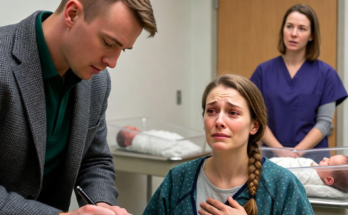
The nurse didn’t argue. When fire sirens get that constant, hospital protocol changes. They yanked Lily’s monitors off, signed a few pages, and practically shoved us toward the exit with a portable oxygen tank.
Outside, the wind had teeth. Hot, weirdly strong, moving in a way that felt wrong. I strapped Lily into her car seat, then stood there for an extra second, staring at her. She was so small. So breakable.
“We’re okay,” I lied. “We’re getting out.”
But roads funnel panic. We weren’t the only ones who had decided to flee at exactly the same time.
We turned onto the main evacuation route and went ten yards before stopping. Ahead of us was an endless line of red brake lights. Behind us, more cars poured in, boxing us in.
The first flames crested the far ridge twenty minutes later.
One Desperate Chance
Which brings us back to the car. The heat. The ash. My baby’s chest not moving.
“I trust you,” Hannah said—and she meant it in a way she hadn’t in months.
In that instant, the hydro tunnel stopped being a rumor.
It became the only idea I had left.
I snapped into motion.
I threw the car into park, yanked up the emergency brake, and bolted out into the heavy, burnt air. Shouts erupted around me. Someone leaned on their horn like it was my fault the road wasn’t moving.
I ran to the trunk, flung it open, and grabbed the emergency kit I’d put together months earlier after one of our bigger fights. Hannah had rolled her eyes when I’d insisted we keep it in the car.
“What do you think you are, a firefighter?” she’d muttered.
No. Just a man who lost an uncle and didn’t want to lose anything else.
I pulled out:
- Two N95 masks
- A thin wool blanket
- A pair of goggles
- An old fire shelter my uncle’s friend had given me “as a joke,” the kind they use as last-resort protection on the line
I ripped the passenger door open.
“Put this on her,” I told Hannah, shoving one of the tiny masks toward her. “Not perfect, but it’s something. Then get in the back. On the floor. Hold her under the blanket.”
“Where are you going?” Her eyes were wild.
“To move this car,” I said. “We’re not staying here.”
Traffic law died the moment the fire crowned the ridge. I slammed the car into reverse, jostling the bumper behind us with a thud. The driver leaned out and cursed at me until he saw the baby in Hannah’s arms. His face crumpled; he waved me on.
I edged the car onto the shoulder, tires bouncing over dirt and rocks. People shouted. Someone tried to block me with their truck, but then the air shifted, and the wall of fire on the hillside roared louder, stealing everyone’s attention.
The access road to the hydro tunnel turned off a quarter mile up—unmarked, barely more than a fire road. I floored it, praying the engine held together. The temperature gauge flirted with the red.
We hit the turn at a skid and bounced up the narrow path. Branches scraped the sides. The fire was on the opposite side of the canyon for the moment, but the wind was pushing embers toward us like glowing dandelion seeds.
Hannah coughed in the back, hunched over Lily, who still hadn’t made a sound.
“I can’t feel her—” she choked. “I don’t know if—Ethan, hurry—”
The fence around the hydro access road appeared through the smoke like a ghost—tall chain-link, locked gate, bright red NO TRESPASSING sign.
I didn’t slow down.
The car hit the gate with a crunch that felt like a car crash and a bad decision colliding. The lock held; the hinges didn’t. The whole structure folded inward enough for me to shove the car through, metal squealing against paint.
We jolted forward, scraping along the frame, then broke free inside the facility road.
Ahead, carved into the canyon wall, was the mouth of the tunnel. A dark, gaping rectangle of concrete, water roaring somewhere deep within it.
The air here was slightly cooler. Not safe—but less murderous.
I threw the car into park, killed the engine, and lunged into the backseat.
Lily’s body was terrifyingly still. Her skin was mottled, lips grayish-blue. The tiny N95 mask looked absurd on her face—a piece of adult panic on a newborn.
My hands shook as I ripped it off.
“Give her to me,” I said.
Hannah hesitated. For a second, I saw every fight we’d had—every “you’re not listening,” every “you don’t care,” every slammed door—flash behind her eyes.
Then she handed me our daughter.
We wrapped her in the wool blanket. I slung the fire shelter over my shoulder, grabbed one mask for myself and one for Hannah, and we ran toward the tunnel.
The concrete radiated coolness. Inside, the roar of diverted water drowned out the sound of the fire above us. It felt like stepping into the throat of some ancient beast.
Five steps in, the light from outside turned the smoke into shifting beams. Ten steps in, it was almost dark. The air was damp, mineral-heavy, and most importantly—less choked with ash.
We pressed ourselves against the wall, Hannah clinging to my arm.
“Here,” I panted. “Here. We stay low. We wait it out. She can breathe here. She has to.”
I laid Lily across my forearm and started CPR the way the NICU nurse had taught us in case of apnea episodes—two fingers, gentle compressions, then tiny puffs of air into her mouth and nose.
“One, two, breathe. One, two, breathe.”
Hannah sobbed into her mask. “Please don’t die, baby. Please. Please.”
The fire outside screamed. The tunnel shook with the concussive thumps of trees exploding. Somewhere above us, something metal warped with a horrifying screech.
“One, two, breathe.”
Nothing.
“One, two, breathe.”
Still nothing.
The concrete under my knees felt like an altar.
Then, on the seventh cycle, she shuddered.
Her tiny chest hitched, once, twice. A wet, fragile sound tore out of her throat—the weakest cry I’d ever heard, but it was a sound.
Hannah let out a noise that was half laughter, half scream.
“She’s breathing,” I choked. “She’s—do you hear that? She’s breathing.”
We stayed like that for what felt like hours—pressed against the wall of the tunnel, breathing through masks, holding our daughter between us like a shared heartbeat while fire turned the world outside into a memory.
When the Smoke Cleared
They found us because of a drone.
The county had started using them after the last big fire, sending them over canyons to look for hot spots and survivors. One of the operators saw the twisted gate, the car, and—miraculously—two heat signatures inside the tunnel.
A strike team hiked in hours later, faces black with soot, voices hoarse.
“You picked the one damn place out here that doesn’t burn,” one firefighter said, shaking his head as they loaded us onto stretchers. “Idiots would call that luck. I call it desperation plus local knowledge.”
At the hospital two towns over, they put Lily back on oxygen. A pediatric pulmonologist told us quietly, “If you’d stayed on that highway another twenty minutes, she likely wouldn’t have made it.”
He paused. “If you’d stayed in the tunnel longer, you might not have made it either. Low oxygen, toxic gases. It was… a risky call.”
“Was it the right one?” I asked.
He looked through the NICU glass at our daughter, who was now pinker, flailing weakly at the tubes in her nose.
“She’s here,” he said. “So I’d say yes.”
The Fire Behind Us, the Fire Between Us
The wildfire destroyed 312 homes, including ours. When we drove back weeks later to see what was left, there was nothing recognizable… except the concrete mouth of the hydro tunnel, blackened on the outside, cool and gray within.
News outlets picked up our story. “Parents Hide in Forbidden Hydro Tunnel to Save Newborn From Wildfire.”
Internet commenters split into camps:
- “Heroes.”
- “Idiots who should be arrested for trespassing and child endangerment.”
- “Climate change martyrs.”
Hannah’s following exploded. Brands reached out. Interviews. Podcasts. People loved the idea of a “fire family” who had stared down the flames and won.
But inside our rental apartment—one beige room at her parents’ house—that wasn’t the story we were living.
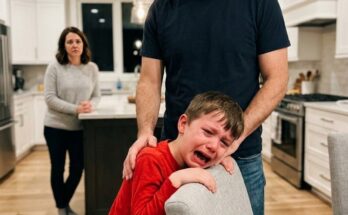
Her parents were furious we’d gone to the tunnel. “You almost killed our granddaughter with that stunt,” her father hissed one night.
“Your son-in-law saved her life,” I shot back.
“We don’t know that,” her mother said coldly. “All we know is you trespassed and put them both at risk.”
Under their roof, I was the reckless one. The unstable one. The man who had cost their daughter her home, her things, her calm life.
They never mentioned that it was their pressure that pushed us into that canyon house in the first place.
Hannah started telling the story differently on camera than she did off.
Online, she’d say: “We made this crazy, brave choice together. My husband thought of the tunnel. He saved us.”
Offline, after the baby went down and the camera was off, she’d say: “You could have killed us. I still have nightmares about not waking up down there.”
We fought. We made up. We fought again.
Our marriage had already been brittle; the fire turned it into glass—beautiful in the spotlight, dangerously easy to shatter.
The revenge in this story isn’t against an ex or a cheating spouse. It’s against something bigger: a system, a mindset, a world that kept pretending wildfires were freak events instead of annual seasons. But there was a more personal revenge too—something quieter, more deliberate.
It started the day her parents tried to tell me I wasn’t allowed to talk to the reporter.
The Real Confrontation
A national outlet wanted to do a long-form piece. “The New Face of Wildfire Families.” They wanted both parents’ perspectives. They wanted to ask about the tunnel, about the decision, about what we’d learned.
At the kitchen table, Hannah’s father slid a folder toward me.
“What’s this?” I asked.
“A media agreement,” he said. “Hannah will be the primary spokesperson. You’ll keep details about the tunnel to a minimum. We don’t want you glorifying that decision.”
I flipped through it. Legalese. Limits. Control.
“You want me,” I said slowly, “to sign a contract saying I won’t mention that the one thing that saved your granddaughter’s life was the thing you’re now ashamed of.”
His jaw tightened. “I want you to stop acting like a hero when you made a reckless choice. The story works better with Hannah as the focus. Brands like a strong mother narrative.”
There it was. The truth.
They didn’t just want to control the risk. They wanted to control the narrative.
“All due respect,” I said, “you weren’t there. You were sitting in your living room watching the fire maps while your daughter and your granddaughter were choking in a car. I made the best call I could with what I had. And it worked.”
He glared at me like I’d spit on the flag.
“You’re emotional,” he said. “You’re not thinking clearly. Sign it.”
I didn’t yell. I didn’t flip the table. I just slid the folder back.
“No,” I said. “I won’t sign away my right to tell the truth about how my daughter survived. If that costs us sponsorships or interview slots, so be it.”
Hannah watched us like someone watching a tennis match. For once, she didn’t jump in.
That night, she sat next to me on the floor of the room we were sharing with a bassinet and two suitcases.
“You really won’t sign?” she asked quietly.
“No.”
“Even if it makes things… harder?”
“They’re already hard,” I said. “At least let them be honest.”
She was quiet for a long time.
Then she said, “Okay. Then we tell it our way.”
Justice, in Our Own Words
We moved out a month later. It was messy. There were accusations, slammed doors, a thrown mug. But we left. We rented a tiny apartment above a closed-down bookstore, far from the canyon.
The article came out. It told the whole story—not just of two “brave parents,” but of a town that had underfunded fire prevention, a county that had “suggested” people buy in risky zones without mandatory disclosures, a power company that had ignored outdated lines.
Our hydro tunnel moment became part of a larger indictment—a symbol of families forced to make impossible choices because the systems meant to protect them had failed.
The county supervisor called me “dramatic” on local radio. The fire chief, off the record, shook my hand and said, “You scared the hell out of me with that tunnel move. But you also scared the hell out of some people who needed it.”
Investigations were opened. Building codes changed. A mandatory disclosure law passed for high-risk fire zones in our county. The hydro facility got a new policy: in declared emergencies, the tunnel would be opened and staffed as an official last-resort shelter, with proper monitoring.
That was the revenge: not a dramatic courtroom takedown, but a slow, grinding shift that meant fewer parents would face the choice we did.
At home, the fire between Hannah and me cooled, too—not all at once, but slowly, through late-night talks and therapy and the daily act of watching our daughter’s chest rise and fall while she slept.
We still argued. We still resented. Trauma doesn’t disappear because a law passes or because a magazine calls you “inspiring.” But every time I thought about walking away, I’d remember the tunnel—the way she had said “I trust you” when trust was the most dangerous and necessary thing in the world.
Lily turned one on a day that smelled like rain instead of smoke. She smashed cake in her hair and tried to bite the candle. We laughed until we cried.
Later that night, after everyone left, Hannah curled into my side on the couch.
“You know,” she said, “sometimes I hate that tunnel.”
“Me too,” I admitted. “But?”
“But I hate to think about the version of us that never went there.” She swallowed. “The version that stayed in that car.”
We sat in silence, listening to Lily snore through the baby monitor.
“We did something insane,” she whispered. “And we got her out. That has to count for something, right?”
“It does,” I said. “It counts for everything.”
The Ending We Chose
People still ask us, whenever another fire burns on the news, “Would you do it again?”
Would we drive up that access road, smash that gate, run into that forbidden concrete throat with our child in our arms?
The honest answer is cruel and simple.
We should never have had to.
But when the world outside your car glows the color of hell, when the air your baby is breathing turns to poison, when every official route has turned into a trap and the sirens are just a soundtrack to collapse, you find out who you really are.
We were desperate. We were terrified. We were reckless.
And somehow, that was enough to save her.
Lily will grow up hearing this story—not the internet’s version, not her grandparents’ edited cut, but ours. She’ll know that when everything burned, her parents did the wrong thing in exactly the right moment. She’ll know that her life forced a town, a county, maybe even a state to look at its fires differently.
Someday, when she’s old enough, we’ll take her back to the canyon. Not to worship it, but to warn her.
We’ll point to the blackened concrete arch and say, “That place almost killed us. And it saved you. Both can be true.”
And then we’ll drive home—early, before the wind shifts, before the sky changes color. Because the real revenge, the real victory, is not having to be heroes ever again.