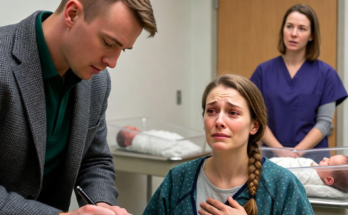
The Night Everything Changed
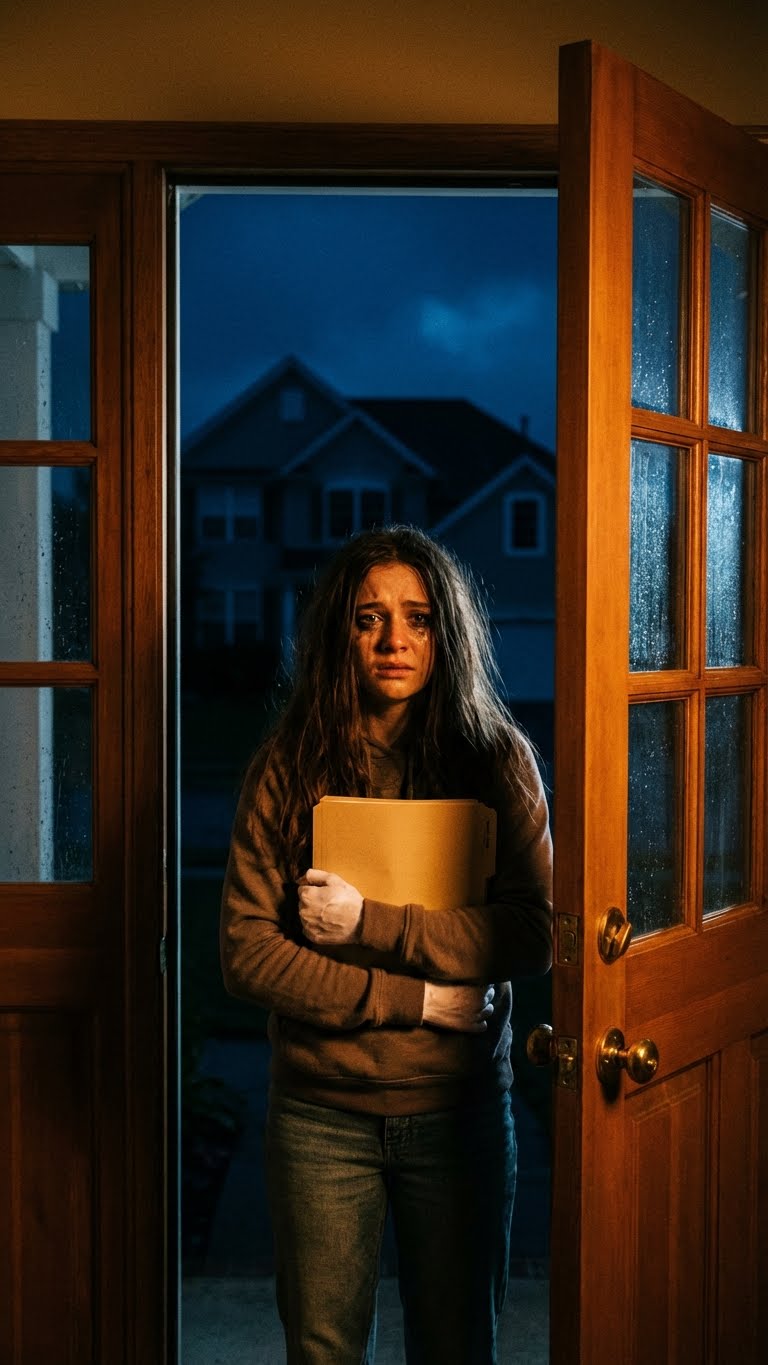
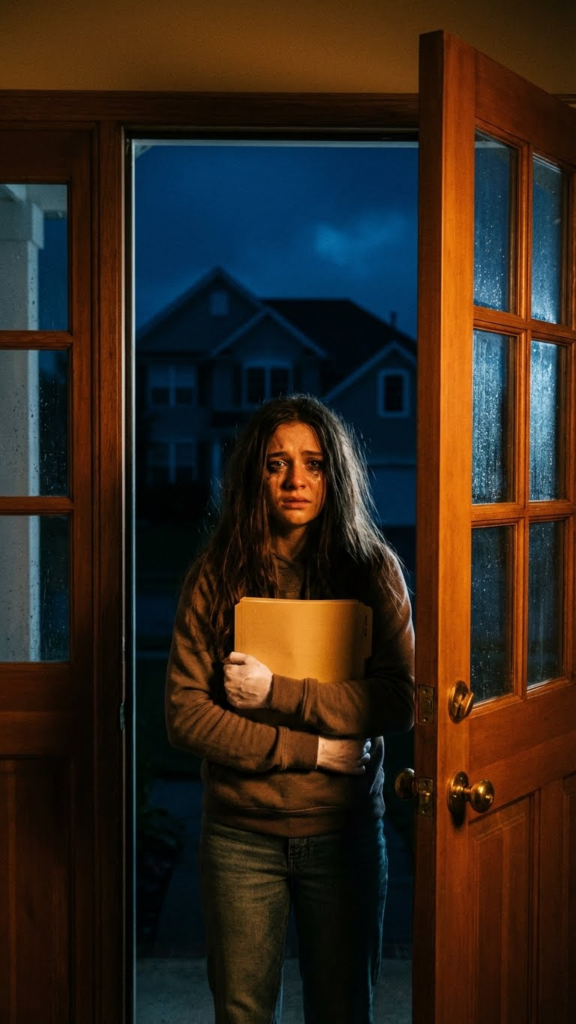
Standing in my doorway at midnight in nothing but my pajamas, I stared at Emma Turner—the perfect daughter of the perfect family next door. She was sixteen, shaking like a leaf, mascara streaking down her face, holding a manila folder so tightly her knuckles had gone white.
“Please,” she whispered, glancing back at her house where every light was off. “I need you to see this before they wake up.”
I’ve lived next to the Turners for three years. David and Sarah Turner are the neighborhood golden couple—the ones who host block parties, whose Christmas lights make our street look like a Hallmark movie, whose marriage counselor friends always joke they should be teaching the classes instead. Their daughter Emma seemed just as perfect: honor roll, tennis team captain, always polite when she’d help me carry groceries. But the girl standing on my porch right now looked nothing like that perfect image.
“Emma, it’s midnight. Does your mom know you’re—”
“They’re not my parents,” she cut me off, her voice cracking. “I found proof. Real proof. And I think… I think they might have done something terrible.”
My blood ran cold as she opened the folder with trembling hands. Inside were photocopies of documents, photographs, news clippings. One photo in particular caught my eye—a little girl who looked exactly like Emma, standing next to a couple who definitely weren’t David and Sarah Turner.
“I found these hidden in a lockbox in their closet,” Emma explained, tears streaming faster. “That little girl is me. Those people are my real parents. And there’s a news article about them. From fifteen years ago. They…” she could barely get the words out, “they disappeared. Both of them. The case was never solved.”
I looked past her at the perfect Tudor-style house with its perfect landscaping and perfect white picket fence. The house where I’d had dinner. Where I’d celebrated birthdays. Where Sarah Turner always made me feel so welcome with her warm smile and homemade cookies.
“Emma, are you absolutely sure about this?”
“There’s more.” She pulled out another document. “This is my birth certificate. My real one. It says my name is Lily Matthews. Not Emma Turner. They changed everything.”
She handed me a faded newspaper clipping. The headline made my stomach drop: “Young Couple Vanishes Without a Trace – Three-Year-Old Daughter Missing.” The photo showed the same couple. Below it: “Robert and Jennifer Matthews were last seen…”
Then Emma pulled out a sealed envelope from the bottom of the folder. “I found this tonight. It’s addressed to Lily. That’s me. My real name.” Her hands were shaking so badly she could barely hold it. “Once we open this, everything is going to explode.”
The Letter That Changed Everything
I invited Emma inside and locked the door behind us. We sat at my kitchen table under the harsh fluorescent light, that envelope between us like a ticking bomb. Emma’s hands hovered over it, trembling.
“What if it’s something horrible?” she whispered. “What if my real parents were criminals? What if that’s why the Turners took me?”
“Or what if they loved you and were taken from you,” I said softly. “Either way, you deserve to know the truth.”
She nodded and carefully opened the envelope. Inside was a handwritten letter, the ink slightly faded but still legible. Emma’s voice shook as she began to read aloud:
“My dearest Lily, if you’re reading this, it means you’ve found the truth. You were three years old when they took you from us. Your father and I fought so hard to get you back, but they had money, connections, power—things we didn’t have. We were just teachers. We couldn’t compete with what they could offer you, or so the courts would have believed if we’d ever made it that far…”
Emma’s voice broke. I took the letter and continued reading:
“Sarah Turner—or Sarah Blackwell as she was known then—was my college roommate. She and David tried for years to have a child. When their last IVF attempt failed, something in Sarah broke. She became obsessed with you, Lily. She would come to our house and hold you for hours, and I thought she just needed comfort from a friend. I never imagined… We trusted her. That was our mistake. The weekend you disappeared, Sarah had offered to babysit while your father and I attended a work conference. When we came back, our house was empty. Sarah was gone. You were gone. All your clothes, your toys, your pictures—everything was gone. We called the police immediately, but Sarah had been planning this for months. She had new identities ready, new documents, a whole new life set up in a different state. By the time the police took us seriously, you had vanished. The investigation went cold. They suspected we had done something to you and were making up the kidnapping story. For two years, we searched for you. We hired private investigators who drained our savings. Your father developed severe anxiety and depression. I wasn’t much better. Then, one night, we got a call from someone claiming to have information about you. They said to meet them at a warehouse outside the city. We went. We had no choice—it was the first real lead we’d had in months. That’s the last thing I remember clearly. I woke up in the hospital three days later. Your father never woke up at all. They said it was a robbery gone wrong, but I know better. Someone wanted us silenced. Someone with enough power to make it look like an accident.”
I stopped reading, my hands shaking. Emma was crying silently, tears dripping onto the table.
The letter continued:
“I’m dying, Lily. The attack left me with injuries that never fully healed. I’m writing this from my hospital bed, and I don’t have much time left. I’ve hidden copies of all the evidence in a safety deposit box. The key is taped inside your original baby book, which should be in the same lockbox where you found this letter. Box number 847 at First National Bank, 2250 Riverside Drive, Chicago. The passcode is your birthday: 030609. Inside, you’ll find everything—proof of the kidnapping, Sarah’s planning documents, witness statements, everything the police refused to investigate properly. I also included a video recording I made, explaining everything in detail, in case this letter isn’t enough. You have a grandmother who never stopped looking for you. Her name is Patricia Matthews, and the last I knew, she still lived in Riverside, Illinois. I’m so sorry I couldn’t protect you. I’m sorry you grew up not knowing how much you were loved, how much we fought for you. I hope the Turners gave you a good life, even if it was built on lies and broken hearts. I hope you can forgive me for not being strong enough to save you. All my love, forever and always, Your mother, Jennifer Matthews.”
The silence in my kitchen was deafening. Emma sat frozen, the letter clutched in her hands, her entire world shattered in the space of two handwritten pages.
“She died thinking she failed me,” Emma finally whispered. “My real mother died believing she couldn’t save me.”
The Decision
“We need to call the police,” I said, reaching for my phone.
“Wait.” Emma grabbed my wrist. “If we call now, what happens? They arrest Sarah and David in the middle of the night, I get taken into protective custody, and then what? I’m thrust into some system, or sent to live with a grandmother I’ve never met? I need… I need time to process this. I need to understand who I really am before everything explodes.”
“Emma—Lily—whoever you are right now, if what this letter says is true, the people sleeping next door murdered your father and almost killed your mother. They’ve been lying to you for thirteen years. Every single day has been a lie.”
“I know,” she said, her voice steadier now. “But I’ve also lived with them for thirteen years. They raised me. Sarah taught me to ride a bike. David helped me with my math homework. They came to every tennis match. They…” she stopped, struggling with the impossible contradiction. “They loved me. I know they did. Even if it started with something horrible, they loved me.”
“That doesn’t excuse what they did.”
“I know that too.” She wiped her tears away. “But I need to confront them first. I need to hear it from them. I need to look Sarah in the eye and ask her why. Why she destroyed my family. Why she let me believe a lie for so long.”
I understood the impulse, but everything in me screamed that this was dangerous. “Emma, if they killed your father to keep this secret, what makes you think they won’t hurt you?”
“Because I’m what she wanted most in the world,” Emma said quietly. “I’m the daughter she couldn’t have. She didn’t kidnap me to hurt me. She kidnapped me because she loved me too much, in the most twisted, selfish way possible. She won’t hurt me. But she needs to face what she did.”
Against my better judgment, we made a plan. Emma would return home before dawn, pretend everything was normal, and wait. I would go to Chicago, verify the safety deposit box, and secure all the evidence. Then, when we had everything documented and backed up, Emma would confront her parents with me present as a witness and with 911 pre-dialed on my phone.
“One wrong move, one hint that you’re in danger, and I’m calling the police immediately,” I insisted.
Emma nodded. “Thank you for believing me. Thank you for not thinking I’m crazy.”
“You’re the bravest sixteen-year-old I’ve ever met,” I told her.
As she slipped back out into the darkness toward the house of lies she’d called home, I watched from my window. Sarah and David’s bedroom light never turned on. They had no idea their perfect life was about to crumble.
The Evidence
I took the first flight to Chicago the next morning, the original birth certificate and bank key Emma had given me burning a hole in my bag. The safety deposit box at First National Bank was exactly where Jennifer Matthews had said it would be.
The bank manager looked at me suspiciously when I explained I was there on behalf of a deceased client’s family, but the key and passcode worked. What I found inside that box was damning beyond anything I’d imagined.
There were dozens of documents: photocopies of Sarah’s infertility treatments, emails between Sarah and David discussing their “plan,” receipts for false identification documents, and most chilling of all—a journal. Sarah’s journal, written during the months leading up to the kidnapping.
I photographed every page with shaking hands. Her entries started normally enough, expressing grief over failed IVF treatments and the pain of wanting a child. But they grew darker, more obsessive. She wrote about Jennifer and Robert’s daughter—about Lily—with an unsettling possessiveness.
“She should be mine. I would be a better mother. They don’t appreciate what they have. They take her for granted. She smiles at me like she knows I’m meant to be her mother. It’s fate. The universe is telling me she belongs with me.”
The entries detailed her planning: studying kidnapping cases that had gone unsolved, researching identity fraud, setting up bank accounts in different names. She’d been meticulous, patient, calculating. This wasn’t a crime of passion. This was premeditated kidnapping executed with chilling precision.
But the video was what destroyed me. Jennifer Matthews had recorded herself from her hospital bed, her face gaunt and pale, clearly in pain. For forty-three minutes, she detailed everything—the friendship with Sarah, the warning signs she’d missed, the babysitting arrangement, the frantic search, the suspicious police investigation, and finally, the attack that killed her husband and left her dying slowly.
“If you’re watching this, Lily, it means I’m gone,” Jennifer said in the video, her voice weak but determined. “I need you to know that every single day, your father and I loved you. Every single day, we searched for you. We never gave up. We never stopped being your parents, even though someone stole that from us. I’m so sorry we couldn’t protect you. But now you have the truth. Now you can decide what justice looks like.”
I also found information about Patricia Matthews, Emma’s grandmother. She was seventy-two, still living at the same address in Riverside, and according to recent records I was able to access, she’d never stopped updating Emma’s missing person case with new information every year on her birthday.
I copied everything, backed it up in three different places, and returned to our suburban neighborhood with evidence that would destroy the Turners and vindicate a mother who’d died believing she’d failed.
The Confrontation
Emma had been texting me updates all day. Everything was normal at the Turner house. Sarah had made pancakes for breakfast. David had mowed the lawn. They’d invited Emma to go to a movie that evening, their usual Sunday tradition.
Emma declined, saying she had homework. In reality, she was preparing for the moment that would change all of their lives forever.
I arrived at seven PM, just as planned. Emma had told her parents I was coming over to discuss a “neighborhood watch meeting.” Sarah answered the door with her trademark warm smile, wearing a floral apron and smelling of the chocolate chip cookies she’d just baked.
“Come in, come in! Emma said you needed to chat about something? Can I get you some coffee?”
The cognitive dissonance was overwhelming. This woman, who seemed so kind and maternal, who’d been nothing but friendly to me for three years, was a kidnapper and potentially a murderer.
“Actually, Sarah, I think we need to talk. All four of us. It’s about Emma.”
Something flickered in her eyes—a flash of fear, quickly masked. “Is Emma okay? Did something happen?”
David came down the stairs, his expression concerned. “What’s going on?”
Emma emerged from the kitchen, the manila folder in her hands. She looked directly at Sarah, her face pale but resolute.
“I found the lockbox, Mom. Or should I say, Sarah?”
The color drained from Sarah’s face. David froze mid-step. The grandfather clock in their hallway ticked loudly in the sudden silence.
“Emma, sweetheart, I don’t know what you think you found, but—” Sarah started.
“My name is Lily,” Emma interrupted, her voice shaking but firm. “Lily Matthews. My real parents were Jennifer and Robert Matthews. You kidnapped me thirteen years ago. My mother died trying to find me. My father was murdered, probably by whoever you hired to silence them.”
Sarah stumbled backward, gripping the wall for support. David’s face had gone from confused to horrified.
“Sarah?” he said, his voice barely a whisper. “Sarah, what is she talking about?”
“You didn’t tell him everything, did you?” Emma pressed on. “Dad—David—do you even know the whole truth? Do you know what she did to my real parents?”
“I… we… Emma, please, you don’t understand,” Sarah’s voice cracked. Tears were streaming down her face now. “I saved you. Your parents—they were struggling. They couldn’t give you everything you needed. I gave you a better life. I gave you opportunities. I loved you like you were my own—”
“I WAS MY OWN!” Emma shouted, her composure breaking. “I belonged to Jennifer and Robert Matthews! You didn’t save me—you stole me! You destroyed my family! My father is dead because of you!”
David looked like he might collapse. “Sarah, tell me this isn’t true. Tell me we adopted Emma legally. Tell me…”
But Sarah’s silence was the confession he needed. He sat down heavily on the stairs, his head in his hands.
“I never meant for anyone to get hurt,” Sarah whispered. “Jennifer was my friend. I loved her. But she had what I couldn’t have. She had you, Lily. And she didn’t even appreciate it. She was always stressed about work, always tired, always complaining about how hard parenting was. I knew I could give you more. I knew I could love you better.”
“So you decided you had the right to just take her?” I interjected, unable to stay silent. “You decided you knew better than her actual parents?”
“The private investigator I hired was supposed to just keep tabs on them,” Sarah continued, as if she hadn’t heard me. “He was supposed to make sure they stopped looking, maybe convince them to move on. I never told him to… I didn’t know he would…”
“Would what?” Emma demanded. “Say it. Say what happened to my father.”
Sarah was sobbing now, her perfect facade completely shattered. “He said Robert and Jennifer were getting close to finding us. He said they had a lead. He said he needed to ‘handle it permanently.’ I told him no, absolutely not, but he said it was either them or us. He said if they found us, I would go to prison and you would be taken away. I couldn’t let that happen. I couldn’t lose you.”
“So you let him kill my father and almost kill my mother,” Emma said coldly. “You chose yourself over their lives.”
David looked at his wife like he’d never seen her before. “Sarah… my God… what have you done? What have we done?”
“We gave her a beautiful life!” Sarah insisted desperately. “Look at her, David. She’s thriving. She’s happy. She has opportunities her biological parents never could have given her. Doesn’t that count for something?”
“No,” Emma said quietly. “It doesn’t. Because every smile, every achievement, every moment of happiness was built on my real parents’ graves. You made me an accomplice to my own kidnapping. You made me love you while my grandmother spent thirteen years searching for me. Do you have any idea what you took from all of us?”
I pulled out my phone, the evidence from Chicago ready to share with the police. “Sarah Turner, or whatever your real name is, I have Jennifer Matthews’ entire account on video. I have your journal documenting the premeditated kidnapping. I have the contact information for the private investigator you hired. And I have the name and address of Lily’s grandmother, who’s been waiting thirteen years to meet her granddaughter.”
Sarah crumpled to the floor, her sobs echoing through the perfect house that had been built on the destruction of another family’s life.
David looked at Emma—at Lily—with tears in his eyes. “I swear to you, I thought it was a legitimate adoption. She told me she’d handled everything through an agency. I never knew… I’m so sorry. I’m so, so sorry.”
“Did you love me?” Emma asked him, her voice small and broken. “Any of it—was any of it real?”
“All of it,” David said without hesitation. “Every single moment. I loved you from the day Sarah brought you home. I love you now. But that doesn’t make any of this right. That doesn’t change what was done to you and your real family.”
Justice and Healing
I called 911. Within twenty minutes, police cars filled the quiet suburban street. Neighbors came out onto their porches, watching in shock as Sarah Turner was arrested and led away in handcuffs, still crying, still insisting she’d only wanted to give Lily a better life.
David was questioned extensively but ultimately not charged—the evidence clearly showed Sarah had hidden the truth from him, forging adoption documents and maintaining the lie for over a decade. He cooperated fully with the investigation, providing additional information about Sarah’s behavior over the years that he’d dismissed as perfectionism or anxiety but now recognized as guilt.
The private investigator Sarah had hired was arrested three days later. Under questioning, he confessed to the attack on Jennifer and Robert Matthews. He claimed it was meant to be a warning, a threat to scare them into stopping their search, but that Robert had fought back and things had “gotten out of hand.” He’d been paid fifty thousand dollars in cash by Sarah, deposited through a complex series of transfers that forensic accountants eventually traced back to her.
Emma—I still called her Emma, because she said she needed time to figure out who Lily Matthews was—stayed with me during the initial investigation. She was placed temporarily in my care since I was a familiar adult and she’d be turning seventeen soon. The state wanted to move her into foster care initially, but her lawyer argued that she’d been traumatized enough without removing her from the only home and neighborhood she remembered.
The hardest part came two weeks after Sarah’s arrest. Emma sat in my living room, holding a phone, staring at a number she’d been given by the police. Patricia Matthews’ number. Her grandmother.
“What if she hates me?” Emma whispered. “What if she looks at me and sees Sarah?”
“She’s been searching for you for thirteen years,” I reminded her gently. “She never gave up. She updated your missing person report every single year on your birthday. She never stopped being your grandmother.”
Emma took a shaky breath and dialed.
I watched as her face transformed during that first conversation. Patricia Matthews cried so hard she could barely speak. She told Emma—Lily—about her mother’s favorite books, her father’s terrible jokes, the lullaby they used to sing to her every night. She sent photos, dozens of them, of Emma as a toddler with her real parents, smiling and loved and free.
“You have your mother’s eyes,” Patricia told her. “And your father’s stubborn chin. Oh my darling girl, I’ve missed you so much.”
They met in person a week later. I drove Emma to a restaurant halfway between our suburb and Riverside. Patricia Matthews was a petite woman with silver hair and Emma’s exact smile. The moment she saw her granddaughter, she broke down completely.
“Lily,” she sobbed, pulling Emma into her arms. “My Lily. I never stopped believing I’d find you.”
Emma clung to her, crying into her shoulder, finally connecting with someone who’d loved her before the lies began.
The Aftermath
Sarah Turner was convicted of kidnapping, conspiracy to commit murder, and multiple counts of fraud. She was sentenced to thirty-five years in prison. During her sentencing, she tried to speak to Emma, to apologize, to explain, but Emma refused to look at her. The judge noted that Sarah’s complete lack of genuine remorse—she still insisted she’d given Lily a better life—demonstrated the depth of her narcissistic delusion.
The private investigator received a life sentence for the murder of Robert Matthews and the attempted murder of Jennifer Matthews.
David Turner sold the house and moved to a different state. Before he left, he asked to see Emma one last time. She agreed, and they met at a coffee shop with me present.
“I don’t expect you to forgive me,” David said. “I should have questioned things more. I should have insisted on seeing official adoption documents. I was so desperate to have a family that I let myself be blind to the warning signs.”
“You were the only real parent I had for thirteen years,” Emma told him. “That’s the part that makes this so hard. I hate what happened, but I can’t hate every memory I have. That would mean hating most of my childhood, and I can’t live like that.”
“I’ll always love you,” David said quietly. “If you ever need anything, anything at all, I’m here. That hasn’t changed.”
They parted with a hug, both crying, both trying to hold onto something real in a relationship built on lies.
Emma decided to reclaim her name. She became Lily Matthews legally, though her friends still called her Emma. She said she was both people now—the girl who’d been stolen and the girl who’d been raised in suburbia. Neither identity was completely true, but together they made her whole.
She moved in with Patricia after finishing high school. Her grandmother’s house was filled with photos and memories of her real parents, and Lily spent hours listening to stories about them. She learned that her mother had been a literature teacher who loved poetry, and her father had been a high school guidance counselor who played guitar badly and told even worse jokes.
“They sound wonderful,” Lily told me during one of our regular phone calls after she’d moved. “They sound like they would have been amazing parents. But they also sound human, you know? Not perfect. Just… real.”
“That’s what Sarah could never understand,” I said. “She was so obsessed with creating the perfect family that she destroyed a real one.”
Moving Forward
Lily is twenty now. She’s studying social work in college, focusing on family reunification and trauma recovery. She wants to help other stolen children find their way home. She visits me every few months, and we’ve stayed close. I’m the only person who was there for both Emma and Lily—the only bridge between her two lives.
Patricia passed away last year. She’d had four precious years with her granddaughter, four years of healing and love and slowly filling the void that Jennifer and Robert’s deaths had left. At her funeral, Lily gave a eulogy about second chances and the enduring power of family bonds.
“My grandmother never gave up,” Lily said, her voice steady despite her tears. “When everyone else said I was gone forever, she refused to believe it. She taught me that love doesn’t end when someone disappears. It just waits, patient and faithful, until it can finally come home.”
Lily still struggles with the duality of her experience. She’s in therapy, working through the complex trauma of having loved and been loved by her kidnapper. She has panic attacks sometimes, usually triggered by the smell of chocolate chip cookies or the sound of a specific lawn mower—sensory memories of her life as Emma that now carry the weight of truth.
But she’s also resilient in a way that awes me. She started a nonprofit called “Found Voices” that helps families of long-term missing children navigate the complicated emotions of reunification. She speaks at conferences about the psychological impact of parental kidnapping. She’s turned her trauma into purpose, her pain into advocacy.
David sends her a card every year on her birthday—her real birthday, March 6th, not the fake one Sarah had created. He never asks for a response. He just wants her to know he’s still there, still the dad who taught her to ride a bike and helped with algebra homework, even if he has no right to claim that title anymore.
Lily told me she might visit him someday. Not to forgive, necessarily, but to acknowledge that their relationship, twisted as its foundation was, contained real moments of genuine care. She said her therapist tells her she can hold both truths simultaneously: that David was complicit in her stolen childhood and that he genuinely loved her. Life, her therapist says, is rarely as simple as pure victims and pure villains.
The house next door to mine sold to a young couple with a newborn. They’re lovely people, and their baby’s laughter sometimes drifts through our shared fence. It reminds me that life continues, that neighborhoods heal, that new stories begin even as old ones end.
But sometimes, late at night, I look at that house and remember the perfect family who lived there. I remember thinking they had it all figured out—the ideal marriage, the model child, the flawless life. I remember how wrong I was, how a perfect exterior can hide unimaginable darkness.
Emma Turner knocked on my door at midnight and said “They’re not my real parents and I have proof.” Those words unraveled thirteen years of lies and set in motion a painful but necessary journey toward truth. It destroyed a family built on deception and gradually rebuilt one founded on authentic love and hard-earned healing.
Lily calls me her “found family”—the person who believed her, who helped her, who stood by her through the worst moment of her life. I tell her I just did what any decent person would do, but she insists I’m special, that I saved her.
I don’t know about that. But I know that truth, no matter how devastating, is always better than even the most beautiful lie. And I know that Lily Matthews—once Emma Turner, stolen daughter, lost child, survivor—is one of the strongest people I’ve ever met.
She got her name back. She got her history back. She got the truth back.
And in the end, that mattered more than all the perfect Christmas lights and chocolate chip cookies in the world.