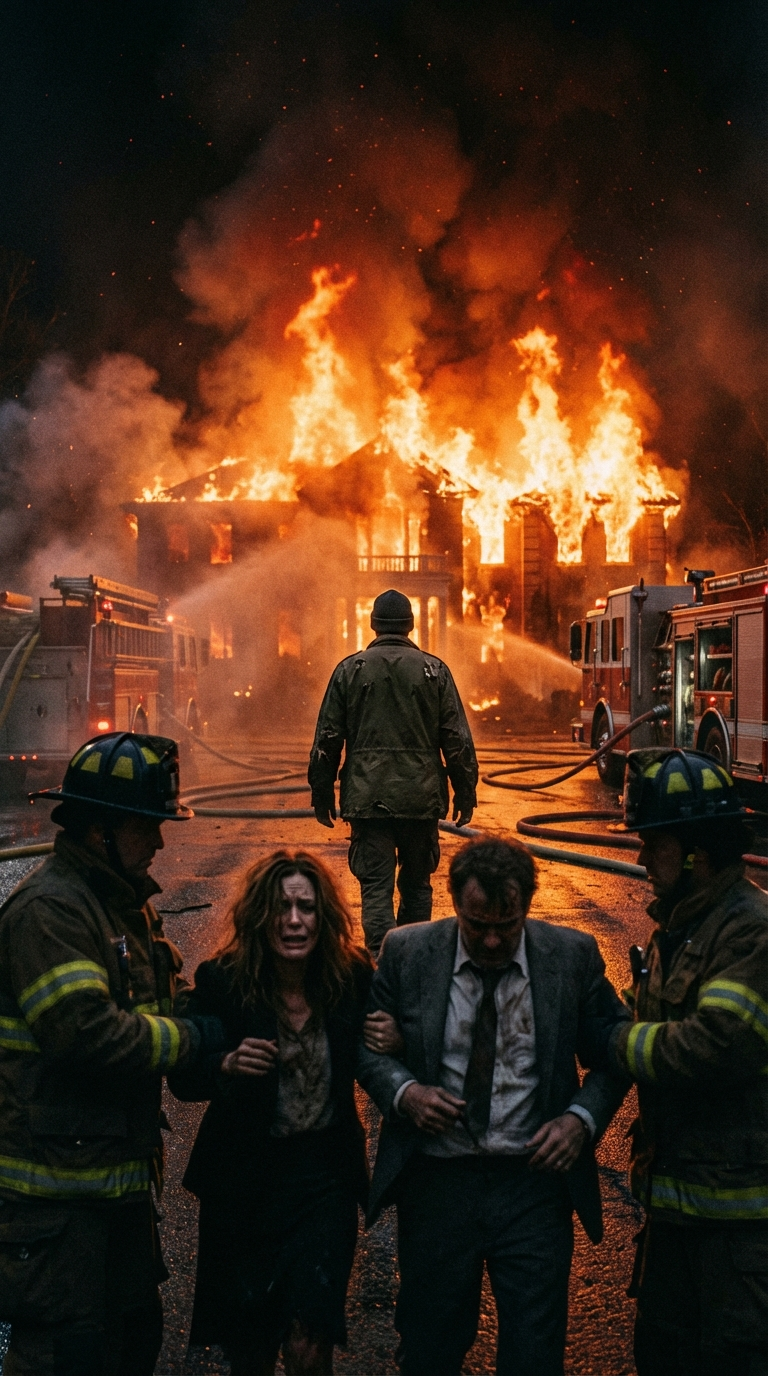
“It’s gone, ma’am. The second floor is fully engulfed. The roof is going to collapse any second. We cannot send men in there. I’m so sorry. It’s now a recovery operation.”
The Fire Captain’s words were clipped, professional, and utterly devastating. They cut through the roar of the flames like ice. They were a death sentence for my three-month-old son, Leo, who was trapped in the nursery where the electrical fire had started just twenty minutes ago.
The heat pushed against us like a physical wall on the front lawn of the sprawling estate my father, Robert Vance, had built to prove to the world that he was untouchable. He was a titan of private equity, a man who believed every problem had a price tag. But tonight, against the indifferent rage of fire, his American Express Black card was useless. All his money couldn’t buy a ladder tall enough or water cold enough to save his grandson.
My father, in his wrinkled Italian silk suit, was losing his mind. His facade of control had shattered. He was grabbing the Captain by his heavy turnout coat, screaming, spit flying from his mouth. “Do you know who I am? I bought this whole damn precinct a new fleet last year! Get your men in there! I’ll sue you into oblivion! I will bury you if you let that boy die!”
I couldn’t scream anymore. My throat was raw, scraped clean by terror. I just stared at the orange hell that used to be the east wing of my home, my knees finally giving out on the wet grass. The sound of the fire was deafening, a hungry, crackling roar that drowned out my father’s threats and the sirens in the distance.
The firefighters were physically holding my father back as he tried to charge the front door—a useless, arrogant gesture born of a lifetime of never being told “no.”
And that’s when I saw him.
He emerged from the deep shadows of the tall manicured hedges bordering the driveway. He was wearing the same filthy, oversized army jacket, the same matted grey beard obscuring his face. It was the homeless man. The one my father had humiliated just twenty-four hours earlier.
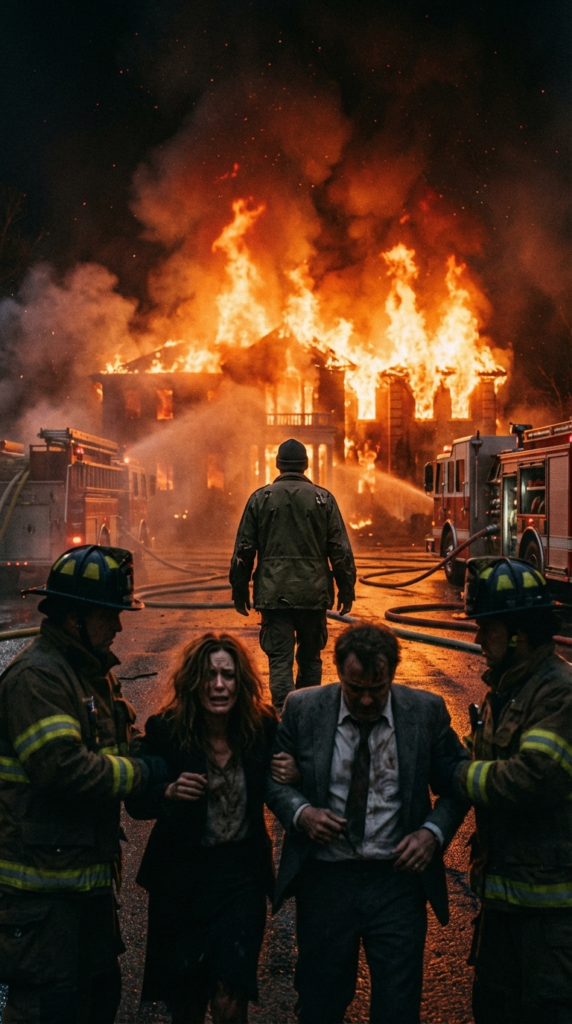
He didn’t run. He didn’t look panicked. He walked with a strange, calm deliberation past the police barricade, ducking under the yellow tape. The firefighters shouted at him to stop, that it was suicide, but he didn’t even flinch. He walked straight toward the inferno that professional rescuers were retreating from.
To understand why the sight of this specific man walking into the fire broke something in my father, you have to understand yesterday.
My father, Robert Vance, is a man who views poverty not as a misfortune, but as a character flaw. He built his empire by acquiring struggling companies, stripping them for parts, and discarding the workers. He valued strength, efficiency, and cleanliness.
Yesterday afternoon, was unseasonably hot. I was on the front porch swing with baby Leo, enjoying the shade, when the man limped up the long driveway. He was old, perhaps sixty, though the streets had aged him to look eighty. He stopped ten feet from the porch, respectful of the boundary. His voice was a dry rasp.
“Ma’am,” he had said, his eyes lowered. “I’m sorry to disturb you. I’m just trying to get to the next town over. Could I trouble you for water from your hose? My canteen is empty.”
Before I could stand up, the front door banged open. My father stormed out, already furious about some stock market dip.
“Get off my property,” my father snarled. “I don’t pay fifty grand a year in property taxes to have beggars darkening my doorstep.”
“Dad, stop,” I pleaded, standing up with Leo. “He just wants water.”
“They always just want something, Sarah. You give a mouse a cookie, he wants a glass of milk. You give a bum water, he wants your wallet.” My father turned to the man. “I gave you an order. Move.”
The man nodded slowly, his dignity wrapped tight around him like his tattered coat. “I understand. No trouble intended.” He turned to leave.
It wasn’t enough for my father. He needed to win. He needed to dominate. He grabbed the garden hose lying on the lawn, twisted the nozzle to the highest pressure setting, and aimed it at the old man’s back.
The jet of cold water hit the man square between the shoulder blades. He stumbled, nearly falling, dropping his empty metal canteen. He didn’t cry out. He just regained his footing, soaked and shivering, picked up his canteen, and kept walking.
“Dad! What is wrong with you?” I screamed, horrified.
My father just laughed, tossing the hose down. “Taught him a lesson about trespassing. He won’t come back. You have to speak their language, Sarah. Force is all they respect.”
He then pulled a hundred-dollar bill from his money clip, crumpled it into a ball, and threw it at my feet. “Give that to Maria to sanitize the porch. He probably has lice.”
That was the man my father was now watching walk into a burning building to save his bloodline.
The scene on the lawn seemed to downshift into slow motion. The firefighters stopped yelling at the man, realizing it was too late to stop him. He had disappeared into the thick black smoke billowing from the front entrance.
“He’s dead,” the Captain muttered, shaking his head. “Nobody survives that heat without gear. The smoke inhalation alone…”
My father stopped screaming. He stared at the doorway where the man had vanished. His face went slack. The arrogance drained out of him, leaving behind a terrified, old man.
“Who was that?” he whispered to me, his voice trembling. “Sarah, who was that?”
“That was the mouse you hosed off the porch yesterday, Dad,” I said, my voice dead flat.
A sickening groan came from the house. The roof over the nursery sagged visibly. Sparks shot into the night sky like terrible fireworks.
One minute passed. Then two. It felt like an epoch. The firefighters were preparing their hoses to contain the fire to the main structure, having given up on the nursery entirely.
“Please,” I whispered to a God I hadn’t prayed to since I was a child. “Please.”
Three minutes.
“There’s movement!” a rookie firefighter yelled, pointing near the front door.
The smoke was thick, oily, and black. But something was moving through it. A shape. It stumbled, fell to one knee, and then pushed itself back up.
The figure burst through the smoke threshold and onto the front lawn.
It was him.
His army jacket was smoldering. His beard was singed almost entirely off. His skin was bright red, blistered and blackened in places. He was coughing violently, his entire body racking with spasms.
But held tight against his chest, wrapped in a bundle of wet blankets that must have been doused in a bathtub, was a small shape.
A cry cut through the night. A thin, high-pitched wail of a terrified baby.
It was the most beautiful sound I have ever heard.
The silence on the lawn was total. The firefighters, the police, my father—everyone froze. They were witnessing something their training said was impossible.
I broke the paralysis first. I sprinted across the wet grass, tripping, scrambling to him.
The old man sank to his knees as I reached him. He looked up at me, his eyes rimmed red, watering from the smoke. He didn’t speak. He just gently peeled back the layers of the wet blanket to reveal Leo.
Leo was red-faced and screaming, covered in soot, but alive. Miraculously, impossibly alive.
I grabbed my son, burying my face in his smoky-smelling neck, sobbing uncontrollably.
The paramedics swarmed us instantly. They took Leo from me to check his vitals, putting an oxygen mask on his tiny face. They tried to attend to the old man, but he waved them off, coughing.
My father approached slowly. He looked at the burning house, then at the baby, then at the man on the ground. The man he had treated like vermin.
My father reached into his pocket. It was muscle memory. The reflex of a lifetime. He pulled out his money clip, thick with hundreds.
He stepped toward the old man, his hand extending the cash. His voice was shaking. “I… I can pay you. Name your price. Anything you want. A house. A car. A million dollars. I’m Robert Vance, I can—”
The old man looked up. For the first time, I saw his eyes clearly in the firelight. They weren’t angry. They were just incredibly tired, and filled with a profound pity.
He looked at the wad of cash in my father’s trembling hand. Then he looked my father in the eye.
“Keep your paper, Mr. Vance,” the man rasped, his voice damaged by the smoke. “Water was free. Life is free. You can’t buy what matters.”
He slowly stood up, wincing in pain. He nodded once to me. “Take care of that little one, ma’am.”
Before anyone could stop him, before the paramedics could insist on treating his burns, he turned and walked away. He slipped back through the gap in the tall hedges and disappeared into the darkness, back into the invisibility from which he came.
The fire destroyed seventy percent of the estate. It took the art collection, the antique furniture, and my father’s prized humidors.
It also destroyed Robert Vance.
The man who existed before the fire died that night. He became quiet. He stopped wearing suits. He stopped checking the stock market. He spent hours just sitting in the guest house where we were staying, staring at the wall.
He had spent a lifetime building a fortress of wealth to protect himself and his legacy. When the true test came, the fortress failed. The expensive professionals failed. His money failed.
The only thing that succeeded was the basic humanity of a man who had nothing.
Three days later, I found him. It wasn’t hard. I asked around at the downtown shelters, describing the army jacket and the burns. He was at the St. Jude’s soup kitchen, sitting in the back corner, nursing a cup of coffee. His hands were heavily bandaged.
His name was Elias.
I sat across from him. I put a photo of Leo on the table—clean, healthy, smiling in the hospital.
“Thank you,” I said. It felt painfully inadequate.
Elias nodded, looking at the photo. “He’s a good boy.”
We talked for an hour. I learned that Elias used to be a structural engineer in Chicago. He had a wife and two daughters. Ten years ago, a drunk driver took them all in a head-on collision. Elias survived without a scratch physically, but he died inside. He started walking and never stopped, letting his life fall away until he was just a ghost haunting the edges of other people’s lives.
“Why did you go in?” I asked finally. “You knew the risks. The Captain said it was impossible.”
Elias took a sip of his coffee. He looked past me, perhaps seeing faces from a decade ago.
“When you’ve lost everything that matters,” he said softly, “you realize that ‘impossible’ is just a word people use when they’re afraid to lose what they have left. I didn’t have anything left to lose, ma’am. But you did.”
He looked down at his bandaged hands. “And maybe… maybe I just wanted to pull someone out of a wreck this time.”
I tried to give him a check. It was for an amount that would ensure he never had to sleep outside again. He pushed it back across the metal table.
“I don’t want his money, Sarah. It’s dirty. It costs too much to hold onto.”
He stood up to leave. “If you want to help, just teach that boy better than his grandpa taught you. Teach him that the measure of a man isn’t how high he builds his walls, but how many doors he opens.”
I never saw Elias again.
My father never fully recovered. He lives in a small apartment near the city now. He volunteers twice a week at the St. Jude’s kitchen, washing dishes. He doesn’t talk much, and he never mentions his past life as a titan of industry.
Sometimes, when I visit him, I see him staring at his hands, the hands that used to sign billion-dollar deals, now red and chapped from dishwater. I think he’s finally understanding what Elias tried to tell him in the shadow of the burning house.
We spend our lives trying to accumulate value, terrified of being poor, of being “the other.” We build gates and judge those outside them. But in the end, when the fire comes—and the fire always comes—the only currency that spends is courage, and the only enduring legacy is kindness.
My son is three now. He has a small, faint scar on his ankle from a burn he got that night. I hope he never removes it. It’s a reminder that the greatest hero he’ll ever meet wasn’t a billionaire or a celebrity. He was the man we tried to wash away.