The Envelope That Changed Everything
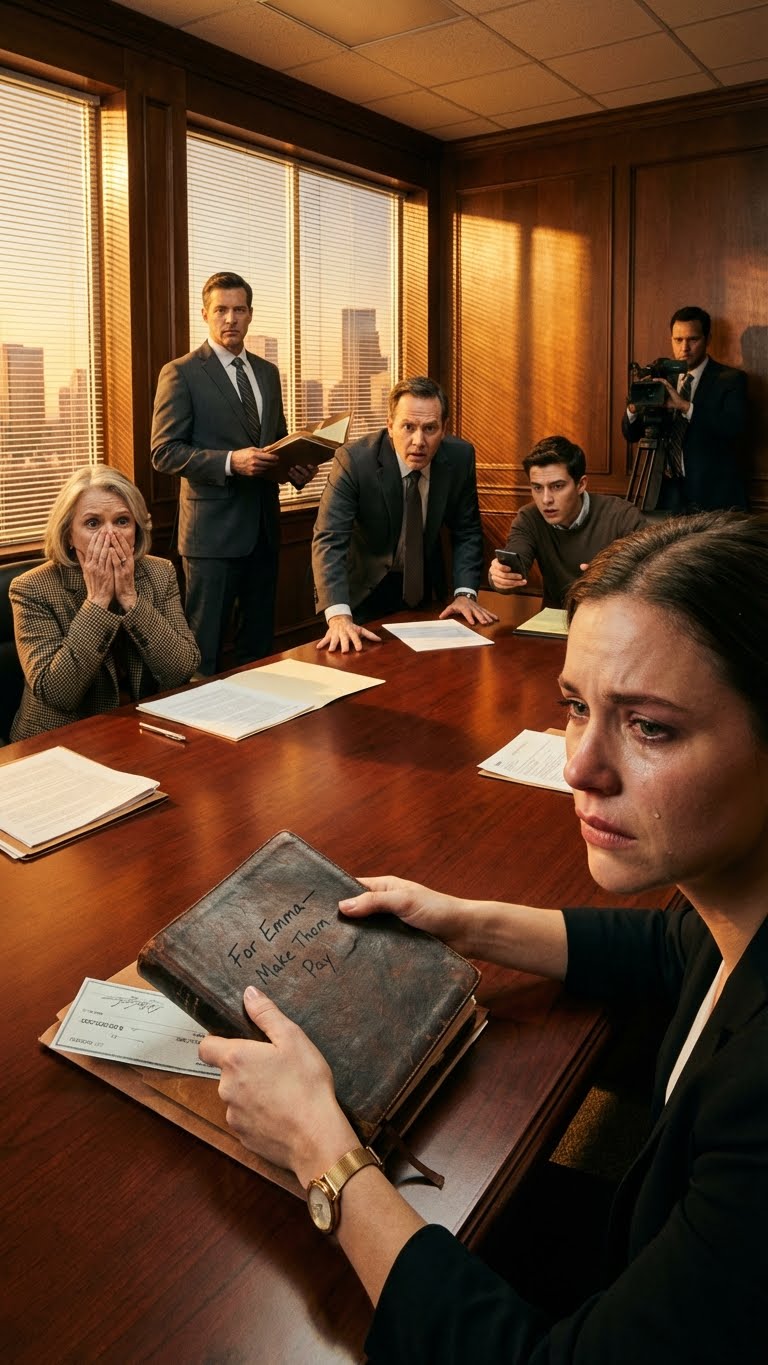
I stood in the lawyer’s office with my hands shaking so badly I could barely hold the envelope. Inside was a check for $89 million and a leather-bound journal with my uncle’s handwriting scrawled across the cover: “For Emma—Make Them Pay.”
Uncle Richard. The family “crazy.” The embarrassment we weren’t supposed to talk about at Thanksgiving. The homeless man my mother crossed the street to avoid when she saw him downtown.
He died three weeks ago under a highway overpass. Alone. Cold. Fifty-seven years old.
I was the only one who went to his funeral. Just me, a priest, and two strangers from the shelter. My mother said she had a hair appointment. My father said Richard “made his choices.” My brother didn’t even respond to my text.
And now this lawyer—this man in a $5,000 suit—was telling me that my “crazy” homeless uncle had been worth almost ninety million dollars. That he’d been living on the streets by choice. That he’d been watching us. Testing us. Waiting to see if anyone would show him an ounce of human decency.
I failed that test for years. We all did.
But three years ago, I started bringing him coffee. Sandwiches. I sat with him. I listened to his stories that everyone else called “rambling nonsense.” I was the only one who treated him like he was still human.
The lawyer slid the journal across the desk. “He left very specific instructions, Miss Cooper. He wants you to have everything. But there’s a condition.”
My throat went dry. “What condition?”
“You have to deliver his final messages to your family members personally. In front of witnesses. He’s written exactly what he wants you to say to each of them.” The lawyer’s expression was unreadable. “And Miss Cooper? Some of these messages… they contain information that will destroy them.”
I opened the journal with trembling fingers. The first page had my mother’s name at the top. The second paragraph made my blood run cold.
She didn’t just abandon him. She did something so much worse.
The Truth About Uncle Richard
Let me back up and tell you how we got here.
Richard Cooper was a legend in our family—before he became the cautionary tale. He was a tech genius who developed security software in the early 2000s. While my mother was struggling through community college and my father was working at a car dealership, Richard was building an empire.
He sold his first company for $12 million when he was thirty-two. His second company went for $45 million. By the time he was forty, he’d made strategic investments that multiplied his wealth exponentially. Forbes estimated his net worth at somewhere north of $80 million.
But Richard had problems. He suffered from depression and anxiety. He had paranoid episodes. He self-medicated with alcohol. And instead of getting him help, my family saw him as a liability.
My mother—his younger sister—convinced him to sign over power of attorney to her when he was going through a particularly bad episode. She said it was “just temporary” and “for his own protection.”
That was fifteen years ago.
What she actually did was lock him out of most of his accounts, claiming he was incompetent. She moved him into a “care facility” that was really just a place to warehouse people with mental illness. She told the family he was “too dangerous” to be around us kids. She took control of his medical decisions and pumped him full of medications that turned him into a zombie.
Richard tried to fight back. He tried to get lawyers. He tried to prove he was competent. But he had a documented history of mental health issues, and my mother had money for good attorneys. The system failed him at every turn.
So he did the only thing he could think of. He escaped.
He walked out of that facility one day and disappeared. He liquidated the one small account my mother hadn’t found—about $200,000—and put everything else into an untouchable trust with a law firm in Switzerland. Then he became homeless.
Not because he had to. Because he wanted to see what we would do.
Would anyone come looking for him? Would anyone show him compassion when he had nothing?
My mother reported him missing but hired exactly zero private investigators. She told everyone he’d “run off” and was “probably dead in a ditch somewhere.” She seemed almost relieved.
I was fifteen when he disappeared. I believed everything my mother told me about him being dangerous and crazy. We all did.
The Coffee That Started Everything
I first saw Uncle Richard again three years ago. I was twenty-five, working as a teacher, struggling with my own student loans and barely scraping by. I’d stopped for coffee before school and there he was—sitting outside the shop with a cardboard sign.
I didn’t recognize him at first. He was weathered, thin, his hair long and matted. But then he looked up and I saw those eyes. The same grey-blue eyes I remembered from childhood, before everything went wrong.
“Uncle Richard?”
He smiled. It was sad and knowing. “Hello, Emma.”
I should have called my mother. I should have told someone. Instead, I bought him breakfast. We talked for two hours and I was late to work. He didn’t tell me about the money or the plan. He just told me stories about when he and my mom were kids. He asked about my life. He listened like every word mattered.
I started meeting him twice a week. Tuesdays and Thursdays before school. I brought him food, clean socks, sometimes a book. I offered to help him get into a shelter but he always refused. He said he was “exactly where he needed to be.”
I told my mother once that I’d seen him. She went ballistic. Told me he was dangerous, manipulative, that he’d try to get money from me. She forbade me from seeing him again.
I kept seeing him anyway. I just stopped telling her.
Richard and I developed a strange friendship. He was brilliant—even living on the streets, he could discuss philosophy, technology, history. He wasn’t crazy. He was the sanest person I knew. But he was testing something, conducting some kind of experiment I didn’t understand.
“People reveal who they really are when they think you have nothing to offer them,” he told me once. “You’re the only one who passed, Emma. The only one.”
The Journal of Destruction
Back in the lawyer’s office, I read through Richard’s journal with tears streaming down my face. It was part confession, part evidence file, part revenge playbook.
He’d documented everything. Every phone call my mother ignored when he tried to reach out from the facility. Every family gathering where they toasted to his memory while he was still alive. Every time my father had crossed the street to avoid him. Every time my brother had laughed and called him a “bum” to his friends.
But the real bombshells were what he’d uncovered about each of them.
My mother had been stealing from him long before she took power of attorney. She’d forged his signature on documents. She’d taken $3 million from one of his accounts and used it to buy her house—the house she claimed she and dad had “worked so hard for.”
My father knew everything and helped her cover it up. He’d even threatened Richard’s lawyer at one point, saying Richard was “mentally unfit” and any lawyer who helped him would face harassment charges.
My brother Marcus had done something even worse. When he found out Richard was homeless, he’d actually gone downtown with his fraternity brothers, found him, and filmed themselves mocking him for TikTok. The video got 50,000 likes. “Crazy homeless guy thinks he’s a millionaire.” Marcus never told the family the homeless guy was his uncle.
But Richard had kept every piece of evidence. Screenshots. Bank records. Forged documents. Witness statements. Videos. Everything.
The journal laid out exactly how I was supposed to confront each of them. When. Where. What to say. What evidence to present. Richard had choreographed their destruction down to the last detail.
The lawyer cleared his throat. “Your uncle’s instructions are legally binding. If you want the inheritance, you have to deliver each message exactly as written, with myself and another witness present. He’s set up accounts to record everything. These confrontations will be documented.”
“And if I don’t do it?”
“Then the entire estate goes to charity and your family never knows the truth. But Emma?” He leaned forward. “Your uncle was very specific about who should get this money. He wanted you to have it. You were the only one who saw him as human.”
I closed the journal. My hands had stopped shaking. Something cold and determined had settled in my chest.
“When do we start?”
The Reckoning Begins
The lawyer set it up perfectly. A “mandatory estate meeting” at his office. My mother, father, and brother all thought they were coming to hear Richard’s will—probably expecting some token apology or maybe a small bequest they could fight over.
They had no idea I’d already inherited everything.
I got there early. The conference room had a long mahogany table and windows overlooking the city. The lawyer had positioned cameras discreetly in three corners. Another attorney sat in as the official witness.
My mother arrived first in her designer outfit. She’d gone to the salon that morning—I could smell the expensive hair products from across the room. She barely looked at me.
“Emma. I’m surprised you took time off work for this. Richard probably left you nothing anyway.”
I smiled and said nothing.
My father came next, already on his phone, making the whole thing seem like an inconvenience. Marcus showed up last, wearing his usual smirk. He was twenty-three now, still living off mom and dad while pretending to be a “crypto investor.”
The lawyer began formally. “Thank you all for coming. We’re here to execute the will of Richard James Cooper. I’ll get straight to the point. Richard has left his entire estate to his niece, Emma Cooper.”
The room went silent. My mother’s face turned white, then red.
“That’s impossible,” she said. “Richard had nothing. He was homeless. He was—”
“Richard had an estate valued at approximately $89 million,” the lawyer continued calmly. “He was never incompetent. He chose to live as he did for personal reasons. And he left very specific instructions for Emma to deliver final messages to each of you.”
My father stood up. “This is bullshit. We’ll contest this. Richard was mentally ill. He wasn’t capable of—”
“Sit down, Mr. Cooper.” The lawyer’s voice was ice. “Everything has been verified by three independent psychiatric evaluations. Richard was of completely sound mind when he executed this will six months ago. And if any of you attempt to contest it, there are additional consequences outlined in the trust documents.”
Marcus was staring at me like he’d never seen me before. “Emma? You knew about this?”
“No,” I said quietly. “I found out three days ago. But Uncle Richard left me instructions. And I’m going to follow them.”
I opened the journal. My hands were steady now.
“Mom. Let’s start with you.”
The Mother’s Sins
My mother’s face was a mask of fury and confusion. She wasn’t used to being on the receiving end of anything uncomfortable.
I read from Richard’s journal, my voice clear and loud.
“Catherine Cooper. My sister. You didn’t just abandon me—you destroyed me. When I was at my lowest, when I needed help, you saw an opportunity. You convinced me to sign over power of attorney by telling me it was temporary. You promised you’d help me get better. Instead, you had me declared incompetent. You locked me in a facility where I was overmedicated and abused. You isolated me from everyone who could help me.”
“That’s not—I was trying to protect you!” my mother interrupted.
“Let her finish,” the lawyer said sharply.
I continued. “You stole $3 million from my accounts before you even had full control. You forged my signature on multiple documents. You used my money to buy your house at 447 Maple Ridge Drive—the house you told everyone you’d worked so hard for. But that wasn’t the worst part.”
I pulled out the first document. A bank statement with my mother’s forged signature. Then another. Then another.
“The worst part was that when I escaped and ended up on the streets, you knew exactly where I was. You saw me downtown multiple times. You crossed the street. You told Emma I was dangerous. You told the family I’d chosen drugs over treatment. But the truth is, I was never on drugs except what you forced into me. I was never violent except in self-defense against the facility staff you paid to keep me locked up.”
Tears were running down my face but I kept reading.
“You let me sleep in the cold. You let me go hungry. You saw your own brother suffering and you felt nothing. And you did it all for money that was never yours.”
My mother was shaking her head, but her face had gone pale. “You have no proof. This is slander. I’ll sue—”
I slid a thick folder across the table. “Bank records. Forged documents. Emails to your lawyer about keeping Richard ‘contained.’ Phone records showing you ignored seventeen calls from his social worker. And video footage from downtown showing you seeing him and walking away. Four separate occasions.”
The lawyer spoke up. “Mrs. Cooper, I should inform you that copies of all this evidence have been sent to the district attorney’s office. Elder abuse. Financial exploitation. Forgery. You’re looking at potential criminal charges.”
My father had gone very quiet. Marcus was staring at the documents like they might bite him.
My mother tried to speak but no words came out. Her perfect façade had cracked completely.
“Uncle Richard wanted me to tell you one more thing,” I said softly. “He forgave you. He felt sorry for you. Because he realized you never learned to see people as anything other than what they could do for you. You’re going to spend the rest of your life knowing your brother died having figured out exactly who you are. And you’re going to live with that.”
The Father’s Cowardice
My father cleared his throat. He was trying to look defiant but his hands were shaking.
“Emma, your mother was trying to help. You don’t understand how difficult Richard was—”
“Your turn, Dad.”
His mouth snapped shut.
I flipped to the next section of the journal. “David Cooper. You weren’t the mastermind. You were the accomplice. The coward. You knew everything Catherine did and you helped her do it. Uncle Richard writes: ‘David, you were the one I thought might stand up for what was right. Instead, you chose comfort over conscience.'”
I pulled out more documents. “You co-signed the forged documents. You threatened Richard’s attorney. You told the facility staff that Richard was dangerous when he tried to advocate for himself. You accepted the stolen money and enjoyed the house it bought. And when you saw me on the streets, you didn’t just cross the street. You called the police and tried to have me arrested for trespassing.”
My father’s face flushed. “He was harassing customers outside businesses—”
“He was sitting quietly with a sign. The police found no cause to arrest him. But you tried anyway.” I leaned forward. “Uncle Richard says he expected better from you. He thought you’d be the voice of reason. Instead, you were just another person willing to destroy someone vulnerable for personal gain.”
The lawyer slid another folder across the table. “Mr. Cooper, you’re named as a co-conspirator in the financial exploitation case. Your cooperation might reduce charges, but I’d recommend getting your own attorney.”
My father deflated like a balloon. All his bluster was gone.
The Brother’s Cruelty
Marcus had been silent, but now he was sweating. He knew what was coming.
“Marcus.” I looked at my little brother. He’d been eighteen when he made that TikTok. Just a kid, I’d told myself when Richard showed me. But Richard had a different perspective.
I read his words: “Marcus represents something I find even more disturbing than Catherine’s greed or David’s cowardice. He represents cruelty for entertainment. The complete absence of empathy.”
I pulled out my phone and played the video. Marcus and his frat brothers, drunk and laughing, surrounding Richard on a street corner. Mocking him. Filming him. Calling him “crazy” and asking him to “do something funny for the camera.”
Richard, in the video, looked directly at the camera and said quietly, “I’m someone’s family. I’m someone’s uncle. I used to be someone’s hero.”
Marcus had responded: “Yeah, and now you’re nobody. Say hi to TikTok, bro!”
Fifty thousand likes. Hundreds of comments laughing at the “crazy homeless guy.”
“You never told anyone that homeless guy was your uncle,” I said. “You let your friends mock him. You humiliated him for internet points. And Uncle Richard says: ‘Marcus has a chance to become a better person than his parents. But only if he faces what he’s done.'”
Marcus’s face had gone from red to white. “Emma, I was drunk. I was stupid. I didn’t know—”
“You did know. He said your name in the video. You cut that part out.”
I had that clip too. Richard had somehow gotten the unedited version. Marcus saying “Uncle Richard?” and then deciding to film anyway.
The lawyer pulled out the final document. “Mr. Marcus Cooper, your uncle has left instructions that a copy of this video, along with his identity and your relationship, be sent to your employer, your university alumni association, and posted on the same social media accounts you used to mock him. Unless.”
Marcus looked up desperately. “Unless what?”
“Unless you agree to the terms outlined in this document. Complete addiction counseling—yes, Richard knew about your drinking. One year of volunteer work at homeless shelters. And a public apology video explaining what you did and why it was wrong.”
Marcus was crying now. “I’ll do it. God, I’ll do anything. Emma, I’m sorry. I’m so sorry.”
The Aftermath
The meeting ended with my family in pieces. My mother and father left in silence, already calling attorneys. Marcus stayed, crying, asking me to forgive him.
I felt hollow. Vindicated but hollow.
“Uncle Richard wanted you to know something,” the lawyer said after everyone had gone. “He didn’t do this for revenge. He did it because he wanted them to face themselves. He wanted them to have a chance to become better people. That’s why he gave them outs—counseling, restitution, consequences that could lead to growth.”
He handed me a final envelope. “This is for you. He wanted you to read it alone.”
I opened it in my car. Richard’s handwriting, shaky but clear.
Dear Emma,
If you’re reading this, you followed through. Thank you. I knew you would.
I don’t want you to feel guilty about the years you didn’t see me. You were a child when I disappeared. You believed what you were told. The fact that you eventually saw through it, that you treated me like a human being when I had nothing to offer you—that’s everything.
The money is yours. Not because you earned it through suffering, but because you’re the only one who remembered that people matter more than what they can do for you.
Use it to build a good life. Help people. Be happy. Don’t let my family’s dysfunction become yours.
The greatest revenge isn’t destruction—it’s building something beautiful that they can never touch.
I loved you, kiddo. I died knowing at least one person in my family still had a soul.
Uncle Richard
I sat in that parking lot and cried for an hour.
Six Months Later
The legal cases are still ongoing. My mother and father face potential criminal charges but will probably settle for restitution and probation. Their marriage is falling apart—apparently shared guilt isn’t a great foundation.
Marcus actually followed through. He’s been volunteering at a shelter, and his apology video went viral—in a good way. People respected his honesty. He’s in therapy and actually seems to be changing. We talk sometimes.
As for me? I quit teaching and started a foundation in Richard’s name. We fund mental health services and housing for homeless people with psychiatric conditions. We advocate for reform in how power of attorney is monitored. We help people who’ve been financially exploited by family members.
I bought a nice house, but not too nice. I’m dating someone kind who volunteers at the shelter. I’m happy.
But sometimes I still go downtown and sit where Richard used to sit. I think about all the people walking by, and I wonder how many of them are invisible like he was. How many are testing the world to see if anyone will see them.
I always carry extra coffee now. And I always stop to talk.
Because Uncle Richard taught me the most valuable lesson of all: Your worth as a human being has nothing to do with your bank account, your address, or your status. It has everything to do with whether you can see the humanity in others—especially when they have nothing to offer you in return.
The family who abandoned him thought they were protecting their comfort and their inheritance. Instead, they lost everything that mattered. And the crazy homeless guy they mocked? He orchestrated the whole thing from a cardboard box.
Some would call that revenge. I call it justice.
And I call it the greatest gift anyone ever gave me—the gift of seeing clearly.