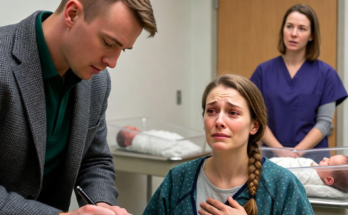
The doctor was asking me to choose which daughter would live.
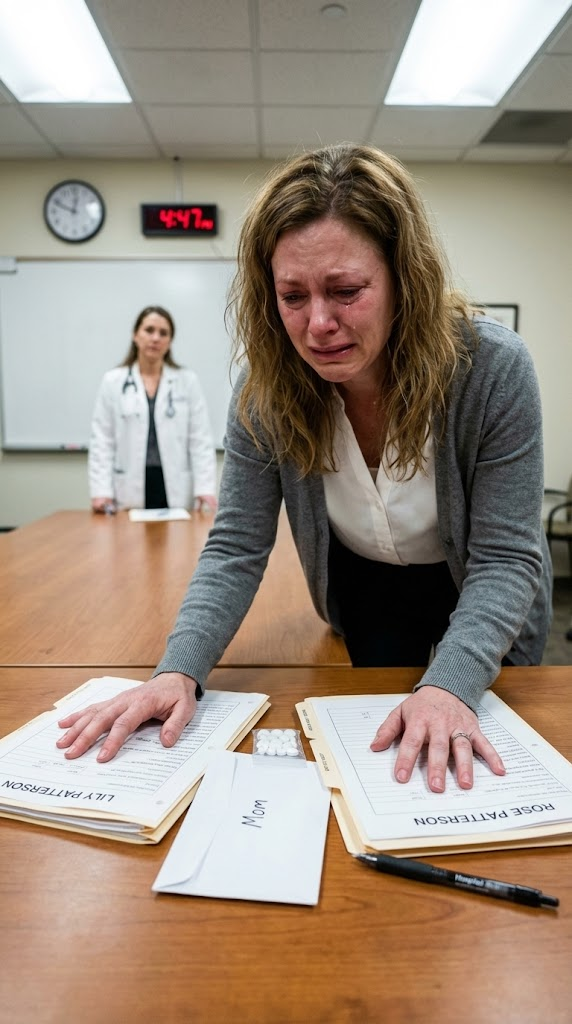
I was standing in a hospital conference room staring at two identical patient files. Lily—File A. Rose—File B. Both sixteen years old. Both in acute liver failure. Both had maybe seventy-two hours left.
Only one donor liver was available.
“Mrs. Patterson,” Dr. Morrison said gently, “I know this is an impossible decision. But legally, as their mother and medical proxy, you have to make the choice. The transplant team needs to prep within the next two hours.”
My hands were shaking so badly I couldn’t hold the files. They slipped from my fingers and scattered across the conference table. Lily’s latest blood work. Rose’s MRI results. Two lives reduced to medical charts.
My husband wasn’t there. Derek was on a business trip in Singapore—or so he said. I’d stopped believing his business trip excuses after I found the texts from his assistant. But that didn’t matter right now.
Right now, I had to choose which of my daughters would get a chance to see seventeen.
“There has to be another option,” I said. My voice sounded like someone else’s. “Another donor. Someone else on the list who—”
“There isn’t time,” Dr. Morrison interrupted. “The liver is viable for transplant for approximately six more hours. After that, it’s no longer usable. And given your daughters’ blood type and the severity of their conditions, another suitable donor could take weeks or months. They don’t have weeks.”
Lily and Rose had been sick for three months. What started as fatigue and nausea had progressed to jaundice, confusion, and finally complete liver failure. The diagnosis was autoimmune hepatitis—a condition where their own immune systems were destroying their livers.
Identical twins with identical autoimmune disorders. The doctors said it was incredibly rare. A genetic perfect storm.
They were in separate ICU rooms now, both unconscious, both on ventilators. I’d spent the last seventy-two hours running between their rooms, holding their hands, begging them to fight.
Now I had to choose which one would get to fight with a working liver.
“I can’t,” I whispered. “I can’t choose between my children.”
Dr. Morrison’s expression was sympathetic but firm. “I understand this is unbearable. But if you don’t choose, we’ll have to follow standard medical protocols—and that means the transplant committee will decide based on clinical factors. Whoever has the slightly better prognosis will get the organ.”
“Who has the better prognosis?”
She hesitated. “It’s very close. Rose’s liver enzymes are marginally better, but Lily’s kidney function is slightly stronger. Medically speaking, they’re almost identical candidates.”
Almost identical. My daughters, who’d shared a womb, who’d learned to walk holding each other’s hands, who’d never spent a night apart until this hospital admission—they were “almost identical candidates” for which one deserved to live.
“There’s something else you should know,” Dr. Morrison said quietly. She pulled out another document. “This was found in Lily’s belongings when she was admitted. It’s addressed to you.”
It was a sealed envelope with “Mom” written in Lily’s handwriting. The paper was wrinkled, like it had been carried around for a while.
“We don’t normally share patient belongings during active treatment, but given the circumstances and the decision you’re facing, the ethics board thought you should see it.”
My hands were trembling as I took the envelope. I could feel the weight of something inside—not just paper. Something heavier.
“Mrs. Patterson,” Dr. Morrison said, checking her watch, “I need your decision in the next thirty minutes. The surgical team is standing by.”
I stared at the envelope. At the two patient files. At the clock on the wall counting down my daughters’ lives.
I didn’t know Lily had written me a letter. I didn’t know what it said or why she’d written it before getting sick.
But I had a terrible feeling that whatever was inside this envelope was about to make the impossible decision even more unbearable.
The Letter That Changed Everything
I opened the envelope with shaking hands.
Inside was a letter written in Lily’s careful handwriting, and a small plastic bag containing pills. White pills with no markings.
The letter read:
“Mom,
If you’re reading this, something bad has happened. I’m probably in the hospital, and Rose probably is too. I need you to know the truth before it’s too late.
I’ve been poisoning us.
Not on purpose. Not to hurt Rose. But I’ve been taking these pills for six months, and I think they’re what made us sick. I found them online—a supplement that was supposed to help me lose weight. Everyone at school was taking them. They worked really fast, so I kept taking more.
Then about two months ago, Rose found my stash. She was worried about me getting too thin. She thought if she took the pills too, I’d see how bad they were and stop.
Instead, we both got sick.
Mom, I looked up the symptoms last week before I got too confused to think straight. It’s liver failure. These pills—they’re not supplements. They’re something toxic, probably from overseas with no regulation. I poisoned myself, and Rose poisoned herself trying to save me.
If we’re both sick and there’s only enough treatment for one of us, you need to save Rose. This is my fault. I brought these pills into our house. I’m the reason we’re both dying.
Rose is better than me. She’s smarter, kinder, more patient. She wants to be a doctor and help people. I’m just the screwed-up twin who can’t stop making terrible choices.
Please save Rose. Please don’t let my stupidity kill her too.
I love you. I’m so sorry.
Lily”
I read the letter three times. Then I looked at Dr. Morrison.
“Did you know about this?” I asked, my voice barely audible.
“The toxicology reports showed unusual compounds in both girls’ systems,” she said carefully. “We suspected supplement contamination but couldn’t confirm the source. This letter… this explains everything.”
“Lily thinks she poisoned her sister.”
“She didn’t know the supplements were toxic. This isn’t her fault.”
“She literally wrote that I should save Rose instead of her.”
Dr. Morrison was quiet for a moment. “What a child writes in a letter doesn’t override your responsibility as a parent. You still have to make the choice based on what you think is right.”
What I thought was right. As if there was a right choice here.
I thought about Lily—my adventurous daughter, always trying new things, always pushing boundaries. She’d struggled with body image since middle school. She’d been bullied for being “the heavier twin” even though she and Rose weighed exactly the same. She’d started dieting obsessively last year.
I should have noticed. I should have seen the signs.
And Rose—my careful daughter, always looking out for her sister, always trying to protect her. Of course she’d taken the pills too. Of course she’d try to save Lily by showing her the consequences.
That was who Rose was. The protector. The selfless one.
Lily wanted me to save Rose. Lily thought she deserved to die for her mistake.
But I was their mother. I couldn’t just follow my sixteen-year-old daughter’s guilt-driven instructions.
The Backstory: How We Got Here
Lily and Rose were born six minutes apart. Lily first, then Rose. From the moment they arrived, they were inseparable.
But they were never quite identical in personality.
Lily was the extrovert—loud, impulsive, the one who made friends easily but also made mistakes constantly. She was the twin who got detention for talking in class, who forgot homework, who acted first and thought later.
Rose was the introvert—quiet, thoughtful, the one who planned everything and rarely got in trouble. She was the twin who helped Lily with homework, who covered for Lily’s mistakes, who smoothed over the consequences of Lily’s impulses.
They balanced each other perfectly. Where Lily was chaos, Rose was calm. Where Rose was hesitant, Lily was brave.
As their mother, I loved them equally but differently. Lily needed more attention, more guidance, more constant supervision. Rose needed less—she was self-sufficient, responsible, easy.
I’m ashamed to admit that meant Rose got less of my time. Because she didn’t demand it. Because she was “fine.”
When they started high school, something shifted.
Social media became everything. Instagram, TikTok, constant comparison to impossible beauty standards. Both girls started obsessing over their appearances in ways that worried me.
But especially Lily.
“I’m the fat twin,” she said one night at dinner.
“You’re not fat,” I said automatically. “You and Rose weigh exactly the same.”
“Exactly. We’re identical. Which means every pound on me is a pound that proves I’m the worse version.”
I tried to talk to her about body image, about health versus appearance, about social media being fake. But I was also working full-time, managing a household, and dealing with Derek’s increasing absences.
I noticed Lily was eating less. I noticed she was exercising more. I didn’t notice when it crossed the line from healthy to obsessive.
Rose noticed. Rose always noticed.
“I’m worried about Lily,” Rose told me six months ago. “She’s not eating at school. She’s taking something—I don’t know what, but I found pill bottles hidden in her room.”
“Did you ask her about it?”
“She says it’s just vitamins. But Mom, she’s getting really thin. It’s not healthy.”
I confronted Lily. She showed me a bottle labeled “Natural Metabolism Support.” The packaging looked professional. The ingredients listed things like green tea extract and cayenne pepper.
“It’s just a supplement,” Lily insisted. “Everyone’s taking it. It’s natural.”
I should have researched it. I should have taken the bottle and thrown it away. I should have done so many things.
Instead, I got pulled into a crisis at work. Derek was traveling again. Life got busy.
And Lily kept taking the pills. And Rose, being Rose, decided the best way to save her sister was to show her the consequences by experiencing them herself.
Two months later, both girls started getting sick.
The Impossible Choice
I sat in that conference room staring at Lily’s letter and trying to figure out how to choose which daughter would live.
If I followed Lily’s wishes, I’d save Rose. Rose was innocent—she’d only taken the pills to protect her sister. Rose had her whole life planned out. Rose wanted to be a doctor, help people, make a difference.
Lily thought she deserved to die for her mistake.
But Lily was sixteen. Sixteen-year-olds make terrible choices. That’s what being sixteen means—your brain isn’t fully developed, your judgment is terrible, and you’re vulnerable to social pressure and dangerous trends.
Lily hadn’t poisoned herself maliciously. She’d been desperate to fit in, to meet impossible beauty standards, to stop being “the fat twin.”
And yes, her choice had consequences. Terrible consequences.
But did those consequences mean she deserved to die?
I thought about what Dr. Morrison had said—that medically, they were almost identical candidates. Rose’s liver was slightly less damaged. Lily’s kidneys were slightly stronger.
If I let the medical committee decide, they’d choose Rose. The marginally better prognosis would win.
But I was their mother. I knew things the medical committee didn’t.
I knew that Lily, for all her impulsiveness and poor choices, had a light in her that drew people in. She made friends effortlessly. She made people laugh. She had a gift for making everyone feel included.
I knew that Rose, for all her brilliance and responsibility, struggled with anxiety and depression. She put enormous pressure on herself. She’d been in therapy for two years for perfectionism and self-worth issues.
I knew that if Rose survived and Lily died, Rose would never forgive herself. She’d taken the pills to save Lily. If Lily died anyway, Rose would carry that guilt forever.
But if Lily survived and Rose died, would Lily forgive herself? Or would she be destroyed by the knowledge that her mistake had killed her sister?
There was no good answer. Every option ended in devastation.
“I can’t decide,” I told Dr. Morrison. “I can’t choose. Let the committee decide.”
Dr. Morrison nodded slowly. “Are you certain? Once we turn this over to the committee, you won’t be able to change your mind.”
I thought about Lily’s letter. About Rose’s selflessness. About the impossibility of being a mother in this moment.
Then I thought about something else—something Lily had written that I’d almost missed.
“Rose wants to be a doctor and help people.”
Rose had wanted to be a doctor since she was eight years old. It was her entire identity, her purpose, her dream.
Lily wanted to be a photographer. She loved capturing moments, finding beauty in unexpected places. She’d won a state photography contest last year with a portrait series about body image.
Both beautiful dreams. Both meaningful futures.
But only one liver.
“Wait,” I said. “I need to see them. Both of them. Before I decide.”
The Hospital Rooms
Rose was in ICU Room 4. She was unconscious, hooked to a ventilator, her skin yellow from jaundice. Monitors beeped rhythmically, tracking a heart rate that was too fast and blood pressure that was too low.
I sat beside her bed and held her hand.
“Rose, baby, I don’t know if you can hear me,” I whispered. “But I need you to know that none of this is your fault. You tried to save your sister. That’s who you are—you’ve always protected her. Always put her first.”
I paused, tears streaming down my face.
“But I need you to understand something. If I choose to save you, you can’t carry guilt for the rest of your life. You can’t let this destroy your dreams. You have to live—really live—not just survive. Can you promise me that?”
Rose’s monitors beeped. No other response.
I kissed her forehead and went to Lily’s room.
Lily was in ICU Room 6. She looked almost identical to Rose—same yellow skin, same ventilator, same failing body.
I sat beside her and held her hand.
“Lily, I read your letter,” I said. “And I need you to know that you’re wrong. You’re not ‘the screwed-up twin.’ You’re not less valuable than Rose. You made a mistake—a terrible, life-threatening mistake—but you’re sixteen. Sixteen-year-olds make mistakes.”
I wiped my eyes.
“If I choose to save you, you have to forgive yourself. You have to understand that what happened to Rose isn’t punishment for your choices—it’s just the horrible randomness of life and timing. Can you live with that?”
Lily’s monitors beeped. The same rhythm as Rose’s.
I sat between my daughters’ rooms and realized the truth: there was no right choice.
Whatever I decided, I would lose a daughter. And the daughter who survived would carry unbearable guilt and trauma.
This was a decision that would destroy our family no matter what.
The Choice
I went back to Dr. Morrison.
“I’ve made my decision,” I said.
She waited.
“I want you to save Rose.”
Dr. Morrison nodded and picked up her phone to call the surgical team.
“Wait,” I said. “I need to explain. Not for you—for me. I need to say this out loud.”
She set down the phone.
“I’m choosing Rose because Lily asked me to. Because Lily’s last conscious act was to write a letter begging me to save her sister. Because Lily loved Rose enough to try to make this decision easier for me, even though nothing could make it easier.”
My voice broke.
“I’m choosing Rose because she tried to save Lily, and she deserves to have that sacrifice mean something. Because if Lily knew I’d ignored her wishes and let Rose die instead, I think that would hurt her more than dying herself.”
I paused.
“And I’m choosing Rose because medically, she has the slightly better chance. And in a situation where there’s no good answer, I have to believe that the universe—or God, or fate, or whatever—put that tiny medical advantage in place for a reason.”
Dr. Morrison’s eyes were wet. “I’ll call the team.”
“There’s one more thing,” I said. “I want to be tested as a living donor. For Lily. I know it takes time to process, and I know she might not have that time, but I want to try. If there’s any chance—”
“We’ll start the compatibility testing immediately,” Dr. Morrison said. “But Mrs. Patterson, you should know that living liver donation is a serious surgery with significant risks, and even if you’re compatible, the timeline—”
“I don’t care about the timeline or the risks,” I interrupted. “I need to try. I need Lily to know I tried.”
The Surgery
Rose’s transplant took eleven hours. I sat in the surgical waiting room, answering texts from Derek (who was “trying to get a flight back” from Singapore), and praying to a God I wasn’t sure I believed in.
At 3 AM, Dr. Morrison came out.
“The surgery was successful. Rose is in recovery. The new liver is functioning well. She’s not out of danger yet, but the transplant went as well as we could have hoped.”
I sobbed with relief and guilt in equal measure.
“And Lily?” I asked.
“Stable. Barely. We’ve moved her to the top of the transplant list for emergency status, and we’ve expedited your living donor compatibility testing. Results should be available in forty-eight hours.”
Forty-eight hours. Lily had maybe seventy-two hours left total.
It was going to be close.
The Aftermath
Rose woke up three days after her transplant. The first thing she said was, “Where’s Lily?”
I held her hand. “Lily’s still waiting for a liver. I’m being tested to see if I can donate part of mine.”
Rose’s face crumpled. “This should have been her transplant. She got sick first. She—”
“Rose, listen to me. Lily wrote me a letter before she lost consciousness. She asked me to save you. She knew what the pills were doing and she wanted you to have the liver. This was her choice.”
“Then she’s an idiot,” Rose said, tears streaming. “She’s an idiot and I love her and she can’t die. Mom, she can’t die.”
“We’re doing everything we can.”
The compatibility testing came back forty-six hours after Rose’s surgery. I was a match. I could donate part of my liver to Lily.
But there was a problem.
My liver showed signs of fatty liver disease—likely from years of stress, poor diet, and wine to cope with Derek’s affairs. It was mild, but it meant I was a borderline donor. The surgery would be riskier for both of us.
“We can proceed if you want to accept the risks,” the transplant coordinator said. “But you should know that there’s a 15% chance of serious complications for you, and a 30% chance the partial liver won’t be sufficient for Lily’s recovery.”
“Do it,” I said.
The surgery was scheduled for the next morning.
That night, I sat with Lily. She was still unconscious, still failing.
“I’m going to give you part of my liver,” I told her. “And when you wake up, you and I are going to have a long conversation about body image, social media, and the fact that you are not now and have never been the ‘fat twin’ or the ‘screwed-up twin.’ You’re just Lily. And Lily is enough.”
The surgery took nine hours. When I woke up in recovery, Dr. Morrison was there.
“The transplant was successful,” she said. “Lily’s body is accepting the liver. She’s stable.”
I cried. Then I asked, “What about Rose?”
“Rose is recovering well. She’s asking to see you.”
Three days later, I was mobile enough to visit both daughters. Rose first, then Lily.
Rose was sitting up in bed, pale but alive. When she saw me, she started crying.
“You gave Lily your liver,” she said. “You saved us both.”
“I did what any mother would do.”
“No,” Rose said fiercely. “Most mothers couldn’t have made the choice you made. You saved me knowing you might lose Lily. Then you risked your life to save Lily. You saved us both.”
Lily woke up a day later. The first thing she saw was Rose sitting in a wheelchair beside her bed.
“You’re alive,” Lily whispered.
“So are you, idiot,” Rose said, crying.
“Mom saved you first,” Lily said. “Like I asked.”
“Then she saved you,” Rose replied. “Like I asked.”
Lily looked confused. Rose explained—how she’d begged me to donate my liver to Lily, how she’d refused to celebrate her own survival until Lily was safe.
“We’re both idiots,” Lily said finally. “Both of us trying to sacrifice ourselves for the other.”
“Yeah,” Rose agreed. “We really are.”
Epilogue: Living with the Choice
It’s been a year since the transplants. Both girls are healthy now, their livers functioning normally. They’re both in therapy—individual and joint—processing the trauma and guilt.
Rose is applying to colleges. She still wants to be a doctor, but now she wants to specialize in transplant surgery. She says she wants to give other families the second chances we got.
Lily is also applying to colleges, but she’s pursuing psychology. She wants to work with teenagers struggling with body image and social media addiction. She says if her story can save one other kid from making her mistake, the whole nightmare will have been worth it.
Derek and I are divorced. He came back from “Singapore” three days after Rose’s transplant and was furious that I’d made medical decisions without consulting him. I told him he’d lost the right to be consulted when he chose his assistant over his family.
He didn’t fight the divorce.
People ask me if I made the right choice. If I’d do it again.
I don’t know. I saved the daughter I thought I was supposed to save based on the information I had. Then I risked my life to save the other.
Both of them survived. I got impossibly lucky.
But I still wake up at night wondering: what if the compatibility testing had taken too long? What if my liver hadn’t been viable? What if I’d had to live with choosing one daughter and losing the other?
I chose which twin would get the organ. Rose got the donor liver. Lily got mine.
Both of them lived.
But I’ll never forgive myself for being put in a position where I had to choose. I’ll never forgive the supplement industry for selling poison to insecure teenagers. I’ll never forgive the social media landscape that convinced my daughter she needed to be thinner.
And I’ll never forget the moment I stood in that hospital conference room and realized that no matter what I decided, I was going to lose part of my soul.
I made my choice. I lived with the consequences.
And I thank God every day that both my daughters survived despite it.