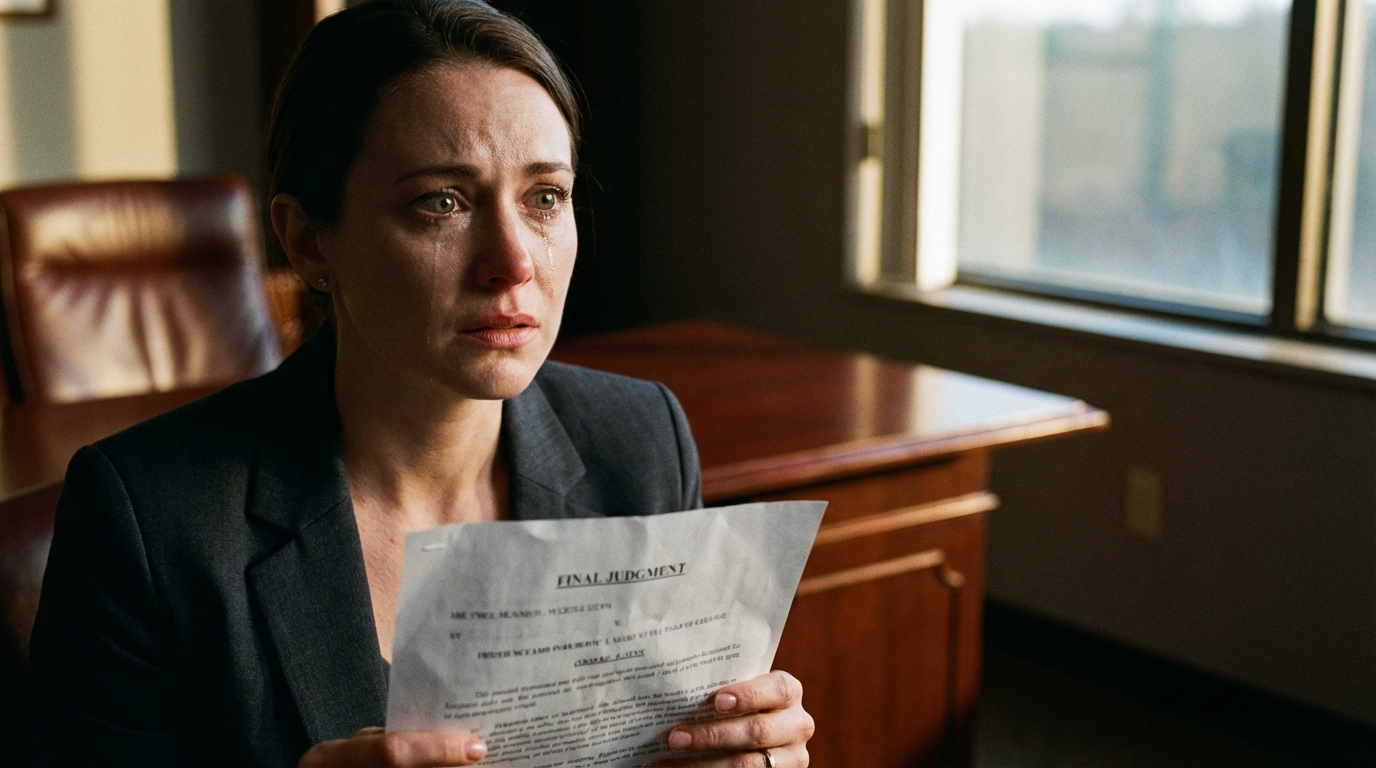
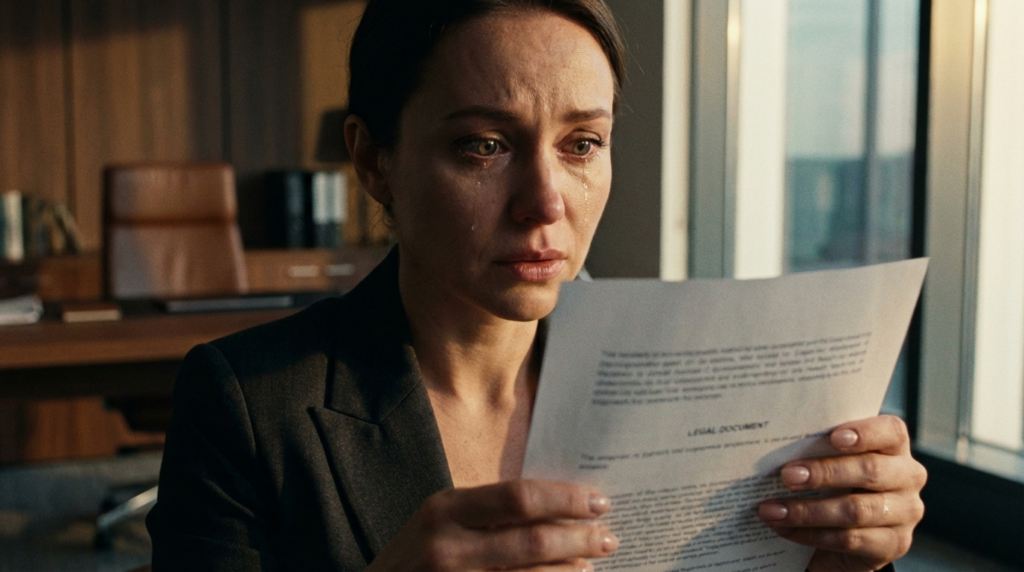
I stood in my father’s attorney’s office, staring at a piece of paper that destroyed everything I thought I knew about my life.
My billionaire father—Richard Caldwell, the real estate mogul who owned half of Manhattan—had died three weeks ago. I’d cried at his funeral. I’d given the eulogy. I’d talked about how he taught me everything about business, about integrity, about working hard for what you believe in.
All lies.
“Miss Caldwell,” the attorney said, sliding the will across his mahogany desk. “Your father left specific instructions.”
My hands trembled as I picked it up. I was his only child. His estate was worth $847 million. This was supposed to be straightforward.
But the words on that page made my vision blur.
“To my daughter Emma, I leave nothing. She has everything she needs—she just doesn’t know it yet.”
Nothing. Not a single dollar. Not the penthouse. Not the company I’d helped build for ten years. Nothing.
“There must be a mistake,” I whispered.
“There’s more,” the attorney said, handing me an envelope. “He left this letter for you. And instructions to deliver it only after you read the will.”
My throat closed up. I wanted to scream. I wanted to throw something. Instead, I sat there, frozen, holding an envelope that probably contained some cruel final lesson about self-reliance or bootstrapping or whatever nonsense he’d believed in.
But then the attorney said something that made my blood run cold:
“Your father also left instructions about a man named James. A homeless man who apparently… well, he left James $50 million.”
The room spun. A homeless man? Fifty million dollars?
“Who the hell is James?” I demanded.
“He’s been waiting outside this building for three days,” the attorney said quietly. “Your father’s instructions were that you two needed to meet. Before you open that letter.”
The Meeting I Never Expected
I stormed out of that office like a hurricane. Three days of grief, confusion, and now rage propelled me down the marble stairs and onto Park Avenue. It was raining—of course it was raining—and there, huddled under the building’s awning, sat a man who looked like he’d been sleeping rough for years.
Torn jacket. Gray beard. Weathered hands clutching a backpack that had seen better decades.
“James?” I said, my voice sharper than I intended.
He looked up, and I saw something in his eyes I didn’t expect. Not greed. Not triumph. Just… sadness.
“You must be Emma,” he said softly. “You look just like your mother.”
I froze. My mother had died when I was six. I barely remembered her.
“How do you—” I started, but he stood up slowly, like his bones hurt.
“Your father asked me to wait for you. Said you’d be angry. Said you’d probably want to hit me.” He smiled sadly. “I wouldn’t blame you.”
“Why did he give you fifty million dollars?” The words came out like venom. “Who are you? Some secret son? A blackmailer?”
James shook his head. “I’m nobody, Emma. Just someone your father met twenty-three years ago. Someone he saved.” He paused, rain dripping from his beard. “And someone who tried to save him back.”
The Story I Wasn’t Prepared to Hear
We ended up in a coffee shop two blocks away. James ordered black coffee and actually cried when it came—said it had been six months since he’d had anything hot to drink.
That’s when the guilt started creeping in. This man, who just inherited more money than most people see in ten lifetimes, was crying over a $3 coffee.
“I wasn’t always homeless,” James began, wrapping his hands around the cup like it was precious. “Twenty-three years ago, I was a cardiac surgeon. Had a wife, two kids, a house in Connecticut. Then my son got sick. Leukemia. The treatments weren’t covered by insurance—experimental trial. I liquidated everything. Took out loans. Sold our house.”
He stared into his coffee, and I realized I was holding my breath.
“He died anyway. Eight years old. And the debt… it buried me. My wife left. I lost my medical license because I couldn’t pay the board fees. Lost everything. I was sleeping in my car in a parking garage when your father found me.”
“Found you how?” I whispered.
“I was trying to kill myself,” James said flatly. “Had a bottle of pills. Figured I’d just go to sleep and not wake up. Then this man in a $5,000 suit sits down next to my car and says, ‘Bad night?’ Just like that. Like we were old friends.”
My heart clenched. That sounded exactly like something my father would do.
“He talked to me for four hours. Didn’t lecture. Didn’t judge. Just… listened. Then he offered me something I’ll never forget. He said, ‘I can’t fix what’s broken, but I can give you a reason to stay alive one more day.'”
“What did he do?” I asked.
“He gave me a job. Custodian at one of his buildings. Minimum wage, but it came with a tiny apartment in the basement. He visited me once a month for fifteen years. Never made a big deal about it. Just… checked in.”
James pulled out a worn photograph from his backpack. My father and James, both younger, standing outside one of Dad’s buildings. Both smiling.
“Then five years ago, I relapsed. Started drinking. Got fired. Ended up back on the streets. I was too ashamed to contact him.” James’s voice cracked. “But three months ago, your father found me again. Sleeping under a bridge. He sat down next to me, just like that first night, and said, ‘Bad night?'”
I was crying now. I couldn’t help it.
“He was dying, Emma. He knew it. The cancer had spread, and he had maybe three months left. He told me he’d wasted too much of his life chasing money and not enough time on what mattered. He said he’d failed the people he loved most.”
“He didn’t fail,” I said automatically. “He built an empire—”
“He failed you,” James interrupted gently. “That’s what he told me. He said he’d given you everything except what you really needed. He said you’d become just like him—brilliant, driven, successful, and completely empty inside.”
The words hit like a physical blow because they were true.
The Letter That Changed Everything
James handed me an envelope. A different one. Crumpled and stained.
“He gave this to me two months ago. Made me promise to give it to you after you read the will. After you met me. He said you needed context.”
My hands shook as I opened it. My father’s handwriting filled three pages.
Dearest Emma,
If you’re reading this, you’ve met James. You’re probably furious with me. Good. I need you to feel something real.
I’ve watched you for the past ten years become a perfect copy of me—ruthless in business, emotionally distant, measuring success in zeros on a bank statement. I did that to you. I taught you that money equals worth. That weakness is failure. That kindness is for people who can’t hack it in the real world.
I was wrong about everything.
When your mother died, I broke. I buried my grief in work, in deals, in building an empire that would prove I mattered. I taught you to do the same. I taught you that vulnerability is dangerous and that the only person you can trust is yourself.
James showed me the cost of that philosophy. When I met him twenty-three years ago, I was at the peak of my success—and the lowest point of my humanity. I’d just closed a deal that destroyed a family-owned business. Hundreds of people lost jobs. I celebrated with champagne.
Then I found a man trying to end his life in one of my parking garages. A man who’d lost everything trying to save his son. A man who’d loved so deeply that he’d been willing to destroy himself.
I realized I’d never loved anything that much. Not even you. Not really.
James became my teacher. Every month, I visited him because he reminded me that there was more to life than winning. He showed me that kindness wasn’t weakness—it was the hardest, bravest thing a person could do.
I’ve left him $50 million because he saved my life in ways I can’t explain on paper. But more importantly, I’ve left him enough to rebuild what the world took from him.
As for you, Emma—I’ve left you nothing because you already have everything you need. You’re brilliant. You’re capable. You don’t need my money.
But you need what James can teach you.
I’ve set up something that will shock you. Every month for the next year, you’ll receive a task. An assignment. It will require you to step outside your comfort zone, to be vulnerable, to practice kindness without expecting anything in return.
Complete all twelve tasks, and you’ll unlock a trust I’ve established for you. Not because you earned the money—but because you’ll have earned something far more valuable: the ability to be human again.
James will be your guide. He doesn’t know this yet, but I’ve asked him in a separate letter to help you. To teach you what he taught me.
I love you, Emma. I always have. But I’ve loved you poorly. This is my last chance to be the father you deserved.
Don’t waste it. Don’t waste your life the way I wasted mine.
Dad
I couldn’t breathe. Tears were streaming down my face, and I didn’t care that I was sobbing in a public coffee shop.
James handed me a napkin. “He gave me a letter too. Asked if I’d help you with whatever these tasks are. Said it might help me as much as it helps you.”
“I don’t understand,” I choked out. “What kind of tasks?”
James pulled out a sealed envelope. The first task.
Task One: The Woman at the Grocery Store
The instructions were simple and terrifying:
Go to the grocery store on 8th Avenue where you shop every week. You walk past a woman every time—she sits outside with a sign. You’ve never looked at her. This week, stop. Buy her groceries. Ask her name. Listen to her story. Don’t leave until you understand why she’s there.
I felt sick. I knew exactly who my father meant. An older woman, maybe sixty, always sitting in the same spot. I’d passed her hundreds of times. Had never made eye contact once.
“I don’t know if I can do this,” I whispered.
James smiled sadly. “Your father said you’d say that. He also said to remind you that I sat next to him under a bridge three months ago, and he stopped to ask if I was okay. A billionaire dying of cancer stopped to help a homeless drunk. He said if he could do it, so can you.”
The next day, I stood outside that grocery store for twenty minutes before I found the courage to approach her.
Her name was Patricia. She was seventy-one years old. She’d been a teacher for forty years before her pension fund was stolen by corrupt administrators. Lost her apartment. Had too much pride to ask her children for help because they were struggling too.
I bought her $200 worth of groceries. She cried. I cried. And then she said something that broke me:
“You’re Richard’s daughter, aren’t you? He used to stop and talk to me every Tuesday morning. Brought me coffee. Never made a big deal about it. I haven’t seen him in months—is he okay?”
That’s when I realized my father had been living a completely different life than the one I thought I knew.
The Year That Changed Me
I won’t detail all twelve tasks—each one deserves its own story. But I’ll tell you this: James became my closest friend.
Task three had me volunteering at a homeless shelter. Task five required me to visit the family whose business my father had destroyed and apologize on his behalf. Task eight sent me to a children’s hospital to sit with kids whose parents couldn’t afford to take time off work.
Each task stripped away a layer of the armor I’d built. Each one showed me a world I’d been blind to—not because it was hidden, but because I’d chosen not to see it.
James walked beside me through every single one. Some days he was living in shelters. Other days he’d show up in clean clothes, slowly rebuilding his life with the money my father left him.
He told me once: “Your father didn’t leave you nothing, Emma. He left you everything. He left you the chance to become the person you were always meant to be.”
The Final Task
Month twelve. The last envelope.
Return to my office. The one you helped me build. Open the locked drawer in my desk—the key is with James. Inside, you’ll find what I really wanted to leave you.
My hands shook as I unlocked that drawer. Inside was a folder. Medical records. Donation forms. And a letter from a transplant coordinator.
My father had been a perfect kidney match for a twenty-eight-year-old mother of two who was dying. He’d donated his kidney six months before the cancer diagnosis—knowing full well it might complicate his treatment.
He’d saved her life and never told anyone.
Beneath the medical records was a bank statement. A trust in my name. Not $847 million. But $50 million. Exactly the same amount he’d left James.
The note attached said:
You’ve learned what I needed you to learn. The rest of my estate is being distributed to the causes you discovered during your tasks—the shelter, the hospital, the pension fund restoration program.
This $50 million is yours. Not because you earned it. But because I trust you to use it wisely.
Be better than I was. Love harder than I did.
You’ve always had everything you need. Now you know it.
One Year Later
I’m writing this from my new office. Not the corner suite in a skyscraper. A small space above a community center in Brooklyn. I run a foundation now—one that helps families facing medical debt, the crisis that destroyed James’s life.
James is my co-director. He’s been sober for fourteen months. He reconnected with his daughter last month. They’re taking it slow, but they’re talking.
Patricia, the woman from the grocery store, works part-time at our foundation. She manages our volunteer program and still won’t let me buy her coffee—says it’s her turn to take care of me now.
I think about my father every day. About the man he was publicly and the man he was in those quiet moments I never knew about. The man who sat with homeless strangers and bought coffee for elderly women and donated organs to people he’d never meet.
He didn’t leave me nothing. He left me everything.
He left me the chance to learn that wealth isn’t measured in bank accounts. That success isn’t about winning. That the only thing that truly matters is how you make people feel when they’re at their lowest point.
James told me something last week that I keep thinking about: “Your father spent sixty years building an empire. But in his last year, he finally built a legacy.”
I’m not my father. But I’m trying to be the person he became at the end. The person he hoped I could be.
And every morning when I walk past someone struggling, someone invisible, someone the world has forgotten—I stop. I make eye contact. I ask if they’re okay.
Because my father taught me, through a homeless man and twelve impossible tasks, that kindness isn’t just something that matters.
It’s the only thing that matters.
Sometimes the greatest inheritance isn’t money. It’s the wisdom to know what really makes you rich.