The Camping Trip That Became a Nightmare
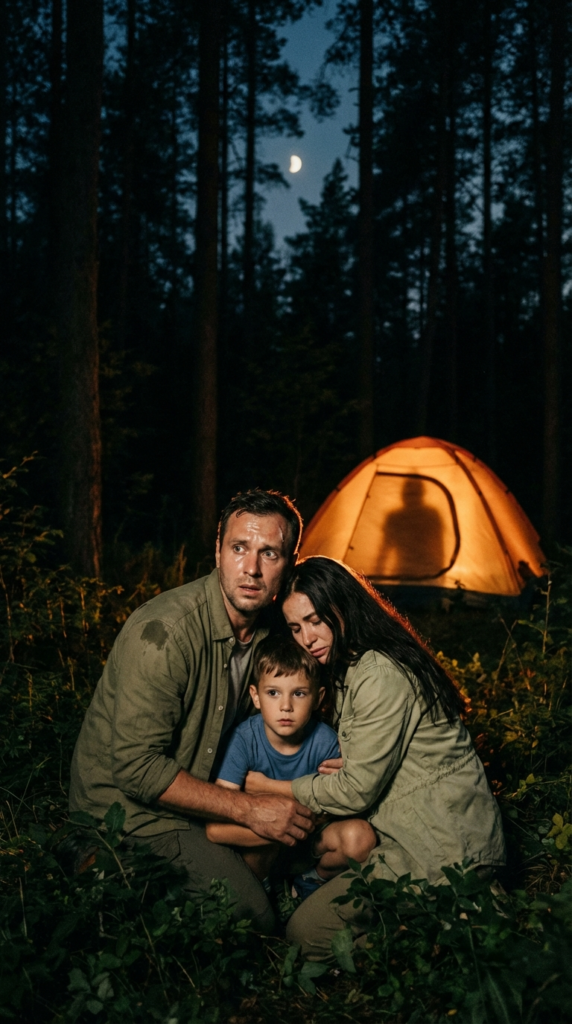
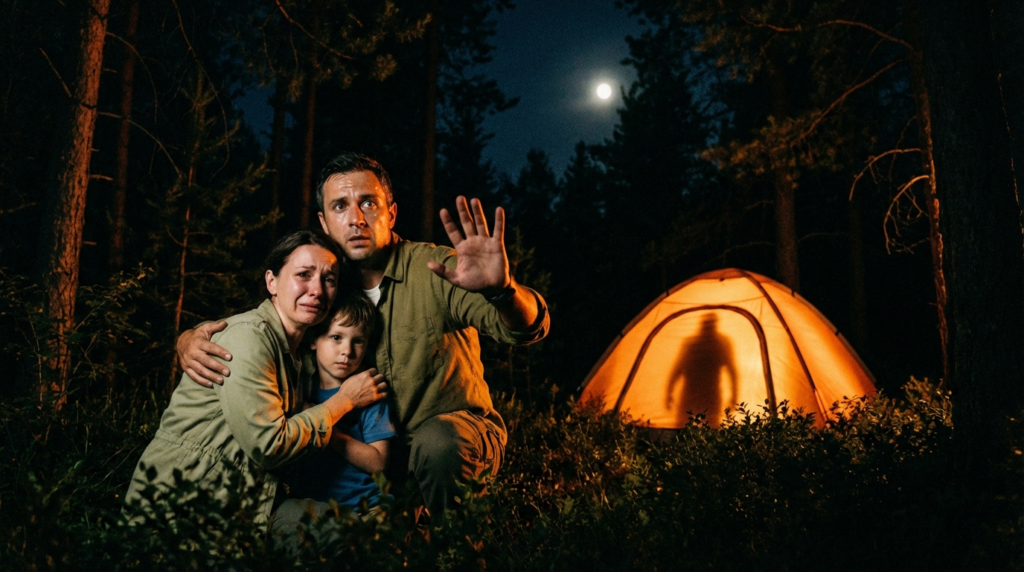
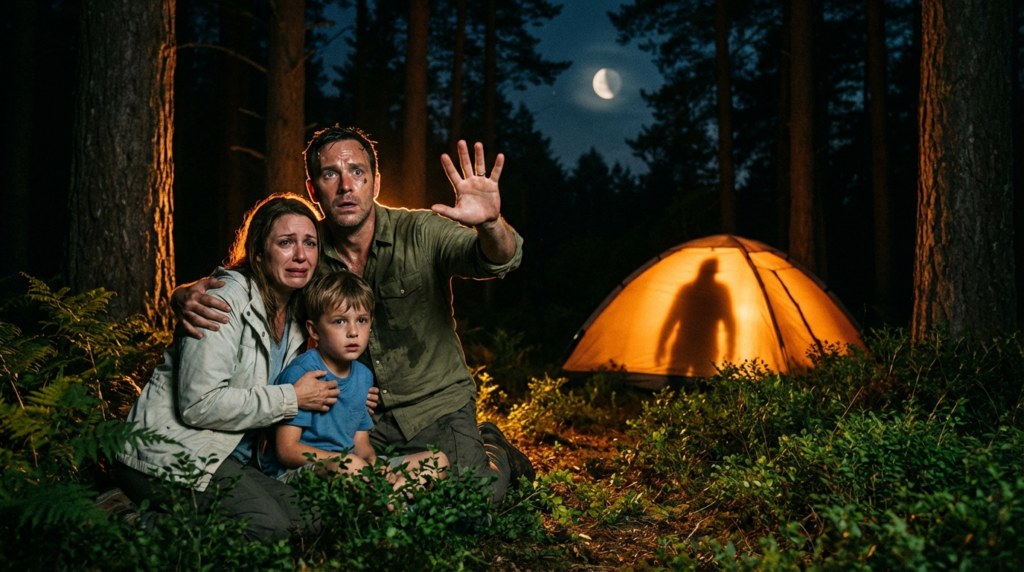
I was holding my seven-year-old son in the darkness, one hand covering his mouth to keep him quiet, when I dialed 911 with shaking fingers.
“There’s someone outside our tent,” I whispered into the phone. “He’s been circling our campsite for the past hour. We’re trapped.”
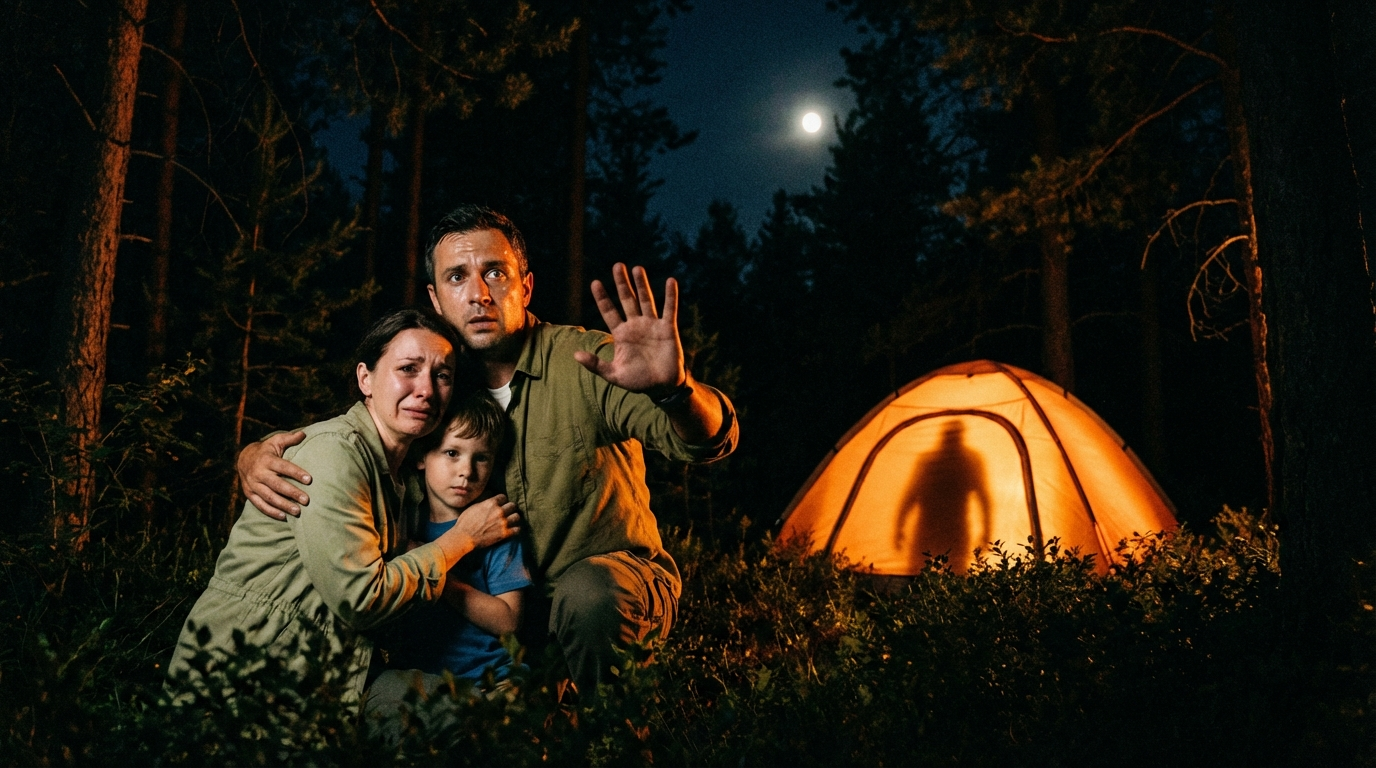
My wife Sarah was pressed against me, tears streaming down her face. Our son Jake was trembling between us. Our family camping trip—the one we’d planned for months—had turned into a living nightmare.
It started around 10 PM. We’d set up camp in Redwood State Forest, about three miles from the main road. The campsite was beautiful—secluded, surrounded by towering pines, with a small creek nearby. Perfect for a weekend away from the city.
We’d roasted marshmallows, told ghost stories (which now seemed like a terrible idea), and watched the stars. Jake had fallen asleep in the tent around 9:30, and Sarah and I were just about to join him when we heard them.
Footsteps.
Slow, deliberate footsteps circling our tent. Getting closer. Stopping right outside. Then moving away. Then coming back.
At first, I thought it was an animal. A deer, maybe. But the footsteps were too deliberate. Too… human.
I’d peeked through the tent flap and saw a tall figure silhouetted against the moonlight. Just standing there. About twenty feet away. Watching our tent.
My blood ran cold.
“Sarah,” I whispered. “Wake up Jake. Quietly. Don’t let him make any noise.”
“What’s wrong?” she asked, then saw my face. “Oh God. What is it?”
“Someone’s out there.”
The Hour of Terror
For the next hour, we sat in that tent in absolute terror.
The figure kept circling. Sometimes we’d hear branches snapping. Sometimes we’d see the shadow pass across the tent wall. Sometimes there would be silence—long, agonizing minutes of silence—and we’d think he’d left. Then the footsteps would start again.
Jake was remarkably brave. He didn’t cry. Didn’t make a sound. Just held onto both of us with his little hands and stared at the tent door.
“Why is he just walking around?” Sarah whispered. “Why doesn’t he leave?”
“I don’t know,” I said. But I had theories. None of them good. We were miles from help. Alone. Three easy targets.
That’s when I called 911.
“There’s someone outside our tent,” I told the operator, trying to keep my voice steady. “He’s been circling our campsite for the past hour. We’re at Redwood State Forest, Site 47. We’re trapped.”
“Are you injured?” the operator asked.
“Not yet. But he’s still out there. He won’t leave.”
“Stay inside your tent,” she instructed. “Don’t confront him. Officers are being dispatched now. Estimated arrival is fifteen minutes.”
Fifteen minutes felt like an eternity.
The footsteps continued. Sometimes close enough that I could see the shadow of the person moving across the illuminated tent wall from our lantern inside. Sometimes I could hear breathing. Heavy, labored breathing.
“He’s hurt,” Sarah whispered. “Listen. He sounds injured.”
“I don’t care,” I said. “I don’t care if he’s hurt. I care about keeping our family safe.”
Then the figure stopped directly in front of our tent entrance.
“Please,” a voice said from outside. Male. Rough. Desperate. “Please, I need—”
“Stay away from us!” I shouted, my voice cracking with fear. “The police are coming!”
“No, you don’t understand—” the voice pleaded. There was genuine desperation in it. Almost… fear?
“We have weapons!” I lied. “Don’t try to come in here!”
That’s when I saw the shadow reach toward our tent zipper. He was trying to get in.
I grabbed the camping knife from my bag—six inches of steel meant for cutting rope—and positioned myself between my family and the door. My hands were shaking, but my resolve wasn’t. If this person tried to hurt my family, I would fight.
“Please,” the voice said again. “You have to listen—”
Blue and red lights suddenly flashed through the trees. The police had arrived.
“Sir, step away from the tent!” an officer’s voice commanded. “Hands where I can see them!”
I heard the man move away. Heard multiple voices. Shouting. Then footsteps approaching our tent again, but different. Official. Controlled.
“Mr. Reynolds? It’s Officer Patterson. You can come out. You’re safe now.”
The Truth That Destroyed Me
I unzipped the tent with shaking hands. Three police officers stood outside—two with their flashlights pointed at a man sitting on the ground about thirty feet away. He was older than I’d expected, maybe late fifties, with gray hair and torn clothing. His hands were raised, and even from a distance, I could see he was covered in dirt and blood.
“Are you and your family okay?” Officer Patterson asked.
“We’re fine,” I said. “But that man—he’s been stalking us for over an hour. Trying to get into our tent. We were terrified.”
Officer Patterson looked at me with an expression I couldn’t read. “Mr. Reynolds, this man wasn’t stalking you. His name is Thomas Chen. He’s been trying to warn you.”
“Warn us? About what?”
The officer pointed his flashlight toward the creek—the one we’d thought was such a charming feature when we’d picked this campsite.
In the beam of the flashlight, I could see it clearly now: the creek had risen dramatically. What had been a gentle trickle at 6 PM was now a raging torrent of water, at least four feet high and climbing.
“Flash flood,” Officer Patterson said. “There was a storm system thirty miles upstream about two hours ago. The creek you’re camped next to can rise ten feet in under an hour during heavy runoff. Mr. Chen was trying to get you to evacuate before it reached your tent.”
I felt like I’d been punched in the stomach. “What?”
The second officer walked over. “Mr. Chen is a volunteer search and rescue member. He was hiking the area when he heard the flood warning on his radio. He ran to this campsite to warn you—the closest occupied site to the flood zone. But apparently he lost his radio and cell phone when he fell crossing the creek upstream. Injured his leg pretty badly.”
I looked at the man sitting on the ground. He was holding his right leg at an awkward angle. Blood seeped through his torn pants.
“He’s been trying to warn us?” Sarah’s voice cracked. “And we… we called the police on him?”
“He was trying to get into our tent to physically move us if necessary,” Officer Patterson explained. “He knew you were in immediate danger. The tent you’re in right now?” He pointed his flashlight at the ground beneath us. “It’ll be under five feet of water in less than ten minutes.”
As if on cue, I heard the rushing water getting louder. Closer.
“We need to evacuate now,” the officer said firmly. “Grab only essentials. Leave the tent. We’ll come back for it when the water recedes.”
The Apology I Could Barely Speak
As Sarah grabbed Jake and our essential supplies, I walked over to Thomas Chen.
He looked up at me with exhausted eyes. His face was scratched, probably from running through the forest in the dark. His leg was clearly broken or badly sprained.
“I’m sorry,” I choked out. “I’m so, so sorry. You were trying to save us, and I—”
“You were protecting your family,” he interrupted. His voice was gentle despite everything. “I understand. From your perspective, I was a stranger acting threatening. You did what any father would do.”
“But you’re hurt. You ran through the forest, injured yourself trying to reach us—”
“And you’re safe,” he said simply. “That’s what matters.”
Tears were streaming down my face now. “You could hear us in the tent. You heard me threaten you. Tell you to stay away. And you kept trying.”
“Because you had a child in there,” Thomas said. “I could hear his voice earlier, before sunset, when you were making s’mores. Sounded about the age of my grandson. And I thought… if my family was in danger and someone knew, I’d hope they’d do everything possible to warn them. Even if it meant being misunderstood.”
The water was at our ankles now. The officers were urging us to move.
“We need to go,” Officer Patterson said. “Mr. Chen, we’ll need to carry you out. That leg needs immediate medical attention.”
“Wait,” I said. I turned to Jake, who was holding Sarah’s hand, watching everything with wide eyes. “Son, come here for a second.”
Jake walked over, and I knelt down next to him and Thomas.
“Jake, this is Mr. Chen. Do you know what he did tonight?”
Jake shook his head.
“He hurt his leg very badly, but he ran through the forest in the dark to warn us about the flood. He was trying to save our lives. And we… we didn’t understand. We were scared of him.”
“Because of the ghost stories?” Jake asked quietly.
The question hit me like a truck. “Yeah, buddy. Because of the ghost stories. Because we let fear make us see a monster instead of a hero.”
Jake looked at Thomas. Then, without hesitation, he walked over and hugged him.
“Thank you for saving us,” Jake said. “Even though we were scared of you.”
Thomas Chen, this man who’d broken his leg trying to rescue strangers, started crying. He hugged my son back and whispered, “You’re welcome, brave boy.”
The Hospital Visit That Changed Everything
The flood did hit our campsite. By morning, the tent we’d been sleeping in was completely submerged. If Thomas hadn’t reached us when he did, we would have been trapped. Possibly killed.
Thomas was admitted to the hospital with a fractured tibia, multiple lacerations, and severe dehydration. The doctors said he’d been in the forest for nearly three hours before reaching our campsite, running on a broken leg, knowing people were in danger.
We visited him the next day. Brought flowers. Chocolate. And a drawing Jake had made—a picture of a superhero with gray hair.
“That’s you,” Jake explained, pointing at the figure. “You’re my hero.”
Thomas’s wife was there—a kind woman named Linda who hugged us like we were family. “He does this,” she said with affectionate exasperation. “Risks his life for people he doesn’t know. Twenty years as a volunteer search and rescue. This is the third time he’s been hospitalized saving someone.”
“Why do you do it?” Sarah asked Thomas. “Why risk so much for strangers?”
Thomas thought for a moment. “Ten years ago, my daughter and her husband went hiking. There was an unexpected storm. They got lost. And a search and rescue volunteer—someone they’d never met—spent two days in freezing conditions looking for them. Found them hypothermic in a cave, on the verge of death. Carried my daughter out on his back.”
His eyes filled with tears. “That volunteer got frostbite so severe he lost three toes. But he saved my little girl. And when I tried to thank him, he said, ‘That’s what we do. We show up for each other when it matters most.'”
“So you became a volunteer,” I realized.
“I became the person who shows up,” Thomas corrected. “Even when it’s hard. Even when it’s dangerous. Even when the people I’m trying to help think I’m a threat.”
The words hung in the air.
“I’m so ashamed,” I whispered. “The things I thought about you. The way I threatened you. If I’d just opened that tent flap and talked to you instead of assuming the worst—”
“You would have done the exact same thing,” Thomas said firmly. “And that’s okay. Fear is a powerful thing. It protects us. But it also blinds us sometimes.”
What My Son Taught Me
On the drive home from the hospital, Jake was quiet in the backseat. Then he asked a question that broke my heart:
“Dad, why did we think Mr. Chen was a bad guy?”
I pulled over. Turned around to look at my son.
“Because we were scared,” I admitted. “And when people are scared, they sometimes see danger even when there isn’t any. We heard footsteps in the dark and assumed the worst.”
“But he was trying to help us,” Jake said.
“Yes.”
“So being scared made us mean to someone nice?”
The simplicity of his understanding made me realize how complicated we make things as adults.
“Yes, buddy. That’s exactly what happened. Fear made us see Mr. Chen as a monster when he was actually a hero.”
Jake thought about that. Then: “Maybe next time we should ask people what they need before we get scared?”
Out of the mouths of children.
“You’re right,” I said. “Maybe we should.”
Thomas Chen became part of our family.
We had him and Linda over for dinner once a month. Jake called him “Mr. Hero” and drew him pictures constantly. Sarah and Linda became close friends.
And Thomas taught us something profound about kindness—something I’d never understood before that night in the forest.
Kindness isn’t always convenient. It’s not always safe. And it’s not always recognized for what it is.
Thomas risked his life running through a dark forest on a broken leg to warn strangers about danger. And those strangers responded with fear and threats.
But he kept trying. Kept persisting. Because true kindness doesn’t require gratitude or recognition. It just requires showing up when someone needs help.
Last month, I joined the volunteer search and rescue program. Thomas trained me himself.
“I need to become the person who shows up,” I told him. “The person who sees past fear to help people who need it.”
He smiled. “You already are. You just needed to learn it.”
I think about that night often. The shadow circling our tent. My terror. My certainty that we were in danger.
And then I think about Thomas—injured, exhausted, desperate—trying to save a family that saw him as a threat.
The Lesson That Changed Us Forever
I tell this story now whenever I can. To friends. To fellow volunteers. To anyone who’ll listen.
Because here’s what that night taught me:
The scariest moment of my life—the moment I thought my family was being stalked by a predator—was actually the moment someone was risking everything to save us.
My fear wasn’t wrong. Fear is a survival instinct. But my fear made me blind to context. To nuance. To the possibility that someone acting strange might be acting that way because they’re trying to help.
Thomas could have given up. When we threatened him. When we called the police. When we made it clear we saw him as a danger.
But he didn’t. Because kindness isn’t about being appreciated. It’s about doing what’s right even when it’s hard. Even when you’re misunderstood. Even when the people you’re helping are afraid of you.
Jake understands this better than most adults I know. Last week at the grocery store, he saw a man acting erratically in the parking lot. Most people crossed to the other side. But Jake tugged my hand and said, “Dad, maybe he needs help?”
The man was diabetic. His blood sugar had dropped dangerously low, and he was confused and disoriented. We called 911. Stayed with him until the ambulance arrived. He thanked us with tears in his eyes.
“You could have just walked past,” he said. “Most people did.”
“My son learned from the best,” I said, thinking of Thomas.
We still go camping. But now Jake insists on talking to everyone we meet on the trail. “Maybe they need help,” he always says. “Or maybe they’re going to help us.”
And he’s right. Because the world isn’t divided into monsters and heroes. It’s full of people trying their best. Sometimes those people look scary because they’re desperate. Sometimes they act strange because they’re injured. Sometimes they persist when told to leave because they know something you don’t.
Thomas Chen—the “stalker” who terrified us—saved our lives and taught us that kindness means showing up even when you’re misunderstood.
And that’s a lesson worth more than any camping trip. Worth more than any vacation. Worth more than pride or fear or the comfort of assumptions.
Sometimes the shadow outside your tent isn’t a monster. Sometimes it’s a hero trying to save you.
And the only way to know the difference is to choose curiosity over fear. Questions over assumptions. Kindness over self-protection.
Thank you, Thomas, for being the kind of person who shows up. Even when it costs you everything. Even when the people you’re saving don’t understand.
You didn’t just save our lives that night. You changed them.