The Watch That Taught Me How to Count
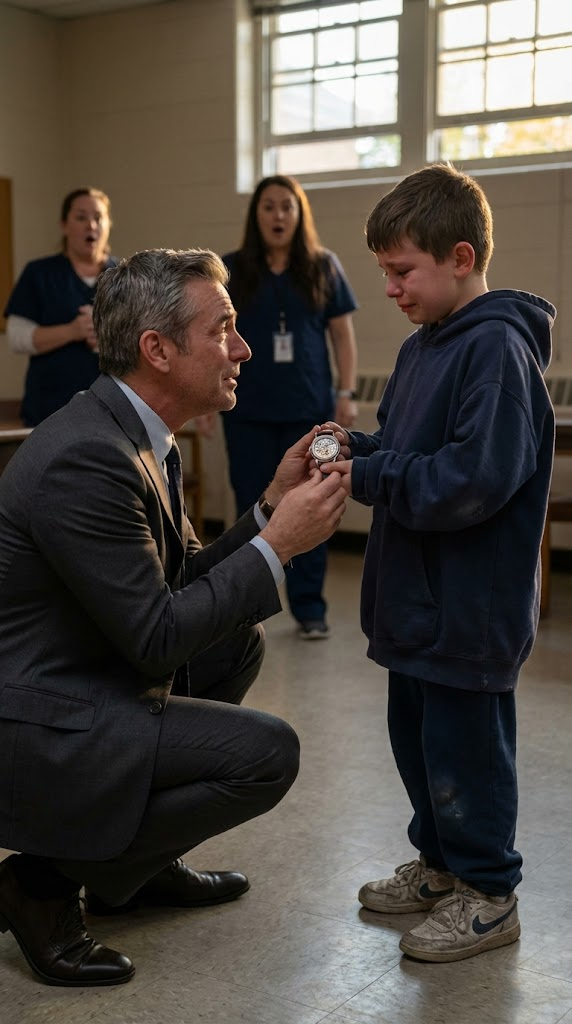
I’ll never forget the look on that kid’s face when he slipped my $45,000 Patek Philippe off my wrist.
I was at Henderson House—a group home I’d been visiting quarterly for the past three years as part of some corporate charity obligation my PR team insisted on. Honestly? I did it for the tax write-off and the photo ops. Shake some hands, write a check, post it on LinkedIn. Easy.
This kid, maybe eleven or twelve, had been watching me the whole time. Messy brown hair, worn-out sneakers with the soles peeling off, eyes that looked too old for his face. While I was making small talk with the director about their “urgent funding needs,” I felt the clasp release. Smooth. Professional, even.
Most people would’ve grabbed his arm. Called security. Made a scene.
I just looked at him.
He didn’t run. Instead, he held up my watch—this piece of mechanical art that cost more than most people make in a year—and asked me the strangest question I’d ever heard:
“Does time feel different when you’re rich?”
I actually laughed. Not a polite chuckle—a real, caught-off-guard laugh. “What?”
“I mean…” He turned the watch over in his small hands, studying the skeleton movement through the sapphire crystal. “You have all this money, right? So you can do whatever you want, whenever you want. Does that make time feel… slower? Like you have more of it?”
My driver was already walking toward us. The director had noticed. I had about fifteen seconds before this became a whole thing.
“Kid, give me back my—”
“My mom died when I was eight,” he interrupted, still staring at the watch. “I was holding her hand. The hospice nurse kept looking at her watch, counting the seconds between breaths. I remember thinking… if we just had more time, if we were rich enough for the better treatment, would those seconds have counted different?”
Everything in me went cold.
This wasn’t a theft. This was something else entirely.
I crouched down to his level and did something I never do—I looked at a stranger and actually saw them. Really saw them. The kid’s hands were shaking. There were old bruises on his knuckles.
“What’s your name?” I asked.
“Marcus.”
I made a decision in that moment that would completely derail my perfectly planned billionaire existence.
“Marcus,” I said slowly, “keep the watch.”
His eyes went wide. The director gasped. My driver stopped mid-step.
“But tomorrow, you’re going to meet me at my office at 9 AM sharp. We’re going to talk about time. And regret. And what happens when you have all the money in the world but you’re still running out of both.”
I stood up, pulled out my business card, and handed it to him.
The Man Who Bought Everything Except Minutes
My name is Richard Castellano. At fifty-three, I’d built a tech empire worth $2.3 billion. Three ex-wives, four estranged children, and a penthouse overlooking Central Park that felt like a museum of my own loneliness. I collected watches because they were one of the few things that appreciated in value without talking back to me.
That Patek Philippe? I’d bought it at auction for exactly $44,750. It had 240 individual components, took nine months to assemble, and could track the phases of the moon until the year 2100. I knew everything about that watch except why I needed it.
Marcus showed up the next morning wearing the same clothes from the day before. My assistant, Jennifer, tried to turn him away at the lobby, but I’d left specific instructions. When he walked into my office, he was still wearing my watch. It hung loose on his thin wrist, the leather band wrapped twice around.
“You actually came,” I said.
“You said 9 AM sharp. It’s 8:47.” He held up the watch. “I’ve been here since 8:15. I didn’t want to be late.”
Something in my chest tightened. When was the last time anyone had shown up early for me?
“Sit down, Marcus.”
He perched on the edge of the leather chair like he might need to run. I poured two glasses of water from the crystal decanter on my desk. He took his but didn’t drink.
“You asked me if time feels different when you’re rich,” I started. “The honest answer? It feels faster. So fast you can’t catch it. I have five meetings today, each one scheduled in fifteen-minute increments. I have three board calls, two conference presentations, and a gala tonight I’m obligated to attend. I will speak to approximately forty-seven people, and I won’t remember a single conversation.”
Marcus listened with an intensity that made me uncomfortable. Nobody listened to me like that anymore. They listened to my money, my influence, my connections. Not to me.
“Why’d you let me keep the watch?” he asked.
“Because you’re the first person in thirty years who made me think about what I’m actually counting.”
The Question That Wouldn’t Go Away
Over the next three months, Marcus became a strange constant in my life. I set up a mentorship arrangement through Henderson House—completely above board, with social workers and quarterly reviews. On Saturdays, he’d come to my office, and we’d talk.
He was brilliant. Not in the way my Ivy League executives were brilliant, with their PowerPoints and market analyses. Marcus saw patterns in people. He noticed things. Like how my assistant Jennifer always scheduled my personal calls during lunch because she knew I’d cancel them. Or how the security guard in the lobby, Miguel, wore different shoes on Wednesdays because that was his long shift.
“You don’t actually see people, do you?” Marcus asked me one Saturday in April. “You see functions. Jennifer the assistant. Miguel the security guard. Even me—Marcus the charity case.”
“That’s not fair.”
“Isn’t it? You’ve told me about your business seventeen times. You’ve mentioned your kids twice. Both times, you changed the subject immediately after.”
He was right. I had three daughters and one son, spread across two marriages. Emma was twenty-eight, working in environmental law. Sarah was twenty-five, teaching abroad in Japan. Michael was twenty-one, in his third rehab stint. And Claire was eighteen, starting college in the fall. I paid for everything and knew nothing.
“My oldest daughter Emma called me last week,” I admitted. “First time in eight months. She’s getting married.”
“That’s amazing! When’s the wedding?”
“October. I’ll be in Singapore for a merger.”
Marcus just stared at me. “You’re going to miss your daughter’s wedding for a business meeting?”
“It’s a $400 million acquisition. I can’t just—”
“Mr. Castellano.” He used my last name when he was being serious. “My mom died on a Tuesday. She asked me to read to her. I told her I had homework. I said I’d do it later, after I finished my math problems. But there wasn’t a later. You know what I’d give to have one more Tuesday? One more chance to pick the right thing?”
I couldn’t look at him.
“How much time do you think you have left?” he asked quietly.
The Heart Attack That Changed Everything
I collapsed during a board meeting on June 14th at 2:37 PM. Massive heart attack. They told me later that I was technically dead for ninety seconds. Jennifer found me on the conference room floor, still holding my presentation clicker.
When I woke up in Mount Sinai, there were flowers from business associates and a card from my lawyer. Emma flew in from Portland. Sarah couldn’t get a flight from Tokyo fast enough. Michael was in rehab and couldn’t leave. Claire came straight from her college orientation.
They sat around my hospital bed like strangers visiting a museum exhibit. We’d become so good at being polite to each other that we’d forgotten how to be real.
Emma held my hand. “Dad, you scared us.”
“I’m fine. Doctors say I’ll be back at work in a month.”
“Dad—”
“The Singapore deal closes in September. I need to be ready.”
My daughters exchanged looks. That silent communication that families develop when they’ve given up on words.
Then Marcus walked in.
He wasn’t supposed to be there. Visiting hours were family only. But somehow he’d convinced the nurses that he was my grandson. He was wearing a button-up shirt that was slightly too big, and my Patek Philippe on his wrist.
“You’re an idiot,” he said.
Emma gasped. “Excuse me?”
“Marcus—” I started.
“No. You’re lying in a hospital bed because your heart literally couldn’t take your life anymore, and you’re already planning to go back to the same thing that almost killed you. You’re an idiot.”
The machines beeped. My daughters stared. Marcus walked to the side of my bed and carefully unclasped my watch.
“I’ve been wearing this for six months,” he said. “Every day. You want to know what I learned? Time doesn’t feel different when you’re rich. It feels different when you’re paying attention.”
He placed the watch on my chest.
“I counted every hour of the last six months. Every Saturday we talked. Every time you actually laughed instead of that fake business laugh you do. Every moment you forgot to check your phone and just listened. I counted forty-seven real hours. That’s it. Forty-seven hours in six months where you were actually present.”
“Marcus, that’s not—”
“Your daughter asked you about her wedding three months ago. You said you’d check your calendar. Did you?”
Silence.
“I Googled her. Emma Castellano, environmental lawyer, Portland. She won a major case last year protecting wetlands. It was in the news. Did you know that?”
I didn’t.
Marcus turned to my daughters. “Hi. I’m Marcus. Your dad talks about you all the time, but I don’t think he actually knows you. And I don’t think you know him either. So maybe, while he’s stuck in this bed and can’t run away to another meeting, you should all try counting the same time together.”
Then he left.
Just walked out, leaving my watch and my daughters and me in the heaviest silence I’d ever felt.
The Hardest Conversation
Emma spoke first. “Who was that?”
“A kid I mentor. From Henderson House.”
“You mentor someone?” Sarah looked genuinely shocked.
“It started as a PR thing,” I admitted. “But he… he sees things I don’t.”
Claire, my youngest, the one who’d barely said five words to me in two years, leaned forward. “Dad, are you actually going to Singapore? Or are you coming to Emma’s wedding?”
This was it. The question I’d been avoiding.
“The merger—”
“Is worth $400 million. We know. You told us.” Emma’s voice cracked. “Do you know what my wedding is worth to me? Do you even know his name? My fiancé?”
I didn’t. God help me, I didn’t know.
“His name is David,” Emma continued. “We’ve been together for four years. He proposed at the wetland site I saved—the case I won that you never asked about. He’s a marine biologist. He’s funny and kind, and he reminds me that there are still good men in the world, even though my father taught me not to trust that.”
Each word was a knife.
“I’m sorry.”
“We don’t need sorry, Dad. We need you to count us. Like that kid said. We need you to count the hours with us the way you count the hours in your board meetings.”
Sarah pulled out her phone. “I teach English in Osaka. I send you pictures every week. Have you looked at a single one?”
I hadn’t.
“Michael calls you from rehab every Sunday at 2 PM. You’ve answered three times in eight months.”
I knew. God, I knew.
Claire stood up. “I’m starting college in six weeks. You asked me what I’m majoring in. I told you psychology. You said ‘That’s nice’ and then took a phone call. Do you remember any part of that conversation?”
“Claire—”
“I’m studying psychology because I want to understand why successful people self-destruct. Why they build empires and lose families. Why they count money and lose time.” Tears streamed down her face. “I’m studying it because I want to understand you. And maybe figure out how not to become you.”
The heart monitor spiked. A nurse came in, checked my vitals, gave my daughters a warning look, and left.
We sat in silence for a long time.
Finally, I said the truest thing I’d said in years: “I don’t know how to be your father anymore. I don’t think I ever did.”
The Reckoning
My daughters stayed for three hours. We talked—really talked—for the first time since they were children. Emma told me about David, about the wedding plans, about how she’d always wanted me to walk her down the aisle but assumed I wouldn’t. Sarah showed me pictures from Japan, her students, the life she’d built an ocean away from me. Claire talked about her fears of starting college, of becoming an adult, of repeating my mistakes.
I listened. Not the performative listening I did in meetings, where I was already formulating my response. Actually listened.
When they left, I picked up my phone and made three calls.
First, to my CFO: “Reschedule Singapore. I don’t care what it costs. I’ll be in Portland in October.”
Second, to Jennifer: “Clear my calendar every Sunday at 2 PM. That time belongs to Michael.”
Third, to Marcus’s social worker at Henderson House: “I want to discuss long-term options. Educational trust. Maybe something more.”
Then I called Marcus directly. He answered on the second ring.
“You came to my hospital room and called me an idiot in front of my daughters.”
“Yes sir.”
“That took guts.”
“You were dying and still planning your work schedule. Somebody had to say it.”
“Marcus, why did you really take my watch that day?”
Long pause. “Because my mom died counting seconds. And I saw you wearing something worth more than her entire medical care, and you kept checking it like you were bored. Like you had so much time you didn’t know what to do with it. And I just… I wanted to know if rich people felt time different. If having money made you care less about running out.”
“And what did you learn?”
“That money doesn’t change time. It just changes what you choose to count.”
Six Months Later
I walked Emma down the aisle on October 12th. The Singapore merger happened without me—my team handled it brilliantly, which was a humbling reminder that I wasn’t as indispensable as I thought.
David was everything Emma said. At the reception, during the father-daughter dance, she whispered, “I’m glad you’re here, Dad.”
“Me too.”
“Marcus texted me earlier. Said to tell you that this is hour forty-eight.”
I laughed. The kid was still counting.
I talk to Michael every Sunday. He’s ninety days sober. We don’t talk about business or disappointment. We talk about baseball, about the books he’s reading, about the small victories of getting through another day. Last week, he told me he was proud of me. I cried.
Sarah visited for Thanksgiving. She brought her boyfriend, Kenji, a fellow teacher. They’re talking about moving back to the States next year. She asked if I wanted to help her look for apartments. I said yes.
Claire calls me from college once a week. We talk about her classes, her roommates, her growing understanding of why people do the things they do. She told me she’s writing her final psychology paper about intergenerational trauma and workaholism. I’m her primary case study. I gave her permission to be brutally honest.
And Marcus? I established an educational trust that will cover his schooling through graduate school. But more than that, we still meet every Saturday. He’s in high school now, honor roll, thinking about studying philosophy or social work.
Last Saturday, he showed up at my office wearing a suit I’d bought him for debate team. He looked sharp. Professional. He placed my Patek Philippe on my desk.
“I think it’s time I gave this back,” he said.
“You sure? That’s yours now.”
“No sir. It was never mine. It was always a question.”
“Did you get your answer?”
He smiled. “Yeah. Time doesn’t feel different when you’re rich. It feels different when you stop running from it.”
I picked up the watch. Forty-five thousand dollars of Swiss engineering. Two hundred and forty components. Accurate to within two seconds per day. I opened my desk drawer and put it away.
“You know what?” I said. “I don’t think I need this anymore.”
Marcus raised an eyebrow. “You’re giving up your watch collection?”
“I’m giving up counting the wrong things.”
I pulled out my phone and showed him my calendar. It was color-coded now. Blue for family. Green for Marcus. Yellow for Michael’s calls. Red for work—and there was a lot less red than there used to be.
“I’m counting hours now. Real ones. Like you taught me.”
Marcus grinned. “How many are we at?”
“With you? Two hundred and thirty-eight. With my kids? Four hundred and twelve and counting. With myself, actually being present in my own life? I’m still playing catch-up on that one.”
“That’s good, Mr. Castellano. That’s really good.”
We ordered lunch from the deli Marcus loved. We talked about his college applications, about a girl he liked, about his plans to volunteer at a hospice. He wanted to sit with people the way others had sat with his mom. He wanted to count time with strangers who were running out.
As he left, he turned back. “Hey, you know what’s wild? That first day, when you let me keep the watch? I was planning to sell it. I had a guy lined up and everything. Forty-five grand would’ve changed my life.”
“Why didn’t you?”
“Because when you looked at me—really looked at me—I realized nobody had done that in four years. Not since my mom died. And I thought… maybe there’s something worth more than forty-five thousand dollars. Maybe there’s someone who needs to learn the same thing I needed to learn.”
“What’s that?”
“That the only time that matters is the time you give away.”
Epilogue
I’m fifty-four now. I still run my company, but I work forty hours a week instead of ninety. I hired a CEO to handle day-to-day operations. I’m chairman of the board, which gives me enough influence to matter but enough freedom to live.
I haven’t missed a Sunday call with Michael in eleven months. He’s six months sober and working as a counselor at his rehab facility.
Emma and David are expecting their first child in March. A girl. They asked me to be involved. I said yes to everything.
Sarah and Kenji moved back to Seattle. I fly out once a month. We go hiking. She teaches me Japanese. I’m terrible at it, but she’s patient.
Claire is thriving at college. She’s decided to combine psychology with business ethics. She wants to teach future executives how not to become me. I couldn’t be prouder.
And Marcus? He got early admission to Columbia. Full ride. He wants to study philosophy and social work, exactly like he said. He still comes by on Saturdays, but now we meet at a diner instead of my office. Better pancakes.
Last week, I bought a new watch. Not a Patek Philippe. Just a simple Timex. Thirty-five dollars. It’s not accurate to within two seconds per day. It doesn’t track moon phases or have 240 components.
But it tells me exactly what I need to know: It’s time. Time to be a father. Time to be present. Time to count the hours that actually count.
Marcus noticed it immediately. “Nice watch.”
“Thanks. Got it on sale.”
“Does time feel different now?”
I smiled. “Yeah, kid. It feels slower. Fuller. Like I finally have enough of it.”
“That’s because you’re finally paying attention.”
He was right. The orphan who stole my watch taught me something no business school, no board room, no billion-dollar deal ever could: Time doesn’t discriminate between rich and poor. It passes at exactly the same speed for everyone.
The only difference is what you choose to count.