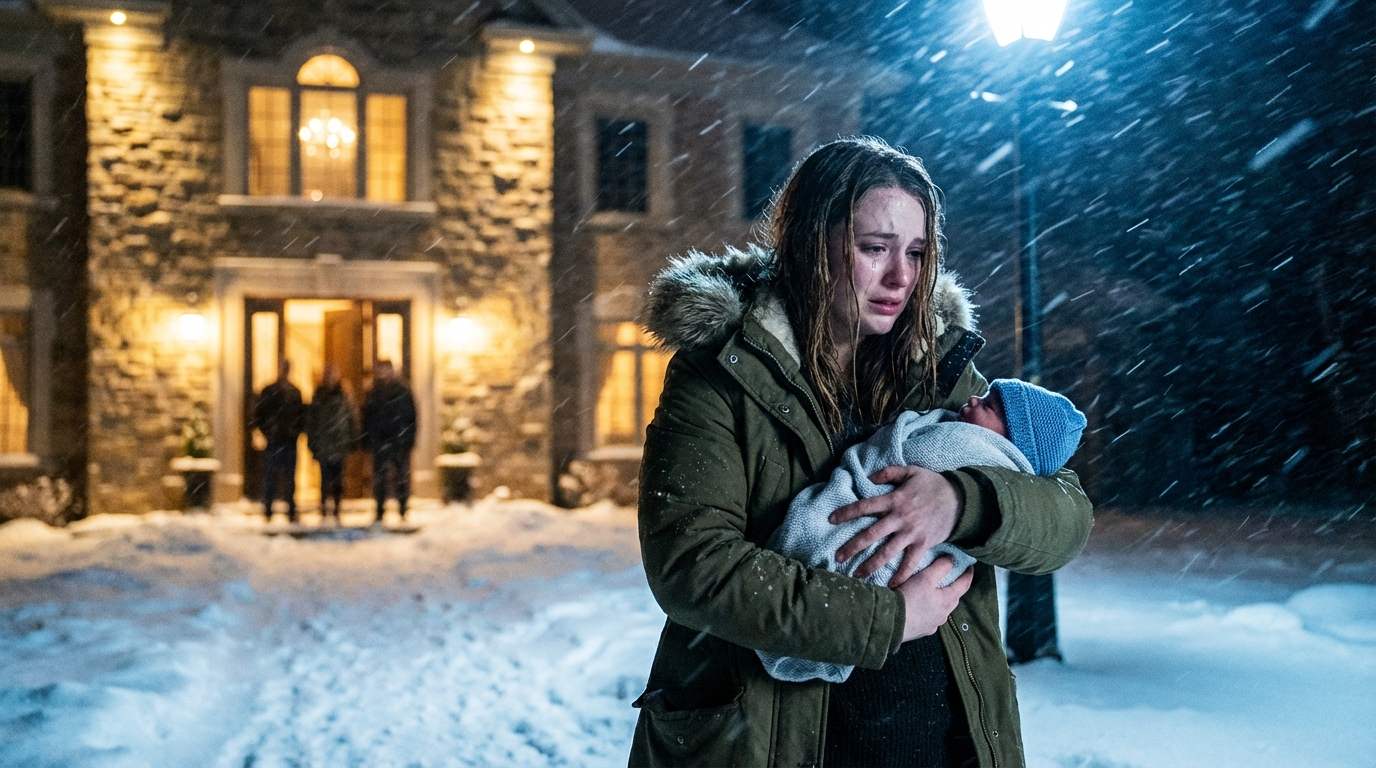
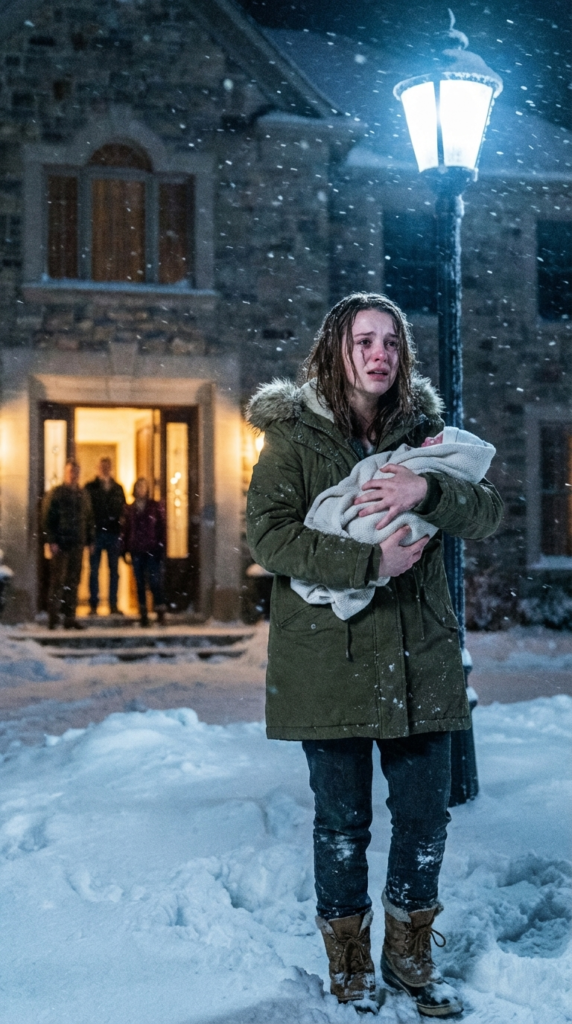
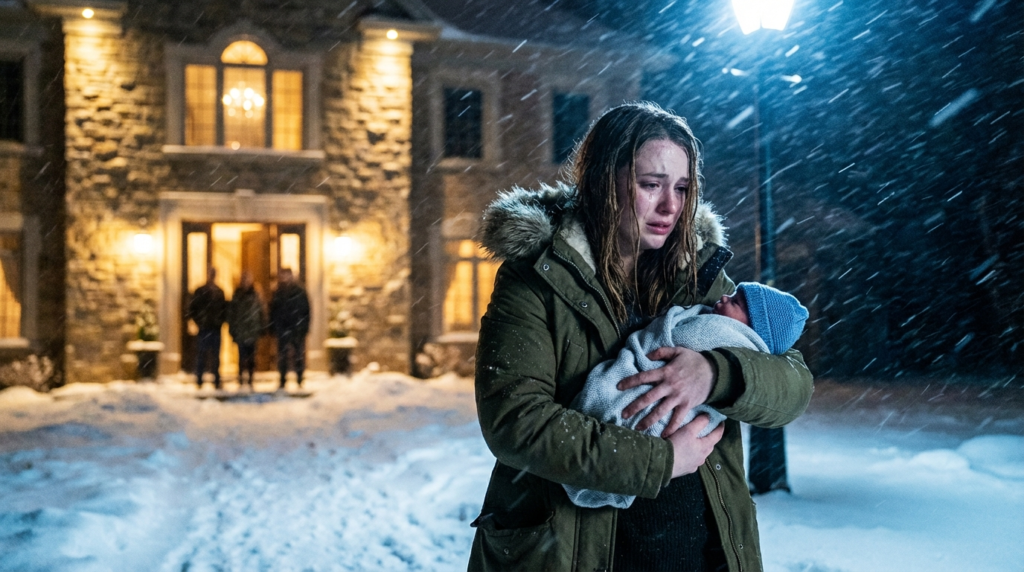
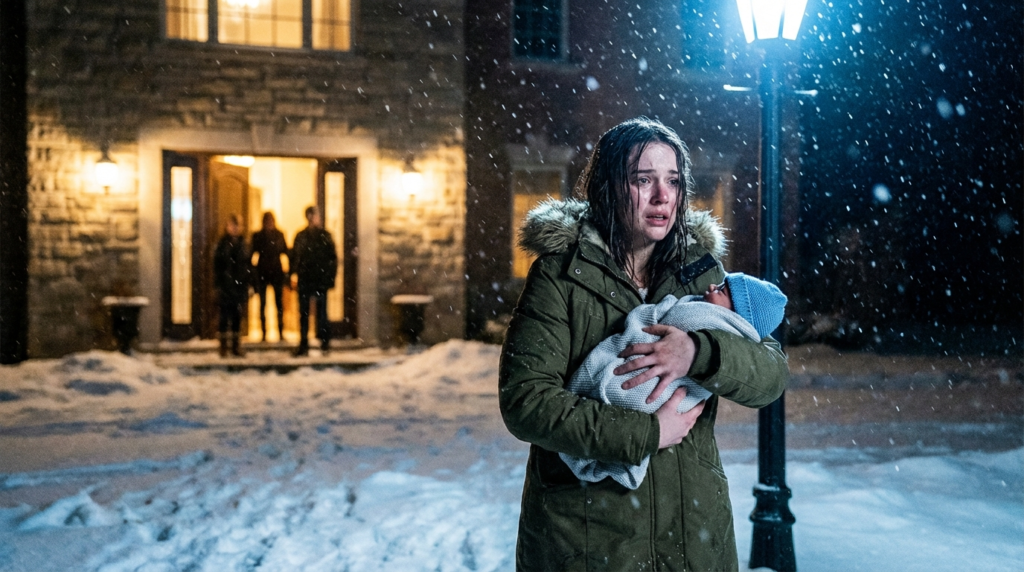
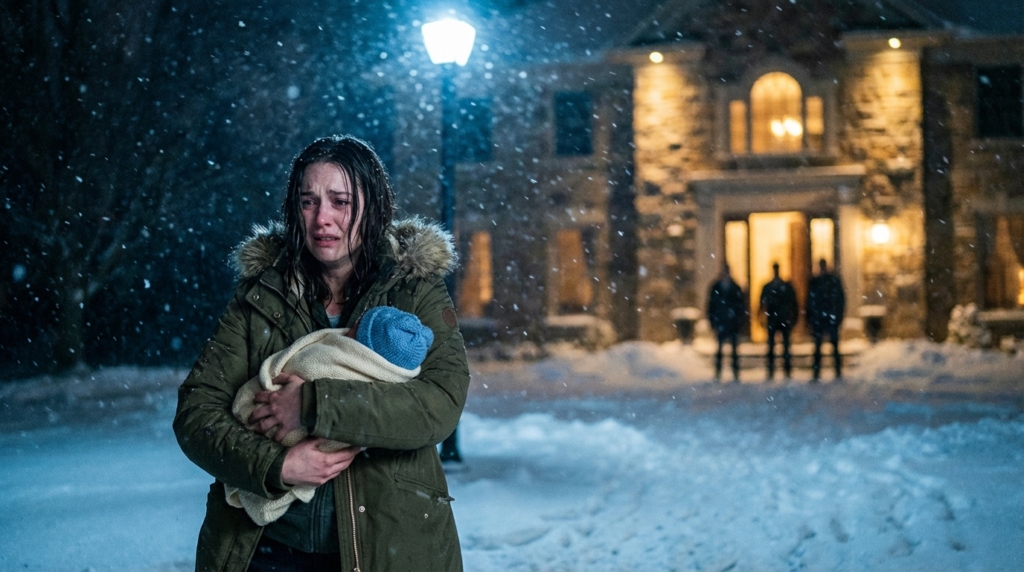
I never thought I’d be standing in a snowstorm at midnight, holding my three-week-old daughter while my in-laws watched from their heated mansion. But here I am, and I need to tell someone what happened before I lose my mind.
Let me back up.
My name is Sarah, and until three weeks ago, I thought I had the perfect life. I married James two years ago—tall, handsome, successful. His family is old money. The kind of wealth where they don’t talk about money because they’ve never had to worry about it. Country club memberships passed down through generations. A “family legacy” that gets mentioned at every dinner party.
I’m not from that world. My parents are middle-class—dad’s a teacher, mom’s a nurse. They taught me that love and integrity matter more than bank accounts. When James and I started dating, he seemed different from his family. He said he wanted to build something of his own, that he didn’t care about the trust funds and board positions his father kept dangling in front of him.
I believed him.
When I got pregnant last year, James was thrilled. We’d been trying for six months, and seeing those two lines on the test felt like everything was falling into place. We announced it to his family over Sunday brunch at their estate—yes, they call it an estate, not a house.
His mother, Patricia, smiled that tight smile she always gives me. “How wonderful,” she said, her voice crisp as the linen napkins. “I assume you’ll be using Dr. Rothschild for the delivery? He’s delivered every Ashford baby for three generations.”
“Actually,” I said, feeling James squeeze my hand under the table, “we’re going with Dr. Chen. She’s amazing, and her practice focuses on natural birth support.”
The temperature in that dining room dropped twenty degrees.
“I see.” Patricia dabbed her mouth with her napkin. “Well, we’ll discuss the details later. There’s quite a bit to arrange for an Ashford heir.”
That word—heir—should have been my first warning.
Over the next few months, the “suggestions” started rolling in. Patricia had opinions about everything: the nursery colors (cream and gold, “traditional Ashford colors”), the baby’s name (James VI for a boy, Caroline after James’s grandmother for a girl), even which hospital I should deliver at (the private wing their family has donated to for decades).
I tried to be diplomatic. I really did. But when she showed up at our apartment with a interior designer to “fix” the nursery I’d spent weeks preparing, something in me snapped.
“Patricia, I appreciate your input, but this is our baby. James and I will make the decisions.”
She looked at me like I’d slapped her. “Sarah, you don’t understand. The Ashford family has certain standards. Certain… expectations. We’re not trying to control you, dear. We’re trying to help you understand the responsibilities that come with this child.”
“What responsibilities? She’s a baby, not a board member.”
“She?” Patricia’s eyes narrowed. “You know the gender?”
I’d slipped. We’d decided to keep it private for a few more weeks. “Yes. We’re having a girl.”
The silence that followed was deafening. James’s father, Richard, set down his scotch glass. “A girl.”
“Is that a problem?” I asked, though I already knew the answer from their faces.
Richard cleared his throat. “The Ashford legacy has always passed through the male line. A daughter complicates things with the trust, the business holdings, the foundation board seats.”
“Complicates things?” I felt my voice rising. “This is your granddaughter you’re talking about, not a stock portfolio.”
James tried to smooth things over after they left. “They’re just old-fashioned,” he said. “They’ll come around once the baby’s here.”
But they didn’t come around. They doubled down.
Two weeks before my due date, Richard invited us to dinner. Just the four of us in their private dining room. I knew something was up when I saw the leather portfolio on the table next to Richard’s plate.
We made it through the first course—some fancy soup I was too nauseous to eat—before Richard opened the portfolio.
“James, Sarah, we need to discuss the child’s future.”
He slid papers across the table. I recognized the letterhead of their family attorney.
“What is this?” James picked up the documents, his face going pale as he read.
“A reasonable arrangement,” Patricia said. “The child will be provided for—the best schools, a trust fund, everything she needs. In exchange, you’ll both agree to certain conditions regarding her upbringing.”
I grabbed the papers from James. The legalese was dense, but certain phrases jumped out: “Primary residence to be maintained within Ashford family properties… Educational decisions subject to approval by family board… Regular appearances at family functions and public events… Surname to be Ashford-Montgomery to reflect maternal family heritage…”
“You want to control where we live? Where our daughter goes to school? You want to hyphenate her name with your family name before mine?”
“We want to ensure she’s raised properly,” Patricia said. “With appropriate values and opportunities.”
“What happens if we don’t sign this?” I asked, though I was pretty sure I didn’t want to hear the answer.
Richard folded his hands. “Then James will be removed from his position at Ashford Industries. His trust fund will be frozen. And he will be formally disinherited from the family estate.”
I looked at James. His face had gone completely white. “Dad, you can’t be serious.”
“I’m entirely serious. This family has wealth and influence that most people can’t even imagine. But that comes with responsibilities. If you’re not willing to honor those responsibilities, then you don’t deserve the benefits.”
I went into labor three days later. Maybe it was the stress, maybe it was just timing, but my water broke at 2 AM, two weeks early.
James drove me to the hospital—MY hospital, with Dr. Chen, not the Ashford family facility. I was in labor for eighteen hours. Eighteen hours of pain and fear and James holding my hand, whispering that everything would be okay.
When they finally placed Emma in my arms—yes, Emma, the name I’d loved since I was a little girl, not Caroline—I cried. She was perfect. Seven pounds, two ounces of perfect, with James’s dark hair and my nose.
“She’s beautiful,” James whispered, tears streaming down his face. “Sarah, she’s so beautiful.”
“Have you called your parents?” I asked.
He nodded. “They’re on their way.”
They arrived an hour later with photographers. Actual photographers.
Patricia swept into the room like she owned it, her eyes going straight to Emma. “Oh, she’s lovely. Richard, come look. She has the Ashford chin.”
“I need to get some photos for the family announcement,” she said, gesturing to the photographers. “Sarah, dear, you look exhausted. Why don’t you freshen up a bit?”
I’d just given birth. Of course I looked exhausted.
“I’m fine right here,” I said, holding Emma closer.
“Patricia,” James said carefully, “we agreed. No public announcements until we’re ready.”
“Nonsense. The Courier has already been notified. We need photos for the Sunday society pages.” She reached for Emma. “Let me hold my granddaughter.”
“No.”
The word came out sharper than I intended, but I didn’t care. I was exhausted, hormonal, and watching my in-laws try to turn my daughter’s birth into a PR opportunity.
Patricia’s smile froze. “I beg your pardon?”
“I said no. I just gave birth. I’m not letting you stage a photoshoot with my newborn daughter for your society friends.”
“James.” Patricia turned to her son. “Control your wife.”
And here’s the moment that changed everything: James looked at his mother and said, “Mom, Sarah’s right. Not now. Give us some time.”
I’ve never loved him more than I did in that moment.
Patricia’s face went rigid. “I see. Richard, we’re leaving. James, you know where to find us when you’re ready to discuss this rationally.”
They left. The photographers followed.
And for two beautiful weeks, it was just the three of us. Me, James, and Emma. Learning to be parents, surviving on no sleep and too much coffee, marveling at every tiny sound she made.
I should have known it wouldn’t last.
They showed up on a Tuesday. No warning, no phone call. Just the doorbell ringing at 7 PM while I was nursing Emma.
James answered. I heard Richard’s voice booming from the hallway. “We need to talk. Now.”
They came into our living room—our small, modest living room in our apartment that doesn’t have a private wing or a ballroom or any of the other things the Ashford estate has.
“You have until Friday,” Richard said without preamble. “Sign the agreement, or James is out.”
“Dad, we’ve been over this—”
“No, YOU’VE been over this. Your mother and I have made our position clear. We’re not negotiating.”
“Then neither are we,” I said, Emma still in my arms. “You can’t buy our daughter.”
Patricia laughed. Actually laughed. “Buy her? Darling, we’re trying to save her. Save her from a life of mediocrity with a mother who doesn’t understand her own limitations.”
“Get out,” James said quietly.
“What?”
“Get out of our home. Now.”
Richard’s face went purple. “Fine. You have until Friday to come to your senses. After that, everything stops. The job, the trust, your credit cards, the car—all of it. You’ll have nothing.”
“We’ll have each other,” James said. “That’s enough.”
They left. And for three days, I believed him. I believed that love would be enough, that we’d figure it out together.
Then Friday came.
James came home early from work, his face ashen. “They did it. I’m locked out of my office. My accounts are frozen. Sarah, they actually did it.”
“It’s okay,” I said, trying to sound confident. “You’ll find another job. We have my income—”
“You’re on maternity leave.”
“I’ll go back early. We’ll figure it out.”
We tried. God, we tried. But the Ashfords didn’t just disinherit James. They systematically destroyed every opportunity he pursued. His job applications mysteriously got rejected. His former colleagues stopped returning calls. The Ashford family influence ran deep.
And the pressure got to him.
It happened three weeks after Emma was born. James had been drinking—he’d started drinking more since the disinheritance. I was in the nursery with Emma when I heard the front door open.
But it wasn’t just James. I heard Patricia’s voice.
“…can fix this. You know you can. Just talk to Sarah. Make her understand.”
I walked out with Emma in my arms. Patricia and Richard were standing in our living room. Again.
“What’s going on?”
James wouldn’t meet my eyes. “Sarah, we need to talk.”
“They offered me everything back,” James said. “My job, the trust, everything. I just have to… we have to…”
“Sign the agreement,” I finished. “That’s what this is about?”
“Sarah, please. We have no money. I can’t find work. We’re going to lose the apartment. Emma deserves better than this.”
“Emma deserves parents who don’t sell her out to your family’s control.”
“It’s not selling out!” James’s voice cracked. “It’s accepting help! It’s being practical!”
“It’s giving them permission to run our lives!”
Patricia stepped forward. “Sarah, dear, you’re being emotional. Think about what’s best for the child.”
“I am thinking about my child. I’m thinking that I don’t want her growing up believing that money is more important than integrity.”
“Integrity doesn’t pay for food,” Richard said coldly. “Integrity doesn’t keep a roof over your head.”
“Then we’ll figure something else out.”
“There IS nothing else,” James shouted. “Don’t you get it? I’ve tried! No one will hire me! My own family has blacklisted me! We’re drowning, Sarah!”
Emma started crying. I tried to soothe her, rocking back and forth. “Then we keep swimming.”
“I can’t keep doing this,” James said, and something in his voice made me go cold. “I can’t watch my daughter grow up in poverty because you’re too stubborn to accept help.”
“This isn’t help. This is a hostile takeover.”
“It’s reality!” He ran his hands through his hair. “Sarah, please. Just sign the papers. For Emma. For us.”
I looked at him—really looked at him. At the man I’d married, who’d promised to build a life separate from his family’s money and influence. And I saw the truth: he’d never really left. Not in his heart.
“No,” I said quietly.
“Then I can’t do this,” James said. “I can’t choose between my daughter’s future and my family’s support.”
“You’re not choosing between Emma and your family,” I said, my voice shaking. “You’re choosing between your daughter and your trust fund. And if you can’t see the difference, then I don’t know who you are anymore.”
The room went silent except for Emma’s crying.
“Maybe,” James said slowly, “you should take some time to think about this. Go stay with your parents for a few days. Clear your head.”
“You’re kicking us out?”
“I’m giving you space to be rational.”
“You’re choosing them.” The tears started flowing then. “You’re actually choosing them.”
Patricia moved toward the door. “Come along, Richard. Let’s give them some privacy. James, we’ll be at the house when you’re ready.”
They left. And I stood there in my living room, holding my crying baby, facing my husband.
“Sarah,” he said softly. “Please don’t make me choose.”
“You already did,” I whispered.
That’s when the screaming match started. I won’t repeat everything we said—some of it I’m ashamed of, some of it needed to be said years ago. But it ended with James telling me that if I couldn’t put Emma’s welfare first, then maybe I shouldn’t be making decisions for her.
“Pack a bag,” he said. “Go to your parents’ house. When you’re ready to talk like an adult, call me.”
“This is my home too!”
“It’s an apartment paid for with Ashford money. Money that’s gone now, because of your pride.”
I couldn’t believe what I was hearing. “My pride? YOUR family is trying to buy our daughter!”
“My family is trying to help us! But you’re so convinced you’re right that you can’t see we’re drowning!”
“I’d rather drown than sell my soul!”
“Then drown,” he said, his voice going cold in a way I’d never heard before. “But don’t take Emma down with you.”
Those words broke something in me.
I went to the nursery and started packing Emma’s diaper bag with shaking hands. Diapers, wipes, bottles, formula. Her favorite blanket. The little blue hat my mom knitted.
James didn’t help. He just stood in the doorway, watching.
“You don’t have to do this,” he said. “Just sign the papers.”
“Go to hell.”
I called an Uber. It was snowing—had been since afternoon—but I didn’t care. I’d go to my parents’ house, regroup, figure out my next move.
But the Uber cancelled. Then the next one cancelled. The snow was getting worse.
I tried calling my parents. No answer—they were probably asleep. It was almost midnight.
“Sarah, it’s a blizzard out there. You can’t leave with a newborn.”
“Watch me.”
I bundled Emma in her warmest sleeper, wrapped her in two blankets, pulled on my parka. My hands were shaking so badly I could barely zip it.
“Sarah, stop. Please. Just stop and think—”
“I’m done thinking. I’m done with you. I’m done with your family and their money and their conditions. I’m taking my daughter and I’m leaving.”
“Where will you even go?”
“Anywhere but here.”
I walked out into the snow. It was coming down in thick sheets, the wind howling. Emma started crying immediately—she could feel the cold even through all the blankets.
I started walking toward the main road, thinking I’d catch a bus or flag down a taxi. Someone would help us.
That’s when I heard tires on the snow behind me. A black car pulled up.
The window rolled down. Patricia.
“Get in,” she said.
“No.”
“Sarah, you’re being ridiculous. You’ll freeze out here.”
“I’d rather freeze than go back.”
“I’m not taking you back to the apartment,” she said. “I’m taking you to the estate. You and the baby can stay there tonight. In the morning, when everyone’s calmer, we’ll discuss this rationally.”
I should have known better. I should have kept walking.
But Emma was crying, and the snow was getting in her face, and I was so cold I couldn’t feel my fingers.
I got in the car.
The drive to the Ashford estate took twenty minutes. Patricia didn’t speak. Neither did I. I just held Emma and tried to keep her warm.
When we pulled up to the house, I saw James’s car already in the driveway. Of course. He’d called his mother the second I walked out.
They were all waiting in the foyer when I came in. Patricia, Richard, James. And someone else—a man in a suit I didn’t recognize.
“Sarah,” Richard said. “This is our family attorney, Mr. Whitmore.”
My stomach dropped.
“What’s going on?”
“We’re here to help you,” Patricia said in that fake-sweet voice. “We’ve prepared everything you need. A guest room for you and Emma. A nurse to help with nighttime feedings. All the resources you could want.”
“In exchange for what?”
“Just a signature,” Mr. Whitmore said, opening his briefcase. “A simple agreement ensuring that Emma receives the best possible upbringing.”
“The same agreement I’ve already refused to sign.”
“Circumstances have changed,” Richard said. “You’re currently homeless. Unemployed. Unable to provide for your child. We’re offering you a way forward.”
“This is blackmail.”
“This is reality,” James said quietly. He still wouldn’t look at me.
I looked around at all of them. At their expensive clothes and their expensive house and their expensive lawyer with his expensive briefcase full of papers designed to steal my daughter.
“No,” I said.
“No?” Patricia’s voice went sharp. “Sarah, be reasonable. You have nowhere to go. No money. You can’t possibly—”
“I said no. I don’t care what you offer me. I don’t care what you threaten. You’re not buying my daughter.”
“Then I’m afraid we can’t help you,” Richard said.
“I don’t want your help.”
“Sarah.” James finally looked at me. His eyes were red. “Please. I’m begging you. Sign the papers. Let’s give Emma the life she deserves.”
“She deserves parents with spines,” I said. “Clearly that’s not going to include you.”
I turned to leave. Patricia stepped in front of the door.
“Where exactly do you think you’re going? It’s a blizzard outside.”
“I’ll walk to the main road. Call a taxi. Figure it out.”
“With a three-week-old baby?”
“Yes.”
“That’s child endangerment,” Mr. Whitmore said calmly. “I’d be obligated to report it.”
“You’re threatening to call CPS on me?”
“We’re concerned about Emma’s welfare,” Patricia said. “Any reasonable person would be.”
The trap closed around me. If I stayed, they’d pressure me until I broke. If I left, they’d use it against me.
But I’d rather face CPS than sell my daughter to these people.
“Move,” I said to Patricia.
“Sarah—”
“MOVE!”
She stepped aside, probably shocked I’d actually raised my voice in the sacred Ashford estate.
I walked out into the snow.
Behind me, I heard James calling my name. But he didn’t follow. He never follows.
I made it about halfway down their long driveway before my phone rang. My mother, finally calling back.
“Sarah? Honey, are you okay? I saw your missed calls—”
“Mom,” I said, my voice breaking. “Mom, I need help.”
I told her everything. The agreement, the ultimatum, James’s betrayal. She stayed on the phone with me while I walked through the snow, Emma crying against my chest, until I reached the main road.
“There’s a gas station about a quarter mile ahead,” she said. “Get there. Stay warm. Dad and I are leaving now. We’ll drive through the night if we have to.”
“It’s a four-hour drive in good weather—”
“I don’t care if it takes ten hours. You’re my daughter. We’re coming.”
I made it to the gas station. The attendant took one look at me—crying, covered in snow, holding a screaming baby—and let me wait in the back office.
I sat there on a folding chair, rocking Emma, watching the snow fall outside the window.
My phone buzzed. A text from James: “Please come back. We can work this out.”
Then Patricia: “You’re making a terrible mistake.”
Then Richard: “I’ve spoken with our attorney about custody options given your current instability.”
A threat. They were actually threatening to try to take Emma from me.
I blocked all their numbers.
Emma finally stopped crying, exhausted. She fell asleep in my arms, her tiny face peaceful despite everything.
“I’m sorry,” I whispered to her. “I’m sorry I can’t give you a mansion and a trust fund and all the things they promised. But I can give you a mother who won’t trade you for money. I can give you a life where you’re more than a business asset. I promise you, baby girl. I promise.”
My parents arrived at 4 AM. My mother burst into that gas station office and wrapped her arms around both of us, crying.
“My girls,” she kept saying. “My sweet girls.”
Dad loaded us into their car. Someone had left the heater running—it was wonderfully warm.
As we pulled onto the highway, heading away from the Ashford estate and the apartment and the life I’d thought I was building, my phone buzzed one more time.
James: “I love you. I love Emma. But I can’t do this without my family’s support. I’m sorry.”
I deleted the message.
And that’s how I ended up here. At my parents’ house, sleeping in my childhood bedroom with my daughter in a borrowed bassinet. No husband. No money. No idea what happens next.
But I chose Emma. And I’d make that choice a thousand times over.
Even if it costs me everything.