The Graduation I’ll Never Forget
I was sitting in the third row of the auditorium, watching my father stumble down the aisle toward the front, when I realized this was going to be the worst day of my life. It was supposed to be the best—high school graduation, valedictorian, full ride to Stanford—but Dad had shown up drunk. Again.
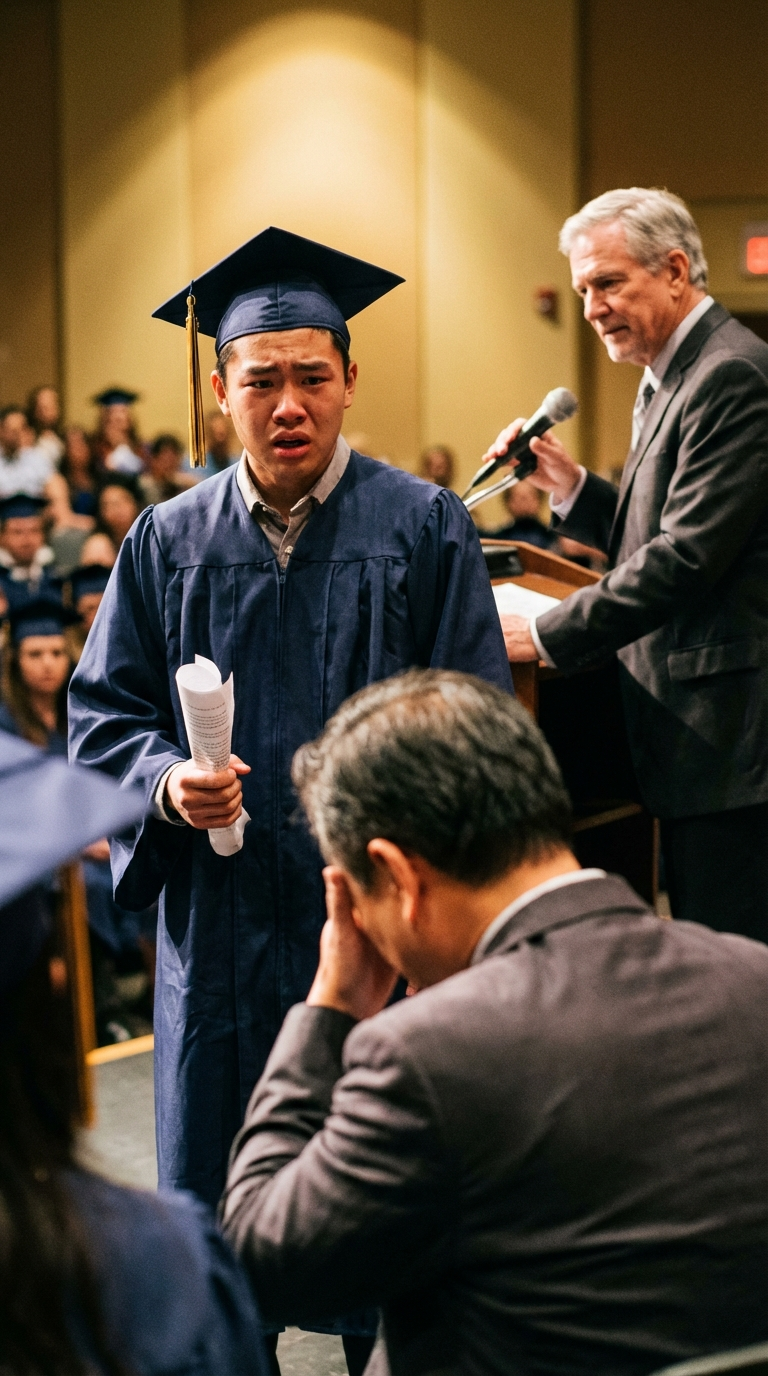
His expensive suit was wrinkled, his tie askew, and he was loud. So loud. “That’s my son!” he slurred, pointing at me as parents turned to stare. “Smartest kid in the whole damn school! Made it all by himself!”
By himself. That phrase cut deep. As if the seventeen years of raising me alone while he built his tech empire from hotel rooms and airport lounges didn’t count. As if my mom—who died when I was three—hadn’t mattered at all.
Principal Morrison was at the podium, mid-sentence in his opening remarks, watching my father with an expression I couldn’t quite read. Not anger. Not embarrassment. Something else.
“Mr. Chen,” the principal said quietly into the microphone, “perhaps you’d like to take a seat?”
Dad waved him off, finally collapsing into an empty chair in the front row, mumbling something about how proud he was. I wanted to disappear. Wanted the floor to open up and swallow me whole. My best friend Maya squeezed my hand, but I couldn’t look at her. Couldn’t look at anyone.
This was it. The culmination of four years of perfect grades, student council, academic awards—all about to be overshadowed by my drunk father making a scene at my graduation.
Principal Morrison cleared his throat and continued. “Thank you all for being here today to celebrate our graduating class of 2026. Before we begin calling names, I’d like to share something about one of our students. Something I think you all need to hear.”
My stomach dropped. Oh God. He was going to talk about me. About my father. About how I’d overcome adversity or some patronizing speech about resilience while Dad sat there drunk in the front row like a living cautionary tale.
“Seventeen years ago,” Principal Morrison began, his voice carrying across the silent auditorium, “a man walked into my office at Lincoln Elementary School. I was a vice principal then. He was carrying a three-year-old boy and a diaper bag, and he was crying.”
I froze. What was he talking about?
“The man had just lost his wife,” the principal continued. “Car accident. He had a failing startup, no family support, and a toddler who kept asking for his mommy. He was completely lost. He asked me if the school had resources for single parents. Support groups. Anything.”
The auditorium was completely silent now. Even Dad had stopped mumbling.
“I told him about a program. Got him connected with other parents. Helped him find childcare. And then, about two months later, that same man came back to my office. He handed me an envelope with five thousand dollars in it. Said he wanted to fund the program permanently. Make sure no other parent had to struggle the way he had.”
My heart was pounding. I’d never heard this story.
“Over the next seventeen years,” Principal Morrison said, his eyes finding my father in the front row, “that man donated over three million dollars to schools in this district. Not for buildings or sports facilities. For the things nobody sees. Food programs for kids who come to school hungry. Clothing closets for families who can’t afford winter coats. Emergency funds for parents facing eviction. Scholarships for students whose dreams would otherwise stay dreams.”
Oh my God.
“He did it anonymously,” the principal continued. “Made me promise never to tell anyone. Said he didn’t want recognition. He just wanted to help kids the way people had helped his son.”
Principal Morrison looked directly at me now. “That man is Andrew Chen. And that son is our valedictorian, Lucas Chen, who’s about to graduate at the top of his class and attend Stanford University on a full scholarship—a scholarship his father secretly funded five years ago to make sure gifted students from low-income families could attend.”
The air left my lungs. My scholarship. The one I’d won through a “national merit competition.” The one I’d worked so hard for. The one I thought I’d earned on my own.
Dad had funded it. All of it.
“Andrew Chen has struggled with alcoholism since his wife’s death,” Principal Morrison said gently. “He’s been in and out of treatment. He’s fought battles most of us can’t imagine. But he has never—not once—stopped putting his son first. And he’s never stopped trying to give other children the chances he wished he could give his own son.”
My vision blurred. The entire auditorium was staring at my father, who had gone completely still.
“So yes,” the principal said, his voice thick with emotion, “Mr. Chen had a few drinks before coming here today. Because he’s terrified. Terrified of watching his son leave for college. Terrified of being alone in the house where he raised that boy by himself. Terrified that he didn’t do enough, wasn’t enough, failed somehow.”
Principal Morrison’s voice broke. “But I’m here to tell you, Andrew, in front of all these people—you succeeded. Your son is brilliant, kind, compassionate, and strong. Everything good in him came from you. And it’s time everyone in this room knew what you’ve done. What you’ve sacrificed. What you’ve given.”
The principal paused, and when he spoke again, his words were directed at the entire auditorium. “Before we celebrate these students, I want us to acknowledge the parents. Especially the ones who fight invisible battles every single day. The ones who give everything and ask for nothing. The ones who show up even when it’s hard. Even when they’re broken. Even when they’re terrified.”
He looked at my father. “Thank you, Andrew. For everything.”
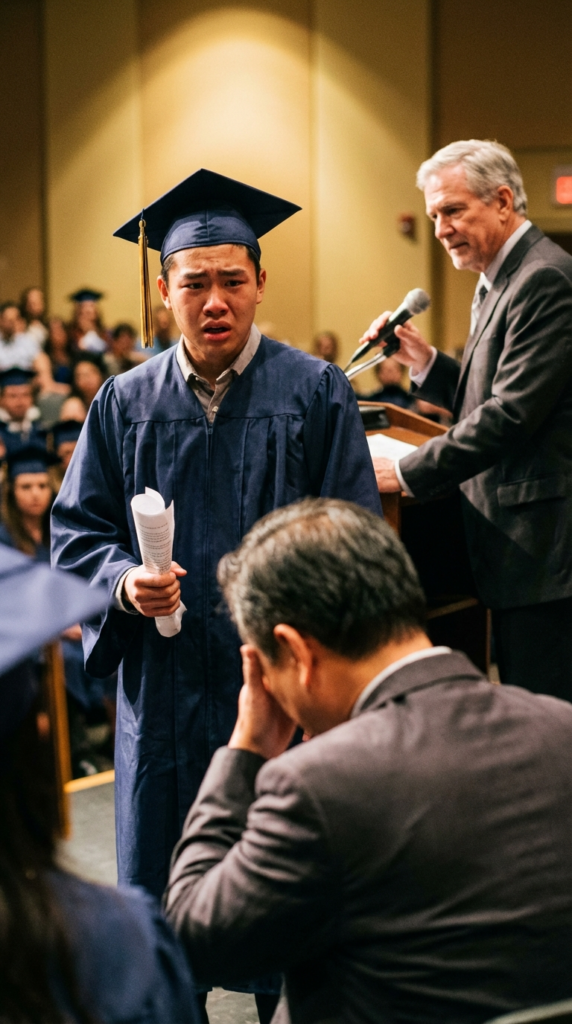
The auditorium erupted in applause. But I wasn’t hearing it. I was staring at my father, who had buried his face in his hands and was shaking with sobs. Seventeen years of grief and guilt and love and sacrifice all pouring out in front of hundreds of strangers.
The Years I Didn’t Understand
To understand what happened in that auditorium, you need to understand my father. Not the successful tech entrepreneur. Not the millionaire philanthropist. But the broken man who lost his wife and somehow kept going.
I don’t remember my mother. I was three when she died. All I have are photographs and stories Dad would tell me on her birthday. How she loved gardening. How she sang off-key in the shower. How she’d wanted three kids but was so happy with just me.
The accident happened on a Tuesday. A truck ran a red light. She was gone instantly. Dad got the call while he was in a pitch meeting for his startup—some kind of data analytics software I never fully understood. He left the meeting, picked me up from daycare, and his entire world shattered.
What I learned later, from his brother during a rare family visit, was that Dad didn’t eat for three days after Mom died. Didn’t sleep. Just held me and cried. His startup was hemorrhaging money, investors were pulling out, and he had a toddler who kept asking when Mommy was coming home.
Uncle James said Dad had two choices: give up or fight like hell. He chose the latter.
For the next five years, Dad rebuilt his company from nothing. Worked eighteen-hour days. Missed bedtimes. Hired nannies I barely remember. But every morning, without fail, he’d wake me up himself. Make me breakfast. Drive me to school. Those thirty minutes in the car were sacred time—just us, talking about everything and nothing.
By the time I was eight, his company had sold for forty-two million dollars. We moved from our tiny apartment to a house with a pool. I got my own room, my own bathroom, everything a kid could want.
Everything except a father who wasn’t drinking.
The Descent
I didn’t understand alcoholism when I was young. I just knew Dad smelled weird sometimes. That he’d forget things. That certain nights he’d hug me too tight and cry about Mom.
By middle school, I understood more. The empty bottles in the recycling. The slurred words at parent-teacher conferences. The mornings he couldn’t get out of bed.
He went to rehab when I was thirteen. Came back after thirty days, sober and determined. Lasted six months before relapsing. Tried again at fourteen. Again at fifteen. Each time, he’d come home promising this time was different. This time would stick.
It never did.
High school was the worst. I became the parent. I’d hide bottles before my friends came over. Make excuses when he missed my debate competitions. Lie to teachers about why he wasn’t at parent night.
I was ashamed. Angry. Resentful. Why couldn’t he just stop? Why did he love alcohol more than he loved me?
What I didn’t know—what Principal Morrison revealed that day—was everything else my father was doing. While I saw only his failures, he was quietly funding programs for families like ours. Anonymously paying for other kids’ school supplies. Creating scholarships for students whose parents couldn’t afford college.
He was saving everyone except himself.
The Moment Everything Changed
Standing up in that auditorium, while everyone applauded my father, I felt seventeen years of anger crack open. Not break. Just crack. Enough to let something else in.
I walked down the row, past Maya and the other students, toward the front. Principal Morrison stepped back from the podium, and suddenly every eye in the room was on me.
My father looked up, his face wet with tears, his eyes red and broken. He tried to speak, but no words came out.
I knelt down in front of his chair. Close enough to smell the alcohol. Close enough to see the decades of pain carved into his face.
“Dad,” I said quietly, just for him. “I need to tell you something.”
He shook his head. “Lucas, I’m sorry. I’m so sorry. I ruined your day. I always ruin everything—”
“Stop,” I interrupted. “Just stop. And listen.”
The auditorium was dead silent. Everyone watching this private moment that had become devastatingly public.
“I’ve been angry at you for years,” I said. “For the drinking. For missing things. For not being the dad I thought I needed. But I never asked why. I never tried to understand what you were carrying.”
His face crumpled.
“Mom died seventeen years ago,” I continued, my own voice breaking now. “And you’ve been drowning ever since. But you never let me drown with you. You kept me safe. Kept me fed and clothed and loved. You built a company and gave away millions so other kids wouldn’t struggle. You’ve been fighting a war inside yourself every single day, and you never stopped trying. You never gave up on me.”
“I wanted to,” he whispered. “God, Lucas, there were days I wanted to give up so badly.”
“But you didn’t,” I said. “That’s what matters. You didn’t.”
I stood up and held out my hand. He looked at it like he didn’t deserve to take it. Like this was some kind of test he’d already failed.
“Dad,” I said firmly. “Stand up. You’re going to watch me graduate. We’re going to take pictures. And then we’re going to go home and figure this out together. Not you fighting alone. Us. As a family.”
Slowly, shakily, he took my hand and stood. I pulled him into a hug, and he broke completely. Sobbed into my shoulder while four hundred people watched. I didn’t care. Let them watch. Let them see what real love looked like—messy and imperfect and still worth fighting for.
“I love you, Dad,” I said into his ear. “And I’m sorry I forgot that loving someone means seeing all of them. Not just the easy parts.”
The Standing Ovation
When we finally separated, the entire auditorium was on its feet. Not polite applause. A roaring standing ovation that went on for minutes. Parents were crying. Students were crying. Teachers were crying.
Principal Morrison had to call for silence three times before people sat down.
“That,” he said, his voice thick with emotion, “is what we’re really celebrating today. Not just academic achievement. But courage. Resilience. Love in its truest form.”
He looked at me. “Lucas, I believe you had a valedictorian speech prepared?”
I did. Three pages about perseverance and chasing dreams and all the platitudes you’re supposed to say at graduation. I’d practiced it for weeks.
I crumpled the pages in my pocket and walked to the podium.
“I was going to talk about success,” I began. “About how hard work and determination can overcome any obstacle. About how we’re all going to change the world.”
I looked at my father, still standing in the front row, wiping his eyes.
“But I realized today that I don’t know anything about real success. Real success isn’t a 4.0 GPA or a full scholarship or getting into Stanford. Real success is my dad showing up today even though he’s terrified. Even though he’s broken. Even though he knew people would judge him.”
My voice got stronger. “Real success is fighting battles nobody sees. It’s waking up every day and trying again even after you’ve failed a hundred times. It’s loving your kid so much that you give away millions to help other kids just like him.”
I looked at my classmates. “We’re eighteen. We think we have everything figured out. But we don’t. We don’t know what it’s like to lose everything and keep going. To fight addiction while raising a child alone. To sacrifice everything for someone else’s future.”
“My father taught me that,” I said. “Not through lectures or advice. But through living. Through showing me that love isn’t perfect. That parents are human. That family means standing by each other even when it’s hard. Especially when it’s hard.”
I turned back to my dad. “So thank you. For everything you’ve done. Everything you’ve given. Everything you are. I wouldn’t be standing here without you. And I’m proud to be your son.”
The applause was deafening. Dad was crying again, but smiling this time. Really smiling.
And for the first time in years, I felt like we were going to be okay.
Three Months Later
Dad went back to rehab the week after graduation. His fifth time. But this time was different. This time, I went with him to family therapy sessions. Learned about addiction as a disease, not a moral failure. Understood the weight he’d been carrying alone.
He’s been sober for ninety-two days now. We talk every day. Real conversations. Honest ones. About Mom. About his pain. About my anger. About how we’re going to build something better together.
I’m writing this from my dorm room at Stanford. The scholarship I thought I’d earned on my own merit? Dad was right—he funded it. But Principal Morrison pulled me aside after graduation and told me the whole story. Dad had created the scholarship five years ago, but the selection process was completely blind. A third-party committee reviewed applications without names. I’d actually won it on merit. Dad just made sure it existed in the first place.
That’s who my father is. He creates opportunities for people and steps back. Helps without taking credit. Gives without expecting recognition.
The story of his anonymous donations went viral after graduation. Someone filmed Principal Morrison’s speech and posted it online. Within a week, it had twenty million views. News outlets wanted interviews. People started calling Dad a hero.
He hated it. “I’m not a hero,” he told me on the phone. “Heroes don’t struggle with addiction. Heroes don’t miss their kid’s childhood because they’re too drunk to function.”
“Heroes are human,” I said. “They’re not perfect. They just keep trying.”
He was quiet for a long moment. “When did you get so wise?”
“I had a good teacher,” I said. “Even if he was drunk for some of the lessons.”
He laughed. Actually laughed. I hadn’t heard that sound in years.
The Letter
Last week, I got a package from Principal Morrison. Inside was a letter my father had written to him years ago, when I was still in elementary school. The principal thought I should have it now.
Dear Mr. Morrison,
I’m writing to make another donation to the family support fund—$50,000 enclosed. I’m also creating an endowment for a scholarship program. Details attached.
But I’m really writing to say thank you. Thank you for that day seventeen years ago when I walked into your office completely lost. You didn’t judge me. Didn’t make me feel like a failure. You just helped.
My son Lucas is six now. He’s smart and funny and kind. Everything good in my life. And I’m terrified I’m going to mess him up. Terrified that my grief and my addiction and my brokenness will damage him beyond repair.
But then I see the programs you’ve built. The families you’ve helped. The kids who are thriving because someone gave them a chance. And I think maybe I can do that. Maybe I can’t fix myself, but I can help fix the system. Make it easier for the next parent who walks into your office crying.
If something happens to me, if my addiction wins, I need you to tell Lucas something. Tell him that every donation, every scholarship, every dollar I gave away—it was because of him. Because he made me want to be better. Because loving him kept me alive.
Tell him I tried. Even when I failed, I tried. And that has to count for something.
Andrew Chen
I cried reading that letter. Cried for the father who’d been fighting alone for so long. Cried for the little boy who didn’t understand why his dad was sad. Cried for all the years we lost to anger and shame and misunderstanding.
But mostly, I cried because I finally understood. My father’s love wasn’t perfect. It was messy and complicated and sometimes came wrapped in failure. But it was real. And it was enough.
The Legacy
People ask me about my father now. About his story. About how I feel knowing he funded everything.
The truth is complicated. Part of me wishes he’d spent that money on himself. On better treatment. On therapy. On whatever he needed to heal.
But another part understands that helping others was how he survived. That creating opportunities for kids like me was how he channeled his grief into something good.
My father isn’t a hero or a villain. He’s just a man who loved his son and did the best he could with the tools he had. Some days his best was incredible. Some days it wasn’t enough. But it was always driven by love.
That’s what I learned at my graduation. That love isn’t about being perfect. It’s about showing up. Trying again. Fighting your demons while protecting the people you care about. Making the world better even when you can’t fix yourself.
Dad is still fighting. Still going to meetings. Still working on sobriety one day at a time. And I’m still learning. Still figuring out how to be angry and grateful and heartbroken and proud all at once.
But we’re doing it together now. No more secrets. No more shame. Just two people trying to honor the woman we both lost by building something beautiful from the wreckage.
That’s the real graduation. Not the ceremony or the diploma. But the moment I stopped seeing my father as a failure and started seeing him as human. Flawed and broken and still, somehow, worthy of love.
That’s the legacy Mom left us. Not perfection. Not easy answers. But the understanding that family means standing together in the mess. That love means seeing someone completely—their worst and their best—and choosing to stay anyway.
So yes, my millionaire father came to my graduation drunk. And yes, it was humiliating and painful and everything I’d feared.
But it was also the day everything changed. The day I finally saw my father. Really saw him.
And that gift—that moment of clarity and compassion and understanding—was worth more than any scholarship or inheritance or perfect graduation day could ever be.