The Choice No Parent Should Make
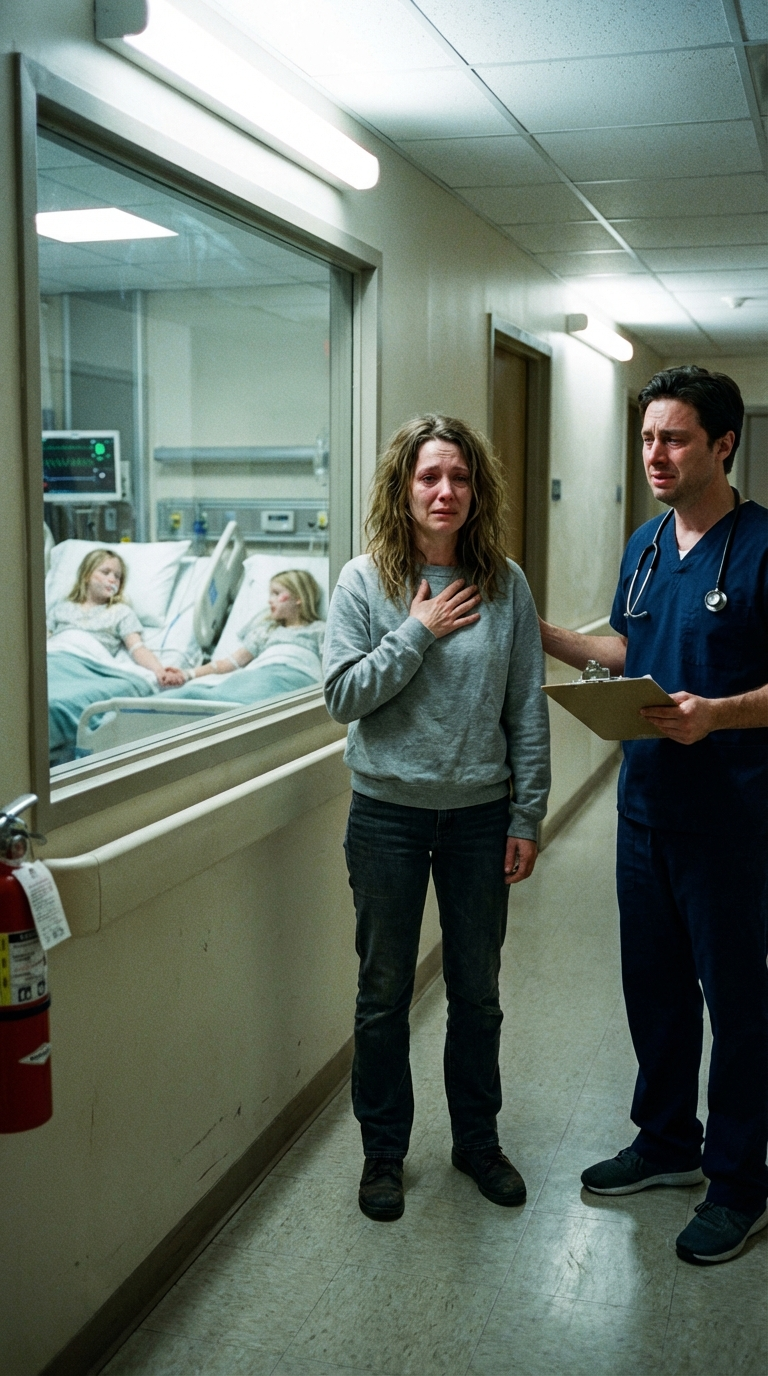
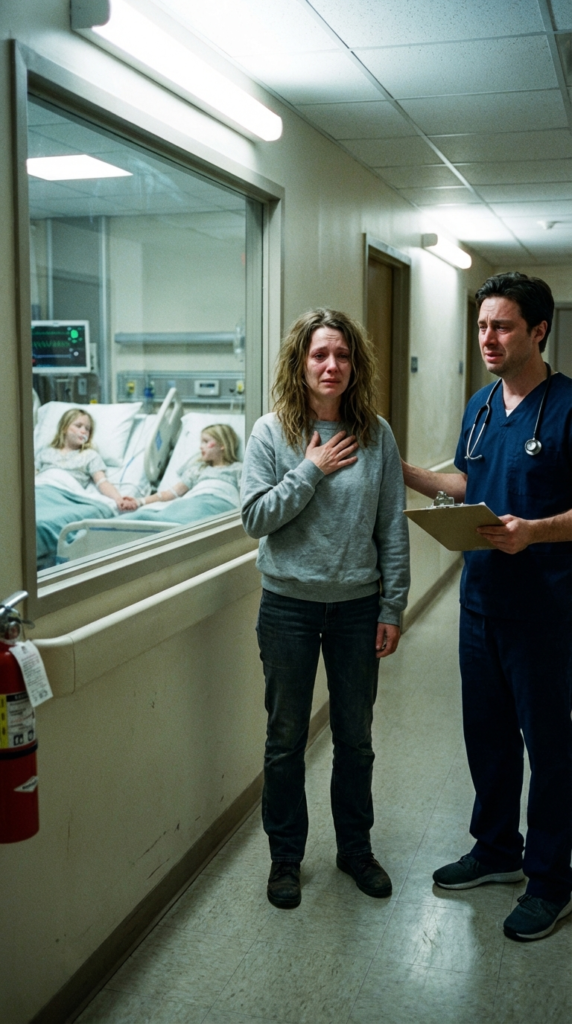
The doctor’s clipboard trembled in his hands as he said the words that would haunt me forever: “Mrs. Patterson, we only have one surgical slot available. The donor heart arrives in four hours. You need to choose which twin receives the transplant.”
I looked through the observation window at my six-year-old daughters, Emma and Lily, lying in adjacent hospital beds. Both born with the same congenital heart defect. Both in acute heart failure. Both with weeks to live without intervention.
Choose. As if one of my children was more deserving of life than the other.
“I can’t,” I whispered, my voice breaking. “I can’t make that choice. There has to be another way—”
“There isn’t.” Dr. Reynolds’s eyes were red, like he’d been crying before entering this room. “The heart is a match for both girls. Same blood type, same size. We could split the wait list, but statistically, the chance of finding two compatible donors in time…” He didn’t finish. He didn’t need to.
My husband Derek stood beside me, his face ashen. We’d been separated for three months—his affair with his coworker had destroyed our marriage—but he’d come back when the girls got sick. Not out of love for me. Out of guilt for them.
“This is your fault,” he said suddenly, his voice sharp. “If you’d agreed to the experimental treatment six months ago instead of being so fucking cautious—”
“The treatment that had a forty percent mortality rate?” I shot back. “The one that could have killed them both?”
“At least we would have tried something!” He slammed his fist against the wall. “Now we have to pick which daughter gets to live. Do you understand that, Claire? We have to pick.”
Dr. Reynolds stepped between us. “Mr. Patterson, this isn’t helping—”
“You pick then,” Derek said, turning to me with wild eyes. “You’re their mother. You pick which one dies.”
The words hit me like a physical blow. The fluorescent hospital lights suddenly felt too bright, the antiseptic smell too strong. Through the window, Emma was reading a book to Lily, who was too weak to hold it herself. They did that. When one was having a bad day, the other would tell stories, sing songs, hold hands across the gap between their beds.
How do you choose between two halves of your heart?
“There has to be something,” I begged Dr. Reynolds. “Some criteria. Medical factors. Something objective so I don’t have to—”
“There isn’t,” he said gently. “They’re identical in every medical sense. Same severity. Same prognosis. The choice is purely…” He paused, searching for a word that wouldn’t destroy me. There wasn’t one. “Personal.”
Derek pulled out his phone. “I’m calling my parents. Maybe they can help decide—”
“No,” I said firmly. “This isn’t their choice. It’s not your choice. You left us. You left when things got hard.”
“I came back—”
“Three months too late.” My voice was ice now. “You don’t get to make this decision.”
He stared at me, and I saw the exact moment he realized I was right. He’d forfeited his vote when he’d walked out. When he’d chosen his mistress over his family. When he’d decided his happiness mattered more than his daughters’ stability.
“Then what?” he whispered. “What do we do?”
I looked at Dr. Reynolds, this stranger who’d become the most important person in my life over the past six weeks. The man who’d held my hand during every bad diagnosis. Who’d sat with me at three in the morning when I couldn’t stop crying. Who’d brought me coffee and reminded me to eat and treated my daughters like they were his own.
“Give me an hour,” I said. “I need to talk to the girls.”
“Mrs. Patterson,” Dr. Reynolds said carefully, “we discussed this. They’re too young to understand—”
“They’re six,” I interrupted. “Not stupid. They know they’re dying. They know one of them might not make it. And they deserve to be part of this conversation.”
Derek looked horrified. “You can’t tell them they have to choose between each other—”
“I’m not asking them to choose,” I said. “I’m asking them what they want. There’s a difference.”
Dr. Reynolds studied my face for a long moment, then nodded slowly. “One hour. Then we need a decision. The surgical team is prepping now.”
I walked toward the girls’ room, my legs barely holding me up. Behind me, I heard Derek say something to Dr. Reynolds, but I wasn’t listening anymore. All I could hear was my own heartbeat, loud and insistent, while my daughters’ hearts were failing.
Emma looked up as I entered, her pale face breaking into a weak smile. “Mommy! Can you tell Lily to stop hogging the good blanket?”
“I’m cold,” Lily protested, her voice barely above a whisper.
They were joking. Dying, and still joking with each other. God, I loved them so much it physically hurt.
I sat on the edge of Emma’s bed and reached across to hold Lily’s hand. “Girls, I need to talk to you about something important.”
Emma’s smile faded. “Is it about the heart?”
She knew. Of course she knew. Emma had always been the more aware twin, the one who listened to doctor conversations and understood more than she should.
“Yes,” I said, because lying to them now felt like the cruelest thing I could do.
“There’s only one,” Lily said. Not a question. A statement.
I nodded, tears streaming down my face. “There’s only one.”
The twins looked at each other. Some wordless communication passed between them, the kind only twins have. Then Emma squeezed my hand.
“Mommy,” she said quietly, “we already know who should get it.”
My heart stopped. “What?”
“Lily should,” Emma said firmly. “She’s sicker than me. She needs it more.”
“No!” Lily’s weak voice gained sudden strength. “Emma, no! You need it too! You have to—”
“You’re my sister,” Emma interrupted, tears now running down her own face. “You’re my best friend. If one of us has to… to not make it… I want it to be me. Because I can’t live in a world without you in it.”
The room spun. I couldn’t breathe. This couldn’t be happening. Six-year-olds shouldn’t have to make decisions about life and death. Shouldn’t have to sacrifice themselves for their siblings. Shouldn’t have to be this brave.
“Stop,” I managed. “Both of you stop. This isn’t—”
Dr. Reynolds appeared in the doorway. His face was strange. Not sad anymore. Something else. Something I couldn’t read.
“Mrs. Patterson,” he said. “You need to come with me right now.”
“I’m talking to my daughters—”
“Now,” he insisted, his voice urgent but not frightening. “Please. Trust me.”
I looked back at the twins, both crying, both holding each other’s hands across the gap between their beds. Then I followed Dr. Reynolds into the hallway.
He closed the door behind us and turned to face me, and I saw that he was crying. Actually crying.
“What?” I demanded. “What happened? Is there another heart? Did someone else—”
“No,” he said. Then he did something that would change everything. He took both of my hands in his and said, “Claire, I need to tell you something. Something I should have told you weeks ago.”
Six Weeks Earlier
To understand what Dr. Reynolds told me that day, you need to understand how we got to that hospital in the first place.
Emma and Lily were diagnosed with dilated cardiomyopathy when they were four. A genetic condition that causes the heart muscle to weaken. Their father Derek had been a carrier without knowing it. I wasn’t. The odds of both twins inheriting it were less than twenty-five percent.
We lost the genetic lottery.
For two years, we managed it with medication. The girls had limitations—no running, no intense activity—but they were alive. Happy. Then six months ago, Emma collapsed during a play date. By the time the ambulance arrived, her heart was barely functioning. Lily’s started failing a week later, like her body couldn’t bear to be healthier than her sister’s.
We were referred to St. Catherine’s Hospital, one of the best pediatric cardiac centers in the country. That’s where I met Dr. James Reynolds.
He was younger than I expected for a lead pediatric cardiologist—maybe forty. Tall, with kind eyes and this way of explaining complicated medical concepts without being condescending. The first time we met, he spent two hours answering my questions. Every single one, no matter how basic or panicked.
“Your daughters are fighters,” he’d said. “And so are you. We’re going to do everything we can.”
Derek had already started pulling away by then. The stress of having sick kids exposed the cracks in our marriage we’d been plastering over for years. He worked longer hours. Came home later. Started “working dinners” with his colleague Amanda three nights a week.
I found out about the affair from a text message he forgot to delete. Something about missing her and wishing he could spend the night. When I confronted him, he didn’t even try to deny it.
“I can’t do this anymore,” he’d said. “The hospital visits. The fear. The constant crisis. I need something normal in my life.”
“Our daughters are dying,” I’d whispered.
“I know,” he’d said. “And I can’t watch it happen.”
He left the next day. Moved in with Amanda. Promised he’d still be involved with the girls, but his visits became sporadic. Always had an excuse. Always had somewhere else to be.
Dr. Reynolds noticed. He never said anything directly, but I’d catch him watching me during appointments, his expression troubled. Once, after a particularly difficult procedure where Emma had coded and I’d stood there alone, he’d found me in the family waiting room at two in the morning.
“You shouldn’t be by yourself,” he’d said quietly.
“I’m not by myself. I have the girls.”
“That’s not what I meant.” He’d sat down beside me, close enough that our shoulders touched. “You need support too.”
“I’m their mother. Supporting them is my job.”
“And who supports you?”
I didn’t have an answer to that. So I’d cried instead. And Dr. Reynolds had sat with me, not saying anything, just being present. It was the first time in months someone had treated me like a person instead of just a crisis to be managed.
After that, he started checking on me as much as he checked on the girls. Brought me coffee in the mornings. Made sure I ate lunch. Sent texts in the evening asking how I was holding up. Professional boundaries got blurry, but neither of us cared. I needed him. And I think, in some way, he needed us too.
The Secret
Standing in that hallway while my daughters cried in the room behind us, Dr. Reynolds took a shaky breath.
“I’m a match,” he said.
The words didn’t make sense at first. “A match for what?”
“For your daughters.” His voice was steady now, like he’d made peace with what he was about to say. “I’m AB positive. Same as them. I got tested three weeks ago, after we knew we were running out of time. I’m a living donor candidate.”
My brain stuttered. “Living donor? But you can’t donate a heart while you’re—”
“Not the whole heart. Part of it.” He pulled out his phone and showed me medical diagrams I couldn’t process. “It’s called a domino transplant. I donate my healthy heart to one twin. The heart going to the other twin comes from the original donor. Two surgeries, two hearts, two lives saved.”
I stared at him. “You’re going to give my daughter your heart.”
“I’m going to save both your daughters,” he corrected. “The surgical team has been prepping for this for weeks. We just needed the donor heart to arrive first. It’s here now. Everything’s ready.”
“Why didn’t you tell me?” I demanded, my voice rising. “Why would you let me think I had to choose? Let me go in there and break my daughters’ hearts—”
“Because I needed to know,” he interrupted. His voice cracked. “I needed to know that you would fight for them. Both of them. That you wouldn’t sacrifice one to save the other. That you’d go in there and find a third option even when there wasn’t supposed to be one.”
Tears were streaming down his face now. “Claire, I’m about to undergo major surgery. There’s risk. Real risk. And if something happens to me, I needed to know that the woman raising these girls—the woman I’m doing this for—wouldn’t give up. Wouldn’t make the easy choice. Would fight until there was nothing left to fight with.”
“You son of a bitch,” I whispered. “You put me through hell to test me?”
“I put us both through hell to make sure I was doing the right thing,” he said. “And now I know I am.”
Derek appeared at the end of the hallway, looking confused. “What’s going on? The surgical team is suiting up—”
“I’m the second donor,” Dr. Reynolds said calmly. “I’m giving one of the girls my heart.”
Derek’s face went white. “That’s not possible. You can’t just—”
“I already signed the papers. Medical ethics board approved it last week. Everything’s legal and ready to proceed.”
“Why?” Derek demanded. “Why would you do this?”
Dr. Reynolds looked at me when he answered. “Because some things are worth dying for.”
The Surgery
The next four hours were the longest of my life. Derek sat on one side of the waiting room. I sat on the other. Dr. Reynolds’s colleague, Dr. Patel, explained the procedure three times, but I couldn’t retain the information. Something about Dr. Reynolds’s heart going to Lily because her condition was slightly more severe. The donor heart going to Emma. Two surgical teams working simultaneously.
“What are his chances?” I’d asked Dr. Patel.
“Of survival? About ninety-five percent. It’s risky, but he’s healthy and young. The bigger concern is recovery time and quality of life after.”
“And if something goes wrong?”
Dr. Patel had hesitated. “Then we lose a brilliant surgeon and your daughter loses her chance. But James is confident. He wouldn’t do this if he wasn’t.”
At hour three, a nurse came out to tell us both surgeries were progressing well. At hour four, Dr. Patel emerged in surgical scrubs, pulling off his mask.
“Both girls came through successfully,” he said. “Hearts are functioning normally. They’re being moved to ICU now.”
“And Dr. Reynolds?” I asked.
Dr. Patel smiled. “He’s in recovery. Asking about the girls. Typical James—more worried about his patients than himself.”
I sobbed. Just completely broke down in that waiting room. Derek tried to approach me, but I held up a hand. I didn’t want his comfort. Didn’t want anything from him.
“Can I see them?” I asked Dr. Patel.
“Give them an hour to stabilize. Then yes.”
I nodded and sat back down. Derek cleared his throat.
“Claire, I—”
“Don’t,” I said. “Whatever you’re about to say, I don’t want to hear it.”
“He did this for you,” Derek said quietly. “Not the girls. You. You know that, right?”
I looked at him. Really looked at him. This man I’d loved for ten years. This man who’d given me two beautiful daughters and then abandoned us when we needed him most.
“Yeah,” I said. “I know.”
“Are you in love with him?”
The question should have surprised me. It didn’t.
“I don’t know,” I said honestly. “But I know he’s the kind of man who gives his heart—literally—to save people he loves. And I know you’re the kind of man who runs away. So whatever happens next, whatever I feel or don’t feel, you lost your vote.”
Derek nodded slowly. “I know. I lost it the day I walked out.”
He left the waiting room. I never saw him again after that day. He signed the divorce papers without contest, gave me full custody, sends child support like clockwork. But he’s not part of our lives anymore. He chose that. Chose to be absent rather than imperfect.
Recovery
The girls woke up three hours apart. Emma first, then Lily. Both groggy, both in pain, both alive. I sat between their beds and held their hands and cried until I couldn’t cry anymore.
“Mommy,” Emma whispered, “we both got hearts?”
“You both got hearts,” I confirmed.
“How?” Lily asked.
I looked at the door, where Dr. Reynolds was supposed to stay in his own recovery room but had somehow convinced someone to wheel him down to pediatric ICU. He was pale, attached to monitors, clearly in pain. But smiling.
“Dr. Reynolds gave Lily his heart,” I said. “And another angel gave Emma hers.”
The girls looked at their doctor with wide eyes. “You gave me your heart?” Lily whispered.
“Just borrowing your chest for a bit,” he said, his voice weak but warm. “Figured you’d take better care of it than I was doing.”
“But what if you die?” Emma asked, always the practical one.
“Then I die knowing I did something that mattered,” he said simply. “But I’m not planning on dying. I’ve got too many reasons to stick around.”
His eyes met mine when he said it.
Six Months Later
Dr. Reynolds—James, he insists I call him now—is still recovering. The surgery was harder on him than anyone anticipated. He can’t perform surgeries anymore. Too much strain on his remaining heart function. He’s taken a position as head of pediatric cardiology instead. Administrative work. Research. Teaching.
He says he doesn’t miss operating. I don’t entirely believe him, but I also know he doesn’t regret his choice.
The girls are thriving. Both of them. Emma’s getting strong enough to play soccer—modified, supervised, but still. Lily’s learning piano. They’re in first grade now, inseparable as always, with matching scars down their chests and a bond that transcends biology.
James comes to dinner twice a week. The girls adore him. Call him Dr. James like he’s some kind of superhero. He helps with homework, reads bedtime stories, sits with me after the girls fall asleep and talks about everything and nothing.
Last week, he held my hand during a movie. Just reached over and laced his fingers through mine like it was the most natural thing in the world.
“Is this okay?” he’d whispered.
“Yeah,” I’d said. “It’s okay.”
We haven’t labeled what we are. Haven’t rushed into anything. But there’s an understanding between us now. A future that’s possible because he made it possible.
“Do you ever regret it?” I asked him one night, after the girls were asleep. “Giving up your career? Your heart? Everything you gave up for us?”
He’d thought about it for a long moment. “I gave up performing surgeries,” he said finally. “But I got to be part of the greatest miracle I’ve ever witnessed. I got to save two incredible little girls and help the woman I love rebuild her life. That’s not a sacrifice, Claire. That’s a gift.”
“The woman you love?” I repeated softly.
“Yeah,” he said, meeting my eyes. “The woman I love. Is that okay?”
I’d kissed him instead of answering. Soft and gentle and full of everything I couldn’t put into words. Gratitude. Hope. Love. The beginning of something beautiful built on the ashes of something broken.
The Truth About Choices
People ask me sometimes about that day. About the choice I was going to make. Which twin I would have picked if James hadn’t intervened.
The truth is, I don’t know. I would have stood in that hospital room forever, frozen, unable to choose, until both my daughters died from my indecision. Because there was no right answer. No choice that wouldn’t have destroyed me.
But James gave me a third option. Not because he’s a hero—though he is. But because he understood that some choices are too cruel to force on someone. That sometimes the answer isn’t choosing between two terrible options but refusing to accept that those are the only options.
He taught my daughters that lesson too. That when faced with an impossible choice, you create a new path. That sacrifice isn’t about giving up what you love but about protecting it at any cost. That family isn’t about biology or obligation but about choosing each other every single day.
Lily carries James’s heart in her chest. Every beat is a reminder that love isn’t just an emotion—it’s an action. A choice. A gift.
Emma carries a stranger’s heart, donated by a family who lost someone and chose to let their grief create life. Another kind of love. Another kind of sacrifice.
And I carry the memory of that impossible day. The day I learned that the right person doesn’t ask you to choose between your children. He finds a way to save them all.
That’s what James did. That’s who he is.
And that’s why, six months after the worst day of my life became the best day of my life, I’m standing in my kitchen watching him help my daughters bake cookies, his scar visible through his open collar, his laugh filling my home with joy, and I’m thinking: this is what happiness looks like.
Not perfect. Not without scars. But real. And chosen. And worth fighting for.
Just like my daughters. Just like James. Just like us.