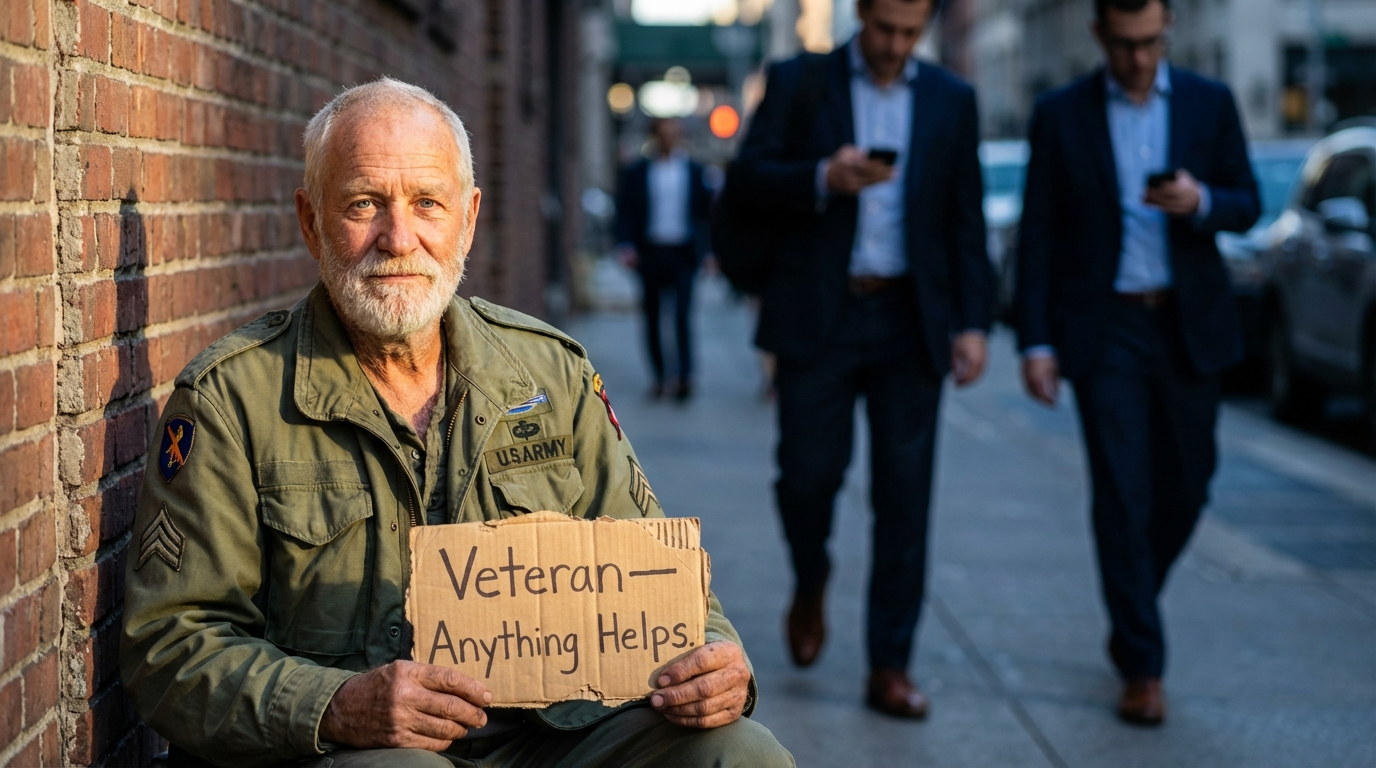
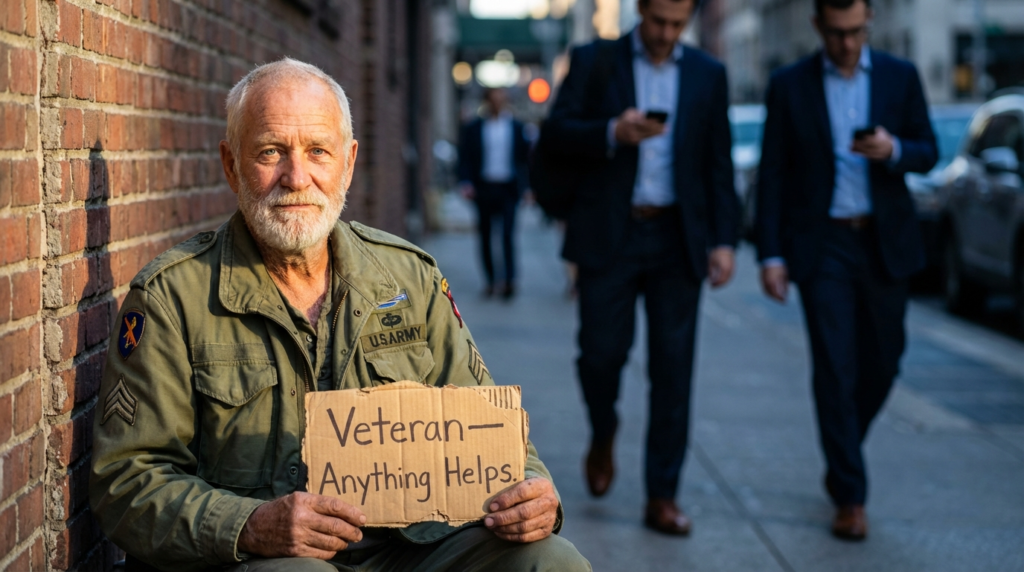
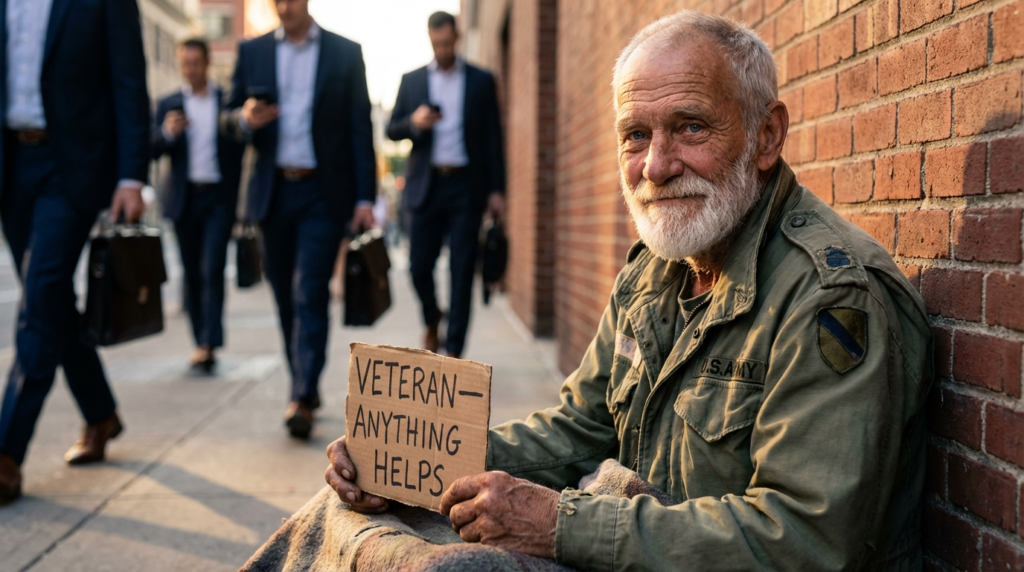
I passed him every single morning for three years. Same corner. Same worn military jacket. Same cardboard sign that read “Veteran—Anything Helps.” And every single morning, I looked straight ahead and kept walking.
I’m not proud of it. But I’m being honest here, and honesty is all I have left after what happened.
My name is Marcus, and I’m a corporate lawyer in downtown Chicago. Or at least, I was. Three years ago, I had everything figured out. Corner office on the 47th floor. Six-figure salary that became seven figures after my last promotion. A penthouse apartment with floor-to-ceiling windows overlooking Lake Michigan. I worked 80-hour weeks and told myself it was worth it because I was building something.
But the truth? I was running from something. From everyone, really.
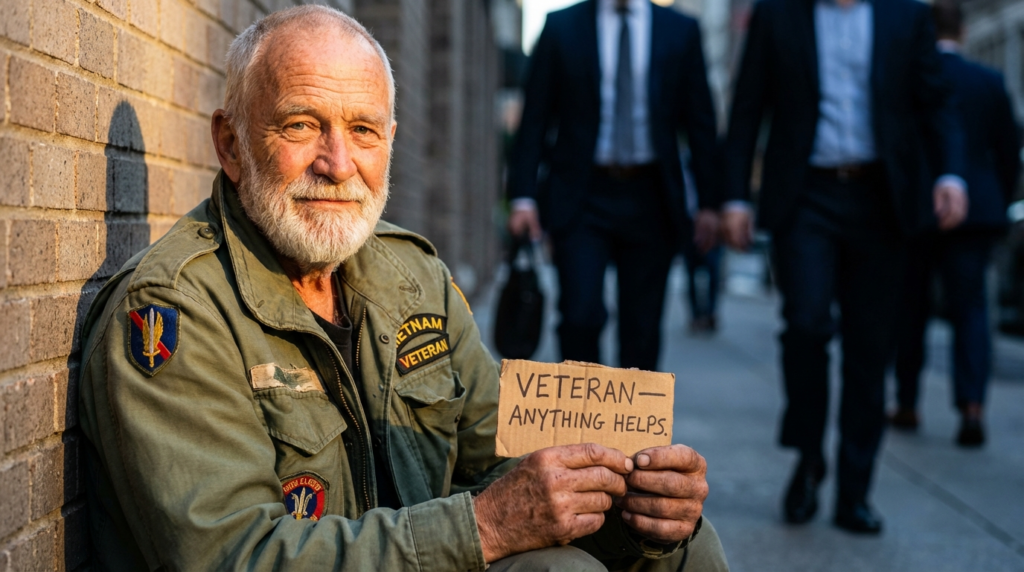
The homeless veteran—I never learned his name—was always there when I left my building at 6:47 AM. He’d be sitting on the sidewalk outside the coffee shop, his back against the brick wall, that sign propped against his knees. He looked like he was in his sixties, maybe seventies. His face was weathered and deeply lined, and he had this thick white beard that was always neatly trimmed. That should have told me something right there. Even homeless, he had dignity. He took care of himself.
Sometimes he’d nod at people passing by. Never aggressive. Never pushy. Just… there. Present. Seeing people even when they refused to see him.
I developed this whole routine to avoid eye contact. I’d check my phone exactly five steps before reaching him, scrolling through emails I’d already read, pretending to be absorbed in something urgent. Then I’d speed up just slightly, like I was late for something important.
I told myself I was too busy. That I gave to charity—I wrote a check to the veterans’ organization every year, didn’t I? That should count for something. I told myself he probably wasn’t even a real veteran, that it was probably a scam, that there were shelters he could go to if he really wanted help.
All lies. All excuses. The truth was simpler and uglier: acknowledging him meant acknowledging my own discomfort. It meant confronting the fact that someone could fall that far, and if it could happen to him, maybe it could happen to anyone. Maybe even to me.
It was a Tuesday in October, unseasonably cold for early fall. I remember because I’d complained about it to my assistant the day before—complained that I’d have to dig my winter coat out of storage earlier than usual. Such a trivial thing to complain about when you have a heated apartment and a working furnace.
I was in the worst mood I’d been in for months. The managing partner had just passed me over for lead counsel on the biggest case of the year. Twenty years of grinding, of sacrificing everything—my marriage, my relationship with my daughter, every weekend, every holiday—and they gave it to Jennifer, who’d been at the firm for eight years. Eight years.
I’d spent the previous evening alone in my apartment, going through a bottle of scotch and spiraling into some dark places mentally. By the time I left for work that morning, I was running on two hours of sleep, a pounding headache, and pure rage.
I didn’t even pretend to look at my phone when I passed the veteran that morning. I just stared straight ahead, jaw clenched, hands shoved in my pockets, walking like I wanted to put my fist through something.
I didn’t see the car.
I was crossing the intersection—I had the light, I remember that clearly—when I heard someone shout. Not words, just this raw, urgent sound. Then something slammed into me from the side, and I was on the ground, my head cracking against the pavement, my vision exploding into white stars.
When my vision cleared, there was a car stopped in the intersection, the driver’s face pale with shock behind the windshield. She’d run the red light, coming way too fast, and would have hit me square on if someone hadn’t shoved me out of the way.
That someone was lying next to me on the pavement.
The homeless veteran.
He’d pushed me. Thrown himself at me hard enough to knock me clear of the car’s path. But he hadn’t made it clear himself.
His leg was bent at a wrong angle, and there was blood seeping through his worn jeans. His face was twisted in pain, but when his eyes met mine, he smiled. Actually smiled.
“You okay, son?” His voice was hoarse but steady.
I couldn’t speak. My brain wouldn’t work. This man—this man I’d ignored every single day for three years, this man whose name I didn’t know, whose story I’d never bothered to learn—had just saved my life.
The next few minutes were chaos. Ambulances arriving, police taking statements, the driver sobbing about how she’d looked down at her phone for just a second. EMTs working on the veteran—I heard one of them say his name was Thomas, or maybe Thompson, I couldn’t hear clearly over the ringing in my ears.
I tried to go with him to the hospital, but they were loading me into a separate ambulance. I’d hit my head hard enough that they wanted to check for a concussion. I kept trying to tell them I was fine, that they needed to focus on him, but nobody was listening.
At the hospital, they kept me for six hours. CT scan, observation, neurological tests. I was fine—minor concussion, some bruising, nothing serious. The entire time, I kept asking about Thomas. Finally, a nurse told me he was in surgery. His leg was badly broken. Multiple fractures. They weren’t sure if he’d walk normally again.
I asked what room he’d be in when he got out of surgery. I asked if he had any family they’d contacted. I asked everything I should have asked three years ago.
The answers gutted me. No emergency contact. No family listed. No insurance, obviously. The hospital would treat him, but after that… the nurse gave me this look that said everything. After that, he’d be back on the streets, probably with a permanent limp and medical bills he’d never be able to pay.
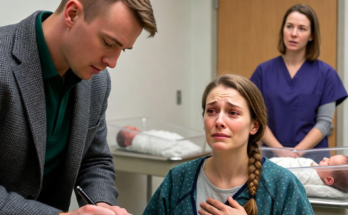
I couldn’t let it go. I went home that night—they released me around 8 PM—but I couldn’t sleep. I kept seeing his face, that smile, hearing his voice asking if I was okay while he was lying there with a shattered leg.
The next morning, I didn’t go to work. I called in sick for the first time in a decade and went back to the hospital.
Thomas was awake but groggy from pain medication. When I walked into his room, he looked confused at first, then his face cleared with recognition.
“The lawyer,” he said. “You came back.”
“You know I’m a lawyer?”
He gave a slight shrug, then winced. “I’ve been watching people for a long time. You learn to read them. The briefcase, the suit, the way you walk like you own the sidewalk. I figured lawyer or banker.” He paused. “You always looked angry. Angry at the world.”
I pulled a chair close to his bed. “What’s your name? Your full name.”
“Thomas Andrew Morrison. Staff Sergeant, United States Marine Corps, retired.” He said it with quiet pride, his back straightening slightly despite the pain.
“How long have you been… on the streets?”
“Four years, two months, sixteen days.” The precision of it hit me hard. “Lost my wife to cancer. Lost my house paying for her treatment. Lost my job because I missed too much work taking care of her. After she died, I just… couldn’t get back up. Tried for a while, but the world moves fast, and if you fall behind, it’s hard to catch up.”
I sat there listening as he told me his story. Twenty-two years in the Marines. Two tours in Iraq. Came home with PTSD that he refused to acknowledge because admitting weakness wasn’t what Marines did. Met his wife, Sarah, at a VA hospital where she worked as a nurse. She saved him, he said. Gave him a reason to fight through the nightmares.
They had thirty-one years together. No kids—they’d tried, but it hadn’t worked out. Just the two of them against the world. When she got sick, he’d done everything he could. Sold everything they had. Took out loans. Maxed out credit cards. Nothing was too much if it meant one more day with her.
But cancer doesn’t care how much you love someone.
“After she passed, I had nothing left,” he said quietly. “No money, no home, no job, no purpose. I thought about ending it, to be honest with you. But Sarah made me promise I’d keep fighting. So I have. Every day, I keep fighting. Some days are harder than others.”
“Why did you save me?” I finally asked. “Yesterday. You didn’t know me. I never even looked at you.”
Thomas was quiet for a long moment. When he spoke, his voice was gentle, without accusation.
“I knew you were hurting. I’ve seen that look before—saw it in the mirror for years. You were so wrapped up in your own pain that you couldn’t see anyone else’s. I understand that.” He shifted slightly in the bed. “But I also knew something you didn’t.”
“What’s that?”
“That every life has value. Even when we can’t see it ourselves. Especially then.” He looked directly at me. “Sarah taught me that. She saw value in a broken Marine with PTSD and nightmares who pushed everyone away. She refused to give up on me. So I don’t give up on people. Even the ones who don’t see me.”
I broke down then. Right there in that hospital room, I cried harder than I had since my daughter stopped talking to me two years ago. This man—this man who had nothing, who I’d treated like he was invisible—had saved my life and was lying in a hospital bed with a shattered leg, and he was comforting me.
I stayed at the hospital until visiting hours ended. Before I left, I told Thomas I’d be back the next day.
“You don’t have to do that,” he said.
“I know. But I’m going to anyway.”
That night, I made some calls. I pulled every connection I had, called in favors from people I’d helped over the years. By the end of the week, I’d arranged for Thomas to move into a VA transitional housing program once he was released from the hospital. I paid off his medical bills—the hospital administrator looked shocked when I handed over my credit card, but I didn’t care. I connected him with a veterans’ services organization that helped him apply for disability benefits he’d never known he qualified for.
But more than that, I visited him every day. We talked. Really talked. He told me about his life, his marriage, his service. I told him about mine—about my failed marriage, about my daughter Emma who wouldn’t return my calls, about the promotion I didn’t get and how it had sent me spiraling.
“You know what your problem is?” he said one day, about a week into his recovery. “You’re so busy chasing success that you forgot what you’re running toward. What’s the point of making partner if you’re miserable? What’s the point of a corner office if you’re sitting in it alone?”
It was the same thing my ex-wife had said three years ago, right before she left. The same thing my daughter had screamed at me before she stopped taking my calls. But hearing it from Thomas, from a man who’d lost everything and still found reasons to smile, still found the strength to save a stranger’s life—it finally broke through.
I didn’t quit my job, but I changed how I worked. I started leaving at 6 PM. I started saying no to cases that would consume my life. I started going to my daughter’s apartment every Sunday, even though she didn’t answer the door for the first month. On the fifth Sunday, she opened it. We didn’t hug. We didn’t reconcile everything in one moment. But we talked. It was a start.
Thomas moved into an apartment through the VA program. His leg healed, though he walks with a cane now. I help him sometimes—groceries, rides to appointments, just spending time together. He’s become one of my closest friends, which is strange to say about someone I ignored for three years.
Last week, we were having coffee, and I finally asked him the question that had been bothering me.
“That day, when you saved me—what if you’d been seriously hurt? What if you’d died? Was my life really worth risking yours?”
He looked at me with those steady eyes that have seen too much and somehow still found kindness.
“Son, I’ve been dead for four years. Just walking around, breathing, but dead inside. When I saw that car heading for you, I didn’t think. I just moved. And you know what? In that moment, I felt alive again. I had a purpose. I mattered.” He smiled. “So yeah, your life was worth it. Any life is worth it. That’s what Sarah taught me. That’s what I’m trying to teach you.”
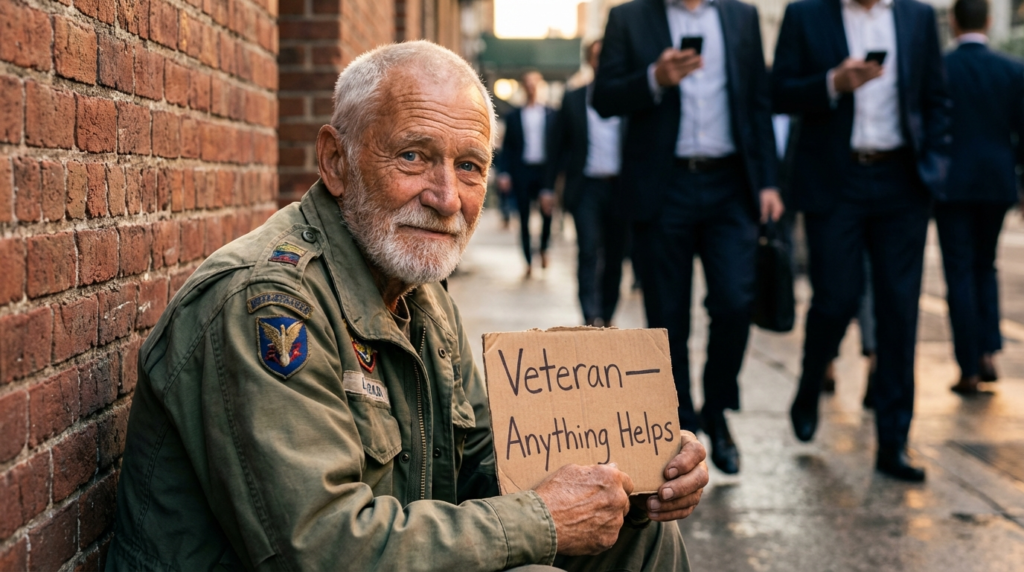
I spent three years walking past Thomas Morrison. Three years of looking through him, around him, never at him. Three years of pretending he didn’t exist because acknowledging his humanity might crack the shell I’d built around my own.
He saved my life twice. Once when he pushed me out of the path of that car. And once when he showed me what it means to be human—to value life, all life, even when your own feels worthless. To choose kindness even when the world has given you every reason not to. To see people, really see them, even when they refuse to see you.
I drive past that corner every day now, and I always slow down. There’s a different person sitting there most days—this city has too many people who’ve fallen through the cracks. I stop. I talk to them. I learn their names. I buy them coffee, sandwiches, sometimes just sit and listen.
Because Thomas taught me something I’d forgotten in my climb up the corporate ladder: We’re all one bad day, one tragedy, one loss away from being the person on the sidewalk. And more importantly, we’re all one act of kindness away from remembering that we matter.
Thomas and I have dinner every Thursday now. It’s the highlight of my week. Last Thursday, I told him I’d finally gotten back in touch with my daughter. She’s bringing her boyfriend to meet me next month. I’m terrified, but Thomas just laughed and said that’s how you know it matters.
I still think about that Tuesday in October. About how close I came to dying without ever really living. About how a man I’d ignored for three years gave me a gift I can never repay: a second chance. Not just at life, but at being human.
I never got to thank him properly that day. I never got to tell him what his sacrifice meant. But I show him every day now. Through friendship. Through presence. Through finally, finally seeing him.
His name is Thomas Andrew Morrison. Staff Sergeant, United States Marine Corps. Hero. Friend.
And I’ll never ignore another person on the street again.
This narrative is structured with clear emotional beats, dramatic tension, and a powerful transformation arc. The story builds from guilt and ignorance through crisis to redemption, perfect for your voiceover-driven video format. Would you like me to break this down into specific scenes with visual descriptions for video production, or develop additional title stories from the list?