THE SOUND OF SHAME
“Leave the apron. You’re done.”
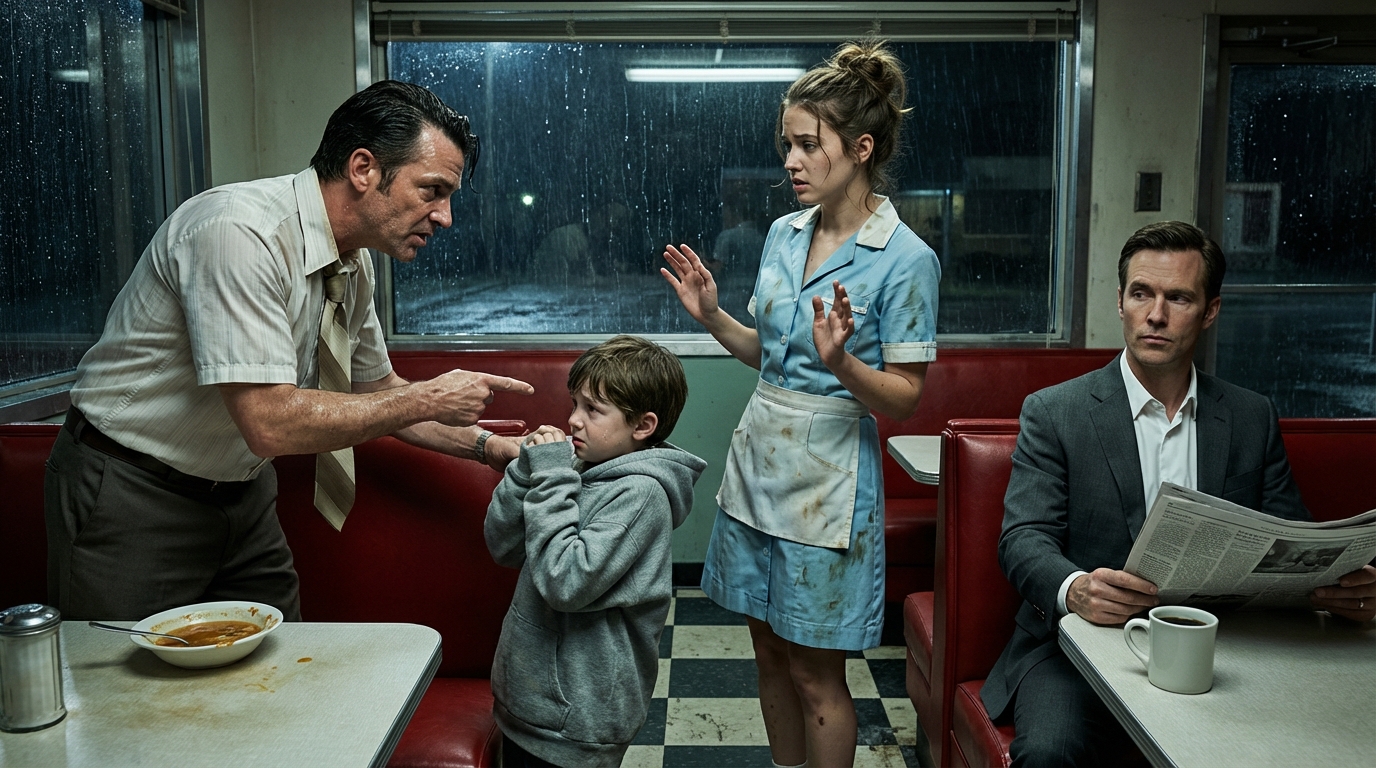
Mr. Henderson’s voice cracked like a whip across the silent diner. It was 9:45 PM on a Tuesday, usually the quietest hour at The Silver Spoon. The dinner rush was over, the grill was being scraped down, and the only sound left was the hum of the refrigerator and the soft, heartbreaking sobbing of a seven-year-old boy in booth six.
I stood there, paralyzed, a plastic takeout cup of tomato basil soup still warm in my hand. I hadn’t even managed to hand it to the child yet.
“Mr. Henderson, please,” I whispered, my voice trembling, trying to keep the scene contained. “It’s the end of the shift. The pot is full. We’re going to throw this batch out anyway. Look at him. He’s shivering.”
The boy, with messy, wet hair and sneakers held together by silver duct tape, shrank back into the cracked red vinyl of the booth. He had come in five minutes ago, asking for a glass of hot water to warm up his hands. Just hot water. I couldn’t just give him water. I physically couldn’t.
THE CRUELTY
“I don’t pay you to run a charity, Sarah,” Henderson spat, his face turning a shade of purple I knew too well. He was a small man who took up a lot of space with his anger. “I pay you to follow rules. Inventory is money. Giving away inventory is theft. Theft is theft. Get out. Now.”
“But my rent…” I started, panic seizing my chest. I had eighty dollars to my name and rent was due in three days. “Please. I won’t do it again.”
“You’re right, you won’t. Because you’re fired.”
He snatched the soup from my hand. He didn’t just take it away. He walked to the trash can in the center of the service aisle—visible to the entire dining room—and dumped it. The thick red soup splattered against the plastic liner. He threw the cup in after it.
He did it right in front of the hungry child.
The cruelty of it took the air out of the room. It wasn’t about the fifty cents of food cost. It was about power.
THE WALKOUT
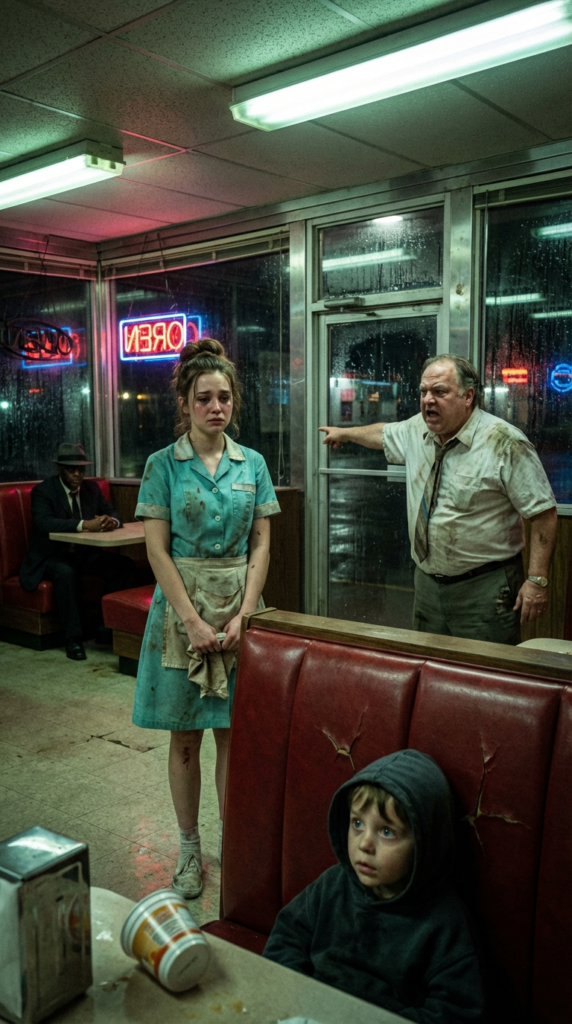
I felt tears hot and fast on my cheeks. There was no point in arguing. I knew Henderson. He enjoyed this.
I untied my apron, my hands shaking so hard I could barely work the knot. I placed it on the counter, right next to the register where I had spent three years smiling at rude customers for minimum wage. I grabbed my purse from under the counter.
I looked at the boy one last time. He looked terrified, like this was somehow his fault.
“I’m so sorry,” I mouthed to him. I reached into my own pocket, grabbed my last twenty-dollar bill—my grocery money—and slid it onto the table in front of him before Henderson could stop me.
“Run,” I whispered.
I walked toward the door, the bell jingling—a cheerful sound for the worst moment of my life. I stepped out into the freezing Seattle rain. The cold hit me instantly, soaking through my thin uniform. My life was falling apart.
THE SHADOW IN THE RAIN
I stood on the sidewalk, the neon “OPEN” sign buzzing above me, wondering which friend I could beg for a loan. I didn’t hear the door open again.
“Miss?” a deep, resonant voice called out.
I turned around, wiping mascara from my cheeks.
It was the man from Table 4. The “Quiet Customer.”
He came in every Tuesday at 8:00 PM sharp. He sat in the back corner. He ordered an Earl Grey tea and the soup of the day. He never looked at his phone. He read hardback books. He tipped exactly 20%. In three years, I don’t think I had heard him say more than five words.
He was standing in the rain now. He wore a charcoal trench coat that looked tailored, and he was holding a large black umbrella. He stepped forward and held it over me, shielding me from the downpour.
“I saw what you did,” he said. His voice was calm, a stark contrast to Henderson’s screeching. “And I saw what he did.”
PART V: THE BACKSTORY
To understand why I was crying over a minimum-wage job, you have to understand the math of my life. I wasn’t just a waitress. I was a twenty-four-year-old culinary school dropout.
I had left the institute when my mom got sick. The tuition money went to chemo. The textbook money went to rent. Mom passed away six months ago, leaving me with a mountain of medical debt and a broken heart.
The Silver Spoon was a diner, sure, but I tried. I was the one who came in early to chop fresh herbs for the garnish because Henderson bought the cheap dried stuff. I was the one who simmered the bones for twelve hours for the broth, even though the recipe card said four. Cooking was the only way I felt close to my mom. She used to say, “Sarah, you can taste love. It’s the only ingredient you can’t fake.”
I had been pouring my grief into those soups. And Henderson had just thrown it in the trash.
THE BUSINESS CARD
“I’m fine,” I lied to the man, hugging my arms. “I just need to go home.”
“You have talent, Sarah,” the man said.
I froze. “How do you know my name?”
“I read your nametag. But more importantly, I taste your soup.” He reached into his coat pocket. “My name is Julian Thorne.”
He handed me a card. It was heavy stock, cream-colored, with embossed black lettering.
Julian Thorne. Executive Chef & Owner. The Obsidian.
My breath hitched. The Obsidian wasn’t just a restaurant. It was the restaurant. It was the place where politicians and movie stars waited six months for a reservation. It was a temple of gastronomy.
“Mr. Thorne?” I stammered. “I… I didn’t know you ate at diners.”
“I eat where the food is honest,” he said. “For the last six months, the only honest thing in that establishment has been the soup. I assumed the old cook had suddenly improved. Tonight, watching you with that boy, I realized two things. One: You are the one making the soup. Two: You have the temperament of a feeder, not a counter.”
THE OFFER
“A feeder?”
“Someone who cooks to nourish, not just to transact,” Thorne said. He looked back at the diner window, where Henderson was now yelling at the busboy. “That man in there is a transaction. You are a chef.”
He looked me in the eye. “My sous-chef walked out tonight. He lacked… empathy. I need someone who can execute technique, yes. But I need someone who understands that food is an act of service. Come to The Obsidian tomorrow at 10 AM. Bring your knives.”
“I… I don’t have professional knives anymore. I sold them,” I admitted, shame burning my face.
Thorne smiled. It was the first time I’d seen him smile. “Then bring your hands. We have knives.”
THE TEST
The next morning, I stood in a kitchen that looked like a spaceship. Stainless steel gleamed under bright lights. There were twelve chefs in crisp white whites, moving in a silent, coordinated ballet.
Thorne was waiting. He didn’t ask for a résumé. He pointed to a station.
“Make me an omelet,” he said.
It’s the classic chef test. Simple. Unforgiving.
I grabbed the pan. I thought about the hungry boy. I thought about Henderson’s screaming. I thought about my mom. I whisked the eggs with a fury, then poured them. I watched the heat, swirling the butter. I didn’t rush. I folded it gently, like tucking a child into bed.
I plated it. No garnish. Just the yellow crescent.
Thorne took a fork. He took one bite. The kitchen went silent.
“Hired,” he said. “Junior Sous Chef. Salary is $85,000 a year. Full benefits.”
I dropped the pan. It clattered loudly, but nobody yelled.
THE NEW LIFE
The next six months were a blur of fire and adrenaline. I learned more in a week at The Obsidian than I had in three years at the diner. Thorne was demanding, yes. He was a perfectionist. But he was fair.
And he never, ever threw food away.
We had a program called “The Staff Meal,” but Thorne expanded it. At the end of every night, any excess prep—the high-quality surplus—was packaged up. We partnered with a local shelter. We didn’t give them scraps; we gave them braised short ribs and truffle risotto.
I was in charge of that program.
THE RETURN
One rainy Tuesday, about eight months later, Thorne called me to the pass.
“We have a VIP table tonight,” he said, a glint in his eye. “A local business owner celebrating his anniversary. He specifically requested the ‘Chef’s Tasting Menu.’ I want you to handle the main course.”
I looked at the ticket. Table 4.
I peeked through the swinging kitchen doors.
Sitting there, looking uncomfortable in an ill-fitting suit, was Mr. Henderson. Across from him was a woman who looked bored.
Henderson was trying to impress her. He was looking around the dining room with a mix of awe and jealousy.
THE DISH
“What should I make, Chef?” I asked Thorne.
Thorne looked at me. “Make him the soup.”
“Sir?”
“Make him the Tomato Basil. But make it your way. The way you made it that night.”
I smiled. I went to my station. I roasted the heirloom tomatoes until they blistered. I used the fresh basil from our rooftop garden. I finished it with a drizzle of 50-year-old balsamic and a parmesan crisp.
But I served it in a simple, white porcelain bowl.
THE CONFRONTATION
I didn’t send a runner. I walked the dish out myself.
I was wearing my pristine white chef’s coat, my name embroidered on the chest: Sarah J. – Sous Chef.
I approached Table 4. Henderson didn’t look up at first. He was too busy complaining about the price of the wine to his wife.
“Your soup, sir,” I said.
He froze. That voice. He knew that voice.
He looked up. His jaw physically dropped. He looked from my face to the embroidery on my jacket, then around the luxurious restaurant.
“Sarah?” he choked out.
“It’s Chef Sarah now,” I said calmly.
“You… you work here?”
“I run the kitchen tonight, Mr. Henderson.” I placed the soup in front of him. “Mr. Thorne told me you appreciate a strict inventory policy. But he also taught me that the best ingredient is generosity. This is on the house.”
THE REACTION
Henderson looked down at the soup. It smelled divine. It smelled like the money he desperately wanted to have.
“I…” He stammered. He looked small. In this room of excellence, his petty tyranny held no power. “I didn’t know.”
“You didn’t ask,” I said. “Enjoy your meal.”
I turned to walk away, but stopped. “Oh, and Mr. Henderson? That boy you threw out? We found him. The shelter we work with took him and his mother in. He’s eating lasagna in the staff room right now. He wants to be a chef when he grows up.”
Henderson turned pale. The neighboring tables were listening. His wife looked at him with narrowed eyes. “What boy, Jerry? What is she talking about?”
THE AFTERMATH
I walked back into the kitchen. The entire line was grinning. Thorne gave me a nod.
Henderson didn’t finish his meal. He paid the bill (which was substantial) and left in a hurry.
Two months later, The Silver Spoon closed down. You can’t run a restaurant on bitterness; the customers can taste it eventually.
THE RESOLUTION
I’m not a millionaire. I work sixteen-hour days. My feet hurt constantly. But every Tuesday night, I sit at Table 4 in The Obsidian after service.
I sit with Julian Thorne. We drink tea. And sometimes, a kid named Leo comes out from the back, wearing a chef’s coat that’s three sizes too big, carrying a bowl of soup he made himself.
He sets it down. “Taste check, Chef Sarah,” he says.
I take a spoon. I taste it. It tastes like roasted tomatoes, fresh basil, and a whole lot of dignity.
“Perfect,” I tell him. “Don’t change a thing.”